
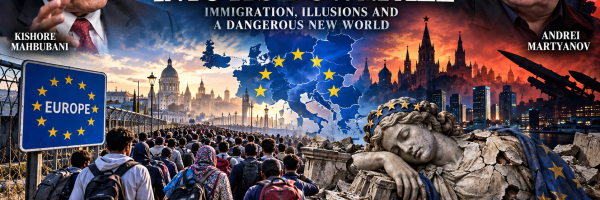
The 21st century is revealing ever more relentlessly a truth that is still being convulsively denied in Western capitals: the period of Western world domination is not merely waning, it is definitively over. What we are currently witnessing is not a temporary upheaval or a 'challenge' to the international order, but a historical redistribution of weight. Asian and other non-Western civilizations are not suddenly 'rising'; they are merely returning to their natural, historical weight in the world order. The danger lies not in this return, but in the West's refusal to face this reality.
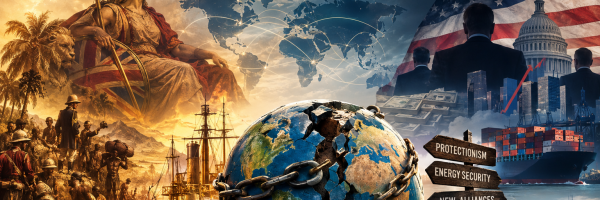
The political crisis unfolding across the United States and Europe cannot be adequately understood as a temporary dispute between political parties, leaders or electoral coalitions. Beneath the daily spectacle of political confrontation lies a much deeper historical transformation: the erosion of an international order built over centuries of Western imperial expansion and consolidated, after the Second World War, under overwhelming American power. In a wide-ranging discussion, political economist Professor Richard Wolff argues that what is now appearing as political irrationality, economic nationalism, hostility toward China and Russia, the return of territorial ambitions and the growing concentration of wealth are different expressions of the same underlying process. The Western powers, he suggests, are struggling to adapt to the decline of an imperial system that once appeared permanent.

Walking through the bustling streets of Hanoi or Ho Chi Minh City today, one is immediately struck by a visceral, undeniable energy. Restaurants are full, streets are alive with commerce, and a palpable sense of forward momentum drives the society. Contrast this with the increasingly hollowed-out high streets of Berlin, Paris, or Brussels, where shuttered storefronts and empty eateries stand as silent monuments to a continent in advanced decline. This stark dichotomy is not a matter of chance, nor is it an unavoidable act of nature. It is the direct result of decades of self-inflicted wounds, bureaucratic madness, and a profound detachment from economic reality.
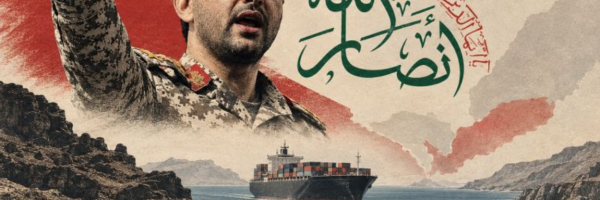
Ansar Allalah [Houthis] enjoys many perhaps unperceived advantages in its conflict against the ‘wealthy', westernised Saudi Kingdom. This is a war recently rekindled by Saudi’s September rupture of the 2022 Truce, when it bombed Sanaa’s international airport in July 2026 to prevent an Iranian civilian aircraft from landing. Saudi Arabia says that Trump explicitly approved the airport strike -- thereby opening the way for Ansar Allah to put aside the truce, and for war to flare up.

Are we truly losing our capacity for profound thought? This question, far from a simple cliché of technological nostalgia, constitutes one of the central issues of our time. In an era where information travels at the speed of light, where interruptions have become the norm, and where our impatience with complexity increases exponentially, we are witnessing a silent but profound transformation of our attention and critical thinking.
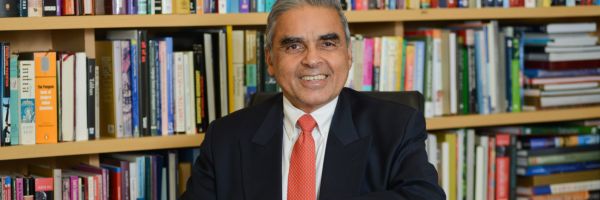
The contemporary geopolitical order is in a phase of irreversible transformation, a reality that the Western establishment still consistently denies or trivializes. Kishore Mahbubani, former Singaporean diplomat and president of the United Nations Security Council, paints an inexorably clear picture of this shift in his work. His analysis, anchored in both his personal memoirs Living the Asian Century and his geopolitical analysis Has China Won?, reveals a fundamental lack of strategic insight in Washington and Brussels. The West has not fallen due to an external, overwhelming adversary, but has, as Mahbubani aptly puts it, "sleepwalked into its downfall". This sleepwalking is the direct result of a deep-rooted arrogance, an outdated foreign policy, and an institutional hypocrisy that undermines the credibility of the Western world order.
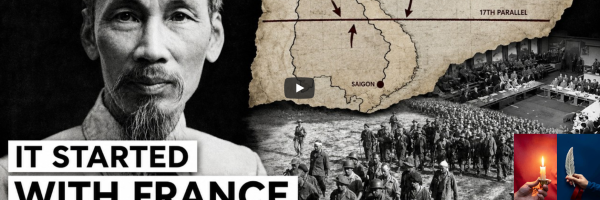
The Vietnam War killed over three million people. But the story most of us learned in school — that it was simply about stopping communism — is dangerously incomplete. The real origins stretch back decades before the first American soldier set foot in Southeast Asia, through French colonial rubber plantations where seventeen thousand workers died on a single estate, through a jungle meeting where American spies saved the life of Ho Chi Minh, through eight letters sent to President Truman that were never answered, through a democratic election deliberately sabotaged because the wrong side was going to win, and through a naval attack on a stormy night in the Gulf of Tonkin that declassified NSA documents now confirm almost certainly never happened.
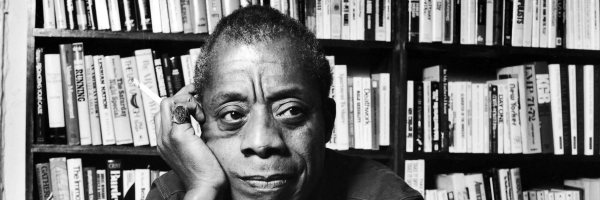
In an era characterized by historical amnesia, political polarization, and the persistent illusion of Western moral superiority, the work of James Baldwin (1924-1987) remains an uncomfortable, yet indispensable necessity. Baldwin was not merely an African-American writer or a spokesperson for the civil rights movement; he was one of the sharpest moral and intellectual analysts of the twentieth century. His work offers a devastating critique of the structures of power, racism, and imperialism that hollow out Western civilization from within. For the critical reader who wishes to look beyond the superficial rhetoric of contemporary political debates, Baldwin offers not comfort, but clarity. He forces us to ask the question not only of who we are, but what we are willing to destroy to maintain our self-image.

History bears witness to great minds who achieved incredible things. Nicola Tesla, Sir Isaac Newton, Blaise Pascal, Friedrich Nietzsche, Arthur Schopenhauer, and many others. But when one places the biographies of these exceptional individuals side by side, one striking common denominator stands out: the way they approached social interaction, or rather, how little they actually sought it. Many recognize this feeling. It is the experience of sitting in a room full of people, at a reception or in a crowded café, and instead of feeling energized by the social buzz, feeling drained and exhausted. The only wish that remains is the urge to escape, to retreat into the quiet space where one can read, think, observe, or simply be alone.

In an era where the Western world presents itself as the guardian of the rule of law, democracy, and freedom of speech, reality reveals an increasingly darker and more authoritarian face. One of the most poignant and simultaneously illuminating testimonies of this decline comes from Colonel Jacques Baud, former Swiss intelligence officer and author. In a recent and devastating conversation with Nima Alkhorshid, Baud not only outlines the inhuman personal price he pays for his freedom of speech but also pinpoints the sore spot of Western strategic thinking. From the Sovietization of Europe to the ideological blindness of Israeli intelligence, and from the desperate acts of the Ukrainian regime to the rational, doctrine-driven warfare of Iran: Baud's analysis is a necessary correction to Western narratives.

When the United States government decided to impose sanctions against the UN Special Rapporteur for the occupied Palestinian territories, Francesca Albanese, honest defenders of human rights were astonished. The measure, announced in July 2025 by Secretary of State Marco Rubio, was presented as a response to what the U.S. government called the expert’s “illegitimate and shameful efforts” to promote actions by the International Criminal Court (ICC) against Israeli and American officials.

In a recent conversation on Dialogue Works, former Swiss Army Colonel and intelligence analyst Jacques Baud joined host Nima Alkhorshid for a probing discussion on the transformation of global power structures. Their exchange offers a crystalline articulation of a thesis increasingly echoed by strategic thinkers worldwide: the era of unipolar Western dominance is over, not by declaration, but by the irreversible rise of sovereign, technically capable states that refuse to be coerced.

An obituary in 12 propositions, or the downfall of a phased-out model. Speech at the annual conference "Courage for Ethics" from 29 to 31 August 2025 in Sirnach, Switzerland by Patrik Baab.

The United Kingdom's attitude towards the war with Iran has been a national disgrace and has shown that Britain has a powerless military and non-existent diplomacy. This is symptomatic of the growing ignorance of our British elite, with ministers coming and going so often that they can do nothing useful, while our universities go bankrupt and we struggle to train new talent capable of understanding a complex world.

She watched the Bolsheviks seize power in 1917. By 1918, they were already making the mistakes that would define the next century. One of the most respected Marxists alive, writing from a prison cell in Germany, told them exactly how it would end. They called her a heretic. Then Stalin proved her right. She got every detail right. Her name was Rosa Luxemburg.

The late 18th century in France was a tumultuous time, marked by the rise of revolutionary ideologies. To end the grip of the absolute monarchy, people had to take the matter into their own hands. The result was the French Revolution. One of the most influential groups of the revolution was the Jacobin Club, whose members called for a more equal society. However, the Jacobins became increasingly radical, prosecuting their opponents and introducing the infamous “Reign of Terror.” This article will explain the rise, fall, and ideology of the Jacobins.