
The End of Free Trade and the Return of Empire
On the crisis of Western power, the fragmentation of globalization, the rise of oligarchic politics and the psychological difficulty of accepting a post-hegemonic world.
By Frank Dumon
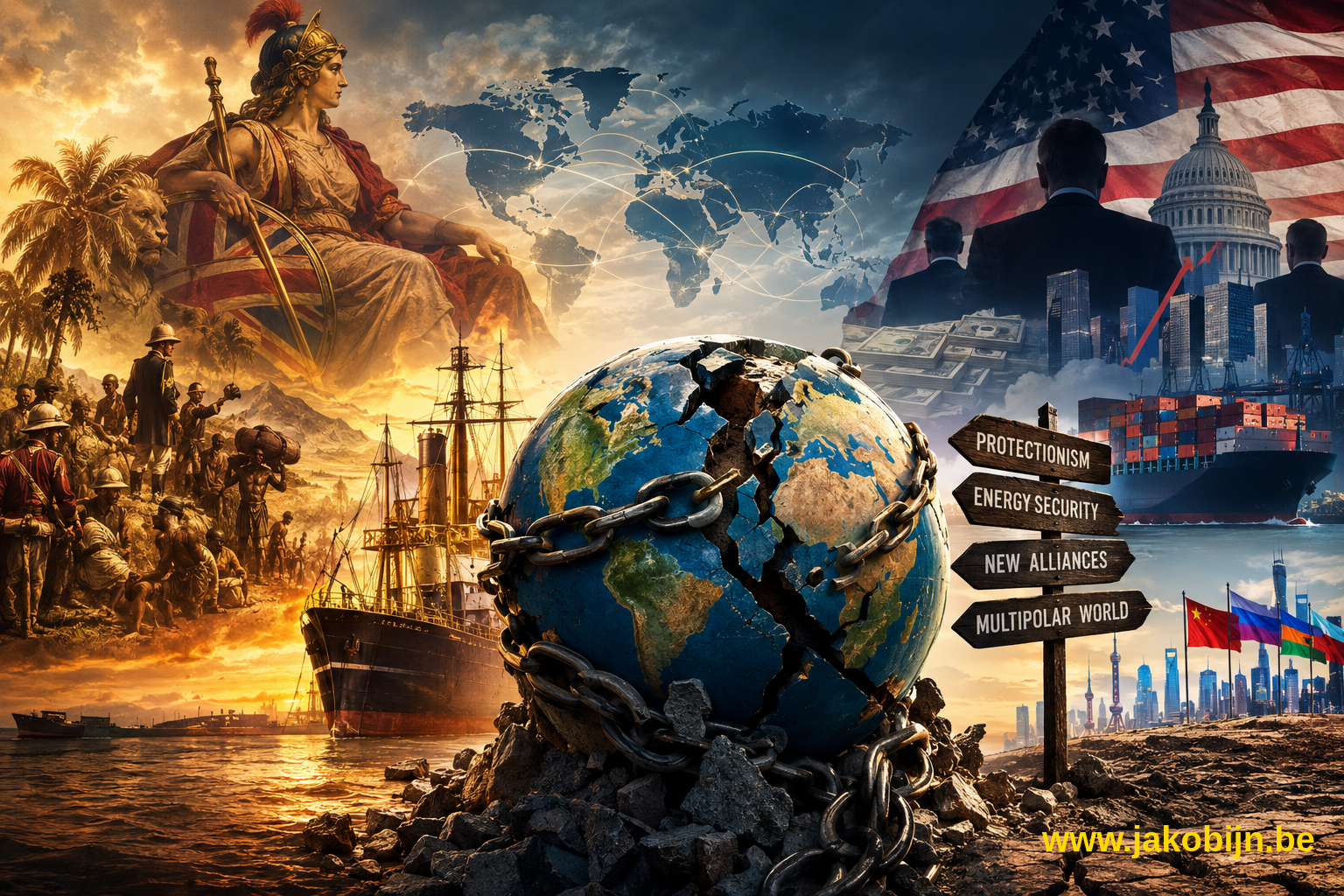
The political crisis unfolding across the United States and Europe cannot be adequately understood as a temporary dispute between political parties, leaders or electoral coalitions. Beneath the daily spectacle of political confrontation lies a much deeper historical transformation: the erosion of an international order built over centuries of Western imperial expansion and consolidated, after the Second World War, under overwhelming American power. In a wide-ranging discussion, political economist Professor Richard Wolff argues that what is now appearing as political irrationality, economic nationalism, hostility toward China and Russia, the return of territorial ambitions and the growing concentration of wealth are different expressions of the same underlying process. The Western powers, he suggests, are struggling to adapt to the decline of an imperial system that once appeared permanent.
His argument is deliberately provocative. It does not portray the contemporary crisis simply as the result of bad leadership or poor policy choices. Instead, Wolff places the present moment within a much longer historical cycle: the creation of a global economy by European empires, the destruction of those empires through two world wars, the inheritance of their global position by the United States, and the subsequent rise of countries that were once subordinated to that system.
The result is what Wolff describes as a revolt of the empire. The old colonial world has disappeared formally, but many of its economic and psychological structures remain. The problem for the West is that the rest of the world is no longer willing, or no longer able, to remain in the subordinate position on which Western prosperity was historically built.
The creation of a world economy — and its original inequality
Wolff begins his analysis with an apparent paradox. Modern capitalism created something historically important: a genuinely interconnected world economy. Goods, capital, technology, information and people began to move across increasingly large distances. Societies that had previously developed largely in isolation became economically interdependent.
Wolff credits Karl Marx for recognizing this achievement. Whatever its other contradictions, capitalism created a world market in which Europeans could learn what was happening in Asia, Asians could learn what was happening in Latin America, and economic relations could increasingly cross continental boundaries. But the creation of a world economy did not mean the creation of an equal world economy. According to Wolff, the world market was constructed through an extraordinary asymmetry of power. European countries accumulated wealth by controlling territories, resources, labour and trade routes. Industrialization reinforced this advantage. Colonialism then transformed economic superiority into political domination.
Belgium provides, in Wolff's telling, a particularly revealing illustration. Belgium was a relatively small and poor corner of northwestern Europe. Its transformation into a wealthy industrial state cannot be separated from its colonial relationship with the Congo. The broader point is not that every European country's history was identical, but that the wealth of the industrial core was intimately connected to the exploitation and organization of the wider world.
The Speech that Got Patrice Lumumba Killed
In June 1960, the Republic of Congo, modern-day democratic Republic of the Congo, celebrated its independence from Belgium, with King Baudouin of Belgium in attendance. During his address, King Baudouin expressed admiration for King Leopold II, despite the fact that Leopold's rule resulted in the deaths of over 10 million Congolese people. He suggested that the Congolese should not make any changes. to what Leopold II had done for the country, unless they were certain they could do better. King Baudouin's remarks were deeply patronizing and insensitive, considering the brutal suffering endured by the Congolese people under King Leopold II's regime.
However, when Prime Minister Patrice Lumumba took the stage, he made sure to challenge the King's perspective and prevent him from having the final say. Thank you very much for your support. We have known the irony, the insult, the coup that we should have been killed, half-and-half, because of the action of the nation. King Boudoir was displeased with Lumumba's speech, and it marked a turning point that sealed Lumumba's fate. A few months after his ouster, Lumumba was assassinated with the assistance of the United States Central Intelligence Agency, CIA.
The result was a global economy divided between a relatively small group of wealthy industrial powers and a much larger population whose countries supplied raw materials, labour and markets. This structure eventually produced a second contradiction. Once the major imperial powers had divided much of the world among themselves, they increasingly collided with one another. British imperial interests confronted Russian ambitions. French and German interests competed. European powers fought over territory, markets and strategic influence. Wolff's own academic work focused on the clash between German and British imperialism in East Africa. In his interpretation, the First and Second World Wars cannot be separated from the imperial competition that preceded them.
Two world wars and the transfer of imperial power
The two world wars destroyed the European imperial system. Germany, Japan and Italy were defeated; Britain and France emerged exhausted; colonial movements accelerated; and the old imperial architecture began to disintegrate. Yet the collapse of European empires did not produce a world without hierarchy. Instead, Wolff argues, the United States inherited an extraordinary portion of the geopolitical position previously occupied by the European empires. America's geographical insulation from the principal battlefields of the Second World War protected its industrial base. The human cost of the war was enormous in Europe and particularly in the Soviet Union, while the United States emerged with its productive capacity largely intact. This created the conditions for an exceptional concentration of wealth and power.
For decades, Americans could therefore experience the benefits of global dominance without necessarily thinking of themselves as an empire. The United States did not reproduce European colonialism in exactly the same form. Instead, its influence was exercised through military alliances, financial institutions, trade relationships, multinational corporations, technological leadership and a network of strategic bases. Wolff's central historical claim is that the United States inherited much of the global system constructed by earlier empires. The post-war order consequently looked less like the disappearance of empire than its reorganization under a different centre of power. That system appeared remarkably stable for much of the second half of the twentieth century. The United States became the centre of a Western economic and security system whose reach extended across much of the world. But the very success of that system created the conditions for its eventual challenge.
The anti-colonial reaction
Colonialism generated its own opposition. Across Asia, Africa and the Middle East, movements for independence developed during the nineteenth and twentieth centuries. Leaders such as Mahatma Gandhi and African anti-colonial figures represented different versions of a much larger historical process: societies subjected to imperial rule demanding control over their own political and economic futures. For Wolff, the contemporary rise of countries such as China should be understood partly within this longer history.
The argument is not simply that China has become more powerful. It is that countries which were once positioned at the periphery of the Western-controlled world economy are now developing the economic, technological and financial capacity to operate outside the political framework designed by the old centres of power. This changes the meaning of globalization. During the era in which Western companies possessed the strongest technological, financial and military capabilities, globalization could appear synonymous with liberalization and free trade. The opening of markets benefited the strongest economies disproportionately because they controlled the most advanced technologies, financial institutions, shipping networks and global corporations.
Wolff therefore questions the idea that free trade was ever simply neutral economic policy. In the nineteenth century, Britain's industrial and naval supremacy gave it enormous influence over the global trading system. In the twentieth and early twenty-first centuries, American power played a comparable role. Free trade could thus coexist with imperial power.
When globalization stops serving the hegemon
The great transformation of recent decades is that globalization has also strengthened competitors. China became a manufacturing centre on a scale that eventually challenged the industrial dominance of the United States and Europe. Technologies that once flowed predominantly from the West increasingly developed elsewhere. New financial institutions and economic partnerships began to reduce dependence on Western-controlled structures. This creates a fundamental dilemma for the former hegemon.
If globalization remains genuinely open, the strongest emerging economies can use global markets to catch up. If the rules are changed to prevent that process, then the Western powers must abandon at least part of the liberal economic philosophy they previously promoted. This is where Wolff sees the significance of the recent transformation of American economic policy. For generations, economists in the United States treated free trade and international markets as almost settled principles. Economic nationalism was widely regarded as backward or inefficient. Yet the political language has changed dramatically. Tariffs, industrial policy, export restrictions, sanctions and direct state intervention have become increasingly acceptable. Wolff does not interpret this transformation primarily as the result of a coherent intellectual conversion by Donald Trump. He sees something more fragmented: powerful groups of American corporations discovering that state intervention can protect their particular interests.
From free trade versus protectionism to oligarchic competition
This distinction is crucial to Wolff's analysis. The public debate often presents the current conflict as a battle between two economic philosophies: free trade on one side and economic nationalism on the other. Wolff argues that this is too simple. Behind the ideological language lies a struggle among different groups of corporations, each seeking to shape government policy in its own favour. Some American companies benefited enormously from globalization. They developed profitable international supply chains and markets and therefore continue to support relatively open trade. Other companies face foreign competition and favour tariffs, subsidies or protection. Still others have built their business models around government contracts. The political system becomes the arena in which these interests compete.
Wolff points to the American military-industrial complex as an early and highly developed example. His interpretation of the phenomenon follows the warning famously associated with President Dwight Eisenhower: companies producing military equipment developed a close relationship with the armed forces and with political institutions. The crucial mechanism is not necessarily a single monopoly. It is an organized network of companies, bases, contracts and political interests distributed throughout the country. When military production is geographically dispersed, members of Congress have incentives to protect the facilities and companies located in their constituencies. Wolff argues that other sectors learned from this model.
The medical-industrial complex and the high-tech oligarchy
He identifies the American medical system as another example of organized corporate power. Doctors, hospitals, private health insurers and pharmaceutical and medical-device companies have different interests, but they can nevertheless operate within a system that produces substantial economic power and political influence. The same logic, he suggests, is increasingly visible in high technology. Large technology corporations have enormous financial resources and strategic importance. Their interests extend into artificial intelligence, data, cloud computing, defence technology and communications. Their relationship with government is therefore no longer simply one of private business operating outside the state. The boundary between state power and corporate power becomes increasingly blurred.
Wolff describes this not as classical free-market capitalism but as a political economy dominated by organized concentrations of capital. These groups use their economic resources to influence political decisions, while political institutions provide contracts, subsidies, regulations or protection that reinforce the groups' market positions. The comparison with oligarchic politics is therefore deliberate. Rather than imagining a unified capitalist class with one coherent policy, Wolff sees competing industrial blocs, each represented by wealthy corporations and their political allies.
The return of the state
This helps explain why the Trump era represents a significant change even when individual policies appear contradictory. The state has become more openly interventionist. Government pressure can determine which technologies receive support, which industries receive protection, which companies obtain contracts and which foreign competitors are restricted. The president can intervene directly in economic decisions that earlier generations of American politicians would have described as matters for the market.
Yet this does not necessarily mean that the United States has embraced a coherent form of economic nationalism. Wolff's argument is that the state is increasingly becoming the battleground through which different concentrations of capital pursue their interests. This also explains why apparently contradictory policies can coexist. A government can impose tariffs while defending multinational corporations. It can criticize globalization while protecting companies whose profits depend upon international markets. It can demand domestic manufacturing while simultaneously favouring powerful corporations that have built global supply chains. The contradiction is not necessarily an accident. It reflects the fragmented interests operating inside the political system.
Greenland, Canada, Venezuela and the psychology of empire
Wolff extends his argument beyond economics. He sees recent American interest in Greenland, Canada, Venezuela and other strategic territories as expressions of an imperial mentality confronted by decline. Whether every individual policy should be interpreted in this way is open to debate. But the broader question is important: what happens psychologically when a dominant power begins to lose relative power?
Wolff's answer is that elites rarely accept decline calmly. They attempt to preserve their privileges. They search for strategic advantages, economic monopolies and new sources of wealth. They also look for explanations that place responsibility outside themselves. This is where he sees a connection between geopolitical anxiety and domestic inequality.
As the capacity of a declining empire to distribute extraordinary levels of wealth becomes weaker, those already possessing substantial wealth have an incentive to protect it. Monopoly positions become more valuable. Political influence becomes more important. Access to technology, finance and strategic industries becomes increasingly concentrated. The result can be an acceleration of inequality precisely when the underlying system is becoming less capable of sustaining the prosperity of the broader population.
Scapegoats and the politics of decline
Another consequence, in Wolff's interpretation, is the search for scapegoats. Immigrants can be blamed for economic insecurity. Foreign competitors can be portrayed as responsible for industrial decline. Russia can be depicted as an existential threat. China can be transformed from an economic competitor into an all-purpose geopolitical enemy. Wolff does not claim that Russia or China have no strategic interests of their own. His point is different: Western political discourse can project its own historical experience onto other countries.
This is particularly visible in the portrayal of Vladimir Putin and Xi Jinping. Western political elites, Wolff argues, often interpret their actions through an imperial template: if the West has historically used economic and military power to expand its influence, then a rising Russia or China is assumed to be planning an equivalent expansion. This becomes a psychological mirror. The fear is not merely of military attack. It is fear of losing a privileged position in the international system. That distinction matters because it changes the question from What does the other country want? to What are we afraid of losing?
The fantasy of restoring the old imperial order
Wolff uses the example of European rhetoric about Russia to illustrate what he considers a deeper historical fantasy. Talk of defeating Russia, weakening it permanently or even breaking it into smaller political units can, in his interpretation, resemble the logic of the nineteenth-century imperial powers dividing territory among themselves. He compares this mentality to the Berlin Conference of 1884–1885, when European powers negotiated the partition of large parts of Africa without meaningful participation by the African peoples concerned.
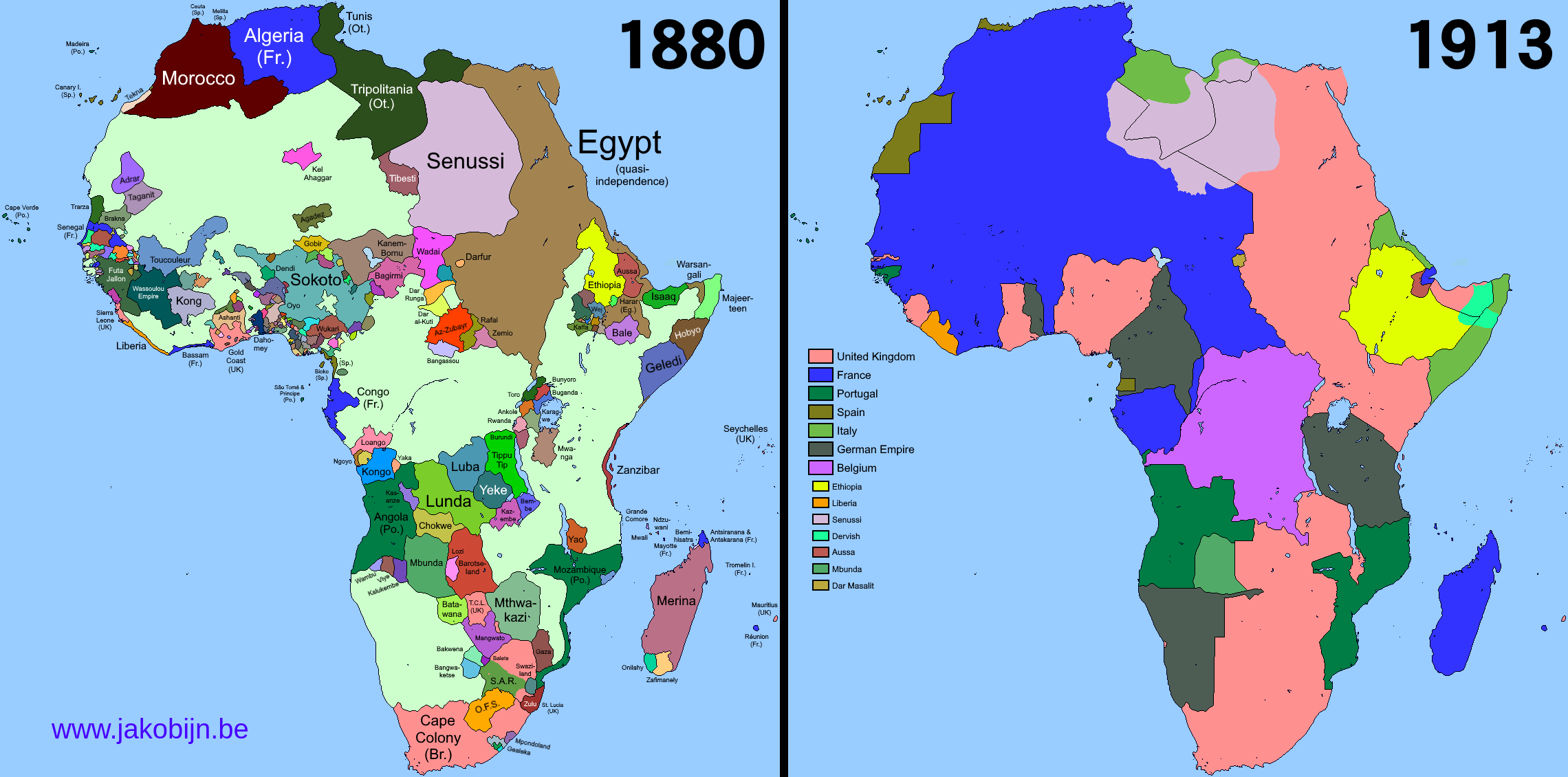
The comparison is intentionally provocative. The geopolitical circumstances are obviously different. But Wolff's argument is about mentality rather than direct historical equivalence. The idea that a powerful Western coalition can redesign the political geography of another large region according to its own preferences belongs, in his view, to an imperial way of thinking. The problem is that the material conditions that made nineteenth-century imperialism possible no longer exist.
Russia is a nuclear power. China possesses enormous industrial capacity. Iran is rising. Regional powers have greater room for manoeuvre. Alternative financial and economic institutions are developing. Western military superiority is no longer sufficient to impose political outcomes everywhere. The old imperial reflex therefore collides with a radically different international balance.
Europe's particular problem
Wolff believes Europe faces this crisis even more acutely than the United States. The European powers lost their empires earlier and more completely. Britain, France, Belgium, the Netherlands and other European states once exercised direct control over large territories outside Europe. That system is gone. Yet the political imagination shaped by centuries of European dominance does not disappear overnight.
Europe therefore confronts a difficult psychological transition. It must accept that the world can no longer be organized according to European strategic preferences. At the same time, European leaders remain deeply dependent on the United States for security. This creates a paradox: Europe has lost its historical empires, but it still participates in an alliance structure dominated by a country whose own global predominance is declining. The result can be political frustration and increasingly aggressive rhetoric.
The energy crisis as a laboratory of power
One of the most revealing examples in the interview concerns energy. Wolff discusses the shortage and rising price of diesel as an illustration of how economic policy actually operates. In the conventional textbook model, markets respond to supply and demand. If supply falls and demand remains strong, prices rise. If supply increases, prices fall. But real markets are organized through corporations with strategic power.
Refineries, oil companies, agricultural corporations and governments all have different interests. When a shortage develops, the actors capable of controlling production, exports or reserves can influence how long that shortage lasts. Wolff therefore rejects the idea that the resulting price is necessarily the simple outcome of impersonal market forces. His example involves American farmers who are severely affected by high diesel prices. Their margins can be squeezed by fuel costs, fertilizer costs and other inputs. From their perspective, an American restriction on diesel exports could appear to be an obvious way to increase domestic supply and reduce prices.
But oil companies and refiners have the opposite interest. They benefit from high prices and can argue that export restrictions would ultimately reduce production or refining activity, causing prices to rise again. The president therefore faces competing groups of political supporters. This, for Wolff, is a miniature version of the larger American political economy. The issue is not simply whether free trade or protectionism is theoretically superior. It is which organized economic group possesses enough political power to determine the policy outcome.
The illusion of a neutral market
This brings Wolff back to one of the central questions of political economy. Markets are never simply abstract mechanisms operating independently of institutions. They depend upon property rights, laws, infrastructure, financial systems, political decisions and the distribution of bargaining power. When a handful of corporations control strategically important parts of an economy, their decisions can have consequences far beyond ordinary commercial competition.
The diesel example is therefore important precisely because it appears mundane. A shortage, a government announcement, an industry lobbying campaign and the release of strategic reserves can seem like separate events. Wolff connects them as expressions of political-economic power. In this interpretation, the contemporary crisis of capitalism is not only a crisis of globalization. It is also a crisis of the institutional arrangements that governed globalization.
Why the West struggles to accept multipolarity
 The deepest argument in Wolff's analysis is psychological. A country that has enjoyed extraordinary global power for decades can mistake its historical position for the natural order of the world. For Americans who grew up during the second half of the twentieth century, American predominance could appear normal. The dollar was central. American corporations were dominant in many sectors. The United States possessed unmatched military reach. Its universities and technology companies attracted talent from around the world. There was little reason, from inside that system, to imagine that it could end. But historical systems do end.
China's rise is therefore particularly threatening because it demonstrates that the hierarchy is changing. The problem is not simply that China is communist, or that China has a different political system. The more profound issue, in Wolff's interpretation, is that China is becoming powerful enough to operate as an alternative centre of economic and geopolitical influence. The emergence of BRICS and other forms of international cooperation reinforces this development. Countries that once depended heavily on Western institutions increasingly have alternatives. The result is not necessarily a new empire replacing the old one. It may instead be a more fragmented and multipolar world.
From hegemony to negotiation
That transition requires a different political mentality. A hegemonic power can issue instructions. A multipolar power must negotiate. This is a profound change. If Washington can no longer assume that other countries will automatically follow its strategic preferences, diplomacy becomes more important. Economic relations become negotiations among multiple centres of power rather than transactions inside a hierarchy.
For Wolff, the refusal to accept this transition produces much of the aggressive language currently dominating Western politics. Instead of asking how to adapt to a changing international system, political leaders may promise to restore a lost hierarchy. Instead of acknowledging relative decline, they can describe every challenge as evidence of foreign aggression. Instead of reforming domestic institutions, they can blame outsiders. But rhetoric cannot reverse structural change.
The real question: reform or confrontation?
If Wolff's interpretation is correct, the central question facing the West is not whether it can somehow restore the twentieth-century order. The more important question is whether it can adapt to a world in which power is distributed more widely. That adaptation would require substantial domestic reform. The concentration of wealth would have to be addressed. Political institutions would need to become less dependent on corporate financing and lobbying. Economic policy would have to distinguish between national interests and the interests of particular corporations. The relationship between government and strategic industries would require greater transparency.
Internationally, the West would have to abandon the assumption that security requires exclusive spheres of influence. A multipolar world does not necessarily mean a world without Western influence. Europe and the United States may remain important economic, technological and military powers. But their influence would be one component of a larger system rather than the organizing principle of the entire system.
The danger of confusing decline with defeat
There is also an important distinction between relative decline and absolute collapse. Wolff's historical framework is about the decline of Western dominance, not necessarily the disappearance of Western prosperity. The United States and Europe possess enormous resources, sophisticated institutions, advanced technology and highly educated populations. The danger arises when relative decline is interpreted as an existential defeat.
If a declining hegemon believes that every increase in the power of another country is a direct threat to its survival, confrontation becomes almost inevitable. Every compromise appears as weakness. Every diplomatic opening becomes appeasement. Every independent policy by another country becomes hostile. That is how a structural transition can become a security crisis. The alternative is to recognize that international power can be shared. The end of hegemony does not automatically mean the end of prosperity. It can mean the end of privilege.
A world after the age of empire
Richard Wolff's analysis ultimately returns to the historical cycle with which the interview began. European capitalism created a world economy, but it created it through extraordinary inequality and imperial domination. The two world wars destroyed the old European empires and elevated the United States into a position of unprecedented global influence. American-led globalization subsequently integrated countries that had once been colonial subjects.
But integration also created competitors. The emerging multipolar world is therefore not simply an external challenge to the West. It is partly a product of the world economy that Western powers themselves constructed. This is perhaps the most important paradox in Wolff's argument. The West created globalization because it believed global integration would reinforce its prosperity and influence. For decades, it did. But globalization also transferred technology, capital, industrial knowledge and market opportunities to other societies. The world became richer and more interconnected, and Western dominance became less exclusive.
The contradiction has now become impossible to ignore. The political language of free trade is giving way to tariffs, sanctions, industrial policy and strategic protection. The rhetoric of universal rules increasingly competes with demands for exclusive spheres of influence. Domestic politics is increasingly shaped by concentrated corporate power. And the old assumption that Western institutions represent the natural centre of the international system is being challenged by the emergence of alternative centres of power.
Wolff calls this the revolt of the empire. Whether one accepts every element of that formulation or not, it offers a useful way to understand the apparent contradictions of the present moment. The West is simultaneously defending globalization and trying to restrict it, defending free markets and intervening directly in markets, advocating democracy while allowing extraordinary concentrations of private political power, and speaking of international cooperation while demanding strategic exclusivity. These contradictions are not necessarily signs of individual incompetence. They can also be symptoms of a system undergoing structural transformation.
The choice before the West
The final choice is therefore political rather than merely economic. One possibility is confrontation: attempt to preserve hierarchy through military alliances, sanctions, economic pressure, territorial influence and control over strategic resources. That approach may produce short-term political gains, but it risks turning relative decline into a much more destructive conflict.
 The other possibility is adaptation. Adaptation would mean accepting that the world is becoming multipolar. It would mean treating China, Russia, Iran and other rising powers not simply as enemies to be contained, but as permanent actors in an international system that no longer has one unquestioned centre. It would also mean confronting the domestic consequences of the old order. If the benefits of globalization are increasingly concentrated among corporations and wealthy individuals, restoring social stability requires more than blaming foreigners or restricting trade. It requires changing the distribution of economic and political power at home.
The central issue is therefore not whether free trade is returning or whether protectionism is replacing it. The deeper transformation is that the economic and geopolitical structures which once made Western dominance appear natural are breaking apart. The question is what comes next. Will the West attempt to reconstruct an imperial hierarchy that history has already undermined? Or will it accept a world in which power is more widely distributed and build institutions capable of managing that reality?
For Richard Wolff, the danger lies in refusing to recognize the transition. Empires rarely announce their own decline. They defend themselves, rationalize their behaviour and search for enemies. Their elites attempt to preserve their privileges. Their political systems become more polarized. Their economic structures become more concentrated. But historical change continues regardless of political rhetoric.
The end of Western hegemony, if that is indeed what we are witnessing, does not have to mean the end of Western civilization, prosperity or influence. It means something more specific and more difficult: the end of the assumption that the world exists primarily to serve Western power. That may be the psychological barrier that Western politics is struggling hardest to overcome.
This article is partially based on an interview transcript with Glenn Diesen and political economist Professor Richard Wolff. It develops and organizes the historical and economic arguments presented in the conversation.
Jeffrey Sachs on neocolonialism, system failure, and the need for reform
Jeffrey Sachs, the American economist attributes DRC mess to CIA, Belgium and white supremacy
In a recent lecture, American economist Jeffrey Sachs paints a somber yet illuminating picture of the causes behind instability in countries like the Democratic Republic of Congo (DRC). His analysis offers a crucial addition to the argument that free trade is not neutral, but often serves as a cover for geopolitical dominance and economic exploitation.
The historical legacy of exploitation
Sachs points out that Western analysts often ask: *"What is wrong with your country?"*, without first facing historical reality. He reminds us that the current suffering in the DRC stems directly from a history of colonial plunder:
1. King Leopold II created a slave colony that was exploited for thirty years.
2. The Belgian state took over this model and administered the colony for another forty years.
3. The CIA played a direct role in destabilization by orchestrating the assassination of the first democratically elected leader, Patrice Lumumba. The plundering of uranium, copper, diamonds, cobalt, etc., had to be preserved.
4. Subsequently, the West supported dictatorial regimes for decades that protected the interests of foreign multinationals such as Umicore, formerly known as Union Minière.
Today, Sachs argues, this dynamic is continued by multinationals extracting resources like cobalt without leaving fair tax revenues for the local population. Instead of addressing this structural injustice, failing governance in the Global South is often unilaterally blamed on local leaders, while external interference is ignored.
The bankruptcy of the privatization model
Sachs draws a parallel with Honduras, where the *United Fruit Company* exercised de facto power for decades, supported by the US military and diplomatic pressure. He refers to the coup against Jacobo Árbenz in Guatemala, orchestrated to protect United Fruit's interests – in which the then US Secretary of State, John Foster Dulles, and his brother Allen Dulles (head of the CIA) were closely involved in the legal and intelligence aspects of this operation.
The conclusion is clear: handing over public goods and strategy to the private sector has failed. The current system does not incentivize companies to act in a socially responsible manner, but maximizes profit at the expense of human dignity. Sachs emphasizes that food security and social protection are not "favors," but fundamental rights as enshrined in the Universal Declaration of Human Rights (1948). The Sustainable Development Goals (SDGs) are nothing more than an attempt by our generation to finally honor these rights.
Observation: The hypocrisy of the 'free market' dogma
It is ironic that the same nations advocating for minimal state intervention in the Global South massively intervene when their own economies falter. Sachs points to the sharp contrast within the United States, where one in seven Americans suffers from hunger, while political elites are primarily focused on tax cuts for the wealthy. This undermines the moral authority of the West to lecture others on "good governance."
Concrete proposals for a more just world order
Sachs formulates three concrete pillars for reform, which seamlessly align with the critique of the current imperialist order:
1. From G20 to G21: Restoring inclusivity
The current G20 excludes 1.4 billion Africans from crucial financial decisions. Sachs advocates adding the African Union (AU) as a full member, turning the G20 into a G21. Just as the European Union is represented, Africa must have a seat at the table. This would fundamentally change the discussion, as the voice of the Global South is currently systematically ignored in financial architecture.
2. Radical scaling up of development finance
During the COVID pandemic, rich countries could borrow $17 trillion at zero interest rates, while poor countries were excluded or had to pay high interest rates (5-10%). The US spent $7 trillion on emergency aid, without sparing a single cent for international solidarity. Sachs calls for an order-of-magnitude larger injection of capital via the World Bank and IMF, based on real needs rather than ideological dogmas. Furthermore, he advocates for technology sharing, such as a fair distribution of vaccines among major powers (US, China, EU, Russia, UK) instead of hoarding.
3. Strengthening the UN and wealth redistribution
The United Nations must become the central institution for a civilized world order again, but this requires funding. The core budget of the UN ($3 billion) stands in stark contrast to the budget of New York City ($100 billion). This disproportion makes effective multilateral governance impossible.
Finally, Sachs points to extreme wealth inequality. With 2,775 billionaires holding a combined $13.1 trillion, there is an excessive concentration of capital. A progressive tax on wealth above one billion dollars would not only be more just but also generate the resources needed for global public goods.
Analysis in light of 'The End of Free Trade'
Sachs' words once again confirm the stance in our article that we are witnessing the return of empire, albeit in a modernized form. Where colonial flags once waved, it is now financial instruments, intellectual property rights, and geopolitical alliances that dictate power relations. Sachs’ plea for a G21 and a strong UN is a direct challenge to Western hegemony. It suggests that "free trade," as long as it is unbalanced, effectively remains neocolonialism. The return of state intervention – as seen in industrial policy and sanction regimes – forces us to rethink a new international contract. A contract based not on the law of the strongest, but on sovereignty, human rights, and fair economic exchange. As Sachs states: "We need a different system."
YouTube
- King Leopold II: The Horrors Of The Congo Free State - https://youtu.be/EAokwWHJKr0
- Leopold II of Belgium: The Biggest Coverup In European History - https://youtu.be/dTq6Hhkpw2s
- The TRUTH About King Leopold II and the Congo - https://youtu.be/7lL0nf1LDGw
- King Leopold II - Congo Massacre - Forgotten History - https://youtu.be/Rg0G7DcEL0w
- King Leopold: The Man Who Killed 10 Million People in The Congo - https://youtu.be/hmA8O-fW9Aw
- The Belgian Congo – Documentary - https://youtu.be/m7ItE4IGYkM
- What King Leopold Did in The Congo Will Terrify You - https://youtu.be/FwbBjvde1Sk
- The Map Is a Lie - How Colonial Borders Broke Africa - https://youtu.be/r3Ra9VrcfKc
- Timbuktu The University They Buried: Africa's 700.000 Hidden Manuscripts - https://youtu.be/viKDLAQMFVA
- What african countries were called before colonization - lost kingdoms and ancient names - https://youtu.be/l4aYRLi0FlQ
- Before Ethiopia - The African Empire That Ruled the Red Sea - https://youtu.be/cI7uRw2RW7w
- What Was Nigeria Called Before Colonialism? The Answer Will Surprise You - https://youtu.be/MvddnpEho1A
- Before the Slave Ships - What Africans Were Really Doing in 1450 - https://youtu.be/yxk5SOlnrb4
- The African Kingdom That Was Trading With China While Europe Was Still in the Dark Ages - https://youtu.be/gdIqx4C_tX0
- The Original African Map That You Were Never Tought - How Borders Broke Africa - https://youtu.be/Y4hptdzTRLs
- What African Countries Were Called Before Colonization - Lost Kingdoms & Ancient Names Revealed - https://youtu.be/zGoZWR4nb5o
- The Lines That Broke A Continent - https://youtu.be/m1HBVelfuI4
- No Africans, No Borders Drawn — The Real Story of the Berlin Conference - https://youtu.be/0lWEXg-U2cU
- How Europe Stole Africa so Quickly, Mapped - https://youtu.be/LjieOlWXwTw