
The Delusion of Western Dominance: Sleepwalking into the Abyss
By Frank Dumon
The 21st century is revealing ever more relentlessly a truth that is still being convulsively denied in Western capitals: the period of Western world domination is not merely waning, it is definitively over. What we are currently witnessing is not a temporary upheaval or a 'challenge' to the international order, but a historical redistribution of weight. Asian and other non-Western civilizations are not suddenly 'rising'; they are merely returning to their natural, historical weight in the world order. The danger lies not in this return, but in the West's refusal to face this reality.
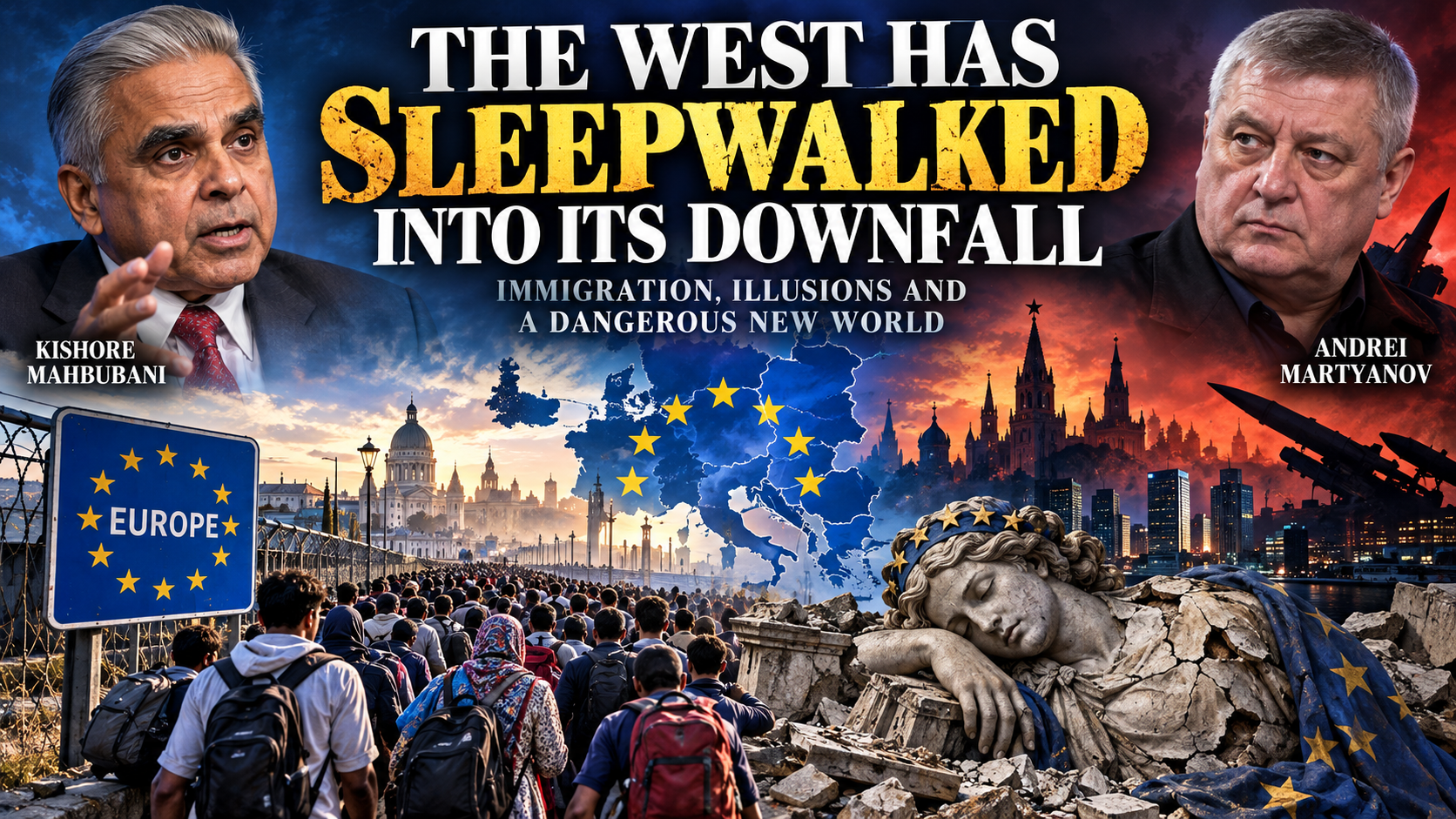
Through the lens of two sharp observers – former Singaporean diplomat and President of the UN Security Council Kishore Mahbubani, and geopolitical analyst Andrei Martyanov – the image of a West sleepwalking toward its own downfall becomes painfully clear. It is a West blinded by its own narcissism, that falsifies its own history, that wages war as its primary foreign policy, and that is led by a political elite that, in Martyanov's words, "is cowardly, ignorant about the reality of organized violence, and that will hide in "gated communities" while the society around them collapses." This article dissects the desperate lies on which the current Western hegemony feeds, and outlines the inescapable reality of a multipolar world.
The Arrogance of the 'End of History'
To understand the current Western disorientation, we must return to the psychological turning point: the end of the Cold War around 1990. The West celebrated the collapse of the Soviet Union as an ultimate victory, achieved without firing a shot. In that euphoria arose the intellectual hubris that was summarized in Francis Fukuyama's notion of the 'End of History'. The assumption was that Western liberal democracy was the final station of human political evolution. The struggle was over. The West had 'made it'.
This arrogance was accompanied by a bewildering demographic illiteracy. The West makes up only 12% of the world population. The remaining 88% lives outside the West. Yet in the 1990s the West effortlessly assumed that the rest of the world was doomed – or should be happy – to become replicas of the West. It was a worldview that dictated: "We have reached the top, we no longer need to struggle. The rest of you must adapt."
Kishore Mahbubani, who experienced this atmosphere of complacency up close at Harvard in 1991-1992, calls this a strategic error of epic proportions. While the West slept in a self-chosen coma of superiority, the rest of the world woke up. China, which began its modernization program in 1979, and India, which changed course in the early 1990s after a severe economic crisis, began the most impressive economic transformations in human history.
It is crucial to repeat Mahbubani's formulation: Chinese civilization has existed for 4,000 years. The past 40 years of economic and social development in China are the best 40 years in 4,000 years of Chinese history. The West, blinded by its own ideological dogmas, could not comprehend this. The Western assumption was that success was impossible without Western democratic structures. This cognitive dissonance still prevents the West from treating China and the Global South as equal partners, rather than as subordinates who make the wrong choices.
The 'Trigger-Happy' Hegemon: Bombing as Foreign Policy
Besides intellectual arrogance, the West committed a second, even bloodier strategic error: the normalization of military violence as an instrument to impose 'values'. In the West there is a persistent myth that Western civilization is the most peaceful and righteous. The data, however, tell a gruesome different story. After the Cold War, the West became 'trigger-happy'.
The illusion that democracy and liberalism are best spread with bombs has destroyed millions of lives. This pattern began in the late 1990s. NATO's bombing of Belgrade in 1999, under the guise of protecting the population of the former Yugoslavia, was a flagrant violation of international law. The Charter of the United Nations – the cornerstone of the 'rules-based order' that the West itself educated – permits the use of force only in two cases: self-defense or with a mandate from the UN Security Council. The bombings of Yugoslavia met neither.
When a prosecutor of the International Criminal Court for Yugoslavia at the time dared to question the legality of this action, the pressure on this person was enormous. The West demanded conformity, not legal integrity. The rest of the world watched and learned: international law applies only to the weak, not to the hegemon.
This tendency toward military adventurism culminated in the invasion of Iraq in 2003. This war was equally illegal, not mandated by the UN Security Council, and based on demonstrable lies about weapons of mass destruction. Mahbubani shares a revealing anecdote from that time: during a lunch at an exclusive club in New York in 2002, a successful American businessman refused French wine because France opposed the war in Iraq. This revealed a deep, disturbing longing for war that was deeply rooted in the Western psyche, far beyond neoconservative circles.
The lessons of Iraq were not learned. The intervention in Libya in 2011 led by France and the United Kingdom was another crime. Muammar Gaddafi was undoubtedly a dictator, but under his rule Libya enjoyed the highest standard of living in Africa: guaranteed income, healthcare, education, and peace. The West bombed the country, created a failing state, left a power vacuum that was filled with terrorist networks, and then washed its hands in innocence. There is hardly any reflection in the West about the question: "How many people have you killed? How many lives have you destroyed by becoming so trigger-happy?" This moral blindness is the direct cause of the loss of trust of the Global South in the West.
Demographic Suicide and the Cowardly Elitism
While the West sows chaos beyond its borders, the internal structure of European civilization crumbles. Andrei Martyanov points to a reality that is consistently suppressed or dismissed as 'extremist' by Western mainstream media: the demographic transformation of Europe. It is not a question of 'racism' to face these facts; it is a question of sociological and historical sense of reality.
Data, analyzed among others by institutes such as the Swedish immigration research cited by Christopher Caldwell, point to an irreversible trend: in various European countries, the indigenous population groups will be in the minority in their own historical homelands by the middle of this century. Countries such as France and Sweden are undergoing a transformation in which the original population threatens to become the 'guests' in their own home.

Click on the map for more details
Martyanov sharply poses the question: how would the indigenous population in a country in Africa, India, or Bangladesh react if a mass of European immigrants moved there, formed the demographic majority, and marginalized the local culture and religion? There would rightly be resistance. People are, at their core, tribal beings attached to their land, their history, and their culture. The claim that these demographic shifts are 'enriching' is a utopian lie proclaimed by political elites, while they themselves will not bear the consequences.
The European political leaders are, in Martyanov's direct wording, "political operatives" who have only one goal: to stay in power. Whether it concerns the center or the so-called 'populist' opposition, the differences are cosmetic. They know that their policy of unlimited migration and cultural self-sacrifice is untenable, but they assume that they personally are safe. They will retreat into their shielded gated communities, protected by private security, while the urban centers of Europe bear the burden of social unrest, parallel societies, and the loss of cohesion.
France is a textbook example of this. With estimates pointing to a significant percentage of the population that does not intend to assimilate, but rather rejects French republican values in favor of their own cultural and religious identities, social peace is a ticking time bomb. The political class responds not with vision, but with repression (such as the deployment of 'special units' against its own citizens) or with even more demagoguery. They are ignorant about the nature of organized violence and social collapse, and think that their rhetoric can hold back physical reality. That is a fatal miscalculation.
Historical Amnesia and the Falsification of the Eastern Front
This Western tendency to bend reality to its own needs also extends to historiography. The narcissistic nature of the West requires that it always be the hero, or at least the ultimate arbiter of good and evil. This leads to a systematic falsification of the Second World War.
A persistent and dangerous narrative that is currently promoted in Western media and political circles is the attempt to marginalize the role of the Soviet Union in the defeat of Nazi Germany, in favor of a Polish- or Ukrainian-centric story. The facts, however, are irrefutable and recognized by serious military historians worldwide: approximately 80% of German military losses during the Second World War were suffered on the Eastern Front.
It was the Red Army that broke the backbone of the Wehrmacht. It was the Soviet population that had to mourn 27 million dead, a sacrifice that is unimaginable in the Western imagination. Yet this historical reality is actively suppressed or rewritten in the current geopolitical climate. Why? Because recognizing the central role of Russia (as the core of the former Soviet Union) in defeating fascism does not fit the current narrative that portrays Russia as an existential, unrestrained threat that must be isolated.
When these historical facts surface on platforms such as YouTube or in alternative media, the response of the Western establishment is predictable: immediate censorship, or the incitement of comments that belittle the Soviet contribution and shift the focus to Western liberation or Eastern European victims. This is not only an insult to the millions of dead on the Eastern Front; it is a symptom of a civilization that has lost its own moral authority and therefore must manipulate history to justify its current policies. As Martyanov states: "They have been lying to themselves and the world for so long that they no longer know what truth is."
The Institutional Stranglehold: IMF, World Bank and the Illusion of Control
Returning to Mahbubani's analysis, we see that Western dominance is defended not only militarily and demographically, but also institutionally. The West claims to believe in meritocracy: the best person for the job, regardless of race, ethnicity, or origin. This is a noble principle, but in the practice of global governance it is a sham.
Take the two most important international economic institutions: the International Monetary Fund (IMF) and the World Bank. In theory, these organizations serve the entire world. In practice, there is an unwritten but iron rule: the director of the IMF must always be a European, and the president of the World Bank must always be an American.
This is not merely a tradition; it is structural exclusion. During the peak of the 2008 financial crisis, when Western economies stood on the edge of the abyss and desperately needed the support of emerging economies, at the G20 summit in London under the leadership of Gordon Brown, it was solemnly promised that the leaders of these institutions would henceforth be chosen on the basis of merit (meritocracy). That was in 2008. Now, in 2026, we are 18 years further. And still 88% of the world population is not qualified to lead 'global' institutions, purely because of their birthplace.
This refusal to share power is short-sighted and unwise. It is a desperate attempt to retain control over a world that has long changed. These decisions, made by a handful of Western diplomats behind closed doors, will ultimately haunt the West. How can the West expect the Global South to respect the 'rules-based order' when the rules of that order are explicitly designed to perpetuate Western privileges? The credibility of these institutions has been undermined, which has directly contributed to the creation of alternatives such as the New Development Bank (NDB) of the BRICS countries and the expansion of the BRICS alliance itself.
The Inescapable Multipolar Reality
The combination of these factors – demographic erosion, military overreach, historical revisionism, and institutional rigidity – creates a perfect storm for the West. The world is no longer unipolar, nor will it be bipolar. It is multipolar, and this reality is driven by mathematics, demography, and economic laws, not by Western approval.
The return of Asia, with China and India as focal points, but also with the dynamic rise of Southeast Asia, is a correction of the historical anomaly of the past two centuries. During the 'century of humiliation' and the subsequent colonial period, global wealth and power were concentrated in a small corner of the world. That concentration was an exception, not the rule. The current redistribution is a return to the historical norm.
For the West, there are two paths. The first path is that of painful adjustment. This requires the West to abandon its narcissism, cease its military interventions, face its history honestly, and learn to sit at a negotiating table as an equal among equals, not as a teacher lecturing less fortunate students. It requires a recognition that security in the 21st century cannot be achieved by undermining the security of others (such as Russia or China).
The second path is that of catastrophic collapse. If the West continues to cling to the delusion that it can continue to dominate the world through sanctions, proxy wars, and demagoguery, it will only widen the gap with the rest of the world. The 'desperate lies' will ultimately no longer be believed, not even by its own population. The political elite that hides behind its walls will eventually find that those walls cannot withstand the historical forces they have ignored.
Conclusion: The End of the Comfort Zone
Kishore Mahbubani began his argument with a sincere apology: if his words feel uncomfortable, that is necessary. For if we are not taken out of our comfort zone, we will not understand the world that is coming. Andrei Martyanov adds that this discomfort is not merely intellectual, but existential. The lies are so deeply woven into the structure of Western society that unraveling them will be painful.
For observers, writers, and citizens who want to face reality, the task is clear: we must stop ruminating on Western propaganda. We must name the historical truths, from the victims of the Eastern Front to the devastated cities of the Middle East. We must recognize that the world is not waiting for us to save it, but that it is reorganizing itself, with or without Western participation.
Years of Western hypocrisy and violence have led to the downfall of the West, which has lost its political dominance forever. Perhaps they can muster the wisdom to find a dignified place in a world that no longer possesses it, but in which it must learn to live.