
The True Origin of the Vietnam War: What Historians Get Wrong
By Frank Dumon
The Vietnam War killed over three million people. But the story most of us learned in school — that it was simply about stopping communism — is dangerously incomplete. The real origins stretch back decades before the first American soldier set foot in Southeast Asia, through French colonial rubber plantations where seventeen thousand workers died on a single estate, through a jungle meeting where American spies saved the life of Ho Chi Minh, through eight letters sent to President Truman that were never answered, through a democratic election deliberately sabotaged because the wrong side was going to win, and through a naval attack on a stormy night in the Gulf of Tonkin that declassified NSA documents now confirm almost certainly never happened.
This is the story of how a war of national liberation was repackaged as a Cold War crusade — and how the decisions that led to millions of deaths were built on colonial greed, diplomatic failure, and fabricated intelligence. What historians consistently get wrong about Vietnam isn't a matter of interpretation. It's a matter of record. The documents are declassified. The letters are in the National Archives. The NSA's own internal study admitted the intelligence was skewed.
The true origin of the Vietnam War changes everything about how you understand American foreign policy — not just in the twentieth century, but today.
Beyond the Iconic Images
Most people know the Vietnam War through a handful of images: the Napalm girl running down a road, helicopters lifting off the roof of an embassy, a wall in Washington covered in 58,220 names. Those images are seared into the collective memory of the Western world, and they are real. But they sit at the very end of a story that stretches back much further than 1965.
The version of this story that most of us learned in school goes something like this: America was trying to stop the spread of communism in Southeast Asia. The dominoes were falling. If Vietnam fell, the United States stepped in to defend the free world. It was a tragedy, sure, but the intentions were noble. That narrative is not just incomplete. In several critical places, it is wrong. Understanding the real origins of this war changes everything about how you see not just Vietnam, but the entire architecture of American foreign policy in the 20th century. The Vietnam War was not born in the jungles of Southeast Asia. It was born in the corridors of Paris, in the boardrooms of rubber companies, in the paranoid calculations of Cold War strategists, and in a series of decisions so cynical and layered in deception that, more than half a century later, the full truth still makes people uncomfortable.
The Colonial Extraction Machine
Let us go back to the 1880s, to a place called Indochina, where this entire catastrophe was set in motion. In the late 19th century, France was an empire. The British had India, the Dutch had the East Indies, and Spain had the Philippines. France, under Napoleon III, wanted its own piece of the map. In 1858, a French-Spanish military expedition landed at the port of Tourane, which we now call Da Nang. The official reason was to protect Catholic missionaries who had been persecuted by the Vietnamese court. The real reason was strategic and economic: France wanted Southeast Asia.
By 1887, France had consolidated its grip over what it called French Indochina, a vast colonial federation that included present-day Vietnam, Laos, and Cambodia. What followed was not a civilizing mission, despite what French colonial propaganda would have you believe. It was an extraction machine. Vietnam was officially designated as a "colony of economic exploitation." That was not what critics called it; that was its formal classification within the French colonial system. The entire point of Indochina was to be squeezed for raw materials and turned into a captive market for French manufactured goods: rice, coal, tin, zinc, coffee, pepper, and above all, rubber.
The rubber plantations deserve special attention, because they were the beating heart of both French colonial wealth and Vietnamese revolutionary anger. At the turn of the 20th century, the automobile industry was exploding in France, creating a soaring demand for rubber. The French poured investment into massive rubber plantations across the southern regions of Vietnam, particularly in Cochin-China and Annam. Virtually all of this production came from the backs of Vietnamese laborers.
The conditions on these plantations were medieval. Workers, derisively called "coolies" by their French overseers, labored for 15 hours a day in debilitating heat. They were paid almost nothing, sometimes in rice instead of money. French colonial law technically prohibited corporal punishment, but that law was a fiction. Overseers beat slow workers routinely. Malnutrition, dysentery, and malaria ravaged the workforce. On the plantations owned by the French tire manufacturer Michelin, conditions were especially horrific. In just 20 years between the two world wars, a single Michelin-owned plantation recorded 17,000 deaths. Seventeen thousand workers, dead on one plantation, to make tires for cars in Paris.
There was a deliberate strategy behind this exploitation. In one secret report, a French colonial official wrote to the governor of Indochina that farmers would only leave their villages and work on plantations when they were starving. Therefore, "the best remedy for the urgent need of workers is to impoverish them, withdrawing allowances and devaluing agricultural produces." They engineered poverty so that people would have no choice but to work themselves to death. This was not incidental cruelty; this was policy.
An Unlikely Alliance: Ho Chi Minh and the OSS
Here is where the story takes a turn that most Western histories either skim over or get entirely wrong. This brutal colonial machine did not go unchallenged; it produced a resistance movement. And the leader of that resistance, the man who would become the face of Vietnamese independence, had a relationship with the United States that almost nobody talks about. His name was Ho Chi Minh, and before he became America's enemy, he was America's ally.
Ho Chi Minh was born Nguyen Sinh Cung in 1890 in central Vietnam. He left his homeland as a young man and spent nearly three decades abroad, traveling through France, England, the Soviet Union, and China. He attended the Paris Peace Conference in 1919, hoping to petition Western leaders for Vietnamese self-determination. He was ignored. He became a founding member of the French Communist Party, not necessarily because he was a devoted Marxist-Leninist above all else, but because the communists were the only major political movement in Europe that was actively opposed to colonialism. For Ho, independence always came first. Communism was the vehicle, not the destination.
During the Second World War, Ho Chi Minh became an asset of the United States government. When Japan invaded French Indochina, the United States needed intelligence on Japanese troop movements in the region. The Office of Strategic Services (OSS), the forerunner of the CIA, was operating out of southern China and desperately needed contacts on the ground in Vietnam. A group of Vietnamese guerrillas emerged from the jungle, escorting a downed American pilot to safety. The group was led by Ho Chi Minh. An OSS agent named Charles Fenn met Ho and described him as articulate, charismatic, and remarkably friendly toward Americans. Ho was given a codename: OSS agent Lucius.
In July 1945, the OSS sent an eight-man special operations team, known as the Deer Team, into the mountains of northern Vietnam. Led by Major Allison K. Thomas, they parachuted into a jungle clearing near Tan Trao, about a hundred miles north of Hanoi. Their mission was to link up with the Viet Minh and train Ho Chi Minh's guerrilla fighters to harass Japanese forces. When they arrived, Ho was gravely ill, burning with fever and suffering from severe stomach pains. An American medic named Paul Hogland treated him with quinine, sulfa drugs, and penicillin. That treatment almost certainly saved his life.
Think about that for a moment: an American military medic saved the life of the man who would later become America's most determined adversary. The Deer Team trained Ho's fighters, including a young military commander named Vo Nguyen Giap, who would go on to become one of the most celebrated generals of the 20th century. But in the summer of 1945, Giap was learning guerrilla tactics from American soldiers. The Americans and the Vietnamese fought together against the Japanese, developing a network of informants and searching for downed Allied pilots. OSS officers described Ho as warm, curious, and deeply interested in the United States. He spoke admiringly of American ideals and was particularly fascinated by the Declaration of Independence.
The Betrayal of 1945: Unanswered Letters
On September 2, 1945, just days after Japan's surrender, Ho Chi Minh stood before an enormous crowd in Ba Dinh Square in Hanoi and declared Vietnamese independence. The words he chose to open that declaration were not from Marx or Lenin. They were from Thomas Jefferson. He began: "All men are created equal. The Creator has given us inviolable rights: life, liberty, and the pursuit of happiness." It was a deliberate and calculated appeal to the United States. Ho genuinely believed that America, a nation born from its own revolution against colonial rule, would support Vietnam's quest for independence.
He was wrong. What followed was one of the most consequential failures of diplomacy in the 20th century. Between October 1945 and February 1946, Ho Chi Minh sent at least eight letters and telegrams to President Harry Truman, as well as three separate communications to Secretary of State James Byrnes. In these letters, Ho described the situation in Vietnam, French aggression, and the Vietnamese people's desire for independence. He explicitly compared Vietnam's situation to that of the Philippines, which the United States had recently granted independence. He asked for American support and recognition.
Not a single letter was ever answered. Historians still debate why. Some argue that the letters were filtered out by mid-level officials at the State Department who had already decided that supporting French colonial interests was more important than Vietnamese self-determination. Others suggest that by 1945, the emerging Cold War had already begun to reshape American thinking. France was a crucial ally in containing Soviet expansion in Europe, and Washington needed Paris more than it needed Hanoi.
Whatever the reason, the silence was devastating. Ho Chi Minh did not start out as America's enemy; he was pushed into that role. When Washington chose to back France's colonial reconquest, Ho turned to the only other major powers willing to help: China and the Soviet Union. The man who had quoted Thomas Jefferson was now receiving weapons from Mao Zedong, not because Ho had always been a dedicated Soviet puppet, but because the United States had slammed the door in his face.
The Sabotage of Democracy: Geneva and Ngo Dinh Diem
The dominant narrative portrays the Vietnam conflict as a straightforward Cold War battle between freedom and communism. But the origins of the war were colonial, not ideological. This was, at its core, a war of national liberation that the United States reframed as a frontline in the fight against global communism, because that framing justified intervention.
From 1946 to 1954, France fought the First Indochina War against Ho Chi Minh's forces. It was a brutal colonial war of reconquest, and the United States bankrolled it. By the end of the conflict, Washington was paying approximately 80% of France's military costs in Indochina. This was not about defending democracy; South Vietnam did not exist yet. This was about keeping France happy in Europe and preventing any communist victory anywhere on the globe, regardless of context.
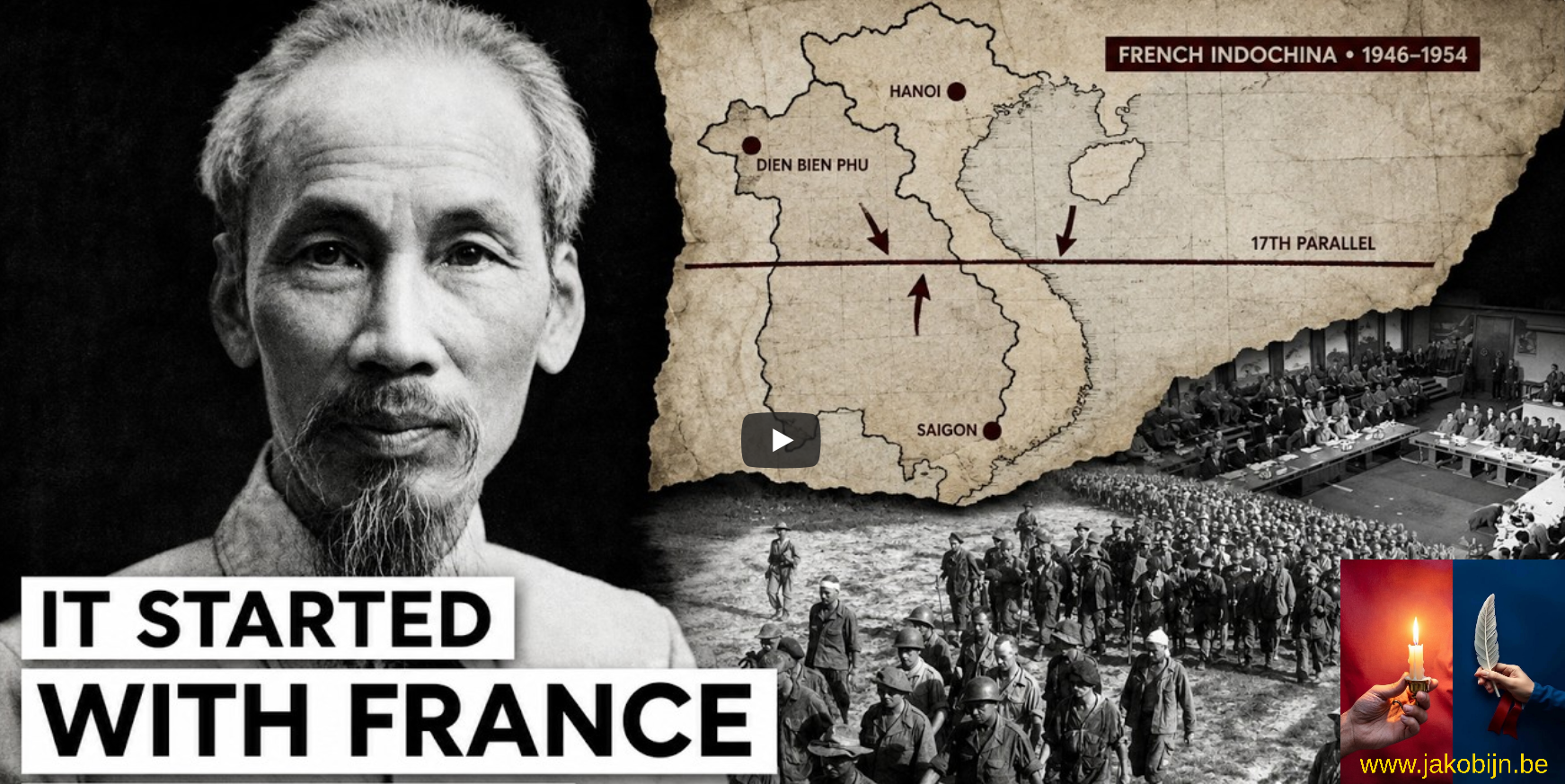
In May 1954, the Vietnamese surrounded and overran the French garrison at Dien Bien Phu. It was a catastrophic defeat. After 56 days, France was done in Indochina. The colonial era was finished.
The 1954 Geneva Conference brought together representatives from eight countries to negotiate the end of the war. The resulting Geneva Accords divided Vietnam temporarily at the 17th parallel, creating a communist-governed north under Ho Chi Minh, and a French-backed non-communist state in the south. The key provision of the agreement was that national reunification elections would be held in July 1956. The Vietnamese people would decide their own future through a democratic vote.
Those elections never happened. This is perhaps the single most important fact that gets buried in conventional histories of the war. The United States, which never actually signed the Geneva Accords, backed the South Vietnamese government of Ngo Dinh Diem in refusing to hold the elections. Why? Because everyone, from the CIA to the State Department to President Eisenhower himself, knew who would win. Eisenhower later wrote quite candidly that, had elections been held at the time of the fighting, possibly 80% of the population would have voted for Ho Chi Minh over the French-backed puppet emperor Bao Dai.
The United States helped sabotage a democratic election because the wrong side was going to win. The Vietnamese had made an enormous concession at Geneva by accepting temporary partition, even though they controlled roughly three-quarters of Vietnamese territory at the time of the ceasefire. They agreed to withdraw to the north on the explicit promise that reunification elections would follow within two years. When those elections were blocked, they felt, with considerable justification, that they had been double-crossed. This betrayal became the spark for the second phase of the conflict.
The Gulf of Tonkin: A Fabricated Pretext
Meanwhile, the American presence in Vietnam was growing quietly but steadily. By the time John F. Kennedy took office in 1961, there were around 900 American military advisors in South Vietnam. By the time Kennedy was assassinated in November 1963, there were 16,000. Lyndon Johnson inherited the situation, and around him gathered a group of advisors, with Secretary of Defense Robert McNamara chief among them, who were pushing hard for escalation. The hawks were circling. All they needed was a trigger.
On August 2, 1964, North Vietnamese patrol torpedo boats engaged the USS Maddox in the Gulf of Tonkin. The Maddox had been conducting signals intelligence operations in the area. This first incident, while involving some disputed details, did happen. There was a genuine exchange of fire.
But it is the second incident that changed everything. On August 4, the Maddox and a second destroyer, the USS Turner Joy, reported that they were under attack again: torpedo boat engagements, incoming fire, evasive maneuvers in the dark. Within hours, President Johnson was on national television announcing retaliatory air strikes against North Vietnam. Congress overwhelmingly passed the Gulf of Tonkin Resolution, granting Johnson the authority to take all necessary measures to protect American forces. It passed unanimously in the House, and with only two dissenting votes in the Senate. Johnson later remarked privately that the resolution was "like grandma's nightshirt, because it covered everything."
There was just one problem: the second attack almost certainly never happened. The night of August 4 was stormy, and the seas were rough. Radar and sonar operators aboard the destroyers were inexperienced and jumpy. The contacts they reported were, in all probability, phantom returns caused by atmospheric conditions and electronic interference. Even at the time, the commander of the destroyer flotilla, Captain John Herrick, cabled back to Pacific headquarters expressing serious doubts and recommending a thorough daylight investigation before any action was taken.
His caution was ignored. Secretary McNamara briefed congressional leaders with what he knew were flawed intelligence reports, presenting the attack as unequivocal. Decades later, the truth came out fully. In 2005, the National Security Agency declassified an internal historical study by NSA analyst Robert Hanyok. The report acknowledged that there had been deliberate distortions of signals intelligence to support the official narrative. Over 90% of the relevant intelligence reports had been skewed, and contradictory evidence had been excluded from the intelligence package sent to the White House. The NSA's own historian concluded that no attack happened on August 4 in the sense that American officials had described.
The legal foundation for the Vietnam War, the document that gave Johnson a blank check to wage war without a formal declaration from Congress, was built on intelligence that was at best catastrophically misinterpreted and at worst deliberately fabricated.
The Legacy of Deception
More than 58,000 American service members would die in the war that followed. The Vietnamese death toll was staggering: over 3 million Vietnamese, more than half of them civilians, perished. Neighboring Cambodia and Laos were devastated. The United States dropped more bombs on Vietnam than all the bombs used by all sides in the entirety of the Second World War. Agent Orange poisoned the land and the people, causing birth defects that continue to this day.
When you trace the chain of decisions that led to all of that destruction, you find not a simple story of democratic nations defending freedom against communist aggression. You find a colonial extraction machine that brutalized an entire population for decades. You find a revolutionary leader who quoted Jefferson and reached out to Washington, only to be ignored. You find a democratic election that was deliberately blocked because the outcome was inconvenient. You find a fabricated naval incident used to bypass Congress and start a war that the administration had already decided to fight.
The Pentagon Papers, the massive secret study leaked by Daniel Ellsberg in 1971, confirmed what skeptics had suspected for years: successive American administrations, from Truman through Johnson, systematically misled the public about the nature and scope of American involvement in Vietnam. The war was not the product of a single bad decision. It was the accumulation of decades of bad faith, strategic miscalculation, and institutional deception.
The patterns established during the Vietnam era did not vanish when the last helicopter left Saigon in 1975. The Gulf of Tonkin playbook — the use of dubious intelligence to manufacture consent for military action — would be recycled again and again. The tragedy of Vietnam is not just that so many people died, but that so many of those deaths were preventable. At virtually every critical juncture, there was an off-ramp, a road not taken.
The Vietnam War killed over 3 million people. It displaced millions more. It poisoned a country with chemical weapons, tore the American social fabric apart, and started fundamentally because one nation decided that another nation's resources were worth more than its people's freedom. Because a revolutionary's letters went unanswered, because an election was sabotaged, and because radar ghosts on a stormy night in the Gulf of Tonkin were turned into a justification for a war that had already been decided upon.
That is the true origin of the Vietnam War. And it is a story that, no matter how many times it is told, never stops being relevant.
Note: This article is based on historical records and declassified documents. For further contextual reference, related audiovisual material can be found at: https://youtu.be/BmKL1F2_ZQ8