
Why the Belgian Subsidy Shop Remains Wide Open: Rhetoric versus Reality
From SME Portfolio to Healthcare Cartel: The True Cost of Belgian Business Support

By Frank Dumon
Analysis of the Belgian subsidy culture: why liberal criticism of SME support contradicts the billions in aid for large corporations and the healthcare sector. While economist Rudy Aernoudt chastises Flemish SMEs for their subsidy reflex, his boss Georges-Louis Bouchez is helping to build Europe’s largest corporate welfare state. In the public debate on the Belgian economy, the term 'baxter economy' regularly surfaces. It is a powerful metaphor for a system in which companies no longer survive on their own business model, but are artificially kept alive by a continuous infusion of government support. Recently, this criticism received renewed prominence in a column by economist Rudy Aernoudt on www.made-in.be/. As chief of staff to MR chairman Georges-Louis Bouchez, he decried the Flemish subsidy culture for SMEs. He rightly stated that instruments such as the SME portfolio and growth subsidies have created a financial reflex: first seek support, then think about strategy and profitability.
His conclusion was clear: abolish the subsidy shop and lower taxes.
At first glance, this seems a laudable plea for free markets and entrepreneurship. However, anyone looking beyond the rhetoric encounters a fundamental paradox. How can the fierce criticism of small SME subsidies be reconciled with the practice of large Belgian enterprises and protected sectors whose interests the same political faction represents? After all, Georges-Louis Bouchez presents himself as the figurehead of Walloon and Brussels employers, a milieu that structurally advocates for industrial support measures, fiscal optimisation, and protected market positions.
This article aims to expose that discrepancy. It argues that the debate about the Belgian subsidy culture should not get bogged down in symbolic SME criticism, but must address the structural state aid to large corporations and the healthcare sector. Because while the working population is called upon for responsibility and purchasing power, the real subsidy shop – that of the corporate welfare state and the healthcare cartel – remains wide open.
"Privatisation of Profits and Socialisation of Losses"
"Privatisation of profits and socialisation of losses" refers to the idea that companies want to keep financial gains for themselves and shift losses onto the rest of society, possibly by lobbying the government for support. This practice was criticised during the 2008 Wall Street bailout.
The Macroeconomic Reality of Business Support
To understand the scale of the problem, we must look beyond anecdotal SME subsidies. The amounts Aernoudt mentions – caps of €7,500 per year or €50,000 per growth trajectory – are marginal in light of the national budget. The real subsidy culture lies elsewhere, in the unspectacular but billion-euro items of the federal and regional budgets.
According to analyses by the National Bank of Belgium and the Federal Planning Bureau, around €25 billion annually flows in subsidies and state aid to Belgian companies. That amounts to 4.1 percent of gross domestic product (GDP). This is not incidental crisis support, but a structural feature of our economy. Where the SME entrepreneur is accused of building his business model around subsidies, exactly the same applies to countless multinationals and large national champions.
Their investment decisions, innovation trajectories, and even their energy supply are inextricably linked to public funding.

Belgium occupies a special position in international perspective. OECD data shows that our country, along with France, is among the most generous countries regarding tax incentives for research and development (R&D). These tax deductions are theoretically intended to stimulate innovation, but in practice often function as a generic labour cost subsidy for highly skilled jobs in the pharmaceutical and technology sectors. However, evaluation of these measures remains limited; the question of whether the societal return on these billions in investments outweighs alternative spending is rarely asked.
The case of Volvo Gent, also cited by Aernoudt, perfectly illustrates this mechanism. A support package of up to €119 million for investments, energy efficiency, and training is justified by the importance of employment and anchoring. But substantively, this means that the government – and thus the taxpayer – takes on a significant part of the business risk. In a true free market, such investments would be financed from equity or debt, with returns and risks resting with shareholders.
In Belgian reality, risks are socialised and profits are privatised.
This is the core of the asymmetry. When an SME fails after receiving a growth subsidy, there is political outrage and controls are tightened. When a multinational, after years of tax support and investment premiums, decides to restructure or funnel profits away through international constructions, the political response usually remains limited to worried press releases. The subsidy shop for large corporations operates under a different name – 'strategic industrial policy', 'innovation pacts', 'energy transition' – but the underlying logic is identical to that of the SME portfolio: dependence on the state as a substitute for market competition.
The Healthcare Sector as a Case Study of Protected Markets
If business subsidies are the visible side of the coin, then the healthcare sector is the invisible but financially weighty reverse. Nowhere is the gap between liberal rhetoric and protectionist practice as great as in healthcare. The sector functions as a closed system in which prices are not determined by supply and demand, but by negotiations between government, mutualities, and suppliers. The result is a price level that is disconnected from real production costs, financed by compulsory contributions and copayments from the working population.
My opinion piece “The Temu Paradox: How the Working Person Pays Usurious Prices for Compression Stockings and Hearing Aids” provides a painfully concrete illustration of this. (with more than 16,000 views on my Facebook page to date)
In it, I describe how compression stockings of excellent quality are available via international trading platforms like Temu for about €8 per pair. The same products, purchased through the Christian mutual insurance or a local pharmacy, cost €50 to €59. For hearing aids, the picture is even more shocking: where functionally equivalent devices can be found online for a few tens of euros, recognised audiologists charge prices of €1,500 and more, largely covered by health insurance.
Lapperre is always there for you is their slogan. Call today for an appointment at 0800 11 766 or visit https://www.lapperre.be/nl/gratishoorcontrole/ (and don't forget your bank card). *A prescription from an ENT specialist is required for a trial period with hearing aids. We will tell you all about it during our first appointment.

This price difference is no coincidence, but the result of deliberate policy. The reimbursement systems and recognition conditions create a protected market in which price competition is eliminated. Pharmacies and recognised suppliers operate in a regulated ecosystem where margins are guaranteed.
The consumer has no freedom of choice: anyone wishing to use the compulsory insurance must purchase within the expensive, closed circuit. Anyone who steps outside the system and buys cheaper loses their right to reimbursement.
What makes this even more problematic is the stance of the government and the European Union towards cheap imports. Under the guise of consumer protection, product safety, and ecological sustainability, border levies and import restrictions are being considered for platforms such as Temu and Shein. The reasoning is familiar: unfair competition, low environmental standards, lack of traceability. Although these concerns may be legitimate in themselves, a bitter ambiguity arises when the same governments refuse to tackle the own, subsidy- and regulation-driven prices in the healthcare sector.
Local producers and distributors are protected against world market prices, while the population is forced to pay usurious prices for essential goods. The ecological footprint of a parcel from China is closely monitored, but the inefficiency and overconsumption resulting from the subsidised healthcare circuit are ignored. This is not free trade, nor is it social protection. It is regulatory capture in its purest form: policy influence where regulation does not serve the general interest, but the profit margins of established players.
A form of corruption of authority that occurs when a political entity, policymaker, or regulator is used to serve the commercial, ideological, or political interests of a small constituency, such as a specific geographic area, industry, profession, or ideological group.
The healthcare sector thus demonstrates that the subsidy culture is not limited to direct cash transfers. Indirect support, via guaranteed sales markets, price regulation, and import barriers, also constitutes a form of state intervention that distorts market functioning. And just as with business subsidies, it is the ordinary citizen who foots the bill, not through corporate tax, but through the payslip and the pharmacy.
Political Positioning and Interest Representation
The question arises as to why these contradictions persist so stubbornly. The answer lies in the structure of the Belgian consultation model and the intertwining of politics and organised interests. Organisations such as AKT, VOKA, and the FEB (Federation of Belgian Enterprises) play a central role in economic policy. Their demands are consistent: wage cost reductions, energy compensations, simplification of administration, and retention of fiscal incentives.
Politicians who position themselves as business-friendly, such as Georges-Louis Bouchez, navigate within this force field. When Bouchez pleads with the Flemish employers' organisations for "fewer rules" and the abolition of "useless or marginal subsidies," one must read the terminology carefully. What is labelled as 'marginal' in this discourse usually concerns the administrative red tape and visible SME support. The structural financial transfers to large corporations and protected sectors, on the other hand, are rarely questioned; they form the backbone of the economic model these politicians defend.
This explains the demagogy in the current debate. It is electorally attractive to hammer on bureaucracy for small entrepreneurs and to advocate for lower taxes. But when these same politicians sit at the negotiating table, priorities appear to be different. Recent budget agreements show that cuts on business support invariably fail in favour of other items. The €25 billion in business subsidies remains largely intact, while the shift of burdens towards labour and consumption continues unabated.
After all, Belgium has the highest tax burden on labour in Europe. The so-called tax wedge – the difference between gross labour costs and net disposable income – for a single average employee is more than 50 percent. This means that an employee in fact spends more than half of their working time financing the government, social security, and protected sectors. When liberals argue for 'lower taxes', they rarely mean a substantial reduction in personal income tax or VAT on basic goods. The focus is predominantly on corporate tax, withholding tax, and fiscal optimisation opportunities for capital.
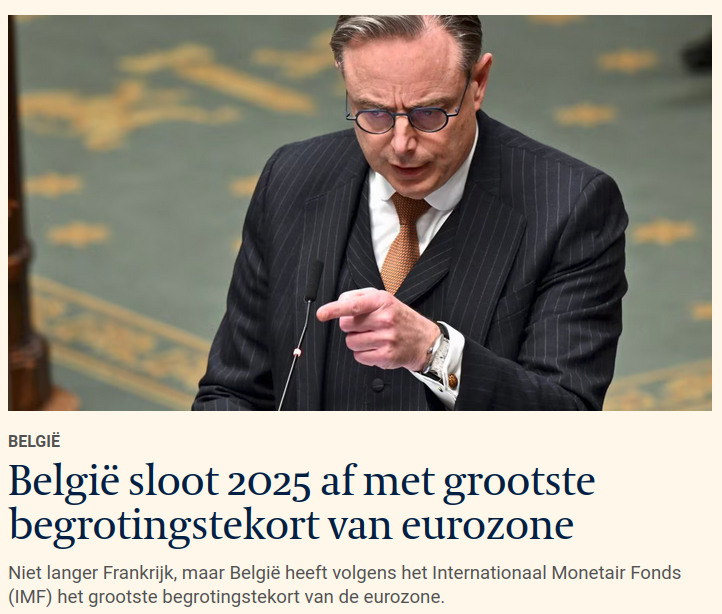
The result is a self-perpetuating system. The working population finances, through its taxes and social contributions, both business support for large corporations and the high prices in healthcare. At the same time, it is told that the market must be free and that subsidies are bad for the economy. This cognitive dissonance is not accidental, but a feature of the system. As long as costs are made invisible through complex tax constructions and compulsory insurances, and as long as benefits remain concentrated among well-organised interest groups, little political pressure for fundamental reform will arise.
The role of politicians like Bouchez and advisors like Aernoudt should be understood in this light. They are not hypocrites in a moral sense, but actors within a rational system that rewards them for defending specific interests. The criticism of the SME subsidy shop is sincere, but selective. It is a luxury criticism only possible because the real subsidy flows remain out of sight. By focusing attention on the small entrepreneur, the debate is kept safely within the boundaries of the existing consensus model. The question of whether that model itself is still sustainable is not asked.
Towards a Consistent Economic Vision
If we take the analysis seriously, it is not enough to merely abolish the SME portfolio or simplify administration. A consistent economic vision requires that we scrutinise the subsidy culture in its entirety, without distinction between small and large, between industry and healthcare, between direct support and indirect protection.
First, there is a need for radical transparency and evaluation of all forms of business support. The €25 billion in subsidies and tax exemptions must be tested annually on effectiveness, efficiency, and societal return. Subsidies that do not demonstrably contribute to productivity growth, innovation, or sustainable employment must be phased out. This applies equally to the investment deductions of multinationals as to SME growth subsidies. Evaluation clauses must be binding, not voluntary.
Second, the market for medical devices and basic care must be opened up. Reference price systems, such as those in the Netherlands and Germany, can put an end to artificially high prices in Belgium. If a compression stocking or hearing aid is available on the world market for a fraction of the local price, reimbursement should be aligned accordingly. Suppliers who want to charge higher prices may do so, but the difference must be borne by the consumer, not by solidarity. At the same time, import barriers that serve only to protect local cartels must be reconsidered. Sustainability and safety are legitimate criteria, but they must not become an alibi for protectionism.
Third, a shift in the tax burden is necessary. As long as the financing of the subsidy state and the healthcare sector rests on wage labour, the purchasing power of the working population will remain under pressure. A fairer system shifts the burden from labour to consumption, capital, and raw materials. This is not an ideological experiment, but an economic necessity in a country with the highest labour tax burden in the world. Lower taxes on labour primarily mean a restoration of the net purchasing power of those who keep the system running.
Finally, we must depolarise the debate. The opposition between 'liberal free market' and 'social protection' is false. Both concepts are abused in Belgian practice to serve vested interests. Genuine free market means no state aid for multinationals and no protected cartels in healthcare. And genuine social protection means no usurious prices for basic goods and no tax burden that discourages labour. It is about consistency: the same principles must apply to everyone, regardless of the scale of the enterprise or the sector in which it operates.
Conclusion
Rudy Aernoudt's column contains a kernel of truth. The bureaucratic subsidy culture for SMEs is stifling and leads to perverse incentives. But by limiting the criticism to this segment, a distorted picture of the Belgian economy is drawn. The real subsidy shop is not with the baker or the plumber who uses the SME portfolio, but with the multinationals that receive billions annually, and with the healthcare sectors that secure their margins through regulation and reimbursement systems.
Georges-Louis Bouchez and the employers he represents are not outsiders in this system; they are its architects and beneficiaries. The liberal plea for lower taxes and fewer rules rings hollow as long as structural state aid and protected markets remain untouched. It is demagogy to lecture the small entrepreneur on free markets while the big players enjoy a comfortable Baxter of public resources.
The bill for this system is presented to the working man. He pays the highest taxes, the highest healthcare prices, and the inefficiency of an economy that simulates competition but organises protection. If we truly want to close the subsidy shop, we must start with the biggest customers. Only then can we speak of a fair market, a just tax system, and a healthcare system that serves the patient rather than the producer.
The time for selective outrage is over. What is needed is a comprehensive review of the Belgian subsidy state, based on transparency, evaluation, and equal treatment. Not because it is ideologically purer, but because it is economically and socially necessary. The working population deserves better than a system in which the rhetoric of the free market applies only to those who can afford it, and the bill for protection always ends up with the same group.
See also
- Crony capitalism
- Corporatocracy
- Fossil fuel subsidies
- Kleptocracy
- Political corruption
- Pork barrel
- Public choice theory
- Public-private partnership
- Regulatory capture
Further Reading
- Johnston, David Cay. Free Lunch (The Penguin Group, New York, 2007.)
- Jansson, Bruce S. The $16 trillion mistake: How the U.S. bungled its national priorities from the New Deal to the present (Columbia University Press, 2001)
- Mandell, Nikki. The corporation as family : the gendering of corporate welfare, 1890-1930 (University of North Carolina Press, 2002).
- Glasberg, Davita Silfen. Corporate welfare policy and the welfare state: Bank deregulation and the savings and loan bailout (Aldine de Gruyter, NY, 1997).
- Whitfield, Dexter. Public services or corporate welfare: Rethinking the nation state in the global economy (Pluto Press, Sterling, Va., 2001.)
- Folsom Jr, Burton W. The Myth of the Robber Barons (Young America)
- Rothbard, Murray N. Making Economic Sense, Chapter 51: Making Government-Business Partnerships ISBN 0-945466-18-8 (1995)