
First Jan Balliauw who claims in Trends about the 90 billion European support for Ukraine:
'Otherwise it would have been over in May'

See the article in Trends. The Egmont Institute (officially EGMONT – The Royal Institute for International Relations) with which he is affiliated receives funding according to various sources from:
• The Belgian government: The Institute is connected to the Belgian Ministry of Foreign Affairs, from which it receives a significant portion of its funding.
• EU institutions: It receives grants and project funding from European Union agencies.
• Membership contributions and private partners: The Institute also depends on membership contributions and support from private sector partners.
• Specific documented contributions include:
◦ Belgian Ministry of Foreign Affairs: €980,000
◦ Enabel (Belgian development agency): €172,005
◦ Belgian Employment Office: €140,542
◦ King Baudouin Foundation: €34,885
The total annual budget is estimated at approximately €1.6 to 1.9 million: see www.lobbyfacts.eu
The institute describes itself as "an independent and non-profit think tank based in Brussels, devoted to interdisciplinary research conducted in a spirit of complete academic freedom"
And now Glenn Diesen who articulates a fundamental problem:
"In all interdependent relationships, one side is always more dependent than the other. Interdependence enables the less dependent state to impose economically favorable conditions and obtain political concessions from the more dependent party."
This is not merely economic, it is profoundly military strategic. Europe's dependence on American security guarantees through NATO has created a structural vulnerability:
• Security architecture as leverage: The revival of militarized dividing lines on the European continent makes Europeans "extraordinarily dependent on the US," while Russia becomes increasingly dependent on China.
• The illusion of autonomy: European aspirations for "strategic autonomy" have been systematically undermined by NATO expansion, which transformed a chance for partnership after the Cold War into a mechanism of subordination.
• Diversion of resources: Under American leadership, European states shift government resources from social welfare to military spending aimed against Russia – a transfer of wealth that weakens European societies while strengthening the strategic position of the US.
The mechanism of proxy war preparation
Brian Berletic outlines how this asymmetry is made operational: "The US seeks to eliminate key partners of the Russia and China-led multipolar world until only Russia and China remain."
Important mechanisms include:
1. Escalation via proxy: CIA-coordinated drone attacks on Russian territory are carried out while Europe is positioned for more direct combat functions, including intercepting Russian energy supplies.
2. The RAND blueprint: The 2019 RAND Corporation report, "Extending Russia," explicitly advised provoking Russia via Ukraine to "overload it militarily or economically," with acknowledgment that this would likely result in "disproportionately large Ukrainian casualties."
3. Strategic sequencing: Europe is being prepared to "fill the growing vacuum created by a gradually collapsing Ukraine," so that pressure on Russia remains continuous while the US maintains strategic flexibility.
The cost to European sovereignty
The consequence is not merely dependence, but active subordination:
• European industries suffer from declining competitiveness due to broken energy ties with Russia and competition from American industrial policy.
• Political elites increasingly function as "comprador" classes, prioritizing alignment with Washington over national or European interests.
• The promise of an "equal US-EU partnership" has given way to a protectorate relationship, where European security dependence is used to enforce geo-economic obedience.
Misplaced European hatred toward the Russian people
The propaganda machine:
Glenn Diesen explains that propaganda "is a science of persuasion that typically bypasses the individual's rational considerations by rather appealing to unconscious group psychology."
Key mechanisms driving anti-Russian sentiments:
• "Othering" as strategy: Russia has been portrayed for centuries as the civilizational "Other" – barbaric versus civilized, autocratic versus liberal, evil versus good. This binary framing "masks reason and reality, such as the humanity of the opponent."
• Exploitation of group psychology: Conformity to one's own group is a survival instinct that is reinforced when confronted with an out-group. Propaganda exploits this by not portraying Russians as a diverse population, but as a monolithic threat.
• The "good war" narrative: Selling the conflict as a struggle between good and evil makes "a workable peace... difficult to justify, since this implies that good compromises with evil."
The human costs of dehumanization
This propaganda has tangible consequences:
• Ordinary Russian citizens, artists, scientists, students are held collectively responsible for their government's actions, fueling discrimination and social exclusion throughout Europe.
• The "Hitler analogy" is routinely invoked, framing diplomacy as appeasement and leaving no room for negotiated solutions.
• As Walter Lippmann observed a century ago: "the enemy had to be portrayed as evil incarnate. Public opinion was so poisoned that people would no longer accept a workable peace."
The strategic function of Russophobia
Diesen emphasizes that Russophobia is not accidental, but functional:
"Russophobia is not a passing phenomenon, but has proven to be extremely durable because of its geopolitical function."
The objectives include:
1. Legitimation of containment: Portraying Russia as inherently aggressive justifies NATO expansion, economic sanctions, and military buildup.
2. Suppression of dissent: Labeling alternative viewpoints as "Kremlin propaganda" marginalizes critical debate within European societies.
3. Maintaining bloc cohesion: A common external enemy strengthens internal solidarity among European states, diverting attention from internal divisions and policy failures.
The tragic irony
The deep irony, as Diesen notes, is that "propaganda appeals to the best in human nature to convince the public to do the worst in human nature."
Europeans are mobilized by appealing to democracy, human rights, and peace – yet these very values are undermined when hatred replaces discernment, and when collective punishment replaces diplomacy.
Conclusion: The architecture of subordination
Europe's current predicament is neither accidental nor inevitable. It is the product of conscious design: a military dependence so thoroughly institutionalized that it masquerades as solidarity, and a psychological campaign so effective that it has convinced a continent to mistake subordination for security.
Asymmetric interdependence is not merely a power condition; it is a control mechanism. Europe's dependence on American security guarantees has been deployed not to defend the continent, but to mobilize it. The NATO infrastructure, the procurement pipelines, the strategic planning apparatus – they all operate on a simple premise: European sovereignty is expendable as long as American primacy remains intact.
And so that this arrangement would not encounter serious democratic resistance, another project runs parallel: the systematic manufacture of Russophobia. By reducing a complex civilization to a monolithic threat, and by merging state policy with popular identity, European elites have created the moral panic necessary to justify endless escalation.
The irony is devastating. Europe, which survived two world wars by learning the futility of continental fragmentation, now voluntarily fragments itself along ideological lines. It breaks centuries of cultural, scientific, and economic exchange with Russia – not because of an inherent Russian threat, but because Washington's strategy requires a compliant borderland. The hatred directed at ordinary Russians is not the expression of popular will; it is the exhaust fumes of a propaganda machine that must transform strategic subordination into a moral crusade.
This is not a partnership. It is protectorate politics wrapped in the language of values. And the costs are known: de-industrialization, demographic pressure, political polarization, and the steady erosion of diplomatic autonomy. Europe is not being prepared for peace, but for perpetual proxy conflict, first in Ukraine, potentially across the Baltic Sea, the Black Sea, and beyond. Meanwhile, the architects of this order remain safe across the Atlantic Ocean, profiting from arms sales while European cities absorb the shockwaves.
Until European leaders and citizens recognize that asymmetric dependence cannot be reformed – it must be rejected – and that fabricated hatred is no substitute for strategy, Europe will remain a staging ground rather than a sovereign actor. The path to true security does not run through Washington. It runs through the difficult, unglamorous work of strategic autonomy, diplomatic pluralism, and the courage to distinguish between the interests of an empire and the survival of a continent. History will not forgive those who confuse dependence with destiny.
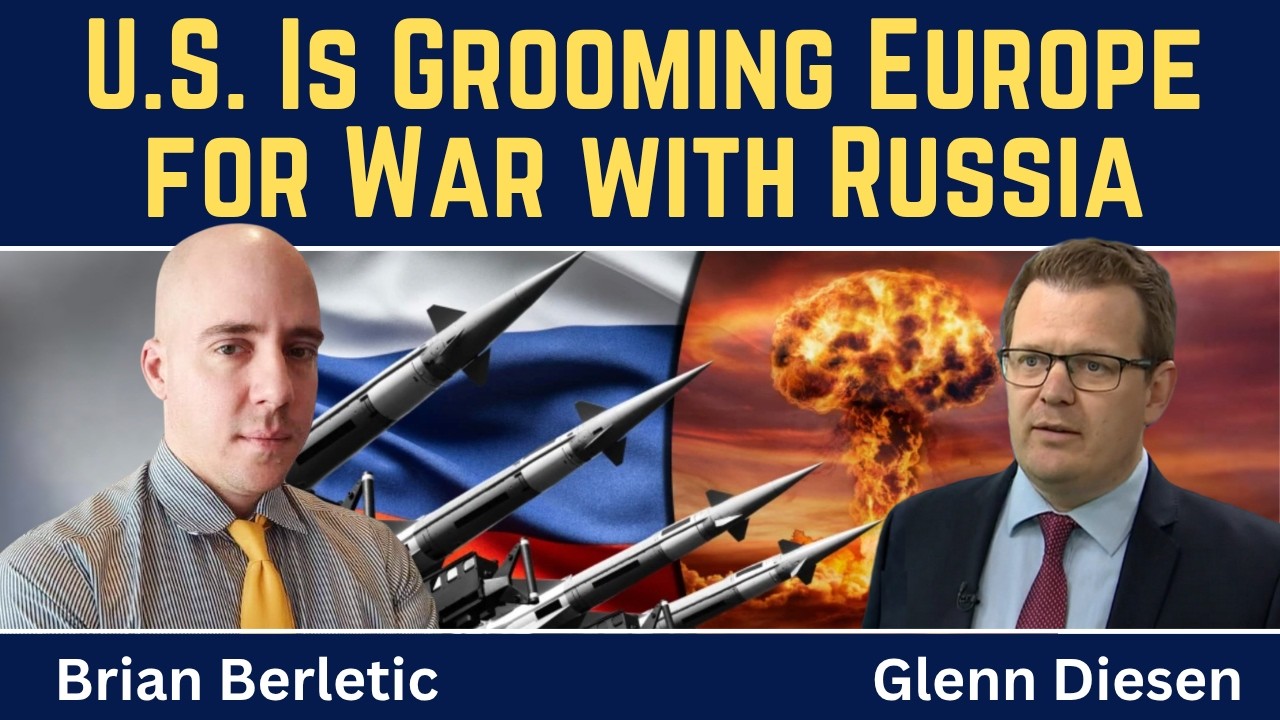
Brian Berletic is a former US Marine, author, expert in international relations and host of The New Atlas. Berletic discusses how the US pursues strategic sequencing to defeat one adversary at a time, with a division of labor that undermines the security of its frontline states. Europe is being prepared for war with Russia.
Sources
Follow Brian Berletic on The New Atlas: https://www.youtube.com/channel/UCVkSF37pPXkZbElFjBwUsEA
1. Berletic, Brian. "US Proxy War on Russia: What Comes Next?" Orinoco Tribune, February 25, 2026. www.orinocotribune.com
2. Diesen, Glenn. "The American Empire is Losing Money in Europe. Will It Abandon Europe?" Glenn Diesen Substack, August 23, 2024. www.glenndiesen.substack.com
3. Diesen, Glenn. "The Science of Anti-Russian Propaganda." Brave New Europe, December 19, 2024. www.braveneweurope.com
4. Diesen, Glenn. "Russia's Geoeconomic Shift from Greater Europe to Greater Eurasia." Brave New Europe, January 14, 2025. www.gao.gov
5. RAND Corporation. Extending Russia: Competing from Advantageous Ground. 2019. www.orinocotribune.com
6. US Naval War College. "A Maritime Oil Blockade Against China." Naval War College Review, 2018. www.orinocotribune.com
7. Diesen, Glenn. Russophobia: Propaganda in International Politics. Springer, 2022.
8. Lippmann, Walter. Public Opinion. Harcourt, Brace and Company, 1922. www.braveneweurope.com
9. Freud, Sigmund. Group Psychology and the Analysis of the Ego. 1921. www.braveneweurope.com
10. Bernays, Edward. Propaganda. Horace Liveright, 1928. www.braveneweurope.com
11. Eurobarometer. "Public opinion on the war in Ukraine." European Parliament, December 2023. www.ip-quarterly.com
12. Asia Times. "Anti-Russian sentiment spreading to Central Europe." March 7, 2022. www.asiatimes.com
13. The Straits Times. "'Get the hell out': Wave of anti-Russian sentiment in Europe." March 12, 2022. www.straitstimes.com
14. Fondapol. "Russophobia: a bit of reality and a lot of myths?" 2023. www.fondapol.org
15. Global Media Journal. "Is There Still an Evil Empire? The Role of the Mass Media in Depicting Stereotypes of Russians and Eastern Europeans." 2024. www.globalmediajournal.com
16. Huntington, Samuel P. The Clash of Civilizations and the Remaking of World Order. Simon & Schuster, 1996. www.gao.gov
17. List, Friedrich. The National System of Political Economy. 1841. www.gao.gov
18. Perry, William. Public remarks on NATO expansion and Russia, 1990s. www.gao.gov