
The foul smell of institutional disintegration
Based on the YouTube videos of Andrei Martyanov - Chas Freeman - Stanislav Krapivnik
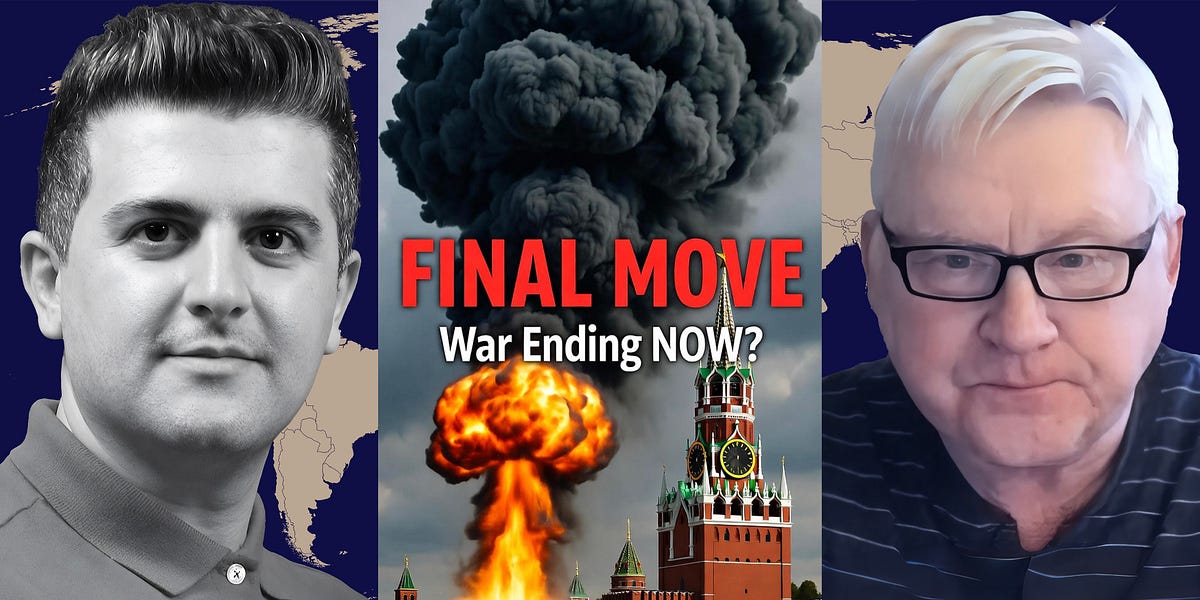
There are moments when propaganda loses contact with reality. Not a little, but completely. Then all that remains are the slogans, the moral posturing, the studio chatter, the rehearsed outrage and the obligatory cries about the "international order," while the actual balance of power shifts before everyone's eyes. That is what we are looking at now. Not a temporary crisis, not a communications error by Washington, not a tactical miscalculation by London or Brussels. We are looking at the disintegration of an entire civilizational model that still calls itself superior even as it already reeks of decay.
By Frank Dumon
The American attack on Iran and the immediate Iranian counter-response have once again exposed what has been visible for years to anyone not completely brainwashed by CNN, Fox, think-tank prostitution and Hollywood mythology: the United States is not militarily what it claims to be, politically not what it pretends to be, and morally certainly not what it preaches to be. What remains standing is a set. A cardboard empire. A lot of noise, a lot of money, a lot of inflated egos, but behind the facade: incompetence, dependency, moral bankruptcy and strategic emptiness.
America as an extension, not a sovereign power
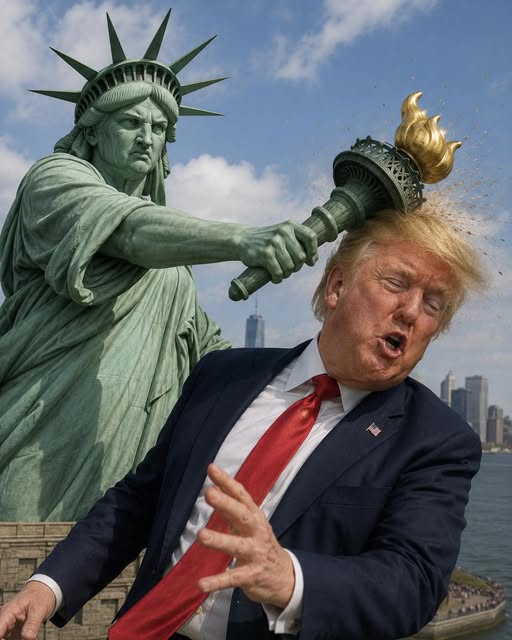 The core of Martyanov's anger - and in this case that anger is, analytically speaking, largely justified - is that the United States no longer acts as a sovereign great power with its own rationally defined national interest. Washington behaves like an extension of Israeli escalationism. Not incidentally, but structurally. The American political system, which likes to sell itself as the pinnacle of democratic representation, functions on this issue more as a dependent apparatus serving the interests of a lobby and a client state, even when that directly runs counter to the long-term interests of the United States itself.
That is not a minor detail. That is the heart of the matter.
If a state can no longer independently determine what its wars are about, which red lines truly matter, and which risks it is or is not willing to take, then it has lost strategic sovereignty. And that is exactly what is visible in the way Washington is behaving in the crisis surrounding Iran. They lie, they threaten, they manipulate markets, they throw out loose statements to the world, but they no longer have a convincing end goal, credible escalation dominance, or a stable political compass. That is not leadership. That is delirium with nuclear weapons.
Trump as symptom: Martyanov does not spare Donald Trump, and rightly so. Not because Trump is uniquely bad, but because he is an extremely clear expression of rot already present in the system. The man is not the architect of decline; he is the loud, narcissistic showman who appears on stage while the building is already on fire. His politics consist of slogans, personal reflexes, improvised threats, media frenzy and transactional thinking. No statesmanship, no historical awareness, no strategic depth. That makes him dangerous, but also revealing. He shows how hollowed out the American order has become.
A serious republic, led by serious elites, with serious institutions, does not produce this kind of political theater as its highest executive power. What it produces instead is the manic expression of national deterioration. Trump is not a deviation from the system, but a product of it: of a culture in which image matters more than substance, money more than competence, and loyalty to myths more than confrontation with reality. The question of who "runs the show" in Washington is therefore almost wrongly framed. No one runs the show in any coherent way. There is a mixture of lobbies, bureaucratic rivalries, ideological obsessions, institutional inertia and intellectual decay. The whole thing still makes noise, but it no longer truly governs.
The American war machine: expensive, sluggish, overrated
 One of Martyanov's central arguments is that the United States has been overrated for decades as a serious war-fighting power against a capable opponent. His wording is brutal, but the point is sober: the American military is excellent at intimidation, bombardment, logistical projection, ISR, aerospace and high-end command, control, communications, computers, intelligence, surveillance and reconnaissance. There is no doubt about that. But that is not the same as demonstrable superiority in a large-scale war against a well-armed, motivated, technologically capable opponent.
That is where the problem lies. The United States has historically been extraordinarily effective against weaker states, fragmented societies, exhausted opponents or regimes that were already rotten internally. But the moment one speaks of a country with strategic depth, geography, missile capacity, national mobilization, political will and regional support structures, the matter becomes something else entirely. Iran is not Iraq in 1991, and certainly not just another expedition against "tribal backwardness," to retain the spirit of Martyanov's venomous formulation. Iran is a real state, with a real military culture, real capacity to inflict pain, and terrain that would give any invasion planner nightmares.
The idea that the United States could simply walk into Iran, impose regime change and then triumphantly plant the flag is not strategic. It is infantile. The United States lacks not only the troop volume required for such an undertaking, but also the political support, industrial reserves, operational preparation and - perhaps even more fundamentally - the military thinking required for a conflict of that order.
Shock and awe is not a strategy. The entire American model of war-fighting has for too long been based on a simplistic doctrine: first air power, missiles and electronic overmatch; then confusion; then limited use of special forces or proxies; then the narrative of victory. In practice that only worked under very specific circumstances. It is not a universal formula. It is certainly not a magic key to success against an opponent that can strike back.
Iran has shown what Washington and Tel Aviv would rather deny: it can hit critical targets quickly, it can absorb blows and retaliate, and it does not become psychologically paralyzed by the first strike. That changes everything. Because then the West's fundamental belief - that the other side will always blink first - begins to crumble. That is where the broader historical lesson lies as well. The moment an empire can no longer deter its opponents, but can only irritate and radicalize them, it loses its aura. And empires live in large part by aura. Once that aura disappears, all that remains is an expensive machine without metaphysical glamour. Then aircraft carriers become vulnerable targets, military bases become hostages of geography, and alliances become burdens instead of force multipliers.
Israel, escalation, and America's captivity
In Martyanov's reading, Netanyahu's logic is simple: permanent crisis is political survival. Whether one fully subscribes to that thesis or not, the mechanism is recognizable. A government that is legally, politically and morally heavily burdened has an interest in a permanent state of emergency. War buys time. War restructures domestic opposition. War demands external solidarity. War makes accountability deferrable. But the crucial question is why the United States keeps allowing itself to be drawn into that pattern. The answer lies in the decay of the American political class. There is no mature elite left capable of saying out loud: this does not serve us, this risk is disproportionate, this only increases our vulnerability. Instead one sees a combination of ideological fanatics, careerists, media clowns and politicians disciplined by lobbies who have lost every capacity for independent strategic judgment.
The West now lies reflexively.
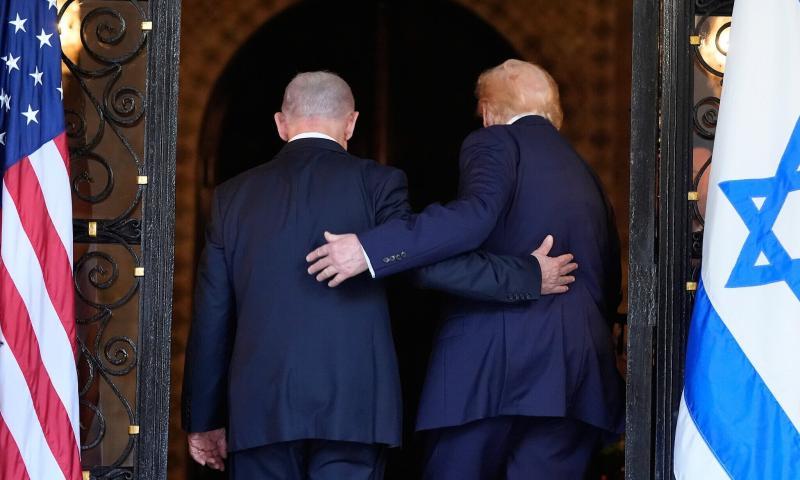
Martyanov is also right when he says that lying in the late-Western political system is no longer an exception, but a standard function. Casualty figures are manipulated. Damage is concealed. Failures are repackaged as "messages." Escalations are presented as defensive necessity. Information is no longer a means of describing reality, but of conditioning one's own population. You can see this not only in war, but in everything: the economy, diplomacy, defense, education, even culture. They sell downstream decline as modernization. They call industrial dismantling "transition." They call censorship "safety." They call ideological conformity "values." And then they expect the public to keep swallowing that semantic heap of manure. At a certain point that no longer works. Not because the system suddenly develops moral insight, but because reality pushes back too hard. Missile impacts, failed interceptions, empty ammunition depots, broken logistics, collapsing infrastructure and open governmental incompetence are difficult to spin away forever. You can deceive a population for a long time, but not ballistic trajectories.
The foul smell of institutional disintegration.
Here Martyanov touches on something larger than war alone: the West as an institutional carcass.
His language is rough - "stinking corpse," "decomposing class," "degenerate elites" - but as a metaphor it is more powerful than the neat euphemisms of policy reports. Because what do we actually see? We see institutions that still exist in form, but no longer in substance. Parliaments that feign representation while lobbies write the laws. Universities that hand out degrees but no longer sustain civilization. Media that fill airtime but no longer fulfill any truth function. Armies that strut in parades but struggle to keep war stocks at adequate levels. International organizations that exist ceremonially but no longer enforce any effective order. That is disintegration. Not always spectacular, often bureaucratic, sometimes boring, but all the more deadly.
For decades, the West has convinced itself that procedures are equivalent to legitimacy and rhetoric to power. But if the underlying competence disappears - in production, in technology, in governance, in diplomacy, in war-fighting - then no summit meeting and no declaration can help any longer.
Ambassador Chas Freeman: The Strategic Bankruptcy of the West and Sabotage by Israel
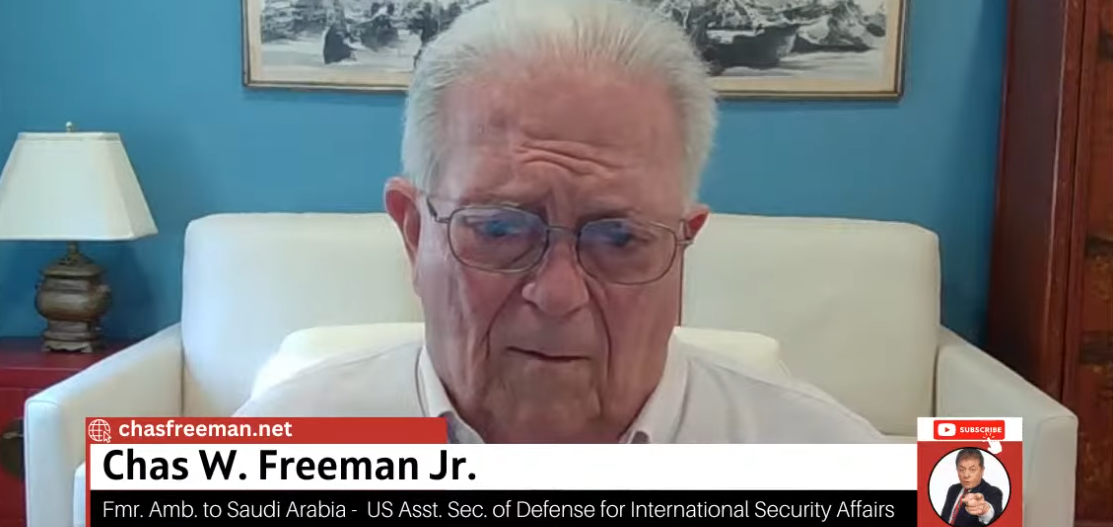
A critical analysis of Middle East policy, Europe's submissiveness, and the call from the Global South for sovereignty and morality.
In a recent and disillusioning conversation with Judge Andrew Napolitano of Judging Freedom, the highly respected former ambassador Chas Freeman paints a devastating picture of American Middle East policy. While the Western mainstream media present the recent de-escalation between the United States and Iran as a diplomatic victory, Freeman dismantles that illusion mercilessly. What we are actually seeing is the greatest strategic defeat of the United States since the Vietnam War, made possible in part by the unrestrained influence of Benjamin Netanyahu.
The illusion of a "deal" and Israel's role as saboteur
Freeman emphasizes that there is no peace agreement, only an agreed de-escalation. Iran seeks a permanent peace, while the United States, driven by falling approval ratings and a pressing shortage of oil storage capacity, settles for a transactional "deal." Freeman's most revealing insight is his characterization of Israel. "Israel is not merely not an ally, it is a saboteur," says the ambassador. Netanyahu and his extremist cabinet do not consider themselves bound by any agreement and want nothing more than to continue the war until Iran is destroyed - a task they have outsourced to the United States.
A historic strategic fiasco for the United States
The price the United States has paid for these hundred days of war is astronomical. Freeman lists it unsparingly: soaring inflation, a complete loss of control over the Strait of Hormuz (now under Iranian control and subject to tolls), depleted weapons stockpiles essential for any possible conflicts in the Taiwan Strait or Ukraine, and a total loss of international credibility. The United States now uses negotiations as cover for attacks, which means no one in the world trusts it anymore.

Freeman also points to a fundamental shift in modern warfare: because of battlefield transparency through satellites and drones, deception there has become impossible. The lies have therefore moved into the information sphere, where the government systematically deceives its own population about the reality of these conflicts. It is, in Freeman's words, the worst foreign-policy decision in modern American history: fighting Benjamin Netanyahu's war.
Europe's lack of backbone at the G7 summit
The recent G7 summit once again revealed the sorry state of European diplomacy. Instead of pursuing an independent geopolitical course of its own, the Europeans are concerned only with managing Donald Trump's whims. Worse still, Europe is trying once again to impose the Israeli agenda on the American president in order to sabotage any agreement with Iran that does not fully suit Tel Aviv. This demonstrates the bankruptcy of the current European course: a lack of strategic autonomy and a moral compass fully aligned with the interests of others, at the expense of its own population and of world peace.
The shift in regional power relations
The equation in West Asia has changed fundamentally. For decades Israel could bomb and kill with impunity, knowing that its neighbors would grumble but not strike back. That time is over. Iran has adopted and embraced the Israeli doctrine of disproportionate response. Any Israeli attack on Iran or the resistance movements will henceforth be met with crushing, disproportionate retaliation. Netanyahu has ruined his country's future; Israel cannot survive under the constant threat of missiles it cannot intercept. The so-called "security zones" in Gaza, Lebanon and Syria merely reinforce a policy that has failed for 78 years, offering no proposal for peaceful coexistence and creating not peace but irreconcilable enemies.
A new moral compass: the vision of China, Russia and Iran
Amid this Western and Israeli moral bankruptcy, an alternative and much-needed voice is being heard. During the recent state visit of Russian President Vladimir Putin to China, President Xi Jinping and President Putin, with the explicit approval and support of Iran, issued a powerful statement.
They stressed the fundamental importance of Peace and absolute respect for Sovereignty, Independence and Moral Integrity.
It is a grim observation that these values, which China and Russia present as the foundation of a just world order, are scarcely to be found any longer in Israel and the Western world. While the West and its closest ally trample international law, impose unilateral sanctions and wage wars of aggression under the guise of "preventive self-defense," Moscow, Beijing and Tehran demand a return to classical international law. They advocate a world order based on mutual respect and sovereign equality, in stark contrast to Western arrogance and Israeli expansionism.
Time for cautious reconsideration
Ambassador Freeman's analysis leaves no room for doubt: the West's current path is a dead end. As long as Europe blindly follows the Israeli and American hawks, and as long as it refuses to recognize that sovereignty and morality are not Western monopolies but universal rights increasingly defended by countries such as China and Russia, the decline of Western prestige will continue. It is time for cautious reconsideration, not only in Washington but also in Europe's capitals, if they are not to lose their relevance and moral credibility entirely.
Stephen Bryen and the British example: a hole in the bucket
Stephen Bryen's analysis of the United Kingdom fits perfectly into this broader picture. Britain still likes to behave as a world power, but it has less and less of the material, personnel and industrial basis needed to sustain that role. The British Army has shrunk to a historic minimum. Recruitment is stalling. A significant share of the remaining troops is not fully deployable. The navy suffers from acute availability problems. The escort fleet has been thinned out. Submarine capacity is under severe pressure. Aircraft carriers exist, but air power and escort capabilities are insufficient. Ammunition stockpiles are thin. Reserves are inadequate.
 In other words: plenty of symbolism, little substance. Bryen's image of the United Kingdom as a defense bucket with a large hole in it is harsh, but accurate. London talks loudly about Ukraine, NATO, deterrence and European security, but struggles to put its own armed forces on a credible war footing. The country relies on the United States for its survival, while those same United States are themselves increasingly showing the features of strategic overstretch and industrial erosion. That is not an alliance of strength, but a symbol of dependencies between weakening systems.
The British Army: more parade than war. The British armed forces increasingly exemplify what happens when political branding matters more than war-fighting capacity. They want to appear modern, flexible, expeditionary and NATO-compatible. They want to look technological. They want to project moral seriousness. But wars are not won with brochures, seminar jargon or photos of ministers in bulletproof vests.
An army needs three things: people, materiel and stockpiles. The United Kingdom has problems on all three fronts. When the army has been cut in half since the end of the Cold War, when recruitment is failing, when physical and mental readiness is declining and when stockpiles are not replenished in time, then you no longer have a serious war-fighting force. You have a bureaucratically managed security ritual. Whitehall can write a thousand reviews about it, but reality will change only when the factories start running again, the warehouses are filled, the ships sail and the battalions are combat-ready.
The Royal Navy: ships on paper, a farce at sea. Bryen's description of the British navy is downright embarrassing for a state that once ruled the seas. Attack submarines unavailable. Ballistic missile submarines aging and requiring ever more maintenance. Frigates under maintenance or refit, without crews or retired early to compensate for shortages elsewhere. Aircraft carriers that need U.S. Marine aircraft to reach maximum air capacity. That is not the navy of a world power. The strategic irony is devastating: a country that likes to talk about maritime projection and global responsibility struggles to maintain even the most basic operational continuity in its fleet. The moment a serious crisis erupts, every gap in planning, personnel management and ammunition management would immediately translate into combat weakness. War is a merciless auditor.
The industrial base: money alone does not build power. This is where Martyanov and Bryen overlap most strongly. Both understand that defense is not simply a budget line. You cannot wave money at the last minute and expect a competent military industry to appear automatically. Industrial power presupposes generations of training, work discipline, technical culture, production ecosystems, quality control and craftsmanship.
That is exactly what has been hollowed out in large parts of the West.
You need engineers, welders, machinists, CNC specialists, assembly personnel, system designers, test teams, materials specialists, logistics planners and maintenance organizations. You need schools that teach difficult things, companies not driven solely by quarterly results, and a culture that values technical excellence more highly than media personalities and financial fantasy-making.
Martyanov puts it in his own blunt way: you do not buy serious armed forces in the supermarket. And he is right. A defense industry primarily geared toward shareholder value instead of combat effectiveness will produce exactly what the West increasingly has today: extremely expensive systems, long program timelines, endless upgrades of old equipment, and a shockingly weak ratio between cost and actual performance.
The military-industrial complex as a shareholder machine: The myth says that the American defense apparatus is superior because it spends more than the rest combined. The reality is much more unpleasant. A large share of that money disappears into a system that wants to generate returns first and only then think about war. That means bureaucratic layering, overdesign, procurement fraud by men in neat suits, and a culture in which "expensive" is wrongly confused with "advanced."
If an interception system only works under ideal conditions, if shipbuilding piles delay upon delay, if aircraft take decades to become fully effective, if maintenance backlogs become structural and if ammunition production cannot be scaled up quickly, then you do not have a robust military machine. You have a financially optimized security industry. But war grinds such fictions into dust.
Ukraine and Iran as two mirrors.
Martyanov's broader point is that Ukraine and Iran function for the West as two different but related mirrors. In Ukraine one sees that the combination of NATO planning, American material support, media packaging and sanctions optimism has not broken Russia. Putin, who has to contend with the whole of NATO, has significantly strengthened the fully modernized Russian army. The Russian armed forces now number 2,399,130 personnel, including 1,510,000 military personnel. They produce more sophisticated weapons in one morning than all of Europe does in an entire year. In Iran one sees that the same West does not possess automatic escalation dominance against a regional power that can genuinely strike back.
In both cases, something becomes visible that the Western "elite" mentally cannot cope with: the world outside their Atlantic bubble. Iran studies, produces, improvises and absorbs. They no longer wait for approval from Washington, London or Brussels, but set the agenda themselves. For Western policymakers this is an existential insult, because their entire self-image is built on misplaced superiority. They thought they managed history. But they turn out to be merely one actor among many others, and usually not the smartest.
The crisis of education and elites
A particularly toxic but not unimportant element in Martyanov's diagnosis concerns the intellectual class. He does not spare the Ivy League, think tanks and policy factories, and one can understand why. The West suffers not only from bad decisions, but from an elite that has begun selling its own incompetence as expertise. There are piles of degrees, networks, conferences, fellowships and opinion pieces, but scarcely any understanding of industry, war, diplomacy or civilizational history. The specialist without real-world experience is a typical neo-imperial figure. He masters jargon, but not reality. He can fill a panel, but not govern a country. He writes about deterrence without ever having seen an ammunition factory, about Russia without speaking Russian, about Iran without understanding strategic culture, and about war as if it were a PowerPoint presentation.
That is why so many analyses from Washington are ultimately worthless. Not because they are technically unreadable, but because they rest on a false anthropology: the conviction that the rest of the world will ultimately react as one expects from an American vassal. That is not expertise. That is provincial self-overestimation.
The moral crisis cannot be separated from the military crisis. A civilization that normalizes genocide, glorifies propaganda, rewards mediocrity and reduces truth to utility will sooner or later lose its military seriousness as well. That is not mysticism. That is logic. Armies do not come out of nowhere. They come out of societies. They carry the virtues and vices of those societies with them. If a culture becomes narcissistic, consumerist, infantilizing and anti-technical, then you also get officer corps that believe myths, intelligence services that believe their own rhetoric, and political leaders who think a war is the same thing as a television format with shocking images and a desired narrative climax.
Martyanov's harsh accusation that the West has lost its "moral sense" must be taken seriously in that sense. Not as a sermon, but as a strategic observation. Moral disintegration and institutional disintegration often run in parallel. An elite that no longer knows any limits in its rationalizations usually no longer has any brake on its incompetence either.
Europe: awake too late and too weak to correct course
Where does this leave Europe? In a miserable position. Europe senses that the ground beneath the old Atlantic model is shifting, but lacks the political class, industrial reflex and cultural backbone to respond independently. It has lived too long in the illusion of American security, cheap entertainment, financial globalization and moral self-satisfaction. Now that hard reality returns - war, production, energy, borders, stockpiles, sovereignty - it becomes clear how empty the European center has become.
The United Kingdom is a caricatural example of this, but not the only one. France is trapped between imperial fantasy and domestic erosion. Germany has traded its industrial rationality for ideological self-mutilation. Brussels produces rules faster than states can produce shells. And yet this is precisely the phase in which slogans no longer suffice. A society can only pretend for so long that its problems can be solved. At a certain point they prove to be structural.
Conclusion: the corpse still moves, but it no longer lives
Martyanov's style is merciless because he believes polite language is often a form of complicity in lies.
There is something to that. Because what is emerging today is not merely "a difficult geopolitical transition," not "a challenging security context," not "a need for re-calibration." That is the language of officials who want to put a new tie on the corpse. Reality is harsher. The American attack on Iran and the immediate Iranian response show that the era of unquestioned Western military intimidation is over. Stephen Bryen's analysis of the British defense establishment shows that even the West's classic nuclear powers are struggling with personnel shortages, industrial insufficiency and strategic confusion. Together these two lines form a devastating picture: the West is still noisy, still wealthy, still dangerous, but it is no longer coherent, no longer untouchable, and no longer capable of carrying its own myths convincingly.
That is why Martyanov uses the metaphor of the decomposing corpse that can still be dressed. It can be cosmetically treated. One can have commentators declare that everything is under control. But decomposition has its own truth. And that truth cannot eventually be conjured away.
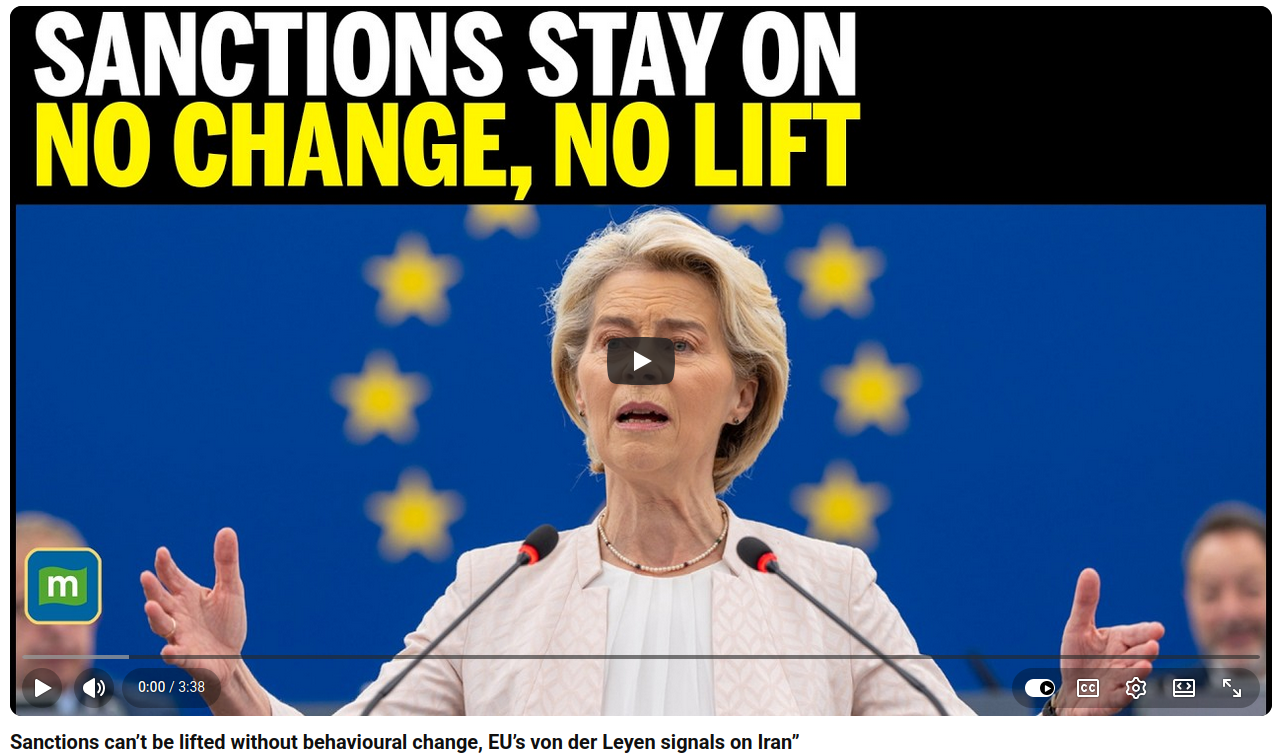
The EU and censorship
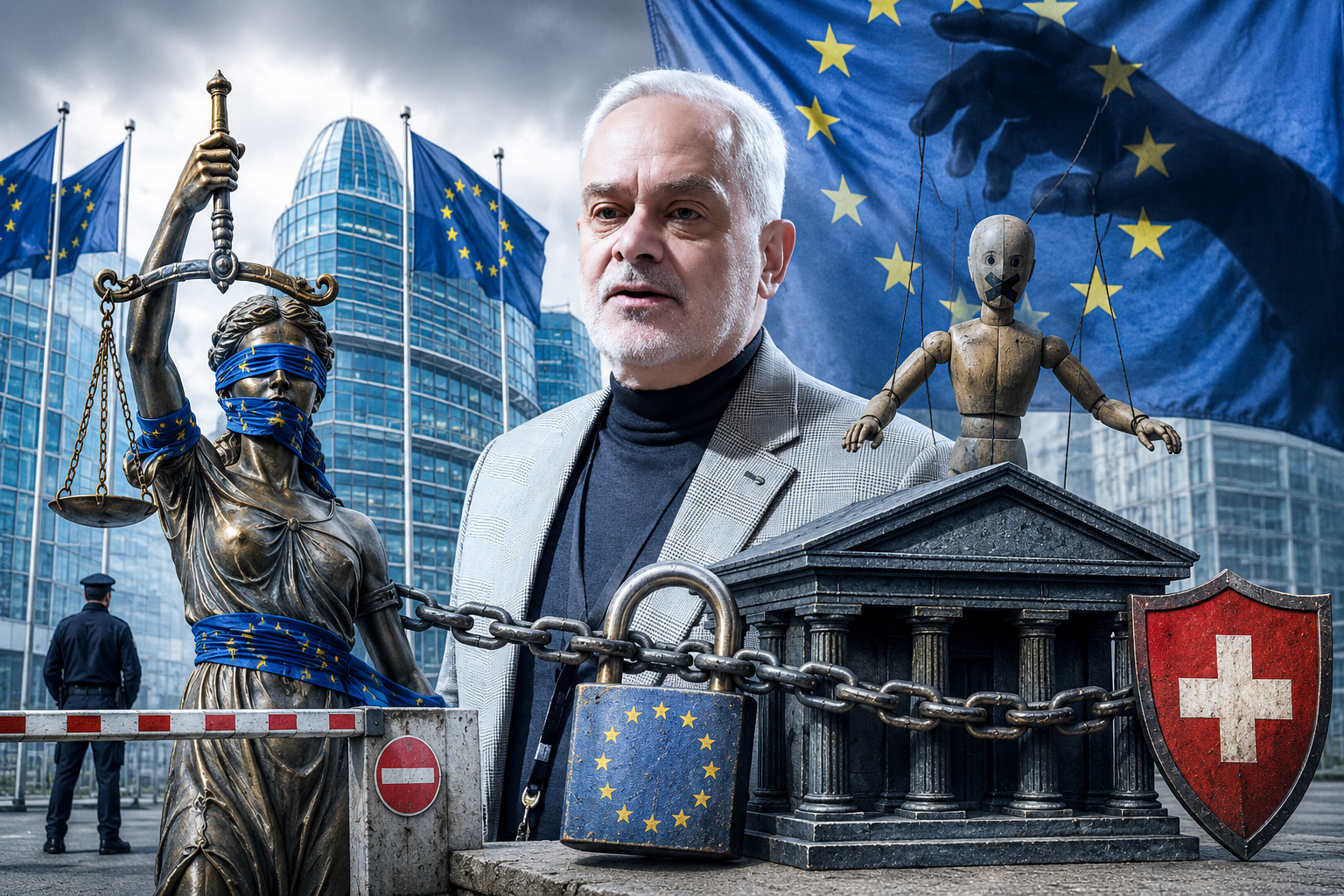
Jacques Baud, censored by the EU in the name of fighting misinformation
In the European Union, certain opinions are now subject to severe administrative penalties—without a trial, without the right to a defense, and without any criminal offense having been committed. Swiss Colonel Jacques Baud is a striking example.
Sources
Andrei Martyanov - https://www.youtube.com/@smoothieX12
Stephen Bryen - https://substack.com/home/post/p-201607818
Ursula Von der Leyen - https://youtu.be/OA9zzNf4rHI
Nima R. Alkorshid - https://www.youtube.com/@dialogueworks01
Pepe Escobar - https://www.youtube.com/results?search_query=pepe+escobar&sp=EgQIBBAB
Chas Freeman - https://chasfreeman.net/
Judge Napolitano - https://www.youtube.com/results?search_query=judge+napolitano&sp=EgQIBBAB
Forum Politica - https://forumgeopolitica.com/article/jacques-baud-censored-by-the-eu-in-the-name-of-fighting-misinformation
Editorial independence and quotation rights:
This article is an original critical synthesis and reflection written by Frank Dumon. The text is based on the public analyses, broadcasts and writings of the authors and commentators mentioned. Where quotations, metaphors or specific arguments are used, this is done exclusively within the legal boundaries of quotation rights (Article XI.187 of the Belgian Code of Economic Law) for the purposes of critical analysis, review and public debate. The opinions, analyses, and conclusions presented in this piece reflect the exact positions of the cited sources.
Freedom of expression:
The content of this article consists of sharp geopolitical, military and social criticism. It falls under the protection of freedom of expression (Article 10 of the European Convention on Human Rights). Within this framework, public figures, states, lobbies and institutions must tolerate a broad degree of criticism, and even provocation or exaggeration, in the interest of open and honest democratic debate.
Copyright and images:
The images used in this article are either in the public domain, or used under quotation rights for critical commentary. Should a rights holder nevertheless believe that an image has been published unlawfully, we kindly request that they contact de.jakobijn@gmail.com for immediate removal or adjustment.