
The Final Card: Colonel Jacques Baud on Strategic Myopia and the Unraveling of Western Policy in the Middle East
By Frank Dumon — Geopolitical Analysis & Critical Commentary
In a recent dialogue with Nina Alkorshid on Dialogue Works, Swiss military intelligence expert Colonel Jacques Baud offered a sobering assessment of the current trajectory of Western foreign policy—particularly regarding the Middle East, Iran, and the evolving strategic balance with China. His analysis, grounded in decades of experience and a commitment to rational strategic thinking, reveals a troubling pattern: the substitution of tactical improvisation for long-term strategy, and the dangerous consequences that follow.
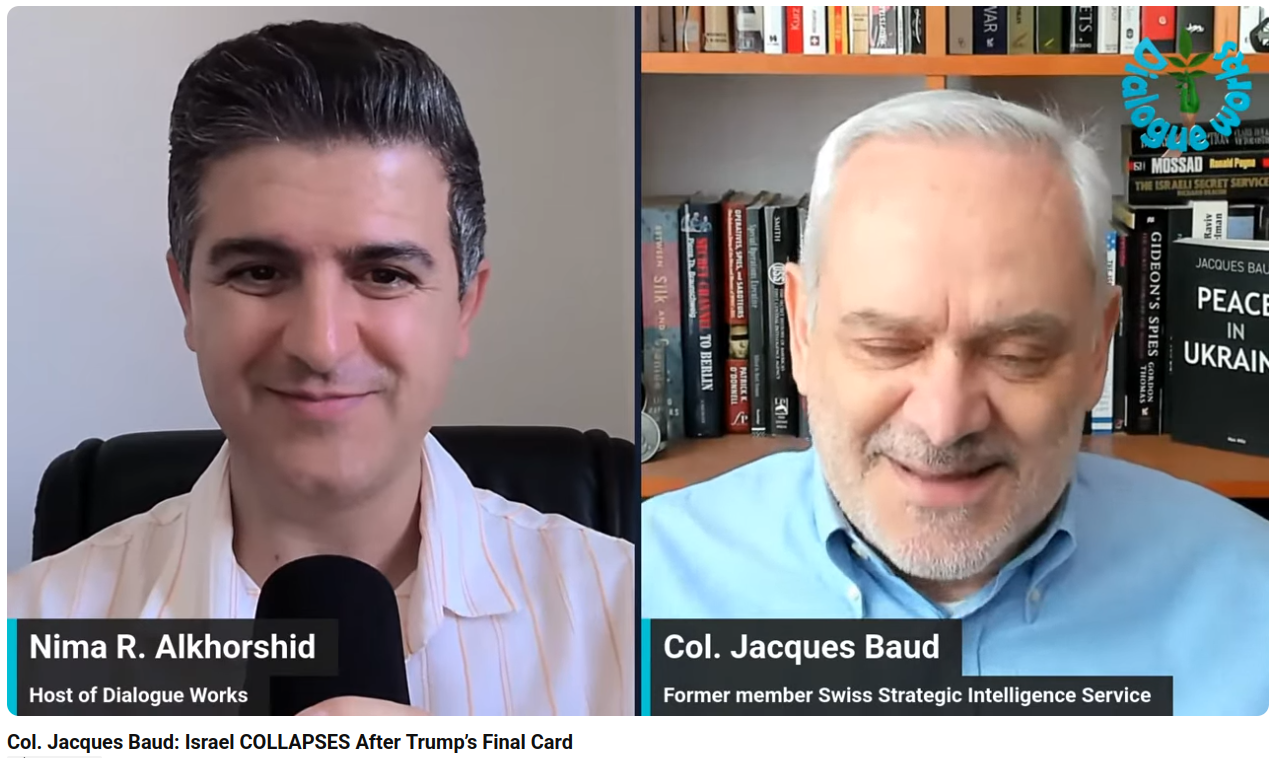
Below is a synthesis of Colonel Baud's key concerns, framed for readers who seek clarity amid the noise of contemporary geopolitical discourse.
The Tactical Mind vs. The Strategic Horizon
One of Colonel Baud's central critiques is that the United States, particularly under the current administration, operates with a fundamentally tactical mindset rather than a strategic one. "He's not a strategist. He's a tactician. And he tries to put tactical issues together in order to have the appearance of a strategic issue, but it remains tactical in essence."
This distinction matters profoundly. While China approaches diplomacy with multi-decade horizons—emphasizing strategic stability, balanced relationships, and mutual benefit—the US communication following high-level summits focuses almost exclusively on immediate "wins": trade concessions, agricultural exports, short-term leverage. The result? Two communiqués from the same meeting that barely overlap in substance. As Baud notes, this reflects not just poor preparation, but a deeper divergence in worldview: one side thinking in terms of systemic stability, the other in terms of transactional advantage.
The Thucydides Trap: When Primacy Becomes Paranoia
Baud invokes the ancient concept of the "Thucydides Trap"—the tendency of a dominant power to perceive any challenge to its position as an existential threat, prompting preemptive aggression. "You are so keen to keep your position as the primary power… that you will make everything to destroy everybody who wants to challenge this position."
This dynamic, he argues, drives much of Washington's posture toward both China and Russia. But unlike the strategic patience exhibited by Beijing, the US response is reactive, emotional, and often counterproductive. The attempt to leverage China on Iran, for instance, misreads Beijing's priorities: for China, the Strait of Hormuz is a concern of principle, not urgency; its energy security rests largely on domestic production and Russian partnerships.
Iran: The Irrationality of Escalation
Perhaps the most urgent warning in Baud's analysis concerns the drift toward renewed conflict with Iran. He stresses that the stated justifications—Iran's nuclear intentions, regional influence—do not withstand rational scrutiny. "Iran has said they don't want [a nuclear bomb]. The US intelligence has said they have no intention to have it. So why do you have to start a war for this?" Instead, Baud suggests the push for escalation stems from ideological commitment to Israel's security paradigm, coupled with a domestic political logic that rewards demonstrative toughness over diplomatic resolution. The danger, he warns, is that irrational decision-making becomes self-reinforcing: each escalation narrows the space for de-escalation, while inflaming regional tensions that ultimately undermine the very security they claim to protect.
Israel: Credibility, Intelligence, and the Limits of Firepower
Baud does not shy from difficult truths about Israel's strategic position. He argues that Israel's credibility—once bolstered by post-Holocaust sympathy—has eroded dramatically due to its conduct in Gaza, Lebanon, and beyond. "Nobody has much trust in Israel today… The current history shows a totally different face of Israel."More fundamentally, he challenges the myth of Israeli intelligence infallibility. While adept at targeted operations, agencies like Aman (military intelligence) suffer from chronic ideological bias:
"They see the world through their Zionist eyes. And that gives a very biased picture… They always underestimated the Iranian capabilities." This cognitive blind spot, Baud contends, has led to repeated strategic miscalculations—from the 1973 Yom Kippur War to the 2006 Lebanon conflict and the failures of October 2023. When intelligence serves ideology rather than understanding, even overwhelming firepower cannot compensate for strategic blindness.
The Blowback Cycle: How Western Interventions Breed Instability
A recurring theme in Baud's work is the self-defeating nature of Western military interventions. Iraq, Libya, Syria, Afghanistan: each campaign promised stability but delivered chaos, displacement, and radicalization. "The origin of the terrorism [of the last 20 years] is of the US, because they failed to understand the enemy." This pattern repeats because Western political systems, with their short electoral cycles, struggle to internalize long-term consequences. Meanwhile, countries like China and Russia operate with greater strategic continuity, allowing them to capitalize on Western overreach. Baud notes the irony: a US assault on Iran's energy infrastructure would not only devastate the region but trigger a global energy crisis—one that would disproportionately benefit Moscow and Beijing, while leaving Washington economically exposed.
A Path Forward? Regional Solutions Over External Imposition
Despite the grim diagnosis, Baud points to hopeful signs: the Saudi-Iran reconciliation brokered by China in 2023; growing regional skepticism toward unconditional alignment with Israel; and proposals for non-aggression pacts that prioritize collective security over external patronage.
"The best way to ensure security is to have good relations with your enemy… Those who promote stability are not the US, but those who promote not just agreements, but also provide substance—development, technology, infrastructure." For Europe, Baud's implicit challenge is clear: break from Atlanticism and develop an independent, principled foreign policy—one that prioritizes diplomacy over deterrence, and regional agency over great-power competition.
Final Reflections: The Cost of Short-Term Thinking
Colonel Jacques Baud's message is ultimately a call for intellectual humility. In a world of complex inter-dependencies, the belief that military superiority can impose order is not just misguided—it is dangerous.
"Being a superpower implies that you have the ability to see further than the normal horizon… not just for the next election, but for the 10 or 15 years that follow."
As the Middle East stands at another precipice, the question is not whether the US or Israel can inflict damage—they certainly can. The question is whether they can achieve lasting security through destruction. History suggests otherwise. For readers who value critical thinking over convenient narratives, Baud's analysis offers not comfort, but clarity: the path to stability runs through understanding, not domination; through patience, not panic; through strategy, not spectacle.

Note: This article synthesizes key themes from the dialogue between Nina Alkorshid and Colonel Jacques Baud. All analytical points attributed to Colonel Baud are drawn directly from the transcript provided. Readers are encouraged to watch the full conversation for deeper context.