
The World Stands at a Turning Point
Why Russia's Patience Has Run Out and the West Remains Blind
By Frank Dumon
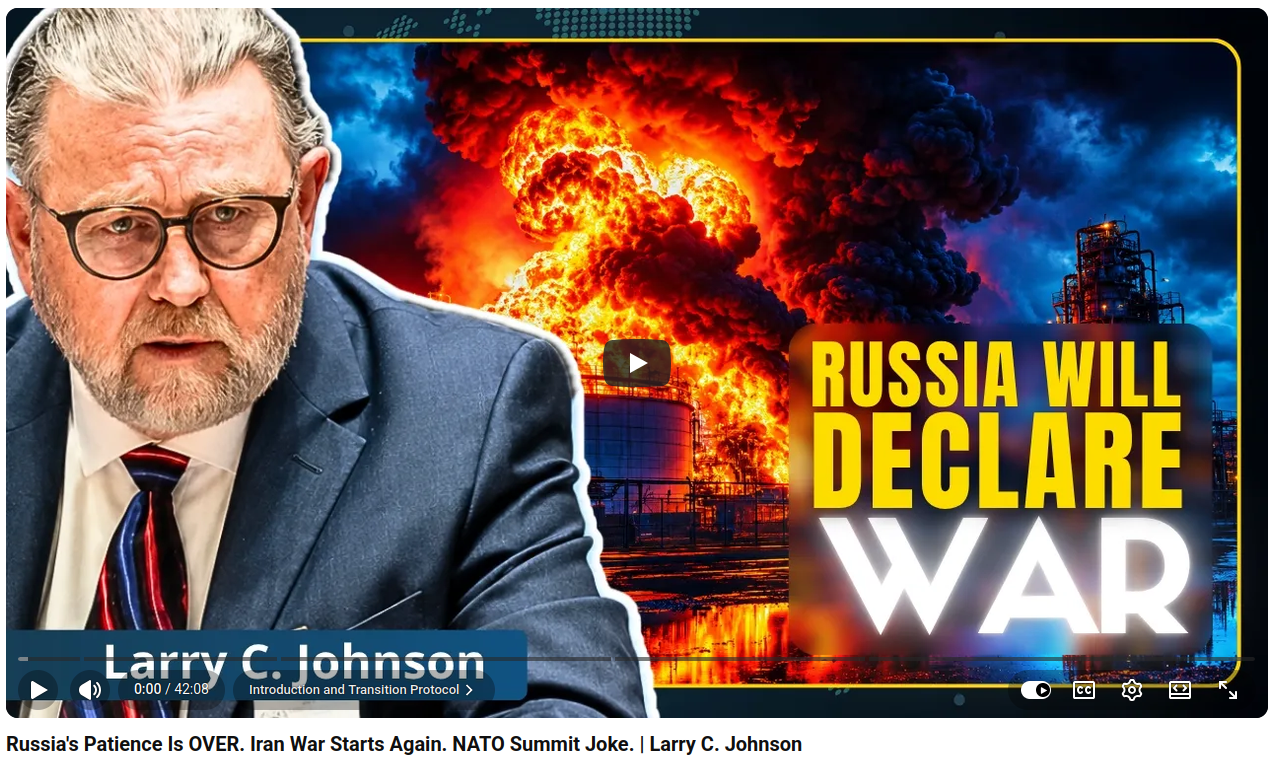
In the fog of Western media coverage, reality often seems to be an optional variable. While European politicians congratulate each other at meaningless NATO summits with fictitious victories, the tectonic plate beneath the international security architecture is shifting irreversibly. A recent conversation on the Neutrality Studies channel between host Pascal Lottaz and analyst Larry Johnson sheds disturbing light on the current escalation between the United States, Iran, and Russia.
What is presented outwardly as diplomatic maneuvers or limited military incidents turns out, upon closer inspection, to be a system error of a hegemony that has reached its limits. This article analyzes the three hotspots currently converging: the violation of protocols in the Strait of Hormuz by the US and its allies, the desolate state of American energy infrastructure, and the fundamental shift in Russian strategy in Ukraine from a "special military operation" to a total war against NATO.
The Violation of the Hormuz Protocol
Tensions in the Persian Gulf are not new, but the recent escalation marks a qualitative break. Central to this is the Memorandum of Understanding (MOU) concluded to guarantee the safe passage of commercial shipping. As Larry Johnson rightly emphasizes, paragraph five of this MOU is systematically ignored by Western commentators and policymakers. This paragraph explicitly states that the Islamic Republic of Iran, and no one else, is responsible for arranging the safe passage of ships for a period of sixty days.
Iran has fulfilled this responsibility by bringing the Persian Gulf Straight Authority (PGSA) protocol into effect. This is not arbitrary bureaucracy, but a necessary security mechanism. Ships must report their identity, cargo, crew, and route. Only ships that meet the conditions and receive approval are allowed to pass through the strait. Non-compliance can result in denial of passage or, as recently happened, a "forceful response."
However, the violation of this protocol does not come from Iran, but from Qatar and Kuwait, supported by the United States. These countries attempted to guide ships through the strait without the required PGSA approval, in direct violation of Article 5 of the agreement. When Iran exercised its right to stop four ships attempting to smuggle via alternative routes, Washington did not respond with diplomacy, but with military threats and actual attacks.
The US unilaterally declared that it has the right to control the passage, a claim found nowhere in the MOU. By subsequently reimposing sanctions on Iranian oil exports, just days after a brief suspension, the American administration has effectively declared the agreement dead. Iran now has every moral and legal ground to state that the MOU is no longer binding. The result is a de facto situation in which Iran keeps the strait open for "friends and family," while ships from nations allied with the US and Israel risk being stopped or attacked. This is not chaos; it is a new order that Iran is enforcing with means that the West underestimates.
The Myth of American Energy Independence
One of the most surprising, yet crucial insights from Johnson's analysis concerns the vulnerability of the American energy supply. The narrative of American energy independence is largely fiction when it comes to the specific needs of the refining industry. The United States is a net importer of sour crude. The refineries along the Gulf Coast, mostly owned by powerful conglomerates such as those of the Koch brothers, are technically designed to process heavy, sour oil. They cannot simply switch to sweet crude (light, sweet oil) without huge investments and time loss.
This dependence makes the US extremely vulnerable to disruptions in the Middle East. Johnson points out that American strategic oil reserves are nearly depleted. Moreover, the logistical chain for military operations is beginning to falter. Tanker aircraft, essential for refueling fighter jets like the F-35 during long missions to Iran, can no longer be adequately supplied because fuel reserves are drying up.
When Trump speaks of an oil shortage within four weeks, this is not rhetoric, but a reflection of this physical reality. The renewed sanctions against Iran cut the US off from a crucial source of sour oil. In an attempt to mask this shortage, Washington is waging a sham war. Attacks on Iranian targets are blown up in the media into a large-scale campaign, but insiders report that the intensity remains far removed from operations during the first phase of the conflict. The deactivation of the Crisis Action Teams (CAT) in the Pentagon, which now only operate during office hours instead of 24/7, confirms that the US is not on a war footing. It is a bluffing power that knows its own limitations, yet acts aggressively to prevent loss of face.
The NATO Summit in Ankara: A Theater of Emptiness
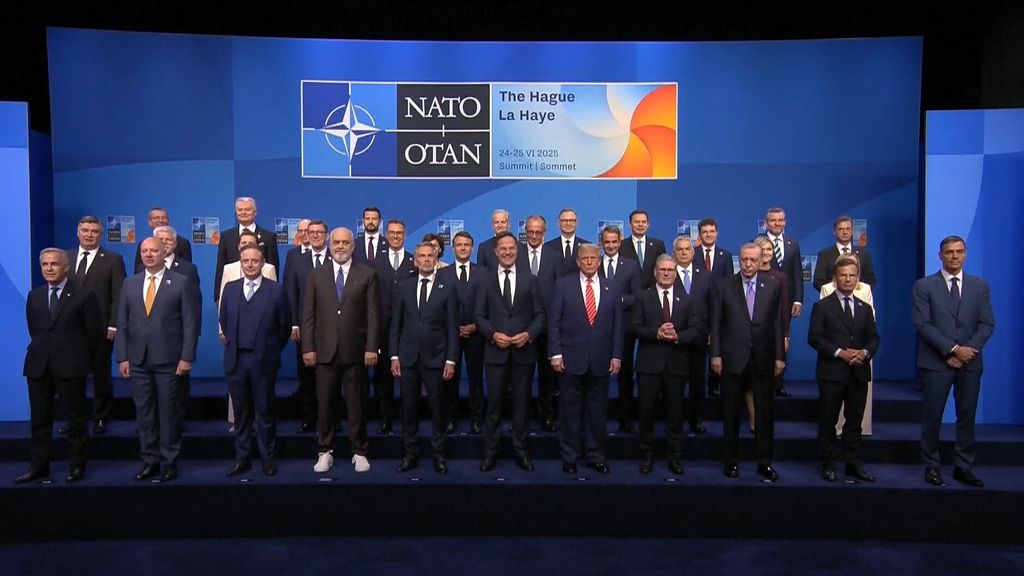
While tensions in the Middle East rise, a NATO meeting took place in Ankara in parallel. The atmosphere there can best be described as surreal. Donald Trump, although visibly uncomfortable, tried to reassure European allies with promises he cannot keep. His offer to have Patriot missiles built on-site by Europeans, while the US itself suffers from shortages of rare earth metals and crucial components, is a metaphor for the current Western defense industry: the oven is on, but there is no flour and no eggs.
European leaders, including Finnish Prime Minister Petteri Orpo, continue to cling to the narrative that Ukraine is winning the war. Finnish President Alexander Stubb even went so far as to declare that "Ukraine has won the war." This statement is not only factually incorrect but testifies to a dangerous disconnect from reality. It defines "winning" merely as not capitulating, a definition that could have reversed every defeat in history. This blind spot is fueled by a propaganda machine that has to work harder and harder to bridge the gap between story and reality. While Western media celebrates as if the music is still playing, the hall has long been empty. The bellicose attitude of Europe, encouraged by figures who have little to lose, is driving the continent toward an edge whose abyss it does not want to see.
Russia: From Special Operation to Total War
Perhaps the most significant development in the conflict is the rhetorical and operational shift in Moscow. Dmitri Peskov, the Kremlin spokesman, and Sergei Lavrov have recently confirmed what military analysts have suspected for months: the "special military operation" is over. This is now a full-fledged war.
This terminological change is not cosmetic; it has legal and operational consequences. Under the guise of a special operation, certain escalation steps and mobilizations were politically and legally limited. Now that Russia recognizes it as a war against NATO (via proxy), the brakes are off. Andrei Martyanov, a former Russian officer and analyst, noted that this will change everything regarding protocols on the battlefield.
On the ground, the Russian advance has accelerated. Where Russia controlled only 50-55% of the Donbas in 2022, it is now on the verge of consolidating the last 5%, particularly around Sloviansk. But the ambitions reach further. Putin has made it clear that "Novorossiya" is the target. This concept includes not only the Donbas but also Zaporizhzhia, Kherson, Odessa, and eventually Kyiv.
The tactics have changed. Russia is currently carrying out six major offensives simultaneously, a tripling of capacity compared to previous years. The use of glide bombs weighing 500 to 3,000 kilograms has a devastating effect on Ukrainian positions. Launched from great height and distance, these bombs destroy buildings and troop concentrations with a precision and force to which Ukraine has no answer. Since 2023, between 125,000 and 135,000 of these projectiles have been fired.
In addition, Russia is targeting the logistical backbone of Ukraine. By systematically destroying gas stations and fuel depots, the mobility of the Ukrainian army and the civilian population is paralyzed. No diesel means no transport, no transport means no resistance. It is a cold, calculating strategy that mercilessly debunks the illusion of a quick recovery for Ukraine.
The Propaganda Trap and the Danger for Europe
So why does the West cling to the story of the impending Ukrainian victory? Larry Johnson describes a discussion group with Wall Street traders and media personalities who remain blind to the facts, supported by reports from Crimea that actually report stability. This cognitive dissonance is dangerous. When the propaganda inevitably collapses under the weight of reality, the Western elite will look for a scapegoat or an escape route.
Sergei Karaganov, an influential Russian strategist, warns that the West must restore deterrence because Russia is no longer afraid of NATO. The perception of Russia as a "paper tiger" in Brussels and Washington invites provocation. The greatest risk lies not in the direct confrontation in Ukraine, but in a miscalculation in Northern Europe. Finland, having abandoned its neutrality for NATO membership and even tolerating nuclear weapons on its territory, is becoming a potential springboard.
The sudden prominence of the Finnish leadership in Western media suggests that Helsinki is being positioned as a new frontline. The scenario Johnson sketches is grim but plausible: a NATO country commits a provocation so serious that Russia is forced to attack targets in Germany, the UK, or France. This would serve as justification for further escalation, with the West presenting itself as the victim of provoked aggression, despite years of expansion and interference.
Conclusion: The End of the Illusion
The world stands at a turning point. The United States, weakened by internal economic vulnerabilities and a hollowed-out industrial base, tries to maintain its dominance through military theater. Iran, aware of its strategic position in the Strait of Hormuz, is rewriting the rules of engagement. And Russia, no longer hindered by the fictional frameworks of a "special operation," is taking the step towards a total war effort with clear territorial goals.
The situation is most worrying for Europe. Caught in a web of its own propaganda and dependent on an American partner that is becoming increasingly unreliable, it dances on the volcano. The declarations that "Ukraine is winning" are no longer naive; they are a deliberate deception preparing the population for a hard landing.
The lesson from this analysis is clear: the time for half-hearted measures and diplomatic pretenses is over. Protocols have been violated, oil reserves are declining, and the bombs are falling heavier. Those who look at open sources see no approaching peace, but the contours of a conflict that will only become deeper and wider. Russia's patience has indeed run out. The question is not whether the illusion will break, but how much damage the fragments will cause when they fall.
For observers like us, who have experienced the history of the region up close, it is painful to see how lessons from the past are ignored in favor of ideological dogmas. But just as reality in Vietnam, Afghanistan, Libya, Iraq, and Iran ultimately always won over narratives, so too will the actual balance of power be the final arbiter here.
And that balance is now definitively tipping to the disadvantage of the West.