
Why Trump's Naval Blockade Cannot Turn Iran into an Island: The Triumph of Eurasian Geography Over Maritime Coercion
The Premise: Maritime Coercion Meets Continental Reality
By Frank Dumon: An Updated Geopolitical Analysis
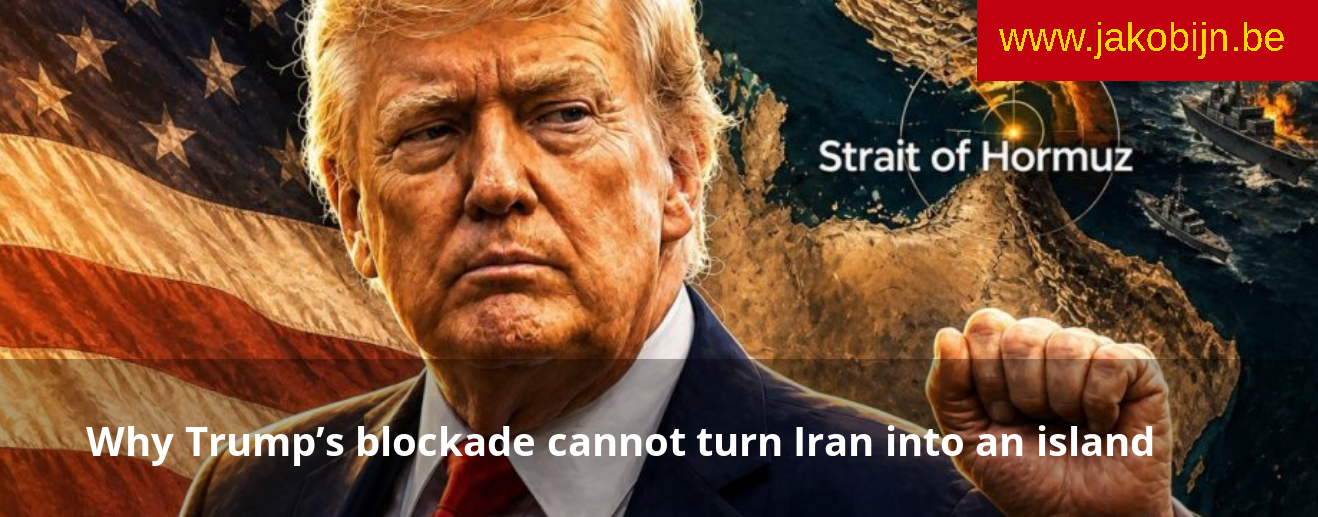
As of late August 2026, the geopolitical landscape of the Middle East has been fundamentally altered by the Trump administration's implementation of a comprehensive naval blockade against the Islamic Republic of Iran. Dubbed "Maximum Pressure 2.0," this strategy represents the most aggressive use of maritime interdiction since the Cuban Missile Crisis. The objective is clear: to financially and economically smother Persia, forcing a capitulation or regime change by severing Tehran from the global maritime economy.
However, a fundamental miscalculation underpins this strategy. The United States may possess the naval supremacy to blockade Iran's seas, but it lacks the physical and geographic capacity to blockade Iran's landmass. In the 21st century, the paradigm of global power has shifted from the maritime chokepoints controlled by the West to the sprawling, integrated continental networks of Eurasia. Iran is not an island; it is the central pivot of the Eurasian landmass.
Building upon the foundational analysis originally articulated by geopolitical analyst Pepe Escobar, this updated assessment explores the limits of the U.S. blockade, Tehran's shifting strategic calculus, and the inescapable reality of Eurasian geography. Furthermore, it integrates additional strategic, economic, and historical perspectives to demonstrate why this blockade will ultimately accelerate the very multipolar order Washington seeks to destroy.
Part I: The Anatomy of the Blockade and Its "Leaky" Nature
The immediate impact of the U.S. naval blockade has been undeniably severe. For 5.5 months, Tehran attempted to manage the clock, maintaining a strategic nutcracker on the Strait of Hormuz. The Empire's response was not to back down, but to escalate through ruthless market manipulation. By depleting the Strategic Petroleum Reserve (SPR) and reportedly utilizing DARPA-employed AI tools to manipulate global energy futures, Washington managed to keep oil prices artificially suppressed, inflicting maximum financial pain on Tehran.
The results are visible in the data. Traffic in the Strait of Hormuz has collapsed. Depending on the tracking source, Iran's crude exports have plummeted from approximately 1.8 to 2.0 million barrels per day (bpd) prior to the blockade to below 300,000 bpd. This represents a massive deprivation of hard currency—or petroyuans—for the Iranian state.
Yet, the American blockade is coercive, not decisive. It is fundamentally "leaky."
Despite the overwhelming presence of the U.S. Fifth Fleet, Iranian crude continues to escape via a sophisticated shadow fleet. Ship-to-ship transfers, particularly in the murky waters off the coast of Malaysia, have become a vital lifeline. Cargo leaves Iranian waters, is transferred offshore to obscure its origin, and moves onward to Asian buyers. During the brief June–July 2026 truce, roughly twenty tankers moved approximately $6 billion in crude through these illicit channels. While this shadow economy cannot replace Iran's pre-blockade export volume, it proves that total physical isolation is impossible. The blockade inflicts pain, but it does not deliver a fatal blow.
Part II: Tehran's Calculus: From Strategic Patience to Preemption
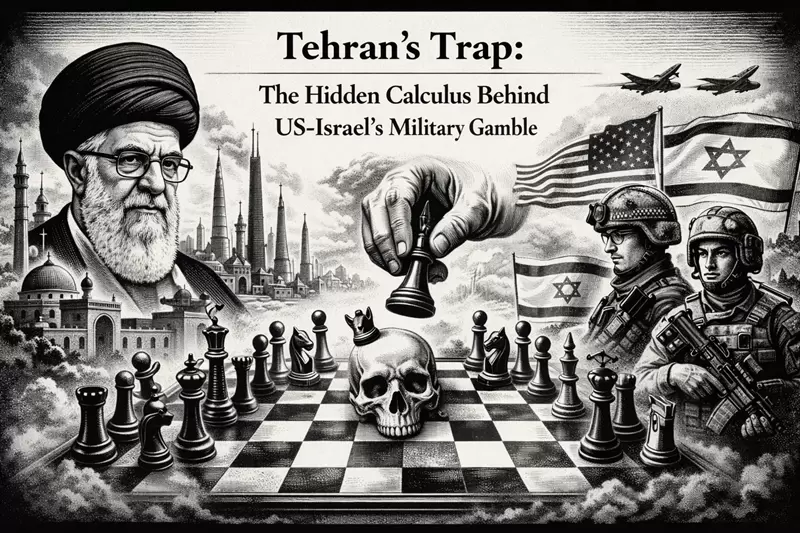
Iran's leadership has perfectly understood that the long-term goal of the Hegemonic Old Order is to replicate the fate of Syria: a protracted, debilitating economic strangulation designed to fracture the state from within. Furthermore, Tehran is acutely aware of the darkening strategic cloud overhead. The collective West has normalized the discourse around genocide in recent conflicts; consequently, the normalization of unleashing tactical nuclear weapons in closed-door "discussions" within Washington's think tanks is viewed in Tehran not as a bluff, but as an existential warning.
Recognizing that a slow strangulation via the Strait of Hormuz risks reversing years of developmental gains, Iran is shifting its doctrine. Strategic patience has its limits. The leadership is now "speeding up the management of the clock."
This shift is personified by Mohsen Rezaee, the new secretary of the Supreme National Security Council (SNSC) and personal representative of Supreme Leader Mojtaba Khamenei. Rezaee is setting a definitive tone: there is no alternative but to go all out to force the Hegemonic Old Order to bow down. Tehran realizes that in a potential Global Great Depression, a slow economic bleed is a death sentence. Therefore, the strategy must shift from absorbing blows to delivering them, forcing a systemic rupture.
Part III: The Diplomatic Minefield: Oman, Backchannels, and Brinkmanship
While the military and economic dimensions of the blockade dominate the headlines, the diplomatic theater is equally chaotic. Direct U.S.-Iran talks are mired in a wild ocean of contradictions. The Islamic Revolutionary Guard Corps (IRGC) and the Iranian Foreign Ministry have explicitly denied the existence of any active direct American channel. The IRGC has mocked U.S. claims of a direct backchannel as mere psychological warfare, even as Donald Trump publicly spins the narrative of an established, direct line to the IRGC.
In reality, a backchannel did exist: the May 2026 channel facilitated through Kurdistan Regional Government President Nechirvan Barzani to senior IRGC leadership. It has since gone dormant, kept in an informal, unresolved status while Tehran publicly denies its existence to maintain domestic and regional posturing.
"Diplomacy" in the traditional sense is alien to the current U.S. executive approach; threats are the preferred vernacular. This was starkly illustrated by Trump's public, repeated threats to bomb Oman.
Oman is far from a peripheral actor. Muscat is simultaneously one of the Gulf Cooperation Council's (GCC) most durable intermediaries, a deeply involved player in the Iran diplomatic channel, and a co-negotiator of the emerging Hormuz transit mechanism. By threatening to bomb Oman, the U.S. President is directly attacking the very mini-state attempting to build an off-ramp for the Empire.
Unsurprisingly, there was no official Omani government statement responding to the threats. No statement from the Sultan, no statement from the Foreign Ministry. But Muscat's silence should not be misread. In the wily diplomatic strategy of the Gulf, silence is not acquiescence, nor is it defiance. It is a calculated maneuver to remain usable to both sides. By alienating Oman, Washington is burning the very bridges it needs to navigate the blockade's endgame.
Part IV: The Geographic Shield: Why Eurasia Cannot Be Blockaded
The core thesis of this analysis rests on a simple geographic reality: the U.S. Navy can control the oceans, but it cannot blockade the Eurasian landmass. Iran is geographically anchored to a vast network of continental connectivity that renders maritime coercion incomplete.
1. The Gwadar-CPEC Land Bridge
The port of Gwadar in the Arabian Sea, the crown jewel of the China-Pakistan Economic Corridor (CPEC), has become strategically paramount as a land-transit gateway to Iran. Cargo arrives at Gwadar, is consolidated, and moves overland approximately 89 kilometers to the Gabd crossing, entering Iran by road. This route is significantly shorter and cheaper than moving cargo through Karachi. While Iranian-flagged ships are not routinely calling at Gwadar, the overland transit of goods effectively bypasses the U.S. naval cordon in the Persian Gulf.
2. The Caspian Sea: An Impenetrable Inland Fortress
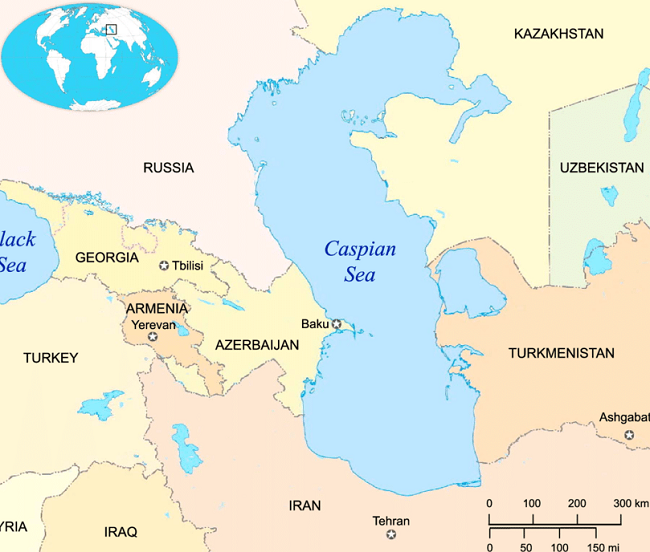 Perhaps the most crucial strategic route immune to the U.S. Navy is the Caspian Sea. Iranian Caspian ports, such as Bandar Anzali, connect directly to Russia, particularly Astrakhan. Since the blockade began, Iranian Caspian ports have increased their operating tempo, with Bandar Anzali approaching full capacity. It is moving grain, agricultural products, industrial goods, and, most importantly, strategic trade between BRICS members Iran and Russia.
The U.S. Navy is physically and legally locked out of the Caspian. The 2018 Convention on the Legal Status of the Caspian Sea explicitly excludes extra-regional naval powers. The Caspian is a closed lake, governed by its littoral states (Russia, Iran, Kazakhstan, Turkmenistan, and Azerbaijan), rendering it an impenetrable fortress against American maritime projection.
3. The INSTC and the Rail Networks
Along the 7,200-kilometer International North-South Transportation Corridor (INSTC), connecting Russia, Iran, and India, bilateral cargo has been growing exponentially. While infrastructure bottlenecks remain—such as the ongoing completion of the Rasht–Astara rail connection inside Iran—the corridor is operational and expanding.
Furthermore, Iran is at the heart of two intersecting connectivity architectures: the China–Central Asia–Iran railway (part of the Belt and Road Initiative) running East-West, and the Iran–Russia Caspian route (part of the INSTC) running North-South. Every day that the U.S. blockade persists, the strategic value of these land-based networks increases. The blockade prevents maritime coercion from becoming complete physical isolation, but it exponentially incentivizes Iran, Russia, China, Pakistan, and the Central Asian republics to deepen and accelerate these alternative infrastructures.
Part V: Additional View and Geopolitical Synthesis
To fully comprehend the strategic failure of the U.S. blockade, one must look beyond the immediate tactical realities and examine the broader geopolitical, economic, and historical frameworks at play. The following analysis provides an expanded view on why this strategy is catalyzing the decline of Western hegemony.
1. The Triumph of the Heartland over the Rimland
From the perspective of classical geopolitical theory, the U.S. blockade is a textbook application of Alfred Thayer Mahan's "Sea Power" doctrine, which posits that control of the seas dictates global supremacy. However, it fatally ignores Halford Mackinder's "Heartland Theory." Mackinder famously warned that "who rules the Heartland commands the World-Island."
Iran sits at the southern pivot of the Heartland. By attempting to use sea power to isolate a continental power, the U.S. is repeating the historical mistakes of maritime empires trying to subdue the Eurasian landmass (e.g., the British Empire's Great Game, or Napoleon's Continental System). The geographic reality is that land-based logistics, particularly when backed by the industrial might of China and the resource wealth of Russia, can sustain a state indefinitely. The U.S. Navy cannot project power over the Hindu Kush, the Caucasus, or the Central Asian steppes.
2. The Acceleration of De-Dollarization and BRICS+ Integration
The blockade is intended to enforce the supremacy of the U.S. dollar and the SWIFT financial system. In reality, it is acting as the ultimate catalyst for de-dollarization. Because Iran is cut off from traditional maritime oil markets priced in dollars, it is forced to integrate entirely into the non-dollar economy of the BRICS+ bloc.
Trade between Iran and Russia is increasingly conducted in rubles, rials, and yuan. The energy trade with China is settled in petroyuans. The blockade has forced the creation of a parallel, sanctions-proof financial architecture. By weaponizing the maritime commons, Washington has inadvertently forced the Eurasian landmass to build a self-sustaining economic ecosystem that entirely bypasses Western financial intermediaries. The "Global Great Depression" threatened by the West will only accelerate the Global South's rejection of Western financial swindling schemes.
3. The Asymmetric Military Reality: A2/AD in the Persian Gulf
The assumption that the U.S. can maintain a permanent, unchallenged blockade ignores the military reality of Iran's Anti-Access/Area Denial (A2/AD) capabilities. Iran retains a multi-layered asymmetric defense architecture. This includes long-range anti-ship missiles (such as the Noor and Qader), extensive naval mining capabilities, and a fleet of fast-attack craft and midget submarines designed specifically for the shallow, constrained waters of the Persian Gulf.
In a full-scale conflict, large American naval forces operating close to a super-hostile coastline face very short warning distances and reduced dispersal space. The cost-exchange ratio heavily favors Iran. A U.S. destroyer costing $2 billion is vulnerable to a $100,000 swarm drone or a $2 million anti-ship cruise missile. The U.S. blockade is currently operating in a "no peace, no war" stalemate because Washington knows that escalating to a shooting war in the Strait of Hormuz would result in unacceptable losses and the closure of the strait to all global traffic, triggering a catastrophic spike in global oil prices that would devastate the Western economy.
4. The Normalization of Extreme Rhetoric and Strategic Instability
The mention of "tactical nukes" in Western strategic discussions is not merely psychological warfare; it reflects a dangerous degradation of the global nuclear taboo. As the West fragments and faces the loss of its unipolar moment, its strategic doctrine is becoming increasingly unhinged. The normalization of genocide in recent conflicts has lowered the threshold for extreme violence.
Tehran's realization of this "long dark cloud" is what drives its shift from strategic patience to preemptive escalation. If the Hegemonic Old Order is willing to discard international law, financial norms, and the rules of war, Iran is justified in concluding that only the total collapse of the Old Order can guarantee its survival. This makes compromise nearly impossible and ensures that the conflict will remain a defining feature of the 2020s.
Conclusion: The Blockade as a Catalyst for Eurasian Integration
The U.S. naval blockade of Iran has undoubtedly devastated the largest single channel through which Tehran earned hard currency. It has wreaked havoc on the Iranian economy and inflicted severe short-term pain. However, in its attempt to turn Iran into an island, the United States has fundamentally misread the geography of the 21st century.
Iran cannot be reduced to an island because it is inextricably linked to the Eurasian landmass. Through the overland routes of the CPEC, the legally protected waters of the Caspian Sea, and the expanding rail and transit networks of the INSTC, Iran remains connected to the east, north, and southeast.
Every single day that the U.S. blockade operates under pressure, it increases the incentive for Iran, Russia, China, Pakistan, and the Central Asian states to deepen their integration. The blockade is not isolating Iran; it is welding it more firmly into the Eurasian network.
Ultimately, Trump's blockade is a tactical maneuver that yields a strategic defeat for the United States. It cannot alter the substantial architecture that keeps Iran connected to Eurasia. Instead of forcing Tehran to its knees, the blockade is accelerating the most crucial geopolitical development of the 21st century: the total integration of the Eurasian landmass and the final, irreversible cleavage between the declining Hegemonic Old Order and the rising, resilient civilization-states of the Global South. The Empire may control the seas, but the Heartland belongs to the future.
Sources and Geopolitical Frameworks Referenced
- Classical Geopolitical Theory:
- Halford Mackinder's The Geographic Pivot of History (1904) and the Heartland Theory, emphasizing the strategic supremacy of the Eurasian landmass over maritime powers.
- Alfred Thayer Mahan's The Influence of Sea Power upon History (1890), representing the maritime doctrine currently guiding U.S. naval strategy, and its limitations in the modern era.
- International Law and Maritime Frameworks:
- The 2018 Convention on the Legal Status of the Caspian Sea, which legally prohibits the deployment of non-littoral state naval forces (including the U.S. Navy) in the Caspian basin.
- Economic and Infrastructure Data:
- Trade and transit data regarding the International North-South Transportation Corridor (INSTC) and the China-Pakistan Economic Corridor (CPEC), specifically the Gwadar-Gabd overland transit route.
- Energy market tracking regarding the depletion of the U.S. Strategic Petroleum Reserve (SPR) and the utilization of algorithmic/AI trading mechanisms in global oil futures markets.
- Military Strategy and Asymmetric Warfare:
- Doctrine regarding Anti-Access/Area Denial (A2/AD) strategies in constrained maritime environments (the Persian Gulf and Strait of Hormuz), focusing on the cost-exchange ratios of swarm tactics, naval mining, and anti-ship ballistic missiles versus traditional blue-water naval assets.
- Contemporary Geopolitical Analysis:
- Foundational analysis by Pepe Escobar regarding the geopolitical realities of the 2025-2026 Middle East crisis, the transition of Iranian leadership under Supreme Leader Mojtaba Khamenei, and the strategic posture of the IRGC.