
Why China Is Not Afraid of the United States
Zhang Weiwei, the Civilizational State, and the Struggle for a Multipolar World Order
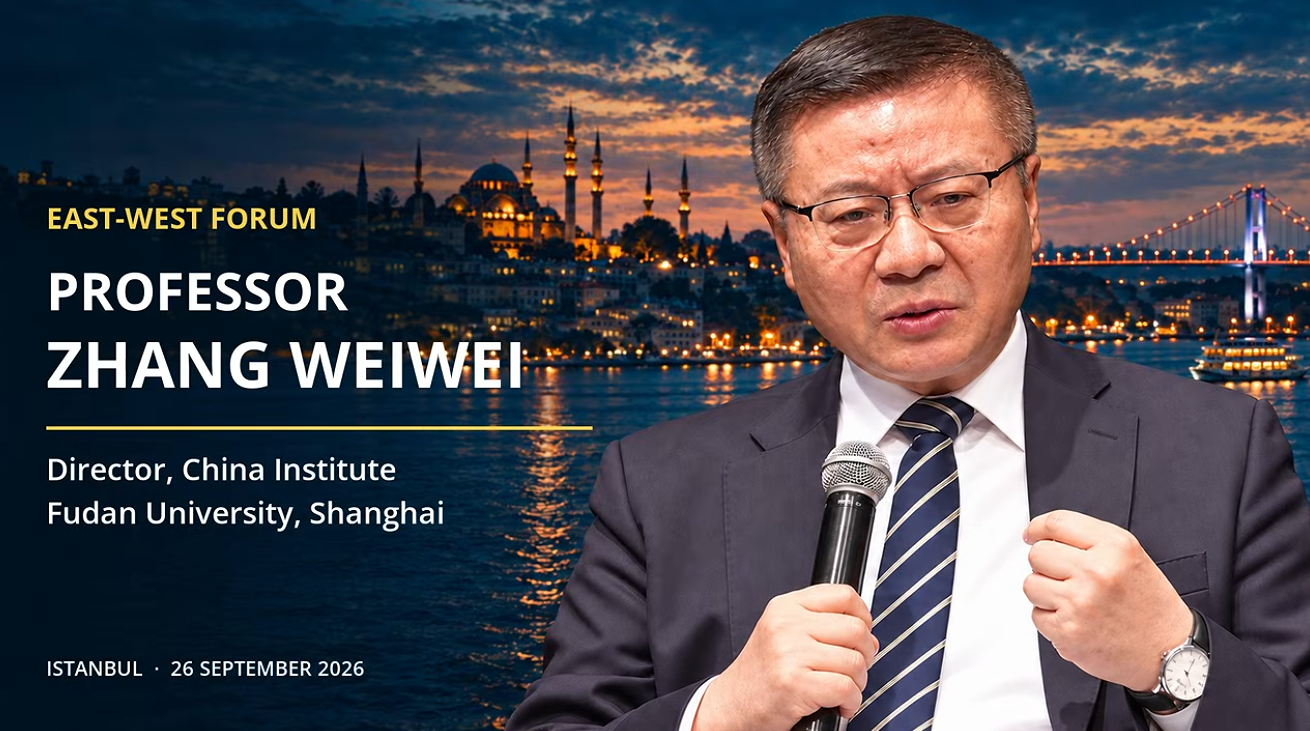
An analysis of China's political philosophy, its economic transformation, the challenge to Western hegemony, and the competing visions of the emerging international order. Based on Professor Zhang Weiwei's address at the East-West Forum in Istanbul, 26 September 2026, supplemented by historical analysis, institutional research and independently verifiable sources.
By Frank Dumon
Introduction: A World Order in Transition
On 26 September 2026, Chinese political scholar Zhang Weiwei addressed the East-West Forum in Istanbul, presenting an interpretation of China's place in a rapidly changing international system. Zhang, director of the China Institute at Fudan University in Shanghai, was participating in a discussion entitled The World in Transition: Multipolarity and the End of the Liberal Order. Other participants included scholars such as Glenn Diesen, Anatol Lieven and Jagannath Panda. The forum brought together intellectuals from Europe, Asia and other regions to examine the changing relationship between civilizations, states and global power.
His central proposition was that the world has already become multipolar in economic and political reality, even though the institutions governing international relations continue to reflect an earlier distribution of power. Zhang's argument goes considerably further than the familiar observation that China has become an economic competitor of the United States. He maintains that China represents a different political and civilizational tradition, one that cannot be adequately understood through the conceptual framework of Western liberal democracy.
In his interpretation, the rise of China is not merely the emergence of another powerful nation-state. It is the reappearance of an ancient civilization as a technologically advanced, industrially sophisticated and politically unified modern state. This distinction matters because it challenges an assumption that has influenced Western international relations since the end of the Cold War: that economic modernization would eventually produce political convergence toward Western institutions. Zhang argues that this expectation misunderstands Chinese history, political culture and statecraft.
His argument also raises questions that deserve independent examination. Does China's development experience demonstrate the existence of a viable alternative model of modernization? Can a multipolar international system become more cooperative rather than more confrontational? And does China's declared preference for peaceful development consistently correspond with its conduct in international disputes? Understanding these questions requires separating three elements: China's measurable economic transformation, Zhang's interpretation of that transformation, and the political claims he makes about the future international order.
1. China as a Civilizational State
One of Zhang's most distinctive contributions to contemporary political debate is his concept of the civilizational state. In conventional international relations, the modern nation-state is generally understood as a political entity exercising sovereignty over a defined territory and population. Its legitimacy may derive from constitutional institutions, national identity, popular sovereignty or historical continuity. Zhang proposes that China cannot be adequately described through this framework alone.
He identifies four characteristics that distinguish China's historical and political development:
- An exceptionally large population.
- A vast geographical territory.
- A continuous historical tradition extending across millennia.
- An exceptionally rich and diverse cultural inheritance.
He refers to these characteristics as the "four supers". His broader theoretical framework also includes four distinctive features of China's language, politics, society and economy. For Zhang, the crucial characteristic is the interaction between ancient civilization and modern institutional capacity. China's historical inheritance is not simply a collection of monuments, philosophical texts and cultural practices. It is presented as a living source of political legitimacy and administrative continuity.
This is why he contrasts China's system of governance with the Western electoral model. In his formulation, Western political systems emphasize election, while the Chinese system combines selection and election, drawing upon an older tradition of administrative recruitment and meritocratic advancement. The distinction reflects an important element of Chinese political history.
For centuries, imperial China employed examination systems to recruit officials into its bureaucracy. These institutions evolved over time and were never completely insulated from patronage, inherited privilege or political interference. Nevertheless, they helped establish a tradition in which administrative competence and education were central to the organization of the state.
Zhang sees contemporary Chinese governance as a modern adaptation of this tradition. However, historical continuity does not establish that contemporary political selection operates independently of party control. Modern China is governed by the Chinese Communist Party, which maintains decisive authority over senior political appointments and the institutional framework within which elections occur.
The distinction between administrative competence and democratic accountability is therefore essential. A government may possess substantial technical expertise while offering limited opportunities for political opposition. Conversely, an electoral system may permit government replacement without guaranteeing effective administration. These are different dimensions of governance, and neither should be treated as a substitute for examining the other.
In a February 2026 interview with Pankaj Mishra, Zhang developed the civilizational-state argument further, presenting China's indigenous political traditions as an alternative to the expectation that liberal democracy represents the endpoint of political modernization. The deeper significance of his theory is that it disputes the existence of a single universal path from economic development to political modernity.
2. The End of the Unipolar Moment
Zhang's second major argument concerns the changing distribution of global power. Following the dissolution of the Soviet Union in 1991, the United States occupied an unusually dominant position in international affairs. American military capabilities, financial institutions, technological companies and alliance networks provided Washington with influence unmatched by any individual competitor.
The international system nevertheless remained more complex than a single hierarchy. The European Union, Russia, China, India and other states retained substantial economic, diplomatic or military capabilities. What has changed over the subsequent decades is the relative distribution of economic production and technological capacity. China has become one of the world's principal manufacturing and trading powers. India has expanded its economic weight, while other Asian economies have developed increasingly sophisticated industrial and technological capabilities.
Zhang points to the growing economic importance of BRICS as evidence that the world economy can no longer be understood primarily through the G7. This argument requires an important statistical distinction. Gross domestic product measured at purchasing power parity (PPP) adjusts for differences in domestic price levels. GDP measured at market exchange rates instead captures the international dollar value of production and is often more relevant to cross-border financial power. The World Bank publishes separate comparative datasets for PPP-based GDP, while the IMF provides internationally comparable economic indicators.
Consequently, a statement that BRICS has surpassed the G7 must specify the membership of each grouping, the reference year and the method of calculation. Even where BRICS exceeds the G7 in PPP-adjusted output, this does not mean that it possesses an equivalent share of international financial infrastructure, reserve currencies, technological intellectual property or military capabilities.
Economic multipolarity is not identical to strategic multipolarity. Nevertheless, the growing economic weight of emerging countries raises a legitimate institutional question: should global decision-making continue to reflect the balance of power established after the Second World War? Zhang's answer is that international governance must adapt to the changing realities of economic and political influence.
The challenge is that multipolarity describes the distribution of power; it does not, by itself, determine how responsibly that power will be exercised. A world with several major powers may produce greater diplomatic flexibility and reduce dependence on any single state. It may also create additional opportunities for rivalry, competitive alliance-building and regional conflict. The outcome depends on the institutions, agreements and political decisions that accompany the redistribution of power.
3. China's Political Philosophy: Unity, Prosperity and Strategic Patience
Zhang contrasts two broad approaches to international relations. He characterizes Western geopolitical thinking as frequently organized around the distinction between friends and enemies, whereas he describes Chinese statecraft as treating other countries as friends or potential friends. He associates this approach with the importance of strategic patience, long-term planning and the avoidance of unnecessary military confrontation.
One historical influence he identifies is The Art of War by Sun Tzu. The text emphasizes the strategic importance of intelligence, preparation, political judgment and achieving objectives without unnecessary combat. Zhang interprets this tradition as evidence of a Chinese preference for minimizing the use of military force. There is an important distinction, however, between a philosophical tradition and the historical conduct of states.
Chinese history includes prolonged periods of internal warfare, territorial expansion, dynastic conflict and military confrontation with neighboring powers. The People's Republic of China has also participated in armed conflicts since its establishment in 1949, including the Korean War, the 1962 war with India and the 1979 invasion of Vietnam. These events do not negate the importance of strategic restraint within Chinese political thought. They demonstrate that philosophical principles cannot be treated as sufficient evidence of consistent national behavior.
Zhang's argument is therefore most useful when understood as a description of China's preferred diplomatic self-image and strategic doctrine rather than as proof that China has historically avoided military conflict. The same distinction applies to his claim that China has an exceptionally high threshold for the use of force. That proposition requires comparative historical evidence, an agreed definition of military force and careful consideration of disputes involving China's borders and maritime claims.
What can be said is that Chinese leaders frequently present development, stability and sovereignty as interconnected national priorities. From this perspective, prolonged confrontation with the United States would impose economic and strategic costs that China has reasons to avoid. This provides a more concrete explanation of strategic patience than cultural tradition alone.
4. Development as a Source of Political Legitimacy
One of the most consequential elements of Zhang's argument is his emphasis on material and social development. He associates Chinese political philosophy with the Confucian principle that government must prioritize the livelihood of the population. In his interpretation, political legitimacy is not established solely through the procedure by which leaders assume office. It also depends on the government's capacity to improve living conditions, provide security and sustain economic development.
This distinction helps explain why Chinese officials frequently emphasize infrastructure, poverty reduction, education and industrial modernization when discussing the country's political achievements. There is substantial evidence that China has experienced an extraordinary transformation in human development. According to the United Nations Development Programme, China's Human Development Index increased from 0.410 in 1978 to 0.752 in 2017. Its February 2026 assessment reported an HDI of 0.797 for 2023, close to the threshold of very high human development.
China's Human Development Index
1978 0.410
2017 0.752
2023 0.797
Source: UNDP national and regional human development reports. Values reflect historical assessments and may differ from subsequently revised time series.
These figures indicate major improvements in income, education and life expectancy over several decades. They also demonstrate why China's development experience attracts attention among countries seeking alternatives to conventional Western development strategies. However, several qualifications are necessary.
First, China's transformation cannot be attributed to political institutions alone. It also involved agricultural reform, industrialization, foreign investment, export-oriented manufacturing, technology transfers, domestic savings, education and integration into international trade.
Second, aggregate national progress does not eliminate regional inequality, demographic pressures or environmental costs. UNDP's 2026 assessment specifically identifies these as continuing challenges. Third, economic performance and political rights should be evaluated separately. Freedom House's 2025 assessment describes substantial restrictions on political competition, independent civil society, media freedom and public dissent in China. That assessment represents a rights-based institutional framework different from Zhang's performance-oriented understanding of governance.
The contrast illustrates a central disagreement between competing political traditions. One approach places particular emphasis on electoral accountability and individual liberties. Another places greater emphasis on collective development, stability and administrative performance. These priorities need not be mutually exclusive in principle. The practical question is how institutions can deliver public services while also preventing arbitrary authority, corruption and abuses of power. A serious comparison should examine both the material results of governance and the mechanisms through which citizens can challenge political decisions.
5. The Belt and Road Initiative: Infrastructure as Geopolitics
Zhang presents the Belt and Road Initiative (BRI) as one of the most tangible expressions of China's preferred international order. Rather than relying primarily on military alliances, the initiative seeks to expand economic connectivity through transportation, energy, logistics and other infrastructure projects. Its significance extends beyond individual construction contracts.
Railway corridors, ports, electricity networks and cross-border trade routes can alter the economic geography of entire regions. For landlocked Central Asian countries, improved transportation links may reduce dependence on a limited number of transit routes and facilitate access to international markets. This is the background to Zhang's argument that regional integration can transform geographical disadvantages into economic opportunities.
He describes a transition from "landlocked" to "land-linked" economies. The World Bank has examined the potential benefits of Belt and Road transport corridors and found that improved connectivity can support trade, investment and economic welfare. However, it also identifies important risks involving debt sustainability, environmental damage, public procurement, corruption and insufficient transparency.
These findings are important because they permit a more precise evaluation than either unconditional praise or blanket rejection. Infrastructure investment is not automatically beneficial merely because a railway, highway or port has been constructed. Its economic value depends on factors such as utilization, financing costs, maintenance obligations, trade facilitation and the distribution of benefits.
For example, a transport corridor may substantially improve regional commerce while generating insufficient revenue to service its financing. Similarly, a port may become commercially valuable while leaving the host government exposed to contractual or financial risks. Zhang's claim that the BRI represents a new model of international cooperation should therefore be evaluated through individual projects and their long-term outcomes.
The relevant questions include who finances the infrastructure, who owns it, who operates it, which companies receive construction contracts and whether the host country's population obtains measurable economic benefits. The initiative demonstrates that China possesses the financial, industrial and organizational capacity to undertake major international development projects. Whether those projects produce more equitable international relationships must be determined through evidence rather than assumed from their stated objectives.
6. ASEAN and the Economic Integration of Asia
Zhang identifies China's relationship with the Association of Southeast Asian Nations (ASEAN) as an example of regional cooperation built around economic interdependence. He emphasizes dialogue, respect for sovereignty, strategic patience and the importance of allowing ASEAN institutions to retain a central diplomatic role. There is substantial economic evidence supporting the importance of this relationship. According to ASEAN's official statistics, China has been ASEAN's largest trading partner since 2009, while ASEAN has been China's largest trading partner since 2019.
ASEAN–China economic relations, 2024
$772.4B Bilateral merchandise trade
$19.3B Chinese FDI into ASEAN
Source: ASEAN Secretariat, official economic relations statistics.
The merchandise trade figure represented approximately 20.1% of ASEAN's total trade in 2024. This degree of economic integration gives China and Southeast Asian countries substantial incentives to maintain stable commercial relationships. However, economic interdependence does not eliminate geopolitical disputes. Several ASEAN members have competing maritime claims with China in the South China Sea. These disputes involve territorial sovereignty, maritime entitlements, fisheries, energy resources and freedom of navigation.
In 2016, an arbitral tribunal constituted under the United Nations Convention on the Law of the Sea issued an award in proceedings initiated by the Philippines. The tribunal addressed maritime entitlements and the legality of certain Chinese activities. China rejected the arbitration and did not participate in the proceedings.
The tribunal did not decide sovereignty over disputed land territories, but its findings remain legally significant. This creates an important test for Zhang's interpretation. If China's regional diplomacy is based on equality and mutual respect, how should disagreements be resolved when neighboring countries interpret international law differently?
China's emphasis on bilateral negotiation and ASEAN-centered diplomacy must be considered alongside the legal positions and security concerns of individual Southeast Asian states. Regional economic integration and strategic competition can exist simultaneously. The ASEAN experience therefore illustrates both the possibilities and the limits of the cooperative international order Zhang describes.
7. China, India and the Problem of Historical Borders
Another important subject in Zhang's Istanbul presentation was China's relationship with India. He referred to the legacy of British colonial boundary-making and argued that unresolved border disputes should not prevent economic development and regional cooperation. This position reflects a broader Chinese diplomatic preference for separating long-term territorial disagreements from immediate economic relationships.
Zhang suggests that some disputes could be deferred while both sides concentrate on development, allowing future generations to negotiate under more favorable circumstances. The proposal raises a practical question: can economic cooperation create sufficient mutual confidence to reduce the danger of territorial conflict? Historical experience provides mixed evidence. China and India fought a border war in 1962, and their disputed frontier has remained a recurring source of tension. In June 2020, soldiers from both countries clashed in the Galwan Valley. At least 20 Indian soldiers were killed, along with Chinese casualties whose number was not confirmed at the time of the initial reporting.
The incident demonstrated that even when governments seek to avoid conventional warfare, unresolved territorial disputes can produce deadly confrontations. Zhang's emphasis on restraint and dialogue is relevant, but his characterization of border confrontations as essentially limited physical altercations risks understating their seriousness. From India's perspective, the issues also concern territorial integrity, military deployments, border infrastructure and the reliability of existing agreements.
A durable settlement would require mutual recognition of security concerns rather than reliance on one country's interpretation of historical boundaries. The wider geopolitical significance is considerable. China and India are both major Asian powers with large populations, substantial economic potential and ambitions for greater international influence. Their relationship will affect the practical functioning of BRICS, regional trade and any future Asian security architecture. A multipolar world cannot be understood solely as a redistribution of influence from the United States toward China. It must also accommodate the interests of other major powers that may cooperate with Beijing on some issues while opposing it on others.
8. The United Nations and the Meaning of International Law
Zhang argues that reform of the international order should be grounded in the United Nations Charter rather than in rules established by individual Western powers. This distinction occupies a central place in contemporary diplomatic debate. The UN Charter recognizes sovereign equality, peaceful settlement of disputes and restrictions on the threat or use of force. Article 2(4) prohibits member states from threatening or using force against the territorial integrity or political independence of other states, subject to the Charter's legal framework, including self-defense and Security Council authorization.
Zhang's criticism concerns the possibility that powerful countries may interpret international rules selectively, invoking universal principles when convenient while departing from them when strategic interests are involved. This criticism has a substantial historical context. The United States and several European countries have conducted military interventions whose legality, political objectives and humanitarian consequences remain disputed.
The 2003 invasion of Iraq, the 2011 intervention in Libya and the broader history of military action during the Cold War provide important examples for examining the relationship between geopolitical power and international law. However, the same legal standards must be applied to all states. Russia's invasion of Ukraine, Chinese maritime claims and military activities, and the actions of Western powers must be examined according to the relevant legal rules rather than different standards based on political alignment.
This is particularly important when discussing the distinction between a UN-centered international order and a so-called rules-based international order. The two concepts are not necessarily incompatible. Many international rules derive from treaties, customary international law and institutions created under or alongside the United Nations system. The substantive question is whether states apply those rules consistently and accept the constraints they impose. Zhang's call for stronger adherence to the UN Charter therefore raises an important issue, but the credibility of that position depends on whether the same standards are accepted when they conflict with China's own strategic preferences.
9. Democracy, Political Accountability and the Purpose of Government
Zhang's critique of Western liberal democracy is not limited to its international consequences. He also questions whether electoral procedures should be treated as the defining measure of democratic governance. He argues that elections are instruments rather than ultimate political objectives. For Zhang, the purposes of government include peace, development, social stability and improvements in living standards. This argument challenges a narrow definition of democracy based exclusively on periodic elections.
Indeed, the quality of governance cannot be determined solely by whether elections take place. Effective institutions, an independent judiciary, public accountability, protection against corruption and the capacity to provide essential services are also important. Yet elections have a specific institutional function that should not be overlooked. Competitive elections permit citizens to remove governments without violence. Independent media and civil society organizations can expose misconduct, while judicial institutions can constrain the exercise of executive authority.
Where these mechanisms are restricted, other forms of accountability become particularly important. Zhang's performance-oriented approach consequently raises a question that cannot be resolved simply by comparing economic growth rates. Who determines whether a government has fulfilled its obligations, and what effective remedies are available to citizens when it has not? China's development achievements provide evidence of substantial administrative and economic capacity.
They do not, by themselves, settle debates about political pluralism, freedom of expression or the legitimacy of concentrated authority. Likewise, the existence of electoral competition in Western countries does not guarantee effective economic management or public trust. A comparative analysis must therefore distinguish electoral accountability, civil liberties, administrative capacity and socioeconomic outcomes rather than treating them as interchangeable measures.
This is where Zhang's challenge to Western political assumptions becomes intellectually significant, even for readers who do not accept his conclusions. It encourages closer examination of the relationship between political institutions and the practical purposes they are intended to serve.
10. NATO Expansion, Ukraine and the Security Dilemma
During his Istanbul presentation, Zhang also discussed NATO enlargement and the origins of the war in Ukraine. He argued that successive rounds of NATO expansion contributed to the deterioration of European security and suggested that a different approach might have prevented the crisis. This interpretation forms part of a wider debate about the post-Cold War European security architecture. Following the dissolution of the Soviet Union, several Central and Eastern European states sought NATO membership, motivated partly by historical experiences of Soviet domination and concerns about their future security. NATO expanded in 1999, 2004 and subsequent rounds. Finland joined in 2023 and Sweden in 2024, following Russia's full-scale invasion of Ukraine in February 2022.
From Russia's perspective, the expansion of a US-led military alliance toward its borders has been presented as a threat to its strategic security. From the perspective of many Central and Eastern European governments, NATO membership represented protection against precisely the kind of military pressure they feared from Russia. Both perceptions are important to understanding the security dilemma.
A measure regarded as defensive by one state can be interpreted as threatening by another, producing escalating military preparations even where the parties claim to seek security. However, explaining this dynamic does not establish that NATO enlargement made Russia's invasion inevitable or legally justified. Ukraine's sovereignty and territorial integrity remain protected under international law.
Nor does Zhang's suggestion that stopping NATO enlargement after an earlier round would have prevented the war constitute a demonstrable historical fact. It is a counterfactual interpretation that cannot be conclusively verified. The debate therefore concerns the relationship between strategic decisions, perceived threats, diplomatic failures and responsibility for the use of force. Zhang's intervention is significant because it illustrates how Chinese geopolitical thinking often places particular emphasis on the security concerns of major powers.
Yet a multipolar system must also account for the sovereignty and security preferences of smaller countries. A stable international order cannot depend exclusively on understandings among the strongest states if those understandings disregard the interests of their neighbors. This is a central challenge for any proposed alternative to the existing security architecture.
11. Donald Trump and Great-Power Diplomacy
Zhang's comments on Donald Trump offer another perspective on China's approach to international relations. He suggested that Trump recognizes the importance of dealing directly with powerful countries and their leaders. In Zhang's interpretation, this creates opportunities for diplomatic engagement between Washington, Beijing and Moscow. The underlying idea is that direct communication among major powers may reduce misunderstanding and provide openings for negotiated settlements.
Historically, great-power diplomacy has played an important role in managing international crises. The Cold War provides examples of both confrontation and negotiated restraint, including arms-control agreements and direct communication mechanisms between Washington and Moscow. However, diplomacy centered primarily on major powers carries risks. Smaller states may fear that their security interests will be subordinated to arrangements negotiated without their participation.
This tension is particularly relevant to discussions concerning Ukraine, Taiwan, the South China Sea and the future of European security. A diplomatic agreement may reduce tensions between major powers while creating uncertainty for countries directly affected by its terms. Zhang's emphasis on strategic dialogue should therefore be considered alongside the principle that sovereign states have legitimate interests in decisions affecting their security and territorial integrity. The practical challenge is to combine direct great-power communication with inclusive diplomacy and respect for international law.
12. Why China Is Not Afraid of the United States
The title of the original video suggests that Zhang's central message is one of Chinese confidence in the face of American power. However, the substance of his argument is more complex than a simple assertion of geopolitical fearlessness. His position rests on several interrelated propositions:
- First, China possesses a large domestic economy, substantial industrial capabilities and a highly developed infrastructure network.
- Second, China's political leadership operates within a historical and institutional framework that Zhang believes encourages long-term strategic planning.
- Third, China is increasingly connected to economic partners throughout Asia, Africa, Latin America and other regions.
- Fourth, the international economy is becoming more diversified, reducing the possibility that any single state can determine global economic outcomes.
- Finally, Zhang believes that China's civilizational traditions provide an intellectual framework for pursuing international influence without necessarily reproducing the military alliance structures associated with Western power.
These propositions explain why he presents China as confident about its long-term international position. Yet confidence is not the same as invulnerability. China faces demographic change, regional economic disparities, environmental pressures and tensions surrounding trade, technology and national security. Its international partnerships also differ considerably in their depth and political objectives. BRICS, for example, includes countries with divergent strategic interests. Membership in the grouping does not imply a common military alliance or uniform support for Chinese foreign policy. China's economic interdependence with the United States and Europe creates opportunities for cooperation while also exposing all parties to disruptions arising from trade restrictions and technological competition.
The question is therefore not simply whether China fears the United States. A more analytically useful question is whether China possesses sufficient economic, technological, diplomatic and institutional resilience to pursue its interests without allowing strategic competition to develop into direct military confrontation. Zhang's presentation suggests that he believes it does. Whether this expectation is borne out will depend on developments that cannot be established by political philosophy alone.
13. Europe Between Washington and Beijing
Although Zhang's presentation focuses primarily on China and the emerging multipolar world, its implications for Europe are substantial. For decades, European economic and security policies developed within a transatlantic framework in which the United States occupied a central position. At the same time, European companies became increasingly integrated into Asian manufacturing networks and Chinese markets.
The resulting relationship is characterized by overlapping economic and strategic interests. Europe maintains extensive security ties with Washington while also possessing significant commercial interests in China and across Asia. This creates difficult choices concerning industrial policy, technology, investment, trade and defense. A policy of unrestricted economic integration may generate vulnerabilities where critical technologies or infrastructure depend heavily on external suppliers.
Conversely, extensive economic separation can increase costs, disrupt supply chains and reduce opportunities for scientific and industrial cooperation. The central question for European policymakers is how to manage these competing considerations while maintaining the capacity to make independent decisions. Zhang's civilizational-state argument introduces an additional dimension. If the international system is becoming more diverse, Europe may increasingly encounter countries that reject the assumption that Western political institutions provide a universally applicable model.
This does not require Europe to abandon its own constitutional principles. It does require a clear distinction between defending those principles domestically and assuming that other societies will necessarily organize their political institutions in the same way. Diplomatic engagement can recognize political differences without implying agreement with every policy pursued by another government. Similarly, economic cooperation need not eliminate legitimate concerns about human rights, security or international law. Europe's challenge is to develop policies capable of balancing these objectives rather than treating them as automatically incompatible.
Conclusion: Asia's Future and the Choices Facing the World
Zhang Weiwei concluded his Istanbul presentation with a historical comparison. He suggested that a century ago Europe represented the established center of world affairs, America embodied the future, and Asia remained associated with an earlier historical period. Today, he argued, the relationship is changing: Europe represents the past, America the present and Asia the future.
The formulation captures an important transformation in the global economy. Asia has become central to manufacturing, international trade, technological development and the growth of the world's middle classes. China's development has been a major part of that transformation, but the wider Asian story also includes India, Japan, South Korea, Southeast Asia and other economies with distinct political systems and strategic interests.
Asia is not a single geopolitical actor. Nor does the expansion of Asian economic influence necessarily imply the disappearance of European or American capabilities. The future international order is more likely to involve complex relationships among several major economic and political centers than a simple transfer of global leadership from one country to another. Zhang's concept of the civilizational state challenges the belief that modernization must produce political convergence.
His emphasis on development raises questions about how governments should be evaluated. His support for multipolarity highlights the growing mismatch between some inherited international institutions and the changing distribution of economic power. At the same time, his claims concerning Chinese restraint, international law and governance require the same scrutiny that should be applied to Western political narratives.
The central issue is not whether one civilization should replace another at the summit of an international hierarchy. It is whether states with different histories, political institutions and strategic interests can establish a system in which cooperation remains possible without requiring ideological uniformity. Such an order would have to accommodate economic competition, political disagreement and the legitimate security concerns of both large and small states.
It would also need to recognize that development, political accountability, sovereignty and peace are interconnected but distinct objectives. Zhang's presentation offers one interpretation of how this transformation might unfold. Its lasting significance lies in the questions it raises about political legitimacy, historical continuity and the organization of international power. The emergence of a multipolar world is not, by itself, a guarantee of greater justice or stability. Its consequences will depend on the principles and institutions through which states choose to manage their growing interdependence.
Sources and references
The following sources provide the primary material, institutional evidence and alternative perspectives used in this article. All links lead to the original publications or data resources.
| Source | Publication and URL |
|---|---|
| Original presentation | Zhang Weiwei, Why China Is NOT Scared of the USA, YouTube video |
| Fudan University, 2026 | Zhang Weiwei at the Istanbul East-West Forum |
| Fudan University, 2025 | Civilizational State as a Meta-Narrative |
| Zhang Weiwei and Pankaj Mishra, 2026 | China and the World to Come |
| World Bank | GDP Rankings Based on Purchasing Power Parity |
| IMF | China Economic Data |
| UNDP, 2026 | Monitoring China's Human Development |
| UNDP | Human Development Data and Documentation |
| World Bank | Managing the Risks of the Belt and Road |
| World Bank | Belt and Road Economics: Opportunities and Risks |
| ASEAN Secretariat | ASEAN–China Economic Relations |
| Permanent Court of Arbitration | South China Sea Arbitration Case |
| United Nations | Charter of the United Nations |
| Freedom House, 2025 | China: Freedom in the World |
| NATO | NATO Membership and Enlargement History |
| US–China Economic and Security Review Commission | Conflict on the Sino-Indian Border |
Editorial note: This article distinguishes Zhang Weiwei's interpretations from independently documented developments. Some statements in the original speech, including specific figures on BRICS, Belt and Road financing and military restraint, cannot be accepted without additional methodological or historical qualification. The source list provides a foundation for continued verification rather than a claim that every statement in the original transcript has been independently confirmed.