
The West is gravely mistaken about Russia's patience
In a recent interview with American journalist Rachel Blevins, former CIA analyst and national security expert Larry C. Johnson warns that the war in Ukraine and the broader conflicts in West Asia have reached a tipping point. According to Johnson, not only Kyiv is in the crosshairs, but Europe is increasingly coming into Russia's "crosshairs" as well. At the same time, he sees in the tensions surrounding Iran the beginning of a new security and world order model, in which the power of the United States and its allies is declining. Johnson's analyses and claims diverge in many respects from the dominant Western narrative.

By Frank Dumon
Imminent Russian long-range missile attacks on Kyiv
The occasion for the conversation is a sharp warning from Russian Foreign Minister Sergey Lavrov to U.S. Secretary of State Marco Rubio. According to Johnson, Lavrov has indicated that long-range attacks on Kyiv are "imminent" and that foreign citizens would do better to leave the Ukrainian capital as soon as possible.
This warning follows:
• Drone attacks launched from Kyiv against civilian targets in the Donbas and in Russian border regions
• A bloody attack on a school boarding facility in the Luhansk region, which Johnson says was attended primarily by middle-school-aged girls
In Russia, Johnson says, that attack has provoked a moral shock similar to the U.S. attack on the school in Iran resulting in the deaths of more than 170 children. The call for retaliation is loud, and he sees the first Russian missile salvos of the past 36 hours merely as an "appetizer."
According to Johnson, Lavrov's call for the U.S. to "get their people out of Kyiv" should primarily be read as an explicit warning to:
• CIA personnel collaborating with Ukrainian intelligence services
• NATO officers and Western military personnel embedded in Ukrainian command centers
Russian leaders, he emphasizes, are generally not ambiguous: When they say you'd better remove your people, they mean it.
From "special military operation" to full-scale war
In the West, the term "special military operation" is often met with derision or incomprehension. Johnson describes it as a conflict with deliberately limited objectives and deployment, in contrast to a mobilization economy like that of World War II:
• Russia has not yet placed its entire society and economy on a war footing
• Consumers in Russia have largely been able to continue living as they did before 2022
• Large parts of industrial capacity have remained untouched, as have many command centers in Kyiv
According to Johnson, that is now beginning to tip. He expects:
• Targeted attacks on decision-making centers in Kyiv
• Heavier strikes on military and industrial infrastructure
• A clear shift toward a more complete war mode in Russia
He directly links this shift to Western actions. In his view, the West has mistaken Russian restraint for weakness—a fatal error, he says.
Europe as the next target?
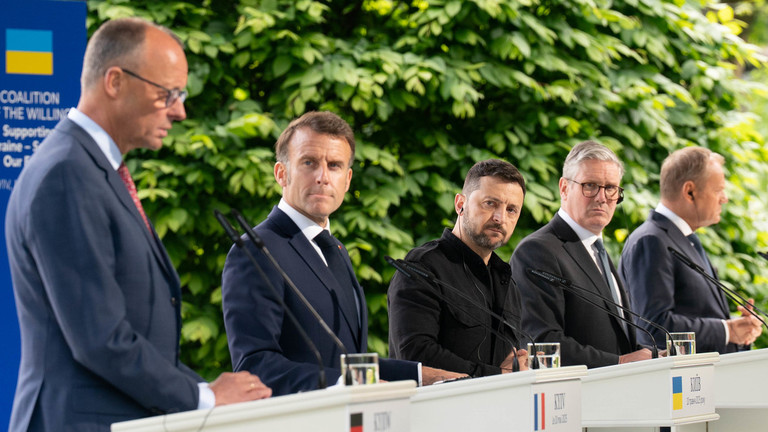
Johnson refers to recent statements by:
• Dmitri Polyansky, Russia's representative to the OSCE
• Sergey Ryabkov, Deputy Foreign Minister
Both are said to have indicated in clear terms that European countries themselves could become targets if they continue to support or enable attacks on Russian territory. The various Russian officials are "singing from the same hymn sheet," he states: their message is coordinated and not merely personal opinion.
In Johnson's reading, the first steps are:
1. Have foreigners leave Kyiv
2. Systematically neutralize the Ukrainian government and central infrastructure
Whereas Russia was previously restrained, he argues, out of fear of killing Western diplomats or military personnel, that restraint has now vanished: anyone who stays does so "at their own risk."
The erosion of international law and the rise of a new world order
A large part of the conversation concerns international law and postwar institutions: the United Nations, the Geneva Conventions, the World Bank, the IMF. Johnson recalls that this structure emerged from the horrors of World War II, in which an estimated 70 million people died, with a particularly high death toll in the former Soviet Union and China.
According to Johnson, the West—and especially:
• the United States
• Israel
• certain European countries —has systematically undermined that system by no longer adhering to the rules itself while simultaneously lecturing others.
He points, among other things, to:
• Western support for armed groups he labels as terrorist, such as figures around Abu Mohammad al-Julani in Syria
• Israel's historical support for Hamas, which later became an adversary
• The selective invocation of international law: first provoke, he says, and then condemn the reaction from Russia or Iran as "illegal"
Because of this hypocrisy, Johnson argues, more and more countries in the "Global South" are turning away from Western dominance. He expects that a new international order will emerge from the current conflicts, in which:
• Russia, China, and the Global South play a larger role
• The U.S. and its traditional allies can no longer dictate the terms
• Economic and legal agreements are distributed more equitably
West Asia: Iran, Saudi Arabia, and shifting alliances
Alongside Ukraine, the conflict surrounding Iran forms the second major axis of the conversation. Johnson speaks of a series of developments that he believes indicate a power shift in the Persian Gulf:
• Saudi Arabia is reducing its dependence on the dollar, selling U.S. Treasury bonds and buying gold
• Saudi Arabia and other Gulf states are selling oil in other currencies, including the Chinese yuan
• Pakistan is attempting to build a new regional security architecture, in which Iran and Turkey also have a place
Johnson claims that Pakistan has even promised Riyadh a "nuclear umbrella": an informal guarantee that an attack on Saudi Arabia by a nuclear power—he is thinking primarily of Israel—would be answered with Pakistani nuclear weapons.
The failed deal with Iran and Trump's role
Regarding U.S. policy toward Iran, Johnson sees no prospect of a durable agreement. He states:
• That any possible deal involving sanctions relief and unfreezing Iranian assets is repeatedly torpedoed
• That Donald Trump cannot distance himself from the pro-Israel lobby in Washington
• That wealthy donors such as Miriam Adelson (widow of casino magnate Sheldon Adelson), in his view, have invested hundreds of millions in Trump and thus influence policy
According to Johnson, Iran's conditions would be clear and non-negotiable:
1. Immediate lifting of sanctions
2. Release of Iranian assets frozen since 1979
3. An end to the wars in Lebanon and Gaza
4. Retention of control over the Strait of Hormuz, with fees that Tehran labels "user charges"
As long as Washington is unwilling to meet these demands and Israel remains closely aligned with Trump, Johnson sees no realistic chance of an agreement.
Economic shockwave on the horizon?
Also interesting is Johnson's analysis of energy markets. He points to a fundamental contradiction:
• Global oil supply, he argues, has fallen by at least 20% due to current wars
• Demand has barely decreased
• Yet official oil prices remain relatively moderate, while the real price in Asian ports, he claims, is much higher
From this he concludes that markets are being artificially manipulated and that the U.S. in particular has not yet fully felt the true cost of oil. The administration, he suggests, has temporarily masked this by drawing on strategic reserves.
In the longer term, however, Johnson expects a significant economic backlash:
• More expensive fuels
• Rising cost of living
• Growing domestic pressure on the U.S. government to find a political way out
Only when that pain becomes truly palpable for the American population, he believes, will Washington be willing to consider any concessions.
Conclusion: a dangerous moment of overestimation and underestimation
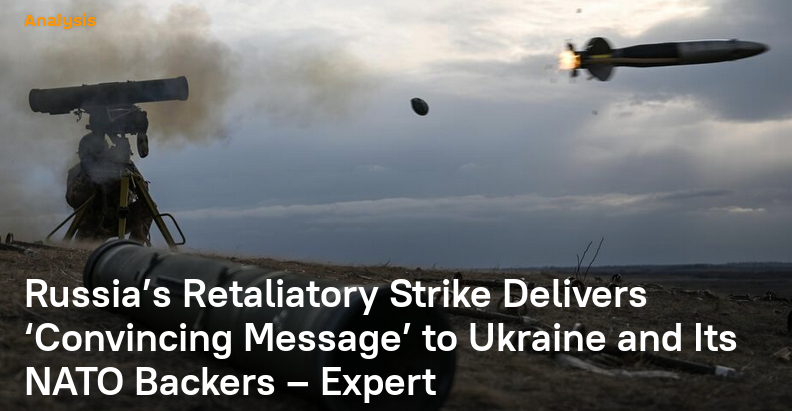
He paints an extremely bleak picture of the current geopolitical situation. In his view:
• The West overestimates its own power and influence, both militarily and economically
• The West underestimates the determination and endurance of Russia, Iran, and their allies
• The era in which the U.S. unquestionably determined the international rules of the game is drawing to a close
Whether one agrees with Johnson's conclusions or not, his analysis forces an uncomfortable question: How long can a world order endure in which the principal architects of postwar law themselves increasingly set that law aside?
Scott Ritter shares the same view

Ukraine violated the laws of war by attacking Starobilsk College. Russia, by contrast, adhered to the laws of war by attacking Kyiv. That is a difference. According to Russian sources, 21 students aged 16 to 18, mostly girls, were killed in this attack. What does international humanitarian law still mean in a war where drones, data, and artificial intelligence increasingly set the tone?
According to Ritter, the attack on the college was not a mistake, but a deliberate strike against civilian targets. In the West, commentators have claimed on social media that the college was a legitimate military target. Ritter rejects that reasoning as dangerously simplistic and contrary to the laws of war: civilians and civilian objects may not be attacked unless they are effectively participating in military operations. There was no legitimate military objective, and the attack specifically targeted sleeping students, which he characterizes as mass murder and a grave war crime.
Drones, Palantir, and the disappearance of the "human factor"
A significant part of Ritter's argument concerns the way targets are now selected. Where human analysts once assessed photos, intelligence, and context, large data and AI systems now play an increasingly prominent role. Western companies supply advanced software enabling Ukraine to process vast quantities of data to select targets for drone attacks. Where a human analyst would investigate whether structural military activities are taking place, an algorithm based on pattern recognition makes quicker, cruder decisions. According to Ritter, this eliminates the human reflection necessary to apply the laws of war: the ability to discern nuance, understand context, and make moral and legal judgments.
The FPV drones: a deliberate and repeated attack
Ritter devotes considerable attention to the technology of the drones used, which he identifies as FPV drones of the "FP1" type, equipped with multiple small rockets. Based on eyewitness accounts, the drones allegedly first fired rockets at the college's sleeping quarters. Each time students fled outside, new salvos were reportedly fired. Only after the ammunition was exhausted, the drones themselves are said to have flown into the building and detonated there. A Starlink antenna reportedly found on one of the downed drones indicates live control and real-time observation of the target. In Ritter's analysis, this suggests Ukrainian operators saw the target, tracked the students' movements, and continued firing nonetheless. He argues this demonstrates a deliberate, carefully orchestrated attack on a clearly civilian target.
Psychological warfare: breaking the Russian will
Ritter places the attack within a broader strategy, which he attributes to Western—especially British—planners: waging psychological warfare against the Russian population. Because a military victory on the battlefield appears difficult or impossible, the aim would be to break the will of Russian society through mass drone campaigns against targets deep inside Russia, creating a sense of insecurity even far from the front lines, and striking symbolic targets to sow fear, anger, and despair. He cites public statements regarding the delivery of tens of thousands of drones and plans for thousands of attacks per day. Rather than breaking Russian resolve, he argues, such actions would only increase anger and determination to continue the war.
Russian counterattacks and the question of legitimacy
Ritter compares the attack on Starobilsk with subsequent Russian strikes on targets in Kyiv and other cities. In his view, a clear difference can be seen in the application of the laws of war: Ukraine, he argues, deliberately locates drone production in civilian buildings: museums, shopping centers, garages, and other seemingly civilian infrastructure. Once those buildings are actually used for weapons production or storage, they lose their protection as purely civilian objects and become military targets.
If Russia attacks such locations with the aim of disrupting drone production, command functions, or weapons storage, Ritter argues this is justifiable under the laws of war, provided efforts are made to minimize civilian casualties. He contrasts this with the attack on sleeping students, where no military advantage can be identified and the target itself is not military. Educational institutions remain civilian targets as long as they are not demonstrably and structurally integrated into military structures.
Ritter's central warning is that the rise of large-scale data analytics, commercial war technology, and unrestrained drone warfare increases the risk that such attacks will no longer remain exceptional but become part of a normalized practice of war in which "lethality" outweighs "legality." Whether one agrees with his broader political conclusions or not: his analysis touches on a core issue relevant to any modern war. Without sustained and conscious application of the laws of war, with genuine human judgment, the boundary between military and civilian risks blurring—with civilians, and especially children, as the first victims.
Sources:
Ritter's Rant 091: The Law of War https://youtu.be/iMfD4OqWQHA
Sky News secures exclusive access inside a Ukrainian drone factory https://youtu.be/04ygR_H0sOA
Inside the Most Secret Ukrainian Factory Producing Thousands Vampire Drones a Day https://youtu.be/CRRYmT6hhQA
Deadly Ukrainian Drone Strike on Starobelsk College in LPR https://youtu.be/LLb2YFJLP40
Where Is CNN? Where Is BBC? https://youtu.be/tlqTkKnLMAQ
RUSSIA CONFRONTS WEST: https://youtu.be/yeZ-Cz6lpgw
Overview Palantir on YouTube: https://www.youtube.com/@palantirtech
Palantir Gotham: Europa https://youtu.be/tZVx3BTkLlI
The Future of Warfare | Palantir: https://youtu.be/UiiqiaUBAL8
Magical on the Front Lines | Intro at AIPCon 9: https://youtu.be/VB_6oi0g_f8
Palantir CEO Alex Karp Opening Remarks | AIPCon 9: https://youtu.be/sDtltYnbJT8