
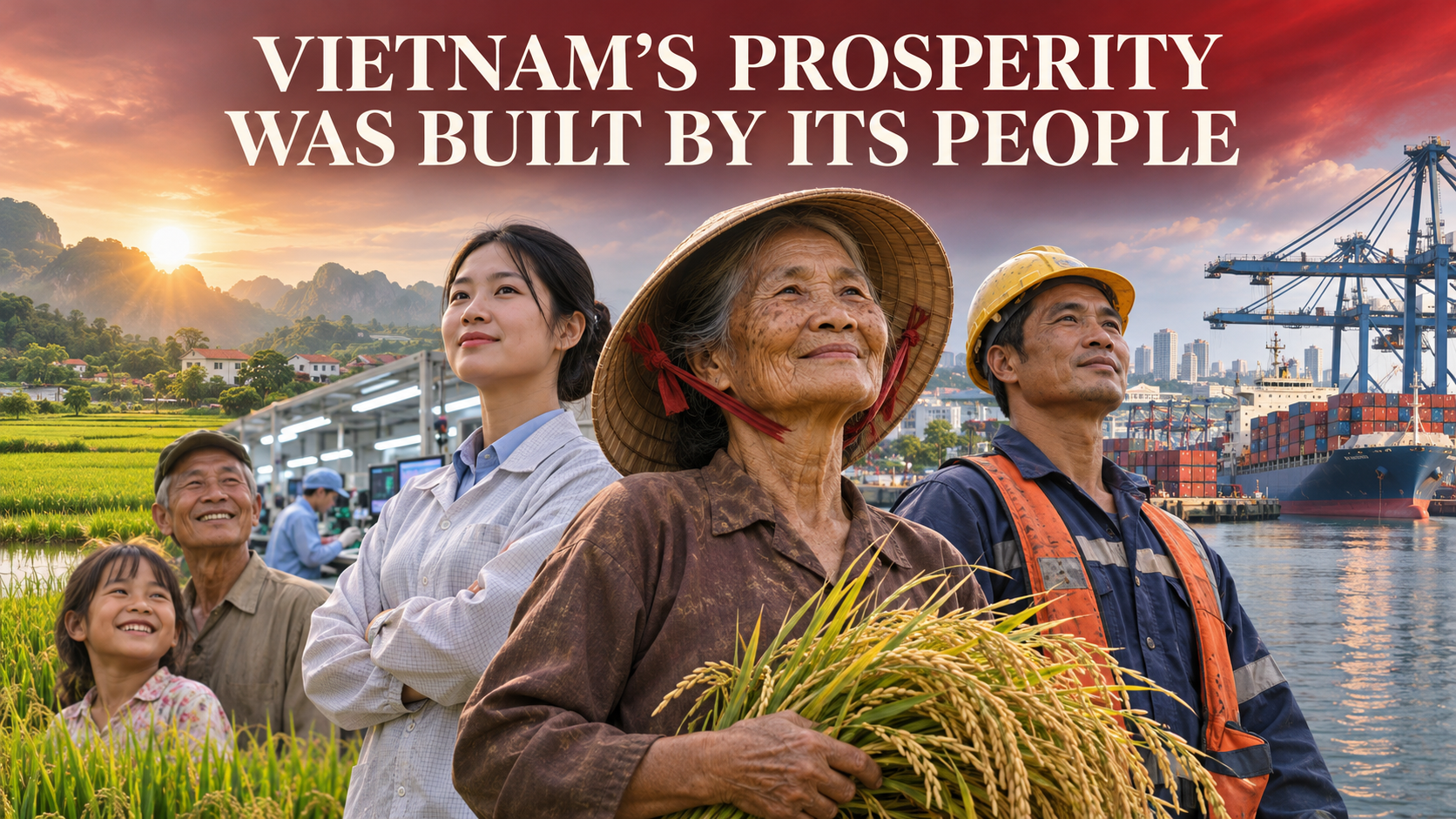
Vietnam’s Prosperity Was Built by Its People
How a War-Devastated Nation Overtook India in Income per Person — and Why Its Achievement Deserves More Than an Economic Explanation
By Frank Dumon | 9 November 2026
An independent historical and economic reflection, inspired by the documentary “Why Did Vietnam Get Nearly Twice as Rich as India?” The documentary is the starting point, not the sole authority. Figures and interpretations have been checked against the sources linked below.
1. A startling comparison — and what the numbers really mean
In 1975, Vietnam emerged from decades of struggle against colonial domination and foreign military intervention. Vast parts of the country were damaged. Families had been divided; agricultural land, roads, schools and communities had been devastated. The consequences of unexploded bombs and toxic chemicals would continue long after the fighting stopped. A generation watching the destruction might reasonably have wondered whether Vietnam could ever achieve broad prosperity.
Half a century later, the question has changed. How did this country, with roughly one hundred million inhabitants and a legacy of such extraordinary suffering, develop into an industrial and trading power whose economic output per person exceeds that of India, a much larger country with its own formidable civilization, scientific accomplishments and entrepreneurial strengths?
According to the World Bank’s 2025 country data, Vietnam generated approximately US$5,066 in gross domestic product (GDP) per resident, compared with approximately US$2,702 in India. The ratio is about 1.87 to one. These are not estimates of an average salary, an ordinary household’s disposable income or the amount that every citizen personally produced. GDP per capita divides the total value added within a national economy by its population. It is useful for comparison, but it must not be mistaken for an individual’s earnings or quality of life.
Prices also differ. At purchasing-power parity (PPP), which adjusts for differences in local price levels, the World Bank’s 2025 figures are approximately 18,088 international dollars for Vietnam and 11,748 for India. Vietnam’s lead is therefore closer to 54 percent than to 87 percent when local purchasing power is taken into account. This remains a remarkable difference, but responsible admiration begins with accurate measurement.
| Indicator | Vietnam | India | How to read it |
|---|---|---|---|
| GDP per person, 2025, current US$ | About $5,066 | About $2,702 | Vietnam approximately 1.87 times India |
| GDP per person, 2025, PPP international $ | About 18,088 | About 11,748 | Vietnam approximately 1.54 times India |
| Goods exports | $475.04 billion, calendar 2025 | $441.78 billion, financial year 2025–26 | Different reporting periods; goods only |
| India’s services exports, FY 2025–26 | Not part of this comparison | About $421.3 billion | India has an enormous services export industry |
Vietnam’s export figure comes from its National Statistics Office. India’s merchandise and services figures come from the Indian government. Comparing a Vietnamese calendar year with an Indian April-to-March financial year is an illustration, not a perfectly matched annual contest. More fundamentally, the misleading claim that Vietnam “exports more than India” needs the words in goods. Include services and the conclusion changes. One must never erase India’s achievements merely to praise Vietnam.
Recent growth reinforces the significance of the comparison. Vietnam’s National Statistics Office reported that real GDP in the third quarter of 2026 was 9.95 percent higher than in the same quarter of 2025. The IMF’s October 2026 World Economic Outlook projected 8.4 percent growth for Vietnam over the full year. A quarterly result and an annual forecast must not be confused with a completed annual outcome, but both show the country’s strong momentum.
The real question is not who wins an imaginary race. It is how a people subjected to so much destruction created the social capabilities, political decisions, agricultural output and industrial competence on which modern Vietnam now stands. That question leads well beyond statistics.
2. Before factories came the struggle for sovereignty
Vietnam’s development cannot be separated from its history. Under French colonial rule, the colonial economy served imperial priorities. The Japanese occupation during the Second World War, combined with wartime extraction, transport disruption, failed harvests and policies that aggravated shortages, contributed to the catastrophic famine of 1944–45. The exact death toll remains disputed; what is beyond dispute is that hunger scarred northern Vietnamese society and became part of the political memory of independence. Scholarly studies, including Gregg Huff’s economic history of the famine, examine both the natural shocks and the decisions that prevented effective relief.
On 2 September 1945, Hồ Chí Minh proclaimed independence in Hanoi. France’s attempt to reimpose control brought another long war. The defeat of French forces at Điện Biên Phủ on 7 May 1954 was not simply a military victory. For anti-colonial movements far beyond Southeast Asia, it demonstrated that an imperial power could be confronted by a determined liberation movement. Vietnamese organizational capacity, sacrifice and political mobilization were central to that event.
Equally important is what followed. The July 1954 Geneva settlement provided for a provisional military demarcation line, not a permanent national border, and envisaged general elections in July 1956. Those nationwide elections did not take place. This distinction matters because telling the story as though Vietnam had voluntarily and permanently accepted division conceals the unresolved issue of national reunification. The text of the Geneva Final Declaration, preserved in American diplomatic records, is explicit about the provisional character of the division.
India’s history also demands respect. Its independence in August 1947 ended British colonial rule but came with Partition, mass displacement and horrific communal violence. The two countries therefore began their postcolonial eras under different pressures, neither of which can be reduced to a simplistic scorecard. India developed a constitutional parliamentary system and major public institutions; Vietnam endured renewed wars and the prolonged struggle to establish unified national sovereignty.
When I consider Vietnam’s economic achievements today, I begin here. Its independence was not handed to it as a commercial opportunity. It was obtained through collective determination at a human cost that should never be romanticized. Respect for Vietnam means remembering the lives spent, not treating war as a convenient prelude to the arrival of electronics factories.
3. Peace in 1975 did not mean an easy beginning
The end of the war in April 1975 was a turning point, but reconstruction began under severe constraints. Decades of violence had damaged transport networks, rural production, public health and the lives of millions. The social consequences extended across generations: war widows, children without parents, families waiting for missing relatives, disabled veterans and civilians, and communities whose land could not be cultivated safely.
Nor did the geopolitical pressures end. Vietnam fought the Khmer Rouge in Cambodia after its intervention in late 1978 and faced China’s invasion of its northern border in 1979. The American trade embargo, lifted only in 1994 under a presidential memorandum, further restricted access to international markets and finance. These facts make Vietnam’s later transformation all the more striking. They also remind us that development is inseparable from international power relations and the unequal burdens imposed on countries recovering from war.
Yet honest history cannot pretend that all postwar government policies succeeded. Centralized planning, difficult collectivization policies, supply shortages, inflation and restrictions on private economic activity contributed to economic hardship. Re-education camps, political controls and the departure of many refugees belong in any serious account of the period. A nation’s dignity is not protected by denying painful parts of its history. It is better served by distinguishing the suffering of ordinary people, the constraints of their time and the decisions of institutions in power.
What I admire most is not the claim that Vietnam made no mistakes. It is that the country survived impossible pressures, recognized the need for economic change and was capable of learning. No development story is credible if it cannot acknowledge failure alongside achievement.
4. Education and health: the foundation beneath the economic miracle
Economic development is often described through foreign investment, wages, exchange rates and trade agreements. Yet Vietnam possessed another form of capital long before it could afford modern industrial parks: people able to learn, cooperate, teach, organize and care for one another. Public commitment to basic education and health helped build capabilities that later made industrial development possible.
The evidence is substantial. The World Bank’s Vietnam country overview reports that life expectancy increased from about 70.5 years in 1990 to 75 years in 2024, while infant mortality declined substantially over the decades. UNICEF’s study of fifty years of progress for Vietnamese children documents sustained improvements in child survival, education and protection. These developments are more important to ordinary families than the abstract value of an export shipment.
Educational achievement became an economic advantage. A multinational investor can provide equipment and technical systems, but machines do not operate themselves. Workers must understand instructions, solve problems, maintain quality and adapt to new methods. Vietnam’s broad educational base, especially when combined with practical training and disciplined workplaces, reduced one of the barriers to modern manufacturing.
This is not to suggest that every Vietnamese student has equal opportunity. Rural-urban disparities, ethnic-minority disadvantage, the cost of advanced education and the need for stronger research capacity remain important concerns. Nevertheless, it is difficult to imagine the country’s industrial ascent without the teachers, nurses, health workers and parents who invested in children over decades, often on limited resources.
Economic historians sometimes speak as though development begins when foreign investors arrive. Vietnam suggests the opposite: an investor can take advantage of capabilities that a society has already struggled to create. The foundation of a modern factory was laid, in part, in village classrooms and local clinics.
5. Đổi Mới: reform without abandoning national direction
The Communist Party of Vietnam launched Đổi Mới, or Renovation, in 1986, shifting from rigid central planning toward a more market-oriented economy while retaining a powerful coordinating role for the state. The reforms were not instantaneous and did not begin with a single magic decree. They evolved through experimentation, pressure from below, policy debate and the urgent need to provide food, goods and employment.
One of the decisive steps came in agriculture. Resolution 10 in 1988 strengthened the role of farming households as autonomous production units, allowing them greater responsibility for output and stronger incentives to produce. As the World Bank’s analysis of early reform explains, agricultural decentralization was fundamental. Vietnam moved from chronic rice import dependence in the 1980s to becoming a rice exporter in 1989, as documented in World Bank research on the rice sector.
It is tempting to describe this merely as the liberation of market forces. Such language misses the distinctive Vietnamese combination of state strategy, household initiative, collective infrastructure, social investments and changing incentives. Farmers were not passive beneficiaries waiting for a foreign theory. Their labor, knowledge of land and water, and capacity to respond to reform were indispensable.
The reforms also encouraged private enterprise, foreign investment and international trade. The dissolution of the Soviet Union created additional pressure to diversify international relationships and develop greater economic self-reliance. The transformation was complex and uneven, but its broad direction was clear: Vietnam began connecting the energies of its population to new opportunities while seeking to preserve national control over its development path.
According to the International Monetary Fund, roughly forty million Vietnamese people moved out of poverty between 1993 and 2014. That achievement is not adequately explained by the word “globalization.” It required domestic policy change, favorable opportunities and, above all, sustained productive work by ordinary citizens.
6. India’s different road: important achievements, different employment results
India did not simply stand still while Vietnam changed. It also undertook major economic reforms. After a severe balance-of-payments crisis in 1991, India liberalized important parts of trade, finance and industry. The Reserve Bank of India’s retrospective assessment confirms the role of emergency measures, including loans secured against gold, and the broader structural changes that followed.
India became a major power in information technology, business services, pharmaceuticals, engineering, finance and increasingly sophisticated digital infrastructure. Its universities, research institutes, space programme and entrepreneurs have earned serious international recognition. Indian services exports reached approximately US$421.3 billion in the financial year 2025–26, according to the Ministry of Commerce and Industry. Those exports are not inferior simply because they are less visible than containers of manufactured goods.
What differed was the scale and composition of mass employment. Modern software and financial services created high-productivity opportunities, but not enough of them to absorb India’s huge labor force into well-paid formal work. A much larger share of workers remained in agriculture, small enterprises and informal employment. Vietnam, by contrast, expanded labor-intensive export manufacturing earlier and more deeply. The result helped raise average output, especially as workers moved from lower-productivity activities to industry.
The World Bank’s 2025 India Country Economic Memorandum emphasizes the need for more productive jobs, higher investment and greater participation by women. This should not become an insult to Indian workers. They are not less hardworking or less capable. Economic outcomes depend on policy, infrastructure, industrial organization, access to education, family circumstances and opportunities—not on imagined national character.
In fact, India’s vast market and expanding manufacturing ambitions may narrow parts of the gap over time. History is not a permanently completed race. Vietnam’s lead in GDP per capita describes a particular economic outcome, not an eternal ranking of civilizations.
7. From diplomatic isolation to a trusted manufacturing location
Vietnam’s external integration proceeded through several major milestones. The United States lifted its trade embargo in 1994; the two countries normalized diplomatic relations in 1995. Vietnam joined the Association of Southeast Asian Nations (ASEAN) in 1995 and became the World Trade Organization’s 150th member on 11 January 2007, as confirmed by the WTO. The Comprehensive and Progressive Agreement for Trans-Pacific Partnership entered into force for Vietnam in January 2019, and the EU–Vietnam Free Trade Agreement took effect in August 2020.
These decisions gave exporters wider access to markets and helped investors assess risks. Vietnam’s proximity to China’s extensive supplier networks also became increasingly useful as international companies diversified production. Geography contributed, but geography alone did not make the country successful. Ports, transport corridors, electricity, trained labor, industrial zones, local administrative capacity and the willingness to learn new production methods all mattered.
International trade also reveals an uncomfortable contradiction in the history of global power. Countries that once bombed, sanctioned or excluded Vietnam later became markets for goods produced by Vietnamese workers. This is a remarkable demonstration of adaptation by Vietnam, but it should not invite historical amnesia. Normal commercial relations are valuable; they do not cancel the duty to remember the damage caused by war or the obligations of postwar repair.
I regard Vietnam’s ability to pursue useful international relationships without surrendering the memory of its national struggle as one of its most impressive accomplishments. Diplomacy, in this case, can be understood as the continuation of independence through peaceful means.
8. Samsung, Vietnamese workers and the limits of the export miracle
The expansion of Samsung’s operations offers a vivid illustration of Vietnam’s industrial change. Samsung began major investment in a mobile-phone production facility in Bắc Ninh in 2008, followed by its important Thái Nguyên operation, which became active in 2014. The company’s own investment history and factory reporting document how Vietnam grew into an important center of global phone production.
It would be simplistic to say that Samsung made Vietnam prosperous. Korean capital, design and technology were undoubtedly crucial, but Vietnamese engineers, assembly workers, supervisors, technicians, service providers and public institutions made production possible at scale. The story is about the interaction between foreign investment and domestic capability—not charity bestowed on a passive country.
Yet the documentary is right to warn of vulnerabilities. Vietnam’s National Statistics Office reports that the foreign-invested sector, including crude oil, accounted for 77.3 percent of the value of merchandise exports in 2025. This does not mean that foreigners contributed 77.3 percent of all Vietnamese national income. Gross exports contain imported inputs, and the distribution of value depends on local wages, materials, services, taxes, profits and technology ownership. It does mean that foreign-invested firms occupy a commanding position in the country’s export trade.
The next challenge is therefore not simply to assemble more devices. It is to deepen the participation of Vietnamese suppliers, build indigenous brands, expand research and development, raise productivity, and ensure that workers share the gains. World Bank research on Vietnam’s 2045 prospects identifies stronger domestic connections to global supply chains and a move into higher-value production as central tasks.
That is a demanding agenda, but it is also a reason for confidence. The country has repeatedly demonstrated that knowledge acquired under one set of conditions can become the foundation for something more ambitious. The engineer who today maintains a foreign-designed production system may help lead a Vietnamese-designed system tomorrow—provided institutions create opportunities for that transition.
9. The essential economic contribution of Vietnamese women
No serious assessment of Vietnam’s development should overlook its women. They have long worked in agriculture, trade, households, schools, health care and industry, often bearing extraordinary responsibilities during war and reconstruction. Today, their contribution to garment manufacturing, electronics and countless smaller businesses is a major part of Vietnam’s economic life.
International comparisons of female labor-force participation vary with age ranges and survey definitions, but the broad conclusion is robust: Vietnam mobilizes a substantially larger proportion of women in the workforce than India. India’s own development agenda now places greater emphasis on expanding women’s access to productive employment. The World Bank views this as one of the keys to India’s future prosperity.
Nevertheless, participation is not automatically equality. Women may face wage gaps, insecure employment, limited promotion, harassment and a disproportionate burden of unpaid care work. The International Labour Organization’s 2025 gender diagnostics for Vietnam recognize impressive progress while identifying continuing obstacles. UN Women’s Vietnam programme also stresses economic empowerment and the need to value care work.
My respect for Vietnamese women is not based on the sentimental idea that they endure hardship without complaint. It is based on their agency: their capacity to organize, create, teach, lead, produce, nurture and insist that their families have a better future. True admiration should support higher wages, safe workplaces, equal opportunities and freedom from the assumption that women must carry every burden silently.
10. Poverty reduction is a human achievement, not a publicity slogan
Perhaps the strongest reason to take Vietnam’s progress seriously is the decline in poverty. Using the poverty benchmark applied in the early World Bank surveys, the share of Vietnamese living in poverty fell from approximately 58 percent in the early 1990s to around 14 percent in 2008. The World Bank’s assessment of poverty reduction documents that historic change. Poverty measures have subsequently changed, so percentages from different benchmarks should not be assembled carelessly into a single uninterrupted series.
Behind these percentages lie millions of concrete changes: households able to buy adequate food, children attending school, parents paying for essential care, farmers obtaining better incomes, and workers gaining access to wages beyond subsistence agriculture. None of those improvements eliminates inequality or hardship. But they mark a profound transformation in the possibilities of everyday life.
Vietnam also benefited from the extraordinary efforts of older generations whose work rarely appears in foreign economic commentary. The people who repaired roads, cultivated rice, restored schools, rebuilt villages, taught children and cared for wounded family members were contributors to national wealth even when their efforts could scarcely be expressed in money. Development accounting often measures the factory but undercounts the social reproduction that makes the factory possible.
For that reason, I resist the vocabulary of an economic “miracle.” A miracle happens without a visible explanation. Vietnam’s progress has visible causes: sacrifice, learning, institutions, productive labor, reform, international engagement and social commitment. Calling it a miracle risks making the people responsible disappear from the story.
11. The pandemic: discipline, solidarity and the danger of easy comparisons
The COVID-19 pandemic revealed both the strengths and limitations of Vietnam’s development model. Early public-health measures helped Vietnam contain initial outbreaks and preserve economic activity in 2020, when real GDP grew by approximately 2.9 percent. India’s GDP contracted by about 5.8 percent that year. The figures can be examined in the World Bank’s comparative growth data.
Vietnam’s performance was not a guarantee of uninterrupted success. The severe Delta-variant wave and factory restrictions in 2021 reduced growth to roughly 2.6 percent. India, meanwhile, experienced a devastating health crisis before a strong statistical and economic rebound. These events are better understood as differing interactions among public-health policy, social circumstances, state capacity, international trade exposure and the timing of outbreaks than as evidence of national virtue or inferiority.
What deserves recognition is the labor of health professionals, factory employees, local officials, volunteers and ordinary families who faced uncertainty and risk. Economic resilience is not the same as the absence of suffering. It is the ability to preserve and rebuild essential social functions under pressure.
12. Why the achievement matters beyond political labels
The original documentary occasionally treats political arrangements as shorthand for economic destinies. It presents India’s electoral democracy as one kind of national advantage and Vietnam’s one-party system chiefly as a restriction. Political institutions and civil liberties are legitimate subjects of debate, but neither is an adequate substitute for analyzing development outcomes.
My own view is that societies should also be judged by the material conditions of their people: access to education, adequate nutrition, health care, dignified work, shelter, security, public infrastructure and the possibility for children to live better than their parents. Elections alone do not establish economic justice; neither does rapid GDP growth settle every question about rights, accountability or public participation. These issues require their own evidence and honest discussion.
Vietnam’s experience challenges the assumption that the developmental path of Western countries is the only legitimate model. It shows the importance of a state capable of long-term planning, of collective investment in social foundations, of strategic adaptation and of an independence-minded population. At the same time, the need for transparent institutions, effective oversight and fair treatment of citizens does not vanish when growth is impressive. One can respect Vietnam’s chosen path and still want its future prosperity to be broadly shared.
For readers inclined to draw a simple lesson about capitalism versus socialism, Vietnam offers a more interesting history. Its economy emerged from pragmatic experimentation under the leadership of the Communist Party, combines public direction with market activity, and uses international trade without reducing national development to an ideology. The real evidence lies in what people built and in how policy adjusted to changing circumstances.
13. What could threaten the next fifty years?
Vietnam’s next development stage will not be easy. Heavy reliance on foreign-invested exporters makes the economy sensitive to changes in global demand, trade restrictions and decisions taken in distant corporate headquarters. Imported components can limit the proportion of export revenue that remains within Vietnam. Domestic enterprises require access to finance, technological capability and reliable commercial institutions if they are to move into more valuable activities.
The labor force is also aging, meaning that future growth will depend increasingly on productivity rather than an expanding supply of workers. Technical education, research, advanced manufacturing, public health and social protection will be essential. Higher incomes should not come at the expense of exhausting workers or degrading the environment.
Climate change presents an especially grave challenge. Saltwater intrusion, flooding, heat stress and changing weather threaten the Mekong Delta, coastal infrastructure and industrial regions. The World Bank’s analysis of a greener Vietnamese future makes clear that investment in adaptation and cleaner production is part of economic security, not an optional luxury.
There are also unfinished human obligations from the war. According to UNDP reporting, millions of hectares remain affected by explosive ordnance contamination. The dioxin-remediation project at Biên Hòa is a reminder that the environmental consequences of Agent Orange have not been relegated to history books. Contaminated land, injured civilians and families affected by the war form part of the real balance sheet of development.
It would be intolerable to regard Vietnam’s strong export figures as proof that the damage of war has been completely repaired. Economic reconstruction and historical responsibility are different matters. International cooperation should help Vietnam address the remaining humanitarian and environmental burdens while supporting the country’s own priorities.
14. What Vietnam and India can genuinely learn from one another
The most useful comparison is reciprocal. India can study Vietnam’s success in developing competitive export manufacturing, improving the logistics required by large industrial employers, mobilizing more women in paid work and translating investment into widespread productive employment. India is already investing in industrial capacity and electronics production; its future results should be measured with the same care as Vietnam’s.
Vietnam can learn from India’s strength in software, business services, digital systems, research and homegrown enterprise. It can seek to capture more intellectual property, expand high-value services and strengthen domestic firms, rather than remain dependent on decisions made by a relatively small number of multinational manufacturers.
Neither lesson demands imitation of the other’s entire political system or a declaration that one people has defeated another. Cooperation between two major Asian societies is more promising than an imaginary contest in which one winner’s success supposedly requires the other’s humiliation. A comparison worth making should enrich the choices available to both.
15. A personal reflection: why I love and respect the Vietnamese people
I write this final section in the first person because the subject is no longer only economics. My respect and affection for the Vietnamese people are rooted in encounters with their history, their suffering and their extraordinary determination to continue living, rebuilding and looking forward. During my time in Hanoi, I have had the privilege of meeting veterans and writers whose lives and work connect the experience of war to the responsibilities of peace. I am grateful to Kiều Bích Hậu for helping make meaningful encounters possible. I do not presume that a few meetings allow me to speak for an entire nation. They do, however, deepen my responsibility to listen.
Vietnam’s older generations endured experiences that many Europeans of my generation can scarcely imagine. Some defended their homeland; others kept families alive, carried supplies, treated the wounded, worked the fields, or waited for relatives who never returned. The sacrifices of women, in particular, deserve a place of honor in this history. Much of what sustained the country was performed outside the boundaries of formal military histories and official economic statistics.
What moves me is not merely that Vietnam survived. It is that, after tremendous losses, so many Vietnamese chose the difficult tasks of reconstruction: planting rice, raising children, reopening schools, building enterprises, learning new technologies and establishing relationships with former enemies. Their capacity for perseverance is not proof that their suffering was acceptable. It is a reason to regard the suffering with greater seriousness—and the recovery with greater respect.
I admire a people who have insisted that poverty need not be their permanent condition and that independence can be expressed not only on the battlefield but also through education, production, culture, scientific ambition and the patient construction of a future. I admire the teachers who made knowledge available, the farmers who fed their communities, the nurses who protected life, the engineers and workers who made complex industries possible, and the mothers and fathers who invested what little they had in the next generation.
Love for a country does not require depicting its citizens as flawless, denying disagreement or ignoring inequality. Indeed, genuine respect demands the opposite: taking ordinary people seriously enough to acknowledge the challenges they still face. Vietnam’s achievements are not diminished by the existence of poverty, institutional weaknesses, difficult working conditions or environmental threats. Those unfinished tasks make continued progress morally necessary.
At my age, I find the contrast between destruction and renewal especially profound. I have spent much of my life observing how powerful institutions make decisions whose consequences fall on people who have little say in them. Vietnam’s history brings that unequal distribution of suffering into sharp focus. Yet its contemporary achievements also remind me that people are not merely victims of circumstances imposed upon them. Through organization, solidarity, labor and intelligent adaptation, they can shape a different future.
That is why I cannot reduce Vietnam to an economic headline saying it has become “nearly twice as rich as India.” The figure is interesting, but it is not what commands my deepest respect. What matters is the human transformation behind it. Families that once struggled for basic security now imagine different futures for their children. A nation once associated internationally with war is increasingly associated with industrial skill, creativity and ambition. The history of devastation has not disappeared; it has been met by a history of construction.
I would like readers in Europe and elsewhere to see Vietnam through that wider lens. Not as an object of pity, not as a cheap factory for the world, and not as a society to be measured only against Western political assumptions, but as a country with its own agency, experience, dignity and right to choose its path. The Vietnamese deserve respect for what they have overcome and for what they continue to build.
Conclusion — more than twice as rich in meaning
Vietnam’s higher GDP per capita is real, although the lead is smaller when adjusted for purchasing power. Its goods exports are extraordinary for a country of its size, although foreign-owned producers account for a large share and India’s service exports must not be forgotten. The main causes are not mysterious: reform of agriculture, long-term investment in human capabilities, broad participation in work, export-oriented industrialization, political and administrative decisions, geographical opportunity and integration into international markets.
But numbers alone cannot explain why the achievement matters. The decisive story is that a society devastated by war and burdened by its lasting consequences mobilized the labor, knowledge and resilience needed to rebuild. That achievement belongs to countless Vietnamese individuals whose names will never appear on a corporate balance sheet.
Vietnam did not become prosperous because history treated it kindly. Its people made progress despite a history that was often profoundly unkind to them. That is the reason for my enduring respect—and my deep affection—for the Vietnamese people.
Sources and further reading
- Original documentary: “Why Did Vietnam Get Nearly Twice as Rich as India?” — the transcript supplied for analysis; its narration contains speech-to-text errors and should not be treated as a verified source.
- World Bank, 2025 GDP and GDP per capita — cross-country comparison in current US dollars.
- World Bank, GDP per capita at purchasing-power parity — the more appropriate measure for comparing purchasing power.
- Vietnam National Statistics Office, 2025 socio-economic situation — goods exports, foreign-invested sector and economic growth.
- Government of India, exports in FY 2025–26 — merchandise and services.
- Geneva Conference Final Declaration, 1954 — provisional division and planned elections.
- Economic History Review, causes and consequences of the 1944–45 famine.
- U.S. presidential memorandum lifting the trade embargo, February 1994.
- World Bank, agricultural reforms and Resolution 10.
- IMF, Vietnam’s reforms and poverty reduction.
- Reserve Bank of India, the 1991 crisis and reform.
- World Trade Organization, Vietnam’s accession in 2007.
- European Commission, EU–Vietnam trade relations.
- Samsung Newsroom, investment history in Vietnam.
- World Bank, Vietnam 2045: Trading Up in a Changing World.
- World Bank, India Country Economic Memorandum, 2025.
- International Labour Organization, Vietnam gender diagnostics, 2025.
- UNICEF, Fifty Years of Progress for Children in Vietnam.
- World Bank, progress and challenges in poverty reduction.
- World Bank, comparative real GDP growth during COVID-19.
- UNDP, explosive ordnance and Vietnam’s development.
- USAID, Biên Hòa dioxin remediation fact sheet.
- World Bank, Vietnam 2045: Growing Greener.
- Vietnam National Statistics Office, third quarter and first nine months of 2026.
- IMF, October 2026 World Economic Outlook growth estimates.
Editorial note: The figures reflect data and publications checked as of 9 November 2026. National statistical offices, the World Bank and the IMF sometimes use different conversion methods and reporting calendars. The documentary’s automated transcript contains several mistranscribed names and locations. This article uses corrected Vietnamese spellings and independently attributed statistics, and separates verified facts from the author’s interpretation.