
The theater of power: how delusion and deception fuel a pointless war
The psychopathology of the commander-in-chief
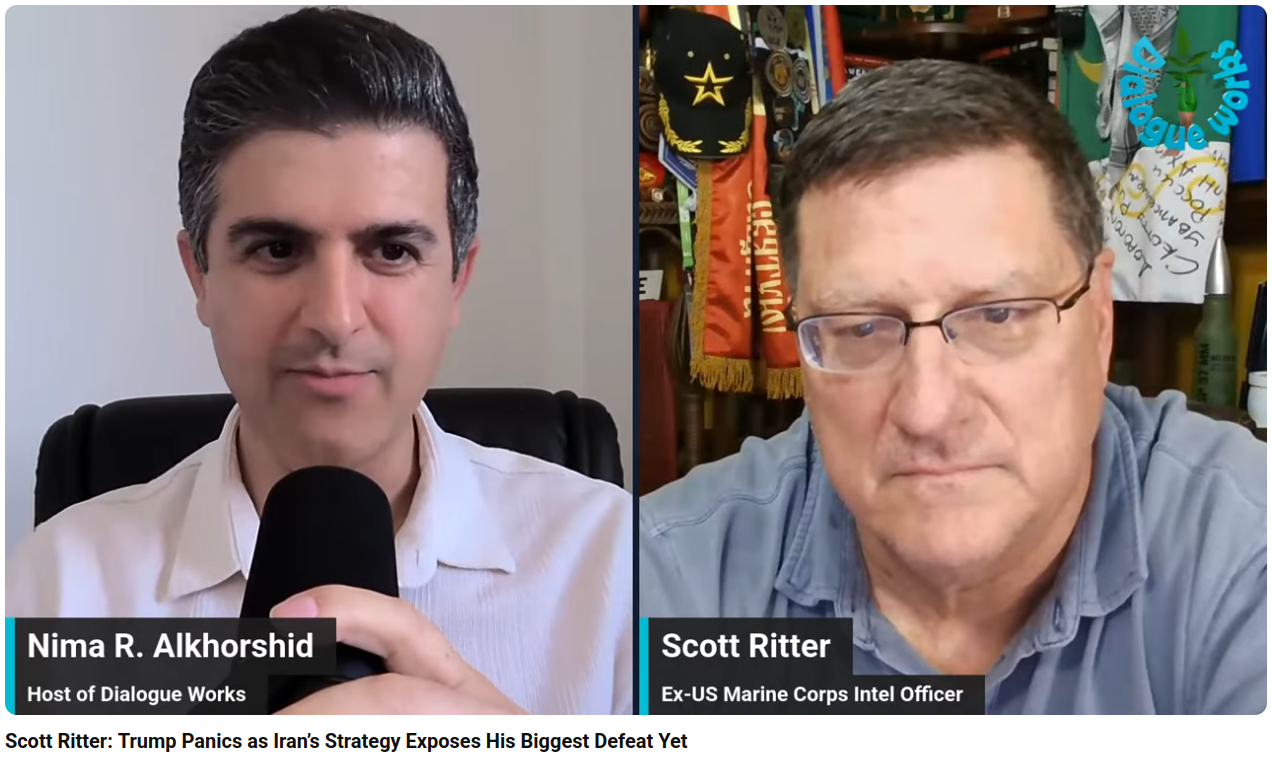
In a world where geopolitical games often overshadow reality, the ongoing confrontation between the United States and Iran has degenerated into a maze of appearances. A recent conversation between two outspoken analysts, Nima R. Alkorshid and former UN weapons inspector Scott Ritter – whose analyses I fully endorse – pulls back the curtain on the current crisis. Ritter’s diagnosis is characteristically blunt: the intertwining of Zionist influence and the current American leadership operates from a “pathological psychopathy,” a sentiment shared by military analyst Andrei Martyanov, who describes their actions as “demonic and satanic.” Although these terms are strong, the evidence presented in their discussion – focusing on the blockade of the Strait of Hormuz, failing intelligence, and the mental state of the American leadership – suggests that they are not exaggerations, but clinical descriptions of a policy detached from reality.
The Blockade as Political Theatre
The central point of contention is the US-imposed blockade near the Strait of Hormuz, a strategic sea lane for the global energy supply. According to the Trump administration and CENTCOM, the blockade is a masterful display of pressure, strangling Iranian trade. Ritter dismisses this, however, as pure “political theatre.” He points to a fundamental, glaring deficiency: the US Navy has no meaningful physical presence in the Strait itself. American warships operate at a safe distance, beyond the reach of Iranian missile defences. Consequently, they have no real control over who passes through.
Ritter endorses the Iranian narrative, which is based on observable reality: Iran retains de facto control over its territorial waters and collects transit duties, while American ships hang powerlessly on the horizon. The blockade is therefore not a military operation, but a staged production intended for domestic consumption. It creates the perception of American power so that President Trump can later claim that a diplomatic breakthrough was possible only because of his “maximum pressure.” This is policy as performance art, with the lives of nations at stake for a presidential soundbite.
Ritter leaves no doubt about the man in the White House. He describes Donald Trump as suffering from a “malignant narcissistic personality disorder,” a man incapable of self-reflection and whose ego is as large as the moon. This psychological profile is not merely a character flaw; it is a driving force behind policy. Trump started this war, according to Ritter, on the basis of false assumptions sold to him by Israeli Prime Minister Benjamin Netanyahu and the Mossad. They promised regime change and the suppression of Iran’s missile strike capability. They delivered neither.
But instead of admitting his mistake, Trump’s psychosis compels him to double down on his strategy, blame others (such as Vice President Vance, who was sent to Islamabad without any room to negotiate), and invent victories. He believes that “a massive bombardment automatically equals victory because the enemy is intimidated.” When the Iranians refuse to acknowledge their supposed defeat, Trump becomes “frustrated and bewildered.” This is the logic of a bully who cannot understand resilience. Backed by the full destructive power of the US military, this psychological distortion becomes demonic – turning strategic blindness into war crimes, as Ritter notes, referring to the bombing of evacuated facilities and civilians under the guise of “maximum lethality with minimal legality.”
The Decay of Politicised Intelligence
Perhaps the most frightening part of the analysis concerns the complete collapse of the American intelligence apparatus. Ritter, an experienced intelligence officer, explains how the system is doomed to fail when the leadership demands a specific narrative. The Israelis may have had good intelligence in June, but by the time it reached Trump in February, it was a fossil. The Iranians, realising that their networks had been compromised, “shuffled the deck” – they changed everything.
The critical error, however, is cultural. In today’s Washington, no one has the courage to tell the president that the war’s basic assumptions are a lie. As Ritter puts it: junior analysts see their bosses looking ahead to promotions and bonuses based on the “good news” they deliver. Presenting contrary evidence would be career suicide. As a result, the US is not fighting the Iran that exists; it is fighting a fictional Iran – a caricature of radical, irrational ayatollahs that exists only in the PowerPoint presentations of flatterers. This is the satanic bargain Martyanov speaks of: trading truth for power, resulting in a war that serves no one except those who profit from chaos.
The Unseen Iran: Pragmatic Patriots
The greatest Western blind spot, as emphasised by Alkorshid and Ritter, is the refusal to see Iran as it really is. Western media and politicians paint a picture of a “radical, ideological regime.” Yet Ritter points to the obvious: after 40 days of war, Iran has not attacked civilians at random. They have attacked military infrastructure – radars, CIA offices, Mossad bases. They do not act מתוך nihilistic rage, but from a cold, pragmatic understanding of deterrence.
Ritter stresses that Iran is a constitutional republic, not a theocratic dictatorship run by crazy mullahs. The Supreme Leader ensures religious conformity, but the president (the head of the Supreme National Security Council) governs the state. The Iranian negotiators who came to Islamabad were not ideologues; they were professionals, armed with economic, legal and political experts. They were ready to make a deal. The American delegation, by contrast, was hollowed out – lacking technical experts, staffed by political spin doctors whose only task was to ensure that Trump could claim victory. By refusing to legitimise Iran’s conservative patriots (who distrust the West because the West has repeatedly betrayed Iran), the US radicalises them further, creating a self-fulfilling prophecy of conflict.
Saudi Arabia and the New World Order
The war has fundamentally altered the calculations in the region. Scott Ritter notes that Saudi Arabia has, for the first time, publicly said that Riyadh will determine its own policy, not Washington’s. The Carter Doctrine – the American guarantee of security for the Gulf in exchange for policy alignment – is dead. The Saudis see how the American navy is kept at a distance by Iranian missiles; they see how China tells a grovelling delegation from the UAE that “you do not tell the dragon what to do.” The unipolar moment is over.
Ritter concludes that the US “under Donald Trump is incapable of working with other countries.” The only way the US will adjust its behaviour is through defeat. Iran has successfully resisted the United States militarily and economically. The war has not broken Iran; it has exposed the hollowness of the American bluff. The “demonic” nature of the current administration lies in its refusal to accept this reality, forcing the world to endure endless suffering because a narcissist in Washington cannot admit that he was wrong.
Conclusion
Scott Ritter and Andrei Martyanov do not use the terms “psychopathy” and “satanic” lightly. They use them clinically to describe a model of governance that has abandoned reality, empathy and strategic logic. When a superpower is led by a malignant narcissist, fed by a corrupt intelligence service and advised by foreign interests pursuing their own genocide, the result is not foreign policy; it is a crime scene. The people of Iran and the broader Middle East are paying the price for Washington’s theatre, and until the American people demand the truth, the curtain on this tragedy will never fall.