
South Vietnam Before 1975: Education, Power, Urban Culture and the Struggle over Memory
From the Classrooms and Cinemas of Saigon to Bảo Đại, Ngô Đình Diệm and the Music of Trịnh Công Sơn
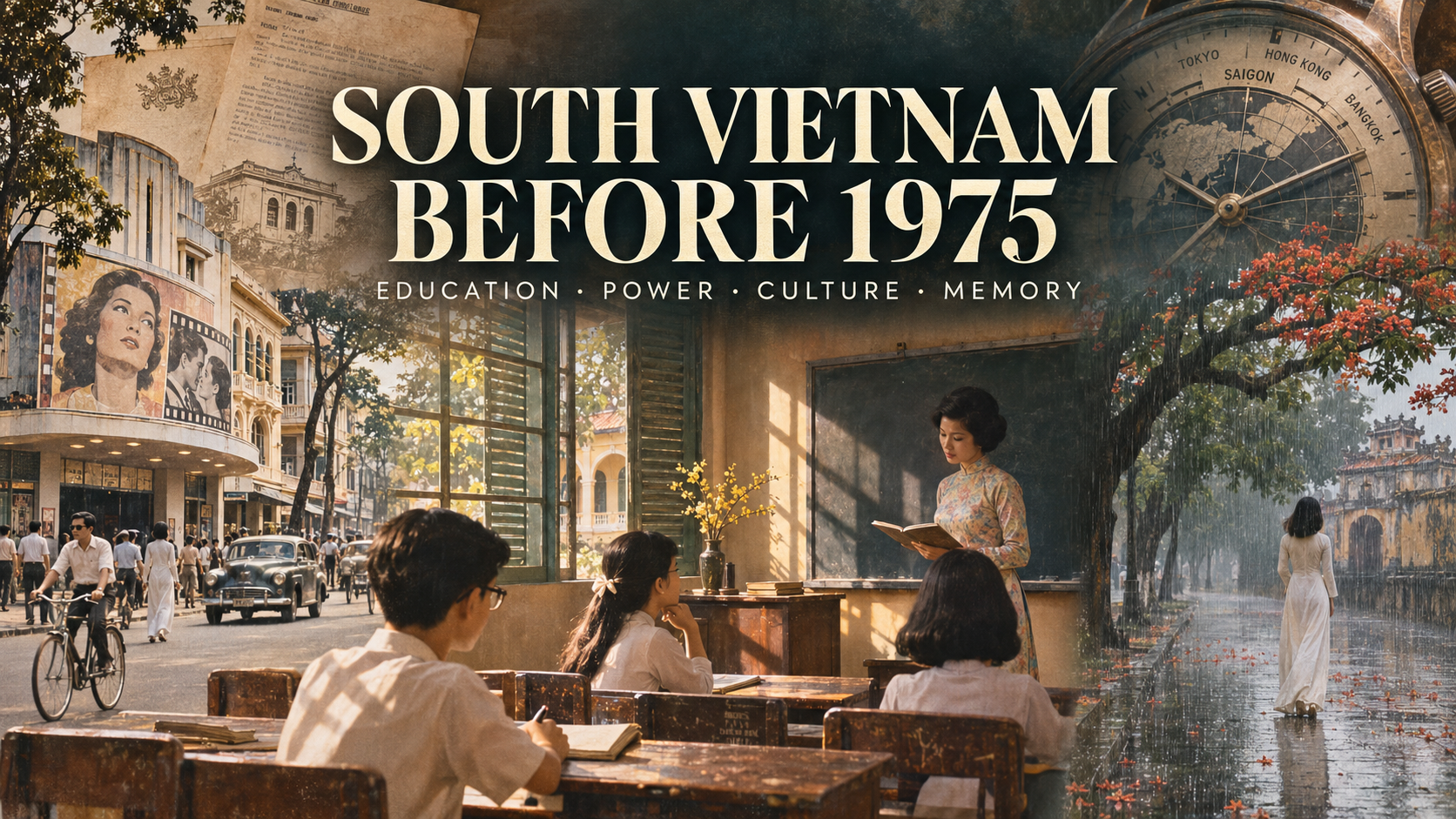
A historical essay exploring six windows onto the former South Vietnam — attending to what people remember with affection, what those in power preferred to forget, and what the available historical evidence actually reveals.
By Frank Dumon
Introduction — A Country That Cannot Be Contained in Two Memories
Anyone who speaks about the past in Vietnam soon discovers that a historical date does not bring a history to an end. On 30 April 1975, the war in South Vietnam came to an end and the Republic of Vietnam collapsed. The country was subsequently reunified under a single political system. Yet people's memories did not disappear that day. One family remembers the liberation of a country that had endured decades of colonial rule and foreign intervention. Another remembers the loss of a familiar school, a profession, a home, a family member, or a way of life. Others carry both experiences within them.
The six Vietnamese texts on which this essay is based form an unusual yet revealing collection. One author defends education in South Vietnam before 1975. Another directs his anger at historians who, in his view, misrepresent the past. A third describes the struggle for power between the last emperor, Bảo Đại, and Ngô Đình Diệm. Alongside these are seemingly lighter stories: the name Saigon on a Swiss world-time wristwatch, the emergence of cinema culture, and the wistful story behind Diễm xưa, a song by Trịnh Công Sơn. At first sight, these subjects seem to have little in common. In fact, they all concern the same question: who decides what a society remembers?
It is tempting to answer that question with political labels. For one reader, South Vietnam was a Western-backed state that obstructed national liberation. For another, it was an imperfect but valuable social experiment, with its own schools, institutions, artists and urban traditions. Both perspectives reflect real historical experiences. Neither is sufficient to describe the entire lives of millions of Vietnamese people.
This article therefore takes a deliberately different path. It recognizes the cultural, educational and personal achievements of people who lived in the South without concealing the colonial legacy, struggles for power, inequality, war or authoritarian character of particular governments. It likewise recognizes the importance of the struggle for independence and reunification without turning that victory into a license to erase every other memory. The voices in the texts provided remain audible, but their claims are treated as historical viewpoints, not automatically as established facts.
1. The Long Background: South Vietnam Did Not Begin in 1954
To understand the society south of the seventeenth parallel, we must go much further back than the Cold War. Over centuries, the region around Gia Định, Chợ Lớn and Saigon was shaped by Vietnamese migration, the presence of Khmer communities, Chinese trading networks, agriculture, rivers, markets and contacts with the outside world. The French conquest of Cochinchina in the nineteenth century profoundly altered that landscape. New roads, ports, schools, administrative systems, printing houses and urban buildings appeared, but this material modernization went hand in hand with military domination, economic exploitation and political inequality.
That distinction is essential. A railway might serve Vietnamese passengers while having been built to advance colonial interests. A school could help a Vietnamese intellectual develop while also promoting French values and administrative needs. A cinema could expand the imagination while also spreading images of colonial power. The colonial legacy is therefore neither simply a collection of benefits nor an account devoid of social change. It is a history of unequal power relations in which Vietnamese people found limited opportunities, then used and expanded them in their own ways.
After the Second World War, that tension became impossible to sustain. In 1945 Hồ Chí Minh proclaimed the independence of the Democratic Republic of Vietnam. The return of French power led to a prolonged war. The Việt Minh victory at Điện Biên Phủ in May 1954 accelerated the negotiations in Geneva. The agreements provided for a provisional military demarcation line and the regrouping of armed forces. The final declaration of 21 July 1954 emphasized that this line was not to become a political or territorial boundary and envisaged general elections in July 1956. The representatives of the State of Vietnam did not accept this political arrangement, and the United States did not bind itself as a signatory to the final declaration either. It is therefore historically incorrect to say that Geneva permanently divided Vietnam into two countries; it is equally incorrect to pretend that the subsequent dispute over the elections was not a genuine diplomatic and political issue.[1]
In the North, a socialist state developed under the leadership of the Vietnamese Communist Party. In the South, an anti-communist state structure continued, evolving from the State of Vietnam into the Republic of Vietnam. Both political projects claimed, in their own ways, to represent the national interest. The South did not speak with one voice: it was home to non-communist nationalists, Catholics and Buddhists, liberal and conservative intellectuals, members of religious communities, revolutionary sympathizers, ordinary farmers, urban workers and people who wanted little more than a safe family life.
The mass movements of people in 1954–1955 made this social landscape even more complex. Hundreds of thousands — nearly a million, according to many historical studies — moved from the North to the South. They brought languages, educational traditions, religious practices, professional knowledge and traumas with them. Others moved in the opposite direction. Behind the strategic maps were families who had to begin their futures again, often under difficult circumstances.[2]
2. Bảo Đại and Ngô Đình Diệm: Two Responses to the Colonial Past
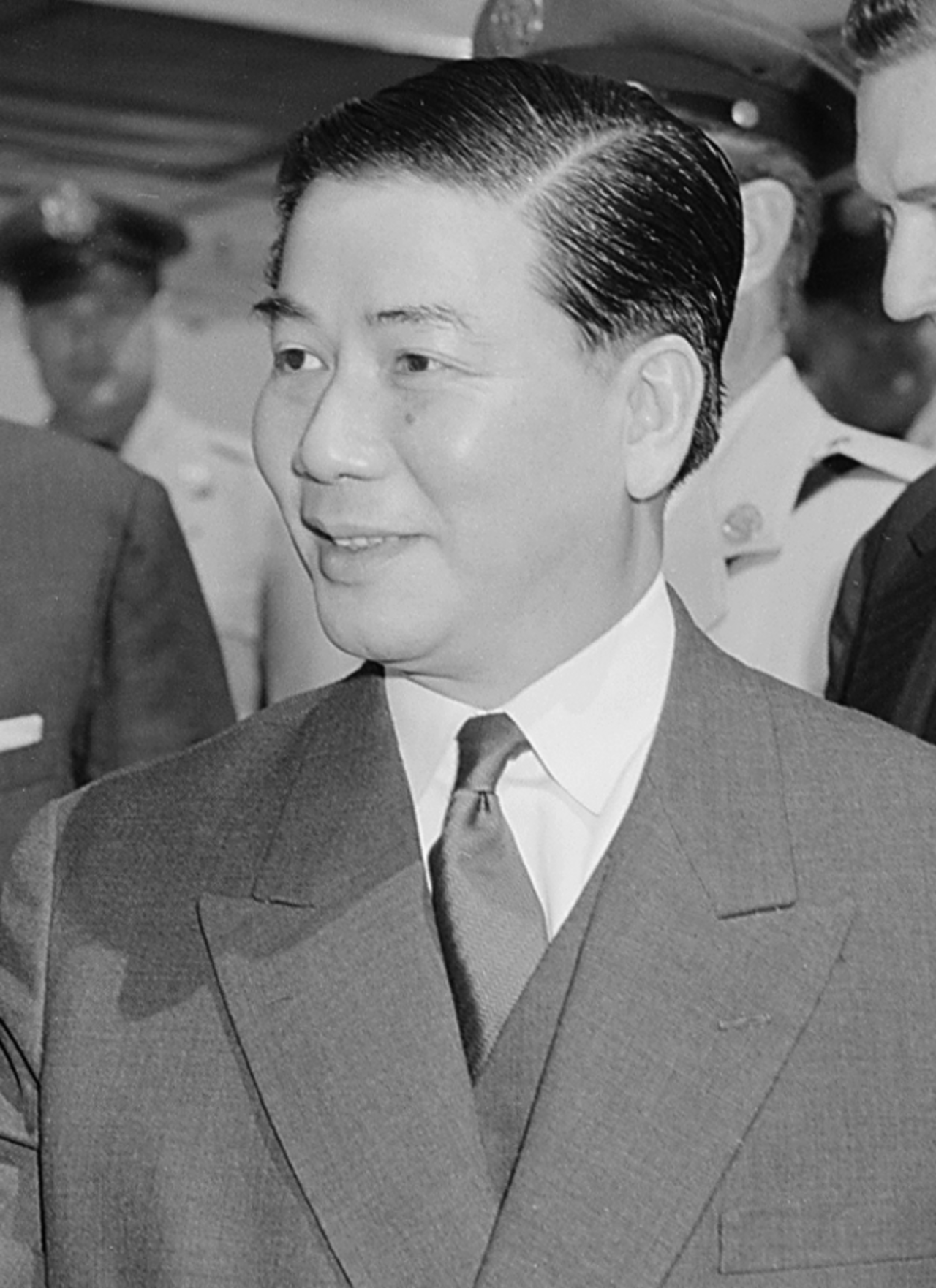 The relationship between Bảo Đại, the last emperor of the Nguyễn dynasty, and Ngô Đình Diệm is one of the most revealing episodes in the political history of the South. They do not represent a simple contest between an old monarchy and a modern democracy. Both sought a form of Vietnamese political independence; both had to maneuver in the face of the French presence and growing American influence; and both operated in a society in which the communist resistance had become a powerful political and military force.
Bảo Đại had been educated within the French colonial world and remained closely connected to it. To his supporters, this made him a potential intermediary; to his critics, it made him a symbol of a dependent and exhausted political order. Diệm came from a mandarin family, had held high office under the monarchy and presented himself as an outspoken anti-communist nationalist. His political career cannot be explained solely by describing him as an instrument of Washington, but neither can it be separated from the American support that became decisive to the survival of his government.
The Vietnamese text supplied refers at length to Bảo Đại's memoirs, in which the former emperor describes how he supposedly asked Diệm on several occasions to assume governmental responsibility. A dramatic scene in which Diệm is said to have sworn before a crucifix to defend his country takes on particular significance. Such passages are historically interesting: they show how Bảo Đại wished to portray their relationship in retrospect, as a matter of duty, personal trust and national responsibility. But a memoir is never a neutral transcript. It is the recollection of a directly involved political figure, written with knowledge of how events turned out. Without comparison with independent documents, the dialogues should not be treated as verbatim, independently established facts.
In 1954 Diệm faced an almost impossible task. He had to build a government challenged by rival military and religious groups, develop an authoritative national army and manage the consequences of migration from the North. His government succeeded in centralizing parts of the administrative and military apparatus. To supporters, this demonstrated political resolve. To opponents, it marked the construction of a power system increasingly unwilling to tolerate dissenting voices. Both judgments concern real aspects of the same project of government.
3. The 1955 Referendum: A Republic Without a Free Choice?
On 23 October 1955, voters were invited to choose between Bảo Đại and Diệm. The official result gave Diệm an overwhelming majority and cleared the way for the proclamation of the Republic of Vietnam. Anyone looking only at the formal result might imagine that the transfer of power was an uncontested expression of the popular will. The historical documents, however, tell a more complicated story.
American diplomatic records from the period describe an extremely one-sided campaign: government information services conducted massive propaganda in favor of Diệm and against Bảo Đại. Streets and squares were filled with humiliating caricatures of the former emperor. The official result of more than 98 percent for Diệm and the exceptionally high turnout also raised questions among American observers about the credibility of the outcome. At the same time, one embassy report stated that observers at the polling stations they visited did not everywhere find direct evidence of fraud or intimidation. That distinction matters: the unequal campaign is well documented; the precise extent of any manipulation of the count cannot be inferred from a single diplomatic report.[3]
A genuinely democratic choice requires more than a polling booth. It requires an opportunity for different parties and candidates to speak freely, persuade citizens and publicly challenge the outcome. It was precisely in this respect that the referendum fundamentally failed. The fact that Bảo Đại had lost political credibility did not make the procedure democratic.
In the original account, Diệm appears as a man who initially hesitated to depose his former sovereign. That, too, may be a meaningful recollection, but a historical assessment must distinguish the symbolic scene from the political act. Royal legitimacy was replaced by a republican presidency that in practice became strongly concentrated around one individual and his family.
This is not merely a legal detail. The crisis of legitimacy shaped the rest of the war. The government in Saigon rejected the general elections envisaged for July 1956, invoking the absence of political freedoms in the North and its own position regarding the Geneva final declaration. The leaders in Hanoi regarded the failure to hold those elections as an obstruction to reunification. The United States, France, the Soviet Union, China and other powers increasingly treated Vietnam as a stake in an international struggle for power. A Vietnamese question thus once again became an international conflict, with consequences extending far beyond the personal rivalry between Bảo Đại and Diệm.
4. Ngô Đình Diệm: State-Building, Repression and the Crisis of 1963
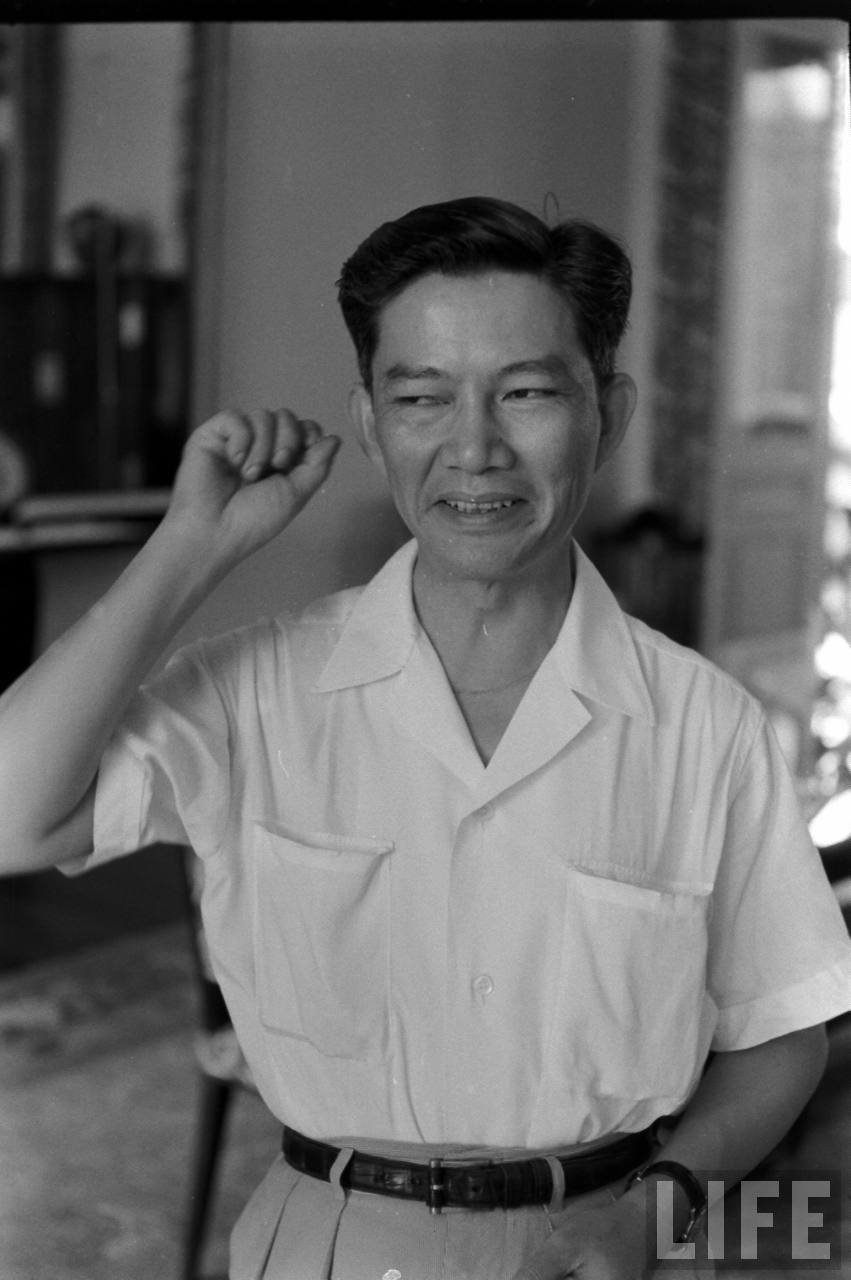
To call Diệm merely a puppet is to disregard his own political outlook, nationalism, mistrust of French influence and ambition to establish a strong Vietnamese state. To portray him exclusively as a savior is to disregard his regime's repressive practices and the hostility his government aroused among different parts of the population. History begins when such contradictions are confronted together.
Diệm and his brother Ngô Đình Nhu believed that their state could not survive without forcefully combating the communist organization in the South. The resulting measures affected not only armed opponents but also suspected sympathizers and other dissidents. Political centralization, security services and the power of the presidential family weakened confidence in independent institutions. These domestic tensions were compounded by guerrilla warfare, sabotage, military pressure and the ever-growing involvement of foreign allies.
The Buddhist crisis of 1963 revealed how deeply the gulf between the government and sections of the population had widened. Demonstrations, deadly violence, arrests and raids on pagodas provoked outrage in Vietnam and abroad. American policy documents from August 1963 warned that martial law and the suppression of Buddhist protests would further alienate the public from Diệm.[4] In November the situation culminated in a military coup in which Diệm and Nhu were killed. American diplomatic contacts with the conspirators form part of the documented background to that upheaval; an extensive historical literature examines the precise responsibilities and decisions involved.[5]
The notion that authoritarian measures were necessary and should therefore be praised as virtues in retrospect is explicitly present in the supplied text about Diệm. It is the voice of a political tradition that placed order and the survival of the state above other values. One can explain that view historically without endorsing it. A sincere fear of communist domination did not give a government unlimited authority to decide who did or did not belong to the nation. Nor does the later American escalation automatically make Diệm's opponents morally or politically right in every respect.
Perhaps the most important lesson is that national independence, security and civil liberty cannot simply be played off against one another. A state that declares one value absolute and subordinates every other value to it risks ultimately losing even the first.
5. The School as a Promise: Humanism, National Identity and Openness
It is precisely against this political background that education in South Vietnam acquires its historical significance. The first text in the supplied collection is imbued with respect for teachers. Its author recalls a school in which a teacher derived authority from knowledge and responsibility, where pupils learned to show respect and where continuity with Vietnamese cultural tradition was highly valued.
This was not an invented tradition. Research from the University of Huế explains how, at the national education congress of 1958, three principles became guiding ideas for the educational philosophy of the Republic of Vietnam: nhân bản (humanism or respect for the person), dân tộc (national identity), and khai phóng (openness, personal development or liberal education). These principles sought to combine the dignity of the individual, a connection to Vietnamese history and culture, and receptiveness to scientific and international knowledge.[6]
The combination deserves serious attention. In principle, humanism placed the pupil at the center as a person, not merely as a future worker or citizen. National identity meant that educational reform need not entail cutting cultural roots. Openness referred to the ability to absorb knowledge from elsewhere without losing sight of one's own society. These were ideals, not proof that every school achieved them. Yet ideals can have historical consequences: they influence which questions teachers may ask, which books are read and what kind of human being a society hopes to educate.
South Vietnamese education retained elements of the French school structure, including forms of examination, teacher training and organizational traditions. Vietnamese educational reforms in the 1940s, associated with the name Hoàng Xuân Hãn, also played a role in the gradual Vietnamization of education. French remained important, but Vietnamese educators increasingly took charge of content, curricula and the training of new generations.
Remarkably, recent historical research at Vietnam National University in Hanoi does not fit neatly into the old political divide. A doctoral study on education in South Vietnam explicitly acknowledges the system's pedagogical achievements: teacher training, international contacts, the ambition to build an independent national education system and the drive for reform. At the same time, it points to the effects of war, financial constraints, administrative instability and the enduring legacy of elite education.[7] The very fact that such nuanced studies are appearing in present-day Vietnam contradicts the assertion that there is room only for a single unchanging official narrative.
6. Teachers and Their Authority: Between Ideal and Reality
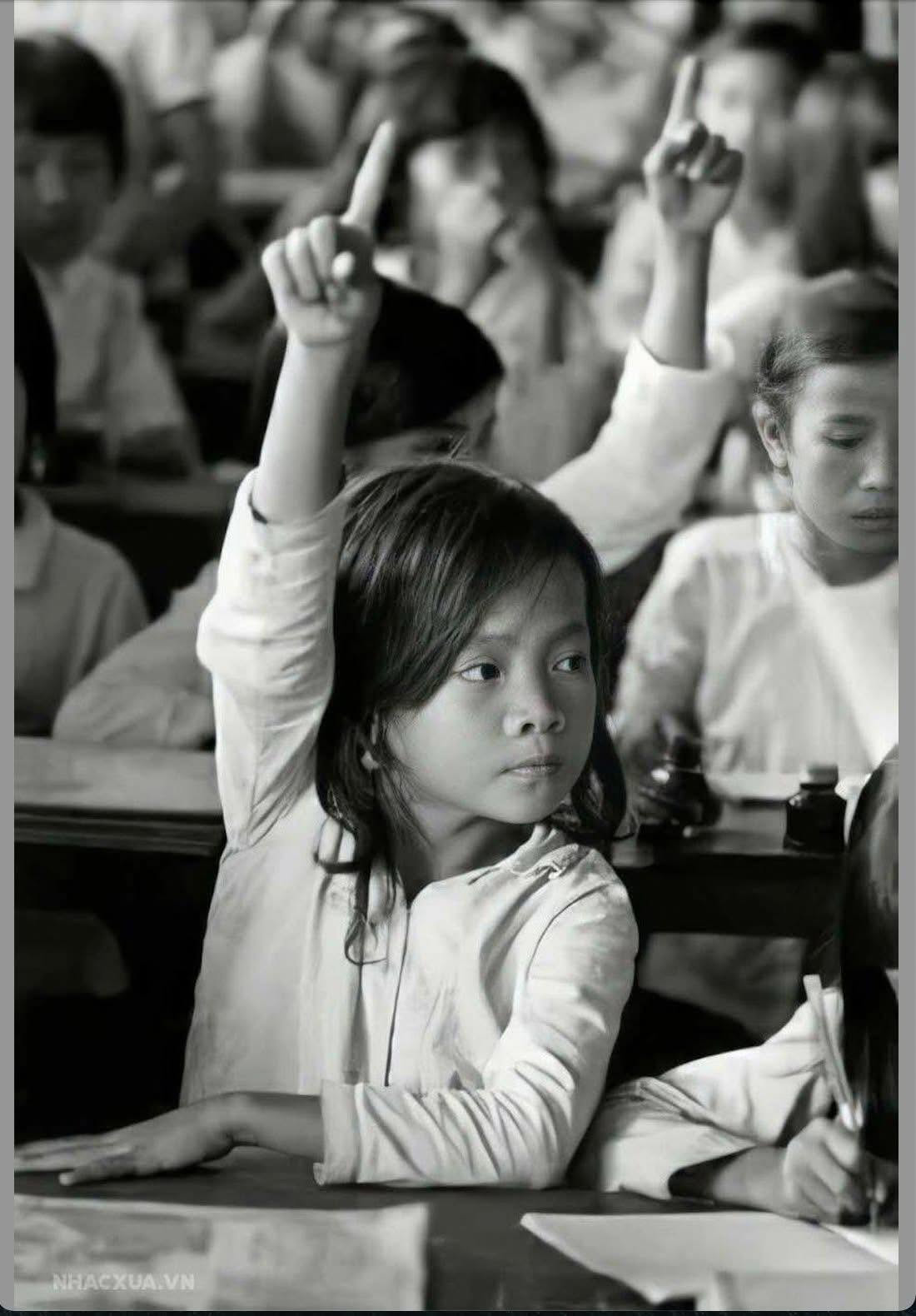 Memories of South Vietnamese schooling repeatedly return to the same details: the moment a teacher entered the classroom, pupils standing up, careful corrections in exercise books, the emphasis on courtesy and the conviction that knowledge carried a responsibility. For former students, these are not incidental details. They are rituals through which a child learns to belong to a relationship between generations.
Many schools bore the names of historical figures, writers and scholars. In this way, pupils were connected to a history older than the government financing their school. This could provide a healthy form of historical continuity. But even such choices are never entirely free from politics: which figures are regarded as national heroes, which conflicts are left unmentioned and who receives a monument in the schoolyard always reflect ideas about the nation.
The original text claims that politics virtually stopped at the school gates. That image requires qualification. Educational philosophy had its own professional logic, but war, ideological conflict, student demonstrations, censorship and administrative decisions did indeed enter educational life. The assertion that schools remained entirely outside the political conflict is therefore untenable. At the same time, the commitment of countless teachers must not be reduced to state propaganda. In difficult circumstances, they sought to protect pupils, organize examinations and preserve educational quality.
Another necessary distinction concerns access to schooling. The memories of a pupil from Saigon, Huế or Đà Lạt may differ considerably from those of a farmer's child in a war zone. Displacement, poverty, bombing, mobilization and the need to work limited many young people's educational journeys. Anyone who wishes to assess education in the past must ask not only how much a successful former student learned, but also how many children never managed to reach a classroom.
This does not make the educational philosophy any less interesting. On the contrary, it subjects that philosophy to a fundamental test. A system that takes human dignity as its starting point must not merely offer excellent schools to those with access; it must also open doors to those excluded by birth, poverty, disability, war or place of residence. From this perspective, the legacy of South Vietnamese education is above all an invitation to think critically, not to repeat nostalgic slogans.
7. Writing History: Who Owns the Past?
The second text supplied is less a historical study than an angry indictment. Its author accuses certain historians, publishers and institutions of incompetence, political conformity and even falsification. His anger focuses, among other things, on interpretations of old Vietnamese documents and on how errors in public exhibitions were allegedly allowed to persist.
The question behind this polemic is legitimate: what happens when a society confuses historical authority with an official title? A professor can be mistaken. A museum can publish an incorrect description. A school textbook can repeat an oversimplification until pupils accept it as unquestionable truth. Scholarship therefore requires verifiable citations, comparison of documents, a willingness to correct errors and open debate. That is true in Hanoi, Huế and Ho Chi Minh City just as it is in Paris, Brussels or Washington.
But the text also makes a leap that a responsible historical essay cannot follow. There is no evidence to justify moving from a number of alleged errors to the conclusion that an entire generation of Vietnamese historians is ignorant or dishonest. Some specific allegations — for example, concerning the precise reading of an old imperial document in Đà Nẵng — deserve separate investigation based on the original Hán-Nôm text, earlier transcriptions and the interpretations of specialists. Without that evidence, such accusations cannot be published as established facts.
The political division after 1954 also produced not one but several interpretations of history. In the North, Marxist interpretations and the history of the anti-colonial revolution occupied a central position. In the South, anti-communist nationalism likewise served at different times to legitimize those in power. After 1975, the history of victory long dominated public institutions, while memories of the defeated Republic of Vietnam were more often preserved within families or overseas communities. The diaspora, in turn, developed accounts that sometimes idealized the South and examined the role of its own leaders less critically.
Today, historical scholarship is not a stationary monument. New archives, university studies, family collections, oral testimonies and transnational cooperation have broadened research. That process deserves support. Not because all interpretations are equally valid, but because an open history of Vietnam must be larger than the self-image of any government or community in exile.
What would that mean in practice? A textbook that describes colonial exploitation but also explains how Vietnamese teachers adapted the colonial school system to their own needs. A museum that presents resistance to American intervention while also taking the experiences of ordinary citizens in Saigon seriously. A study of Diệm that neither excuses the killing of political opponents nor denies the nationalism of his supporters. And a history of 1975 in which liberation and loss are not treated as mutually exclusive terms, but as different experiences within one national history.
8. Saigon on a Swiss Watch: World City, Symbol and Misconception
 One of the most charming parts of the supplied texts concerns a Swiss watch bearing the name Saigon . It refers to Patek Philippe world-time watches, including the rare reference 2523, whose production began in 1953. The mechanism was based on a concept by Louis Cottier: the wearer could read both local time and the times in other parts of the world on a single dial. An outer ring displayed the names of cities used as time-zone references. Christie's auction catalogues confirm the production dates and technical features of various examples; historical watch descriptions document that Saigon did indeed appear among the city names on such rings.[8]
For many Vietnamese people, that little word means more than a technical detail. It evokes the image of a city sustained by shipping, international trade, diplomacy, foreign visitors and a mixture of languages. It offers a tangible sense of connection with the wider world.
Yet a correction is necessary. The presence of Saigon on the dial does not mean that a Swiss manufacturer had officially selected the forty most important or beautiful cities on Earth. On world-time watches, the place names served above all a practical purpose: they made time zones recognizable. The number of cities displayed also varied between versions. The original text further associates an exact sale price and particular rarity with one specimen; without identifying the precise watch, including its reference, case number and auction, those details cannot be attributed to every model.
The moving quality of the watch lies elsewhere. A city is more than its political name. For those who knew it as Saigon, that name remains bound to youth, markets, schools, theaters and family memories. For others, Ho Chi Minh City is the name of a unified and rebuilt Vietnam. Both names tell a different part of the history of the same metropolis. A watch dial from the 1950s can thus become a surprisingly small but powerful witness to the past.
9. The Cinema: How a Colonial Invention Became a Vietnamese Experience
The story of the cinemas takes us back to a Saigon that existed long before the Republic of Vietnam, when moving pictures still seemed miraculous. On 6 October 1898, the weekly newspaper Nam Kỳ advertised a performance then described in Vietnamese as hát hình máy . An advertisement for the screening of moving images is among the earliest known documents concerning public film exhibitions in Saigon. Vietnamese researchers have drawn renewed attention to the notice. Appropriate historical caution is required, however: an early documented screening is not necessarily the absolute first time moving images were shown anywhere in Vietnam.[9]
The announcement listed different kinds of scenes, a starting time and ticket classes. This is a revealing detail. From the outset, cinema was both a new art form and a commercial space, in which audiences were divided according to what they could afford. Urban life acquired a new rhythm: people arranged to meet, bought tickets, watched in amazement and told others the next day what they had seen.
During the first decades of the twentieth century, permanent cinemas and multipurpose venues emerged. French exhibitors, foreign distributors and local entrepreneurs all contributed to that development. Historical recollections mention such names as Casino, Eden and Majestic, alongside many smaller neighborhood cinemas. Some venues offered comfortable seats, private boxes and strict rules of conduct. Others were basic, hot, noisy and affordable to patrons of modest means. The original text depicts those contrasts with an eye for detail: it is a history of city dwellers gathering to watch stories unfold on a screen.
Yet once again, the picture is not entirely innocent. In colonial Indochina, moving images were also used to glorify the French presence and promote the prestige of the colonial state. Film formed part of an unequal cultural market initially dominated by French productions and commercial interests. At the same time, Vietnamese audiences incorporated cinema into their own lives. They did not necessarily see what colonial producers wanted them to see; they brought their own desires, humor and interpretations to the screen.
The development of a distinct Vietnamese film culture was uneven, but it was not simply a passive extension of the colonial project. Later, popular music, theater, cải lương, film publications and private enterprise flourished alongside one another in Saigon. Cinema became a place where global culture and Vietnamese creativity met. Anyone who discovers an old film poster or a photograph of a vanished theater today is looking at more than nostalgia. It is evidence of the ways in which ordinary citizens helped shape the modern city.
10. An Urban Culture That Did Not Represent the Entire South
It is important to understand why such memories remain so vivid. Stories about beautiful watches, the Majestic cinema, French cafés, elegantly dressed audiences and prestigious secondary schools often come from educated urban circles. They are valuable, but they are not representative of all the inhabitants of South Vietnam.
For many families outside the cities, everyday life looked very different. Rice cultivation, floods, tenancy arrangements, seasonal work, religious festivals and family obligations determined their existence. As the war intensified, displacement, shelling, forced evacuation, military presence and fear occupied an ever larger place. One young person sat in a cinema; another sought shelter with the family. One father worked as a civil servant; another had to leave his rice field behind. A recollection of urban refinement becomes historically persuasive only when it can coexist with such experiences.
That does not mean that Saigon and Huế were merely artificial showcases of foreign influence. It means that every capital is a selective mirror of its country. The cultural creativity of artists, teachers and entrepreneurs was real. So were the poverty, inequality, political tensions and suffering of civilians. The term South Vietnam refers not to a single way of life but to a collection of markedly different worlds linked by war and politics.
11. Trịnh Công Sơn and Diễm xưa: The Power of an Unfinished Memory
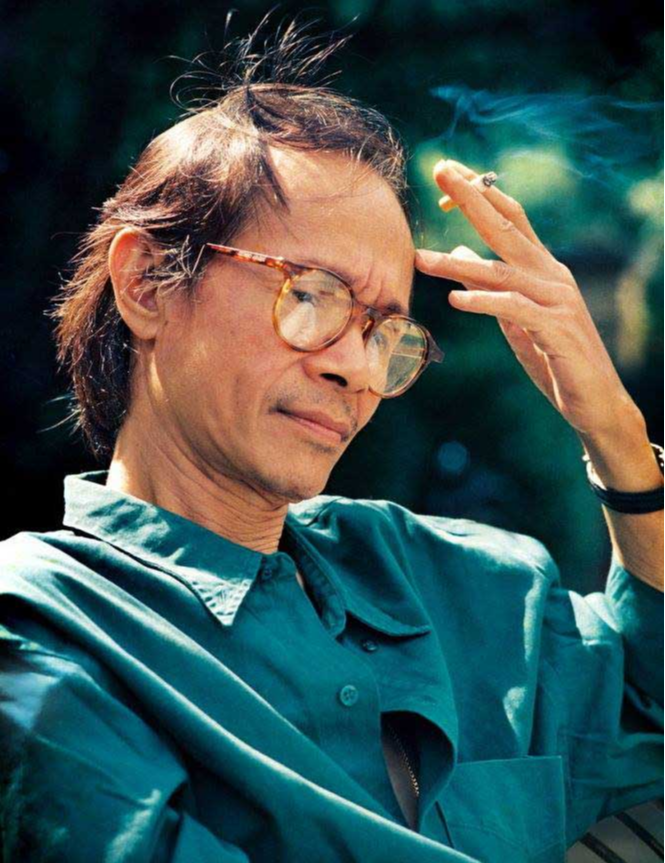 In the final part of the supplied texts, the tone changes. Political struggle briefly recedes and gives way to the image of a young woman walking to school beneath the trees of Huế. She is Diễm, associated with one of Trịnh Công Sơn's best-known love songs. The city, rain, bridge, trees and passing figure merge into a memory that has grown larger than the biography of two individuals.
The heart of the story is well documented. In a personal reflection from 1997, Trịnh Công Sơn wrote about a young woman who regularly walked past his home on her way to university, along avenues of camphor trees and across a bridge. For him, she became bound to the distinctive landscape and rhythm of Huế. His recollection was not about a dramatic meeting but about repetition, distance and imagination. The name he gave to that world was Diễm.[10]
Later Vietnamese accounts identify her as Ngô Thị Bích Diễm. At a gathering in Huế in March 2010, she spoke about her youth, her former neighborhood and the memories the song brought back. Some romanticized details in the supplied text — the precise first encounter, the exact evening on which the first notes were supposedly played, or the suggestion that the composer's entire body of work became possible only through this one love — are literary interpretations, not verifiable historical facts.[11]
Yet such a correction does nothing to diminish the beauty of the story. Perhaps it makes that beauty even greater. A young woman did not need to be a mythical muse to move an artist profoundly. A passer-by can grow in another person's memory into the symbol of an entire city and a lost time. The historical person has her own life; the artwork follows its own course through the world.
Trịnh Công Sơn also offers an important answer to the simplistic division between North and South, communist and anti-communist. His love songs resonated widely, but it was above all his anti-war songs that made him an exceptional cultural figure. His music could be banned by the authorities in the wartime South and regarded with suspicion after reunification as well. Scholars describe how, despite political resistance from different directions, he became an enduring voice of sorrow, humanism and the longing for peace.[12]
That is precisely why Diễm xưa belongs in a historical essay about South Vietnam. The song reminds us that people are not exclusively political beings. They fell in love, waited for someone to pass by, wrote letters, listened to music, longed for a different future and felt the pain of passing time. Anyone who describes the war solely in terms of generals, governments and front lines loses sight of that human life.
12. What Changed in 1975 — and What Endured?
Vietnam's reunification marked the end of a long period in which colonial war, foreign intervention and political division had torn the country apart. For countless Vietnamese people, it was a victory for which generations had made enormous sacrifices. That historical fact deserves recognition. But we come no closer to understanding it if we assume that one victory immediately erased every social difference.
After 1975, state institutions and education systems were merged and reorganized. For some, this brought new opportunities and a stronger sense of national unity. For others, it meant the loss of employment, changes in property ownership, political exclusion or departure abroad. People who lost a school, a public office or a place in their community often carried those memories for decades. Nor should the experiences of Vietnamese refugees be set against those of people who remained in the country.
Present-day Vietnam meanwhile offers more opportunities for historical and cultural research than the harsh language of older polemics would suggest. Scholarly research into education in the former Republic of Vietnam provides a concrete example. There is also room in contemporary Vietnamese culture to appreciate anew the music of Trịnh Công Sơn, old photographs of Saigon and the heritage of colonial and postcolonial buildings. This does not mean that every discussion is free or every historical controversy resolved. It does show, however, that national memory can evolve and that political history and cultural heritage need not coincide forever.
This brings us back to the educational principles of humanism, national identity and openness. Perhaps it is precisely because they were formulated by people living in a state that no longer exists that they deserve to be discussed again in a different historical setting. A valuable idea need not disappear with a regime. Conversely, a historically important idea need not be glorified merely because one regards the world in which it emerged with nostalgia.
13. Six Memories, One Responsibility
The six original texts show how varied social memory can be. Admiration for teachers is a plea for the dignity of education. The indictment of historians reminds us of the need for critical source verification, while also warning against the harm caused by unfounded allegations. The account of Bảo Đại and Diệm portrays a period in which national independence, political legitimacy and authoritarian power were painfully intertwined. The world-time watch bears witness to Saigon's place in international networks. The cinemas show how a colonial technology became part of an indigenous urban life. And Diễm xưa tells us that a song can sometimes preserve more human truth than a triumphant political monument.
The same historical discipline applies to all these subjects. A memory is not worthless because it is subjective. On the contrary, memories are indispensable sources for emotions, meanings and experiences rarely fully captured in official records. But a memory is not automatically an exact description of events either. It must be compared with other voices, documents, photographs, newspapers, oral histories and scholarly research. This is not distrust of witnesses. It is respect for the complexity of their lives.
The word reconciliation also demands precision. Reconciliation does not mean forgetting colonial domination, war crimes, political repression or the responsibility of foreign powers. Nor does it mean portraying every political project as equally valid or innocent. It begins with a willingness to recognize that people within the same history hoped, acted, suffered and remembered in different ways. That can happen only when no one claims the exclusive right to speak on behalf of all Vietnamese people.
A pupil who remains grateful to a former teacher need not therefore defend the presidency of Ngô Đình Diệm. Someone who takes pride in Vietnam's independence and reunification need not deny that important educational institutions, books, songs and cultural forms developed in the South. And a music lover moved by Trịnh Công Sơn need not first declare which political camp they belong to. Human dignity cannot be neatly divided into two ideological columns.
Conclusion — History Belongs to the Living and the Dead
Imagine a classroom in Saigon, a crowded cinema in Chợ Lớn, a young woman walking to school beneath the trees in Huế, and a watchmaker in Geneva engraving the name Saigon on a metal ring. None of these images tells the history of South Vietnam on its own. Together, however, they reveal how much more a society is than its governments.
There is therefore no need either to glorify or to condemn the past of South Vietnam as one undivided whole. It deserves research, recognition, criticism and human attention. The political history from 1954 to 1975 was a history of competing claims to independence, international intervention, violence and extraordinary sacrifices. But it was also a history of teachers teaching, parents raising children, students asking questions, artists searching for beauty and citizens trying to carry on with ordinary life despite the war.
Perhaps the most fruitful starting point is also the simplest: no Vietnamese life should be judged solely by the camp that held power at a particular moment. Anyone who truly wants to understand the past must listen to the victims of colonial domination, the fighters for independence, the inhabitants of the former South, the refugees, those who stayed, the teachers, workers, farmers and artists. Not to erase historical differences, but to see the full human cost of the twentieth century.
History can then become more than a struggle for the last word. It can become a meeting between memory and evidence, between national pride and self-criticism, between grief and dignity. And perhaps that is precisely what the finest Vietnamese cultural traditions, on both sides of the former dividing line, have always asked of us: not a monopoly on truth, but the courage to keep seeking it together.
Sources and Editorial Note
This essay is a historical adaptation of six supplied Vietnamese texts. It is not a literal translation and does not automatically endorse the political opinions of the original authors. Where the source texts contain a personal memory, an unsubstantiated claim or a polemical characterization, this is made clear in the analysis.
- United Nations, Geneva Agreements, 20–21 July 1954; see also the final declaration in the U.S. diplomatic archive.
- Diplomatic History, study of refugee resettlement, 1954–1956.
- U.S. Department of State, diplomatic report on the Diệm–Bảo Đại referendum, 1955.
- U.S. Department of State, assessment of martial law and the Buddhist crisis, August 1963.
- National Security Archive, documents concerning the November 1963 coup.
- Phạm Ngọc Bảo Liêm, study of the educational philosophy of the Republic of Vietnam (University of Huế, 2022).
- Nguyễn Kim Dung, doctoral research on education in South Vietnam (Vietnam National University, Hanoi).
- Christie's, auction catalogue for a 1953 Patek Philippe Ref. 2523; historical overview of the model; description of the city ring, including Saigon.
- Tuổi Trẻ, historical research into Saigon's early cinema audiences and the 1898 advertisement.
- Trịnh Công Sơn, Diễm của những ngày xưa, personal recollection from 1997.
- VOV, report on the meeting with Diễm in Huế in 2010.
- John C. Schafer, research on Trịnh Công Sơn, Journal of Asian Studies (2007).