
Social Murder in America
How the American oligarchy perpetuates a culture of impunity and violence
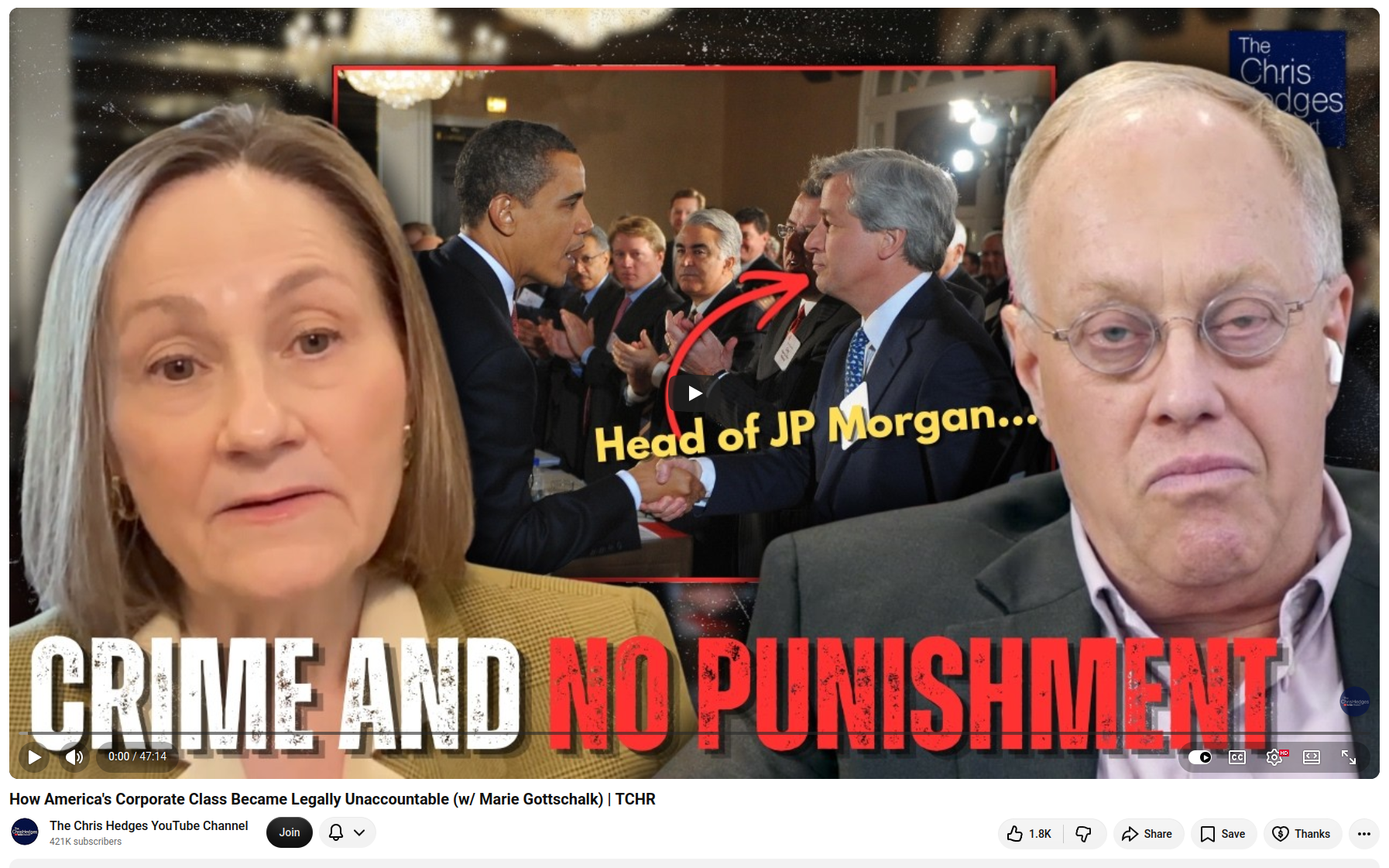
The United States likes to present itself as the shining example of democracy and prosperity, but behind the facade of the "indispensable nation" lurks a dark reality. America is exceptionally violent, exceptionally unequal, and exceptionally relentless in punishing the poor while the rich go free. In her groundbreaking book *Crime and No Punishment: Wealth, Power, and Violence in America* (2025), Marie Gottschalk, a political scientist at the University of Pennsylvania, dissects what she describes as a system of "social murder" – a term she borrows from Friedrich Engels. The growing concentration of economic, political, and military power, Gottschalk argues, drains vital resources from American society, pushes more and more people to the margins, and normalizes violence and death to a degree that deviates substantially from other Western countries.
By Frank Dumon
Introduction
The numbers are staggering. The American life expectancy has historically fallen below that of many poorer countries. Millions of Americans are at risk of losing their homes, their health, their livelihoods, and their savings. Tens of millions of loaded weapons lie ready in American households, waiting for a moment of civil unrest. And the electoral system, once the crown jewel of American democracy, is in mortal danger from escalating political violence. This article, based on an in-depth interview that Chris Hedges conducted with Gottschalk and supplemented with her academic work, examines the three pillars of this crisis: the erosion of public health and welfare, the militarization of domestic security, and the political disruption that results from it.
Part I: The Erosion of American Life Expectancy
A Historical Turning Point
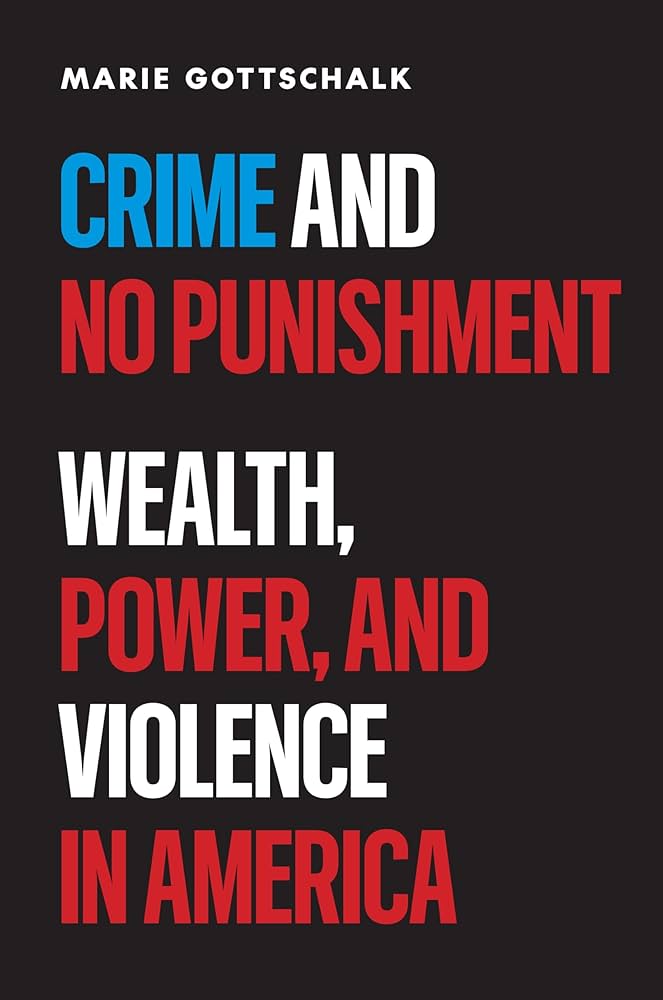 In the opening chapter of *Crime and No Punishment*, titled "Social Murder," Gottschalk paints a disturbing picture: "The United States is an exceptionally militarized, lethal, and violent country." What distinguishes this country from other Western democracies is not only the scale of violence but the systematic manner in which economic and political elites sustain violence and even profit from it. In a historic reversal, American life expectancy has fallen below that of many poorer countries, while a growing number of Americans risk losing their homes, health, livelihoods, and savings.
This decline is not a natural phenomenon. It is the direct result of policy choices that prioritize the interests of the rich over the well-being of the population. Gottschalk emphasizes that the United States increasingly shows an inability or unwillingness to curb violence in all its forms. Powerful economic and political interests make less powerful groups and individuals more vulnerable to premature death and other harms – what Engels called "social murder."
Mortality Rates That Scream
The numbers speak for themselves: the US has exceptionally high rates of homicide, gun violence, suicide, drug overdoses, incarceration, traffic fatalities, poverty, and police violence compared to other Western countries. What stands out is the multiplicity of forms in which violence manifests itself. It is not only the street violence that makes headlines, but also what Gottschalk calls "deaths of despair" – deaths caused by despair, suicide, alcoholism, drug overdoses, and chronic diseases.
These deaths of despair are not individual tragedies; they are the symptom of a society that structurally abandons its citizens. The de-industrialization that affected American cities from the 1950s and 1960s has now also reached rural areas. After the signing of NAFTA and the relocation of production to Mexico, China, and Vietnam, millions of Americans lost their livelihoods. Without work, without prospects, and without a safety net to catch them, many turned to alcohol, drugs, or the gun.
The Legacy of the Great Recession
Gottschalk points to the lasting traumatic impact of the Great Recession of 2008 as a crystallizing moment. Millions of people lost their homes – an estimated nine to ten million families would eventually lose their homes, about two-thirds through foreclosure. The largest mass migration since the Great Depression took place. People lost their pensions, their healthcare, and their trust in the system.
What made the wound even deeper was the realization that no one was held accountable. The banks that had caused the crisis were bailed out with hundreds of billions of dollars in taxpayer money. The top executives remained in their positions, often with substantial bonuses. The Obama administration supported a flawed mortgage plan that, as we now know, was primarily designed to give the banks some breathing room, not to help the people who were about to lose their homes. Gottschalk cites Obama's own defense: if we had brought these corporate leaders to court, it would have been "violence against the social order." The irony is not lost – while millions of Americans lost their homes, their pensions, and their futures, punishing those responsible was apparently a greater threat to social order than the misery in which they were left.
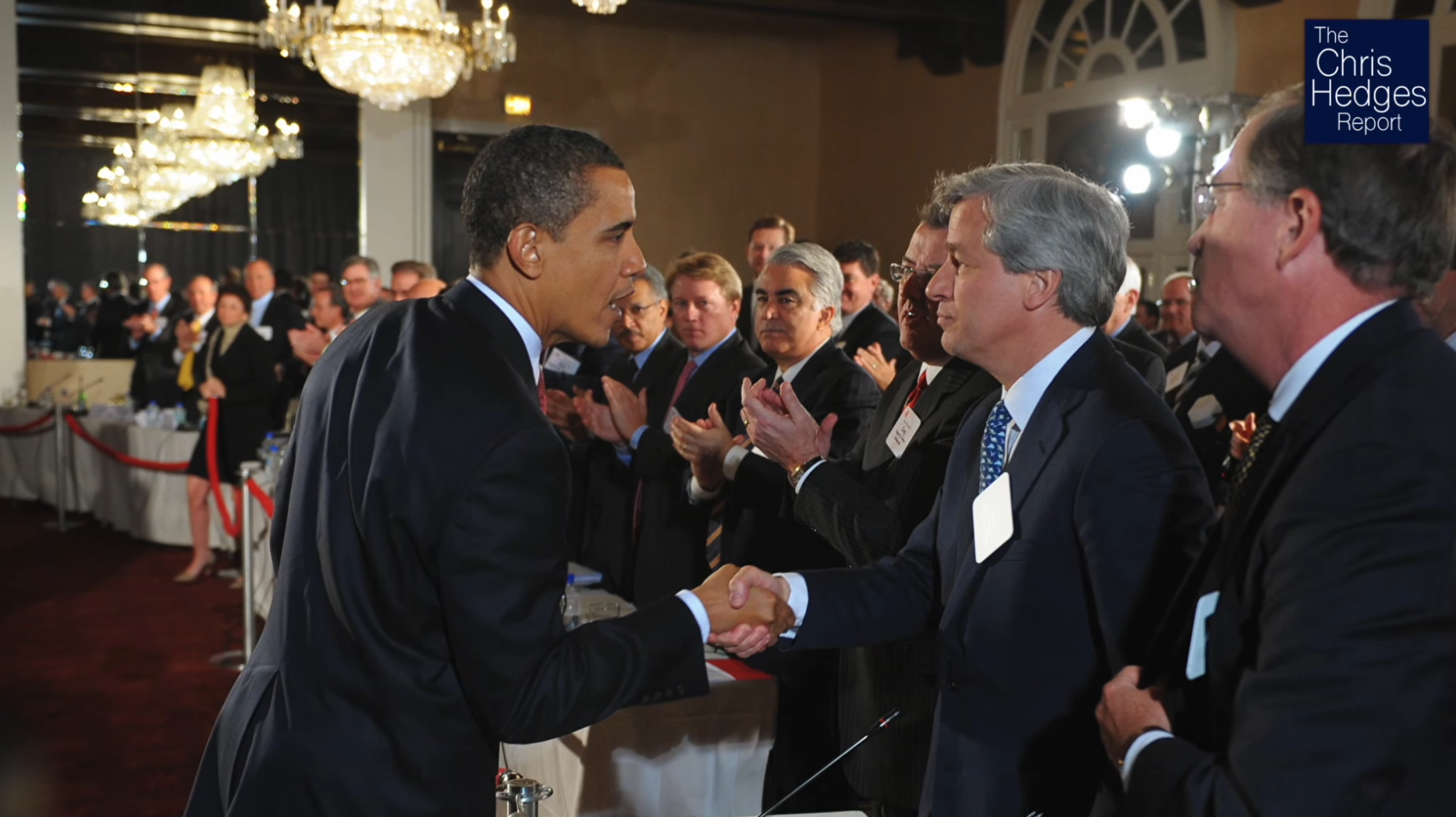
President Obama selling America to the Zionist bankers with Jamie Dimon
This event undermined trust in government at a fundamental level. And that trust has never been restored. Gottschalk emphasizes that the Obama administration had a historic moment to fundamentally restructure the banking sector. After the bailout, there was broad support, including from Republicans, for strict regulation. But Obama hesitated, the financial sector regrouped, and the opportunity was lost.
Part II: The Two Faces of Criminal Justice – Street Crime versus Corporate Crime
The Blind Spot of Criminology
One of the most striking revelations in Gottschalk's work is her own confession: for years, like most other criminologists, she had largely ignored corporate crime. "It's crazy," she admits in an interview with *Corporate Crime Reporter*. "This book is in a way my *mea culpa*. Why didn't I do that? Why didn't I teach more about corporate crime?" She can't blame her education – she's a political scientist, not a criminologist, and only came into contact with the prison system later. But she acknowledges it was a "real blind spot." She was so focused on the problem of mass incarceration and the role of race that she simply overlooked corporate crime.
This blind spot is not accidental. It is institutional. In criminology programs and sociology programs, white-collar crime is rarely taught. Attention remains fixed on street crime – theft, robbery, drug trafficking – while the much greater damage caused by corporate crime and economic violence remains largely undiscussed. Gottschalk argues that this focus on street crime is not only an academic blind spot but also a political instrument. By creating hysteria about street crime, attention is diverted from corporate crime. You create panic about one while covering up the other.
The De Facto Decriminalization of Corporate Crime
While the US incarcerates more of its citizens than almost any other country – with a prison rate of about 600 per 100,000 inhabitants – it has simultaneously undergone a remarkable process of decriminalization of elite corporate crime. Since the 1990s, and especially under the Clinton, Bush, and Obama administrations, the prosecution of white-collar crime has drastically declined. Instead of criminal prosecution, large corporations receive so-called "deferred prosecution agreements" – agreements where prosecution is deferred in exchange for certain behaviors.
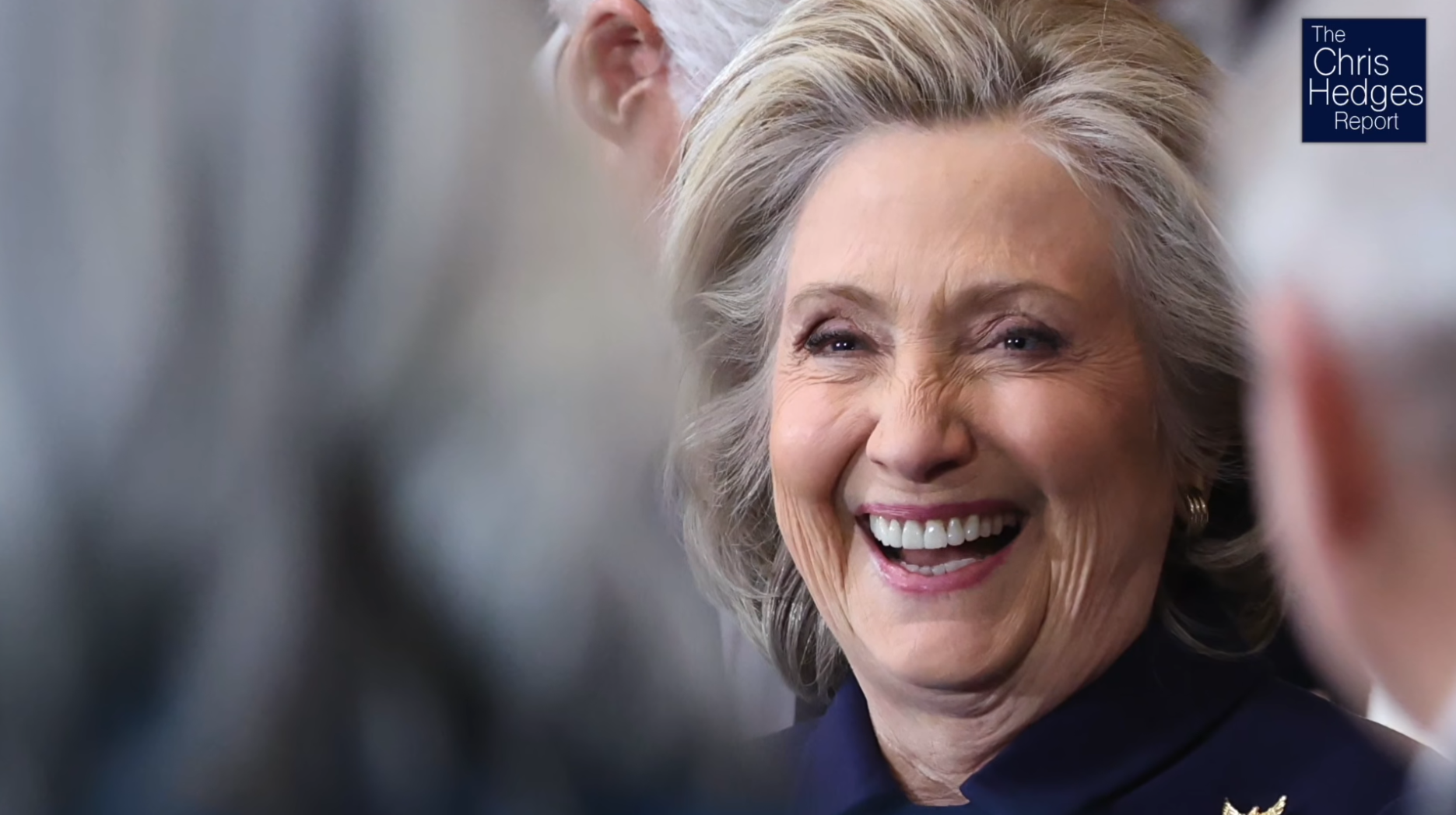
Hilary Clinton, together with her husband President Bill Clinton, selling America to the Zionist bankers
Gottschalk points out the irony: these mechanisms were originally intended for young delinquents – a chance to reform without a criminal record. But they have become the instrument of choice for treating corporate America. And what happens when a company violates the agreement? It often simply receives a new deferred prosecution agreement. It is, as Gottschalk puts it, "Oops, I did it again."
The fines imposed are often nothing more than a slap on the wrist. Gottschalk quotes Jamie Dimon, the CEO of JPMorgan Chase, who told Elizabeth Warren: "Go ahead, find me. I don't care. It's only 15 million dollars, whatever it is." And he's right. The billion-dollar fines imposed are often not even equal to the quarterly profits of these companies. They can often be deducted from taxes, and the government often doesn't even check whether they have been paid.
The Shift to the Corporation, Not the Executive
Another crucial shift is that prosecution focuses on the corporation as an entity, not on individual executives. This means that even if a settlement is reached, those who made the decisions personally remain untouched. They keep their bonuses, their reputation, and their freedom. The message is clear: if you are rich and powerful enough, you are above the law.
This culture of impunity has profound consequences for trust in the legal system. Gottschalk emphasizes that with street crime, we obsessively ask whether someone will re-offend. But we have large corporations that repeatedly break the law and repeatedly receive a deferred prosecution agreement. The message being sent is that there is one legal system for the poor and another for the rich.
The Role of the Clinton Administration
Gottschalk repeatedly points to the Clinton administration as a turning point. It was Clinton who embraced the "law and order" agenda and accelerated the expansion of the prison system. But it was also Clinton who pushed through the deregulation of the financial sector and revived private equity. The combination was deadly: on the one hand, a ruthless approach to street crime; on the other, a free pass for corporate crime.
This dichotomy is not an accident. It is a political strategy. By focusing attention on street crime – and thus on the poor, often Black and Brown population – politicians could position themselves as "tough on crime," while simultaneously serving the interests of the financial elite. The result is a system that punishes the poor and protects the rich.
Part III: Police Violence – A National Phenomenon
Forgetting the Countryside
When we think of police violence, we think of cities like Chicago, Los Angeles, or New York. But Gottschalk debunks this misconception. Her research shows that police violence is a national phenomenon, with a remarkable concentration in rural and suburban areas. In 2020, approximately three-quarters of fatal police incidents occurred in communities with fewer than 100,000 residents. Eight of the ten states with the highest rates of fatal police violence are in the West, where Black people make up an average of only 3% of the population.

American riot police
These statistics are remarkable because they contradict the conventional narrative. We think police violence is primarily an urban problem that disproportionately affects Black men. And while Black Americans are indeed disproportionately killed by police, the number of White Americans killed by police is higher than that of any other racial or ethnic group. In fact, White Americans in rural areas are at greater risk of being killed by police than White Americans in urban areas. And compared to White citizens in the United Kingdom or Germany, the risk for White Americans to be killed by police is extremely high.
Indigenous People – The Greatest Risk
Another group often overlooked is the Indigenous population. Native Americans face the greatest risk of being killed by police, but their deaths typically occur in rural, sparsely populated areas, without witnesses who can capture the fatal encounters on smartphones. As a result, these deaths rarely receive the attention they deserve. Gottschalk emphasizes that the lack of attention to these deaths is not accidental – it is the result of a combination of geographic isolation, lack of media coverage, and the absence of political networks that can exert pressure.
The Culture of Impunity
The most distressing aspect of police violence is the near-complete impunity. Gottschalk points out that we have very good data on how many officers are killed each year, but we have no reliable data on how many citizens are killed by police. There is no national database. The data we have is collected by enterprising journalists and citizens.
And even when a homicide occurs, officers are rarely charged. Even more rarely convicted. And even when they are convicted, the sentences are often symbolic. Gottschalk cites the example of officers who use a chokehold, even in departments where it is banned, and then lose only a few vacation days as internal punishment.
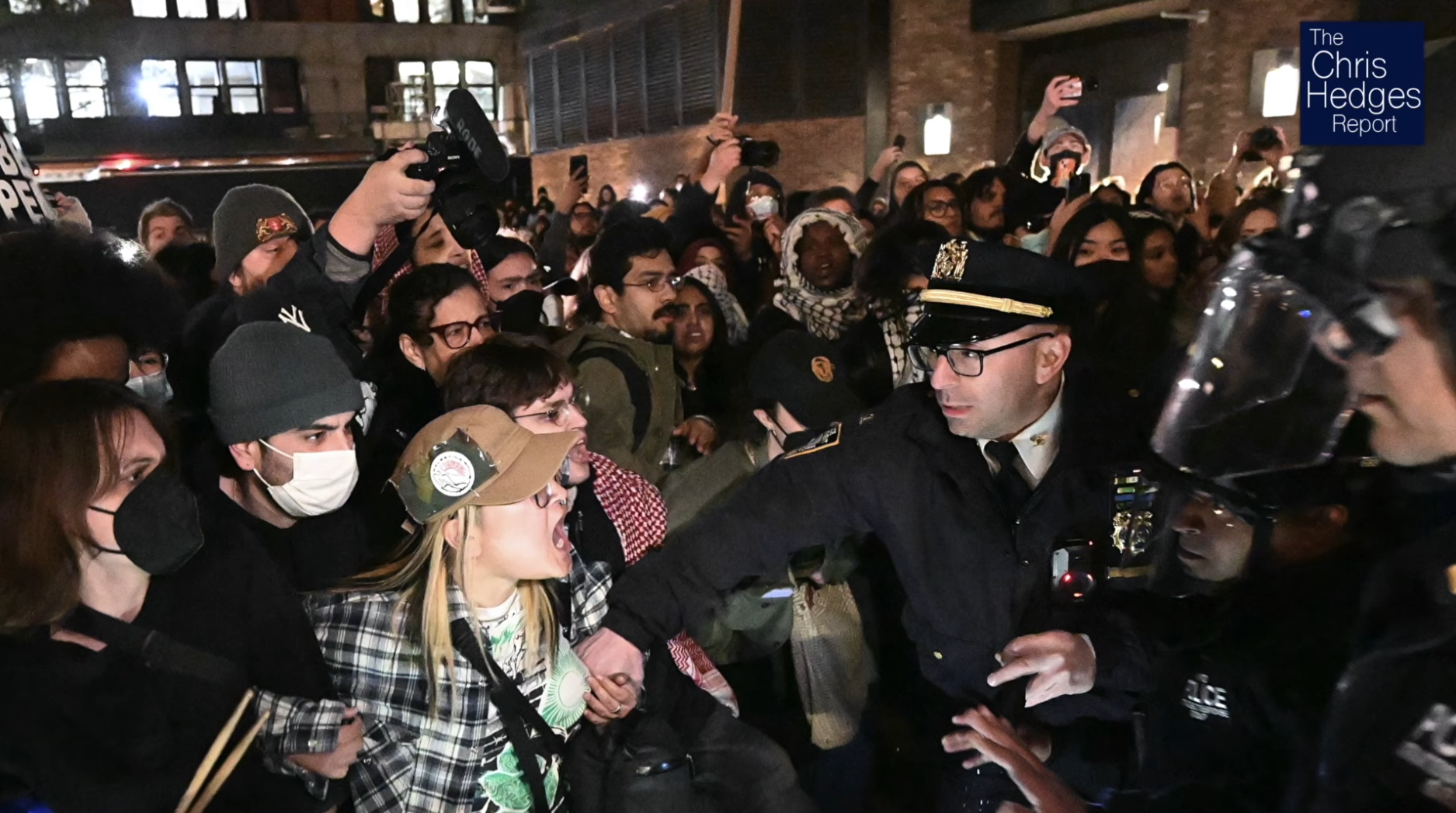
The message is clear: the police are above the law.
This culture of impunity is reinforced by "qualified immunity," a legal principle that effectively grants police officers immunity from civil lawsuits. Even if a victim wins a lawsuit, the officer usually does not pay the damages – they are paid by the city or department. And the officer himself rarely faces serious consequences.
The Role of Sheriffs and the "Constitutional Sheriff" Movement
A specific problem in rural areas is the role of sheriffs. In many rural areas, sheriffs are elected and function as an idiosyncratic power. They are in many ways above the law and now form an important recruiting ground for the "constitutional sheriff" movement – a movement that argues that sheriffs can interpret the law at their discretion because they are elected. This movement, which is gaining more and more followers, views sheriffs as the ultimate defenders of the popular will, above the judiciary and even above the Constitution.
Gottschalk warns that this development is extraordinarily dangerous. Sheriffs who place themselves above the law can use arbitrary violence, intimidate citizens, and undermine the rule of law. And because they are elected, they are difficult to hold accountable.
Police Strikes and Misconduct
Gottschalk also pays attention to sexual abuse by police, a topic that rarely receives the attention it deserves. Sexual abuse and misconduct are, according to her, one of the most reported forms of police crime, only surpassed by excessive force. Low-income groups, LGBTQ people, Black women, and members of other historically disadvantaged groups are most likely to be victims. Officers conduct digital anal and vaginal examinations on the flimsiest of pretexts during roadside stops. Schools and police continue to search students – from kindergarteners to high schoolers – in violation of the Constitution, because courts cannot bring themselves to punish them for it. It is, as Gottschalk puts it, a culture of impunity.
Part IV: The Militarization of Domestic Police
The Connection to the Empire
One of the most original contributions of Gottschalk's work is the analysis of the connection between American imperialism and domestic police violence. The country's deep investment in its overseas empire – including the gigantic defense budget and the unwavering assumption that the United States is the indispensable nation that must police the world – has exacerbated the problem of violence in America.
This connection works in several ways. First, there is the simple matter of money: the defense budget sucks up resources that could otherwise be spent on social services, healthcare, and education. Second, there is the "blowback" from the empire: policing methods developed abroad have returned to the US. Veterans are recruited for police services and bring their military training with them. Police departments are equipped with military equipment. And the mentality of "fighting the enemy" is transferred to domestic police.
The Historical Roots
Gottschalk places this militarization in a historical perspective. The roots of the militarization of police and its autonomy are intertwined with the development of the American empire. In the early twentieth century, when capital did not want to pay for police services and relied on private armies, the government began to think about professional police services. This coincided with American expansion as an imperial power. Veterans returning from overseas brought with them policing tactics they had developed there. The idea was that professional police should be autonomous and behave like the military.
This vision of police as an autonomous, paramilitary force has only been strengthened since then. The "war on drugs" and the "war on terror" have further accelerated this militarization. And despite repeated scandals and calls for reform, police autonomy has only increased.

The Myth of "Non-Lethal" Weapons
Gottschalk points to an ironic twist: in the 1960s, during the rise of "professional policing," there was talk of "non-lethal" weapons. But many of these so-called non-lethal weapons – tear gas, rubber bullets – were in reality highly lethal. Tear gas used in Vietnam and imported to the US was highly lethal. Rubber bullets could kill or seriously injure. The language of "non-lethal" masked the true nature of the violence.
The Role of Police Unions
Gottschalk also pays attention to the role of police unions, which wield enormous power. In cities like Philadelphia, where Gottschalk teaches, police unions are compared to hate groups. They make political endorsements, support their own candidates, and go far beyond the traditional role of enforcing policy.
Police unions have acquired a special position in the American political landscape. They are often invincible: police commissioners admit they have no control over the unions. Officers have the right to view the video before an interview following a shooting, so they can tailor their story to the footage. They are often interviewed immediately after a shooting, before they have time to think. And arbitration is heavily weighted in favor of police. It is extraordinarily difficult to punish officers, fire them, or impose new rules.
Part V: Political Disruption and the Rise of Trump
Obama's Missed Opportunity
One of the most controversial arguments in Gottschalk's book is that the Obama administration paved the way for the rise of Trump. The Obama administration, she argues, failed to reverse the remarkable inversion in the criminal justice system of the past five decades: the massive expansion of the prison state to punish street crime, drug offenses, and immigration violations, and the accelerated de facto decriminalization of corporate crime. The non-prosecution and deferred prosecution agreements used under Obama to handle cases from the financial and mortgage crisis were even more deeply institutionalized.
Obama's mortgage relief plan turned out to be a fortune for the big banks, which accelerated the mortgage crisis and evicted millions of people from their homes. By the time Obama had missed his chance to restructure the banks, capital had regrouped. The big banks were stronger than ever.
Gottschalk cites Obama's own words: if we had punished corporate executives, it would have been "violence against the social order." But what, she asks, was the violence against the millions of Americans who lost their homes, their pensions, and their futures? The irony is bitter: protecting the elite from justice was apparently more important than protecting the ordinary citizen from economic destruction.
The Erosion of Trust
These events have profoundly undermined trust in government and the legal system. Gottschalk emphasizes that we should not be fixated on the lack of trust in Congress; there is also a fundamental lack of trust in corporations. More and more people distrust capitalism and have a more favorable view of socialism.
The Great Recession was a crystallizing moment for many people: they experienced economic trauma and saw that no one was held accountable. The elite treated it like a natural disaster, an act of God. But people knew there had been warnings, that something could have been done. And it wasn't done.
Trump as Symptom
Gottschalk is clear: Trump is the symptom, not the disease. He tapped into a legitimate feeling of betrayal by both parties. Millions of Americans who voted for Obama later voted for Trump. Sanders voters went to Trump. Trump's 2016 campaign was in many ways a Sanders campaign, except that the voice was unmistakably Trump's: images of the "global elite," the oligarchy, interspersed with multicultural workers.
Gottschalk warns that the Democratic Party elite refuses to acknowledge its share in the current crisis. They want to go back to the "good old days" of Clinton and Obama, without recognizing that those days sowed the seeds of the current disruption. The golden days were Clinton's deregulation, Obama's missed opportunity to restructure the banks.
The Media and the Oligarchy
Gottschalk also points to the role of the media. A handful of oligarchs – Larry Ellison, Jeff Bezos – buy up the media, with corrosive consequences for political life. But the problems with the press predate Bezos. We have had decades of media concentration, without using antitrust legislation or the FCC to prevent this concentration. We also have no support for local journalism, as in other countries where people pay taxes for journalism as a public service, like for roads.
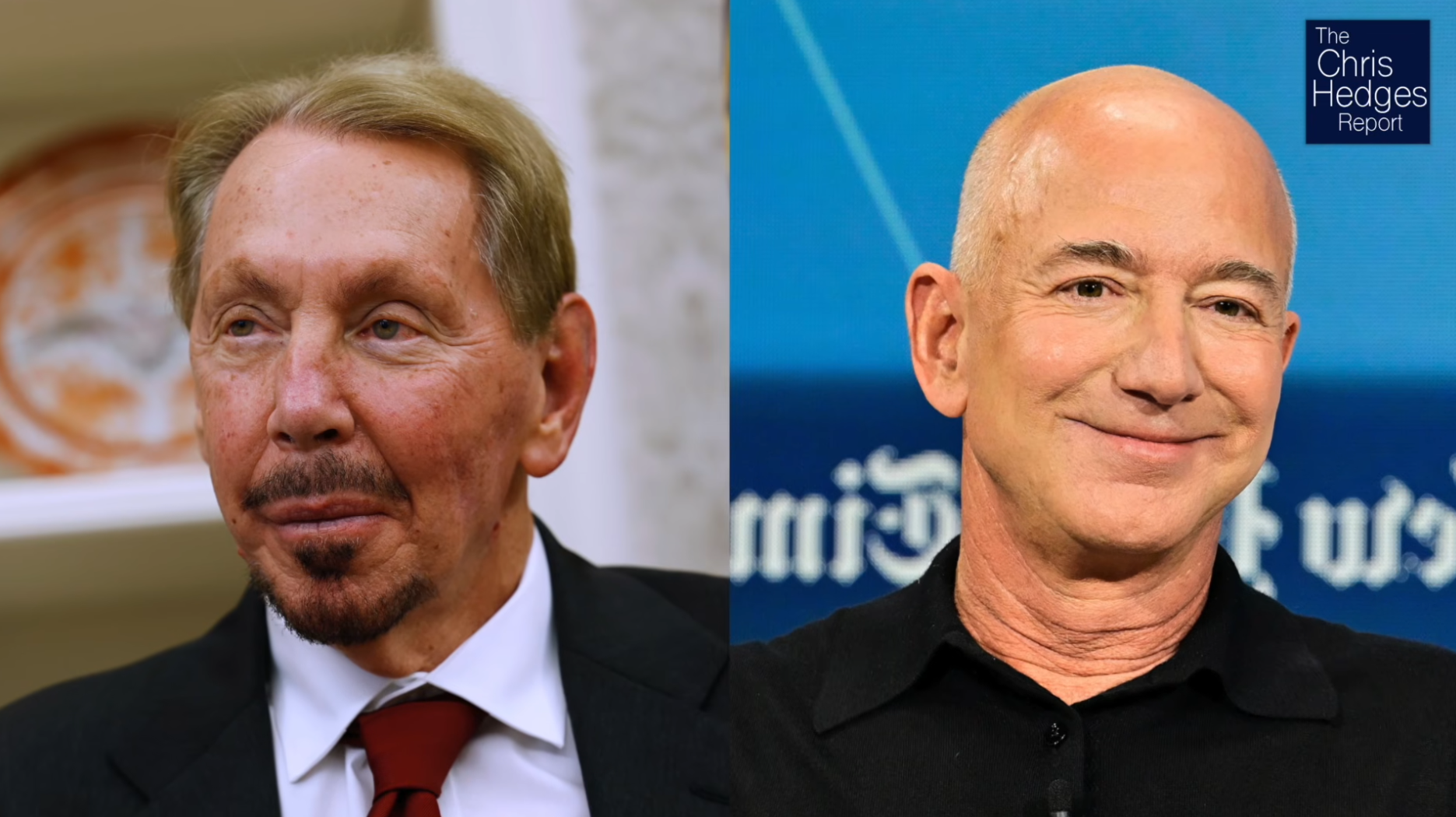
Left Larry Ellison Oracle and right Jeff Bezos Amazon
Private equity, which flourished again after deregulation under Clinton, has been particularly corrosive to journalism. Newspapers are bought up, stripped down, and often closed. Local journalism is dying, and with it, local democracy is dying.
Part VI: The Future of American Democracy
Democracy in Danger
Gottschalk warns that democracy in America is in mortal danger. The 2024 elections and their aftermath made this painfully clear. Trump refused to recognize the election results and spoke of a third term. The attempt to undermine the 2020 election was a direct attack on democracy.
But Gottschalk emphasizes that the threat does not come only from Trump. Democracy is also being eroded from within by the concentration of power, the impunity of the elite, and the lack of trust in institutions. The "constitutional sheriff" movement, the militarization of police, the erosion of press freedom – these are all symptoms of a democracy in decline.
Universities as the Last Bastion
Gottschalk also expresses her concern about universities. She describes how at her own university, a SWAT team was deployed to search for a student who had thrown paint on a statue. She warns that freedom of speech on campuses is under pressure, and that this is a harbinger of something much worse. In her book, she describes how universities, once the last bastions of free speech, are increasingly being blackmailed by political forces.
Gottschalk compares the situation to the Weimar Republic: once universities are closed, the end is near. She calls on universities not to cower and wait for better times, but to actively defend democracy.
The Need for Reckoning
Gottschalk concludes with an urgent appeal: there must be a reckoning with the past. The elite of both parties must acknowledge their share in the current crisis. It is not about going back to the "good old days," but about a fundamental reflection on what went wrong. The takeover of the Republican Party by Trump was no accident; it was the result of a decades-long project.
Gottschalk is skeptical about the willingness of the Democratic elite to embrace this reckoning. They want to go back to the time before Trump, without recognizing that the Clinton years and the Obama years contained the seeds of the current crisis. But without that recognition, there is no way forward.
A Call to Action
Gottschalk calls for a broad coalition that focuses not only on street crime or police violence, but on the underlying structures of inequality and impunity. She emphasizes that mass incarceration now affects a broad range of Americans – not only urban Black men, but also White rural residents. This offers opportunities for new coalitions.
She also points out that there have been historical moments when it was possible to do something differently. After the savings and loan crisis under George H.W. Bush, for example, regulatory measures were indeed taken. The question is whether such a moment will come again now.
Conclusion
Marie Gottschalk's *Crime and No Punishment* is a relentless and sobering analysis of the American malaise. She shows that the United States is not only an exceptionally violent country, but also a country that systematically sustains violence through the impunity of the elite, the militarization of police, and the erosion of social services. Life expectancy is falling, millions of people are losing their homes and their futures, and democracy itself is at stake.
But Gottschalk is not a fatalist. She points to historical moments when change was possible, and she calls for a broad coalition that addresses the underlying structures of inequality and impunity. The question is whether the elite of both parties is willing to acknowledge its own share in the crisis. Without that recognition, there is no way forward. The future of American democracy depends on the willingness not only to fight Trump, but also the systems that made him possible.
This article is based on an interview that Chris Hedges conducted with Marie Gottschalk, supplemented with information from her book *Crime and No Punishment: Wealth, Power, and Violence in America* (Princeton University Press, 2025) and other sources.
About the Author
Marie Gottschalk is Distinguished Professor of Political Science at the University of Pennsylvania. She is the author of *The Prison and the Gallows: The Politics of Mass Incarceration in America* (2006), *Caught: The Prison State and the Lockdown of American Politics* (2016) and *Crime and No Punishment: Wealth, Power, and Violence in America* (2025). Her research focuses on the origins of the prison state in the United States, critiques of the scope of the prison network, and the intersections of the prison state with race and economic inequality. She served on the National Task Force on Mass Incarceration of the American Academy of Arts and Sciences and on the Committee on the Causes and Consequences of High Rates of Incarceration of the National Academy of Sciences. She was featured in the Academy Award-nominated documentary *13th* (2016).
https://en.wikipedia.org/wiki/Marie_Gottschalk
Marie Gottschalk is an American political scientist and professor of political science at the University of Pennsylvania, known for her work on mass incarceration in the United States. Gottschalk is the author of The Prison and the Gallows: The Politics of Mass Incarceration in America (2006), Caught: the Prison State and the Lockdown of American Politics (2016) and Crime and No Punishment: Wealth, Power, and Violence in America (2025). Her research investigates the origins of the carceral state in the United States, the critiques of the scope and size of the carceral network, and the intersections of the carceral state with race and economic inequality.
Crime and No Punishment: Wealth, Power, and Violence in America By Marie Gottschalk.
The consequences of America's retreat from prosecuting elite-level corporate crimeThe United States is an exceptionally violent country, increasingly unable or unwilling to stem violence in its many forms. A growing corporate crime wave has gone unprosecuted and unpunished, with those in the C-suites largely escaping accountability. Meanwhile, the country has doubled down on pursuing people accused of street and drug crimes and immigration offenses. Corporate impunity, the financialization of the economy, militarized policing, the burgeoning carceral state, and the forever wars in Afghanistan, Iraq, and elsewhere all have fostered corporate, economic, and state violence in America. In Crime and No Punishment, Marie Gottschalk argues that these developments have undermined the legitimacy of American political and economic institutions. Gottschalk analyzes how the concentration of economic, political, and military power has siphoned off vital resources, preying on the most vulnerable communities and normalizing violence and death. It has kept America from attacking the root causes of violent street crime and curtailing "deaths of despair" from suicide, alcoholism, drug overdoses, and chronic diseases. The United States continues to incarcerate more of its people than nearly every other country even as it decriminalizes or turns a blind eye to elite-level corporate crime. Public and scholarly attention, however, remains fixated on violent street crime–although corporate and white-collar crime and state and economic violence directly and indirectly hurt far more people in the United States. Gottschalk contends that the US failure to protect its people from these harms has increased the fragility of democracy in America.
Career
In the 1980s she spent two years in China as a university lecturer and published on international relationships between China and the United States under the Bush administration.[1] By 1992, after having worked as a journalist, she was associate editor of World Policy Journal (WPJ). In a 1992 WPJ article she echoed concerns expressed by Washington Post journalist, Colman McCarthy that the American media, which were under "unprecedented restrictions" during the Gulf War, was—like the "American consumer, corporation and Congress"—being profoundly re-shaped by the Bush administration.[2][3][4] Before joining the University of Pennsylvania, she also worked as a visiting scholar at the Russell Sage Foundation and as a Fulbright Program Distinguished Lecturer in Japan. She served on the American Academy of Arts and Sciences' National Task Force on Mass Incarceration and the National Academy of Sciences' Committee on the Causes and Consequences of High Rates of Incarceration.[5] She was featured among the experts interviewed in the Academy Award-nominated 2016 documentary 13th.[6]