
The slow-motion collapse: how Iran broke the American empire
An analysis based on the strategic vision of Patrick Henningsen
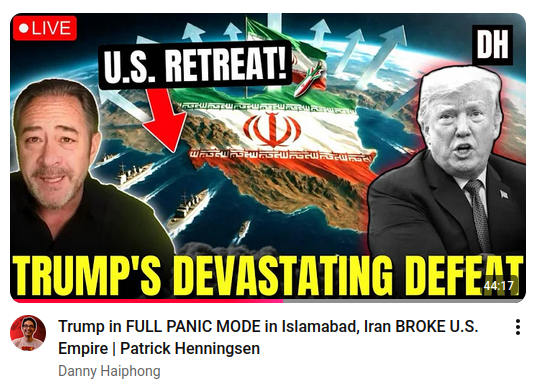
The images coming out of the White House these days tell a story of desperation disguised as victory. Donald Trump, a president who built his reputation on winning, finds himself in a position that no post on Truth Social can save. According to geopolitical analyst Patrick Henningsen, we are witnessing something unprecedented: the strategic defeat of the United States at the hands of Iran, and the slow, painful unraveling of the American empire itself.
This is no exaggeration. It is the cold analysis of a pattern that has been unfolding for months, and one that Henningsen expresses with devastating clarity. The transcript of his recent interview reveals a thesis that must be taken seriously: the United States has abandoned diplomacy, adopted Israeli gangland tactics, and in doing so sacrificed its position as a normative power within the international system.
The war that was sold with fake intelligence
Let us begin where this latest catastrophe began. The leaks from the New York Times confirmed what many had already suspected: the entire push toward war with Iran was a “clumsy sales pitch” by Benjamin Netanyahu. The Israeli prime minister arrived in Washington in mid-February, was treated like a king, and sold intelligence that later turned out to be fraudulent on virtually every point.
None of it was true. Not the timelines, not the capabilities, not the expected outcomes. The American national security apparatus, the same machine that once justified the Iraq War on equally fabricated grounds, swallowed the bait whole.
This matters because it reveals something fundamental about the relationship between Washington and Jerusalem. When Henningsen describes the United States as having “left the high road” in favor of “the gutter where Israel resides,” he is pointing to a transformation that has been underway for decades but has now reached its logical conclusion. American diplomacy has been replaced by Israeli assassination politics, zero-sum maximalism, and a total rejection of the normative frameworks that have governed international relations since 1945.
The cascade of incompetence: Hegseth and the hollowing-out of the Pentagon
If you want to understand how an empire collapses from within, look at the confirmation of Pete Hegseth as Secretary of Defense. Henningsen is merciless in his assessment: here is a man who is “not even qualified to lead a platoon,” who was thrown out of the Washington D.C. National Guard, who has a documented history of alcoholism, allegations of sexual misconduct, and a record of bankrupting every charitable organization he ever led.
How could he have been confirmed? According to Henningsen, the answer is both simple and deeply disturbing: the Israel lobby instructed American senators to vote for him. They wanted a religious ideologue with a compromised past because “they will absolutely do what they are told when they are placed in that position.” Hegseth is accountable not to the American people or the Constitution, but to the interests that rescued his career from the scrapyard of scandal.
The result is predictable. Hegseth made history by denying the press access to the Pentagon, citing “national security” in what appears to be an unprecedented violation of transparency norms. A court has already ruled his actions unlawful. This is not governance; this is an administrative collapse in slow motion.
The pope, the schism, and the isolation of American conservatism
One of the most remarkable developments Henningsen highlights is the intervention of Pope Francis. When Hegseth invoked Jesus to justify bombing Iran, when Trump launched an “almost satanic tirade about killing Iranians and destroying their civilization” at Easter, the Vatican finally spoke out. The pope rebuked them directly.
This is unprecedented. As Henningsen notes, the Church remained largely silent during the Iraq War. But this American pope has drawn a line. The result is a schism within the American conservative political landscape itself, with traditional Catholic conservatives now being forced to choose between their faith and their party loyalty.
The geopolitical consequences are already visible. Giorgia Meloni’s Italy, a G7 country, is considering opening diplomatic relations with Tehran. Spain is talking about establishing a diplomatic mission in Iran. When Trump threatened Spain, he only proved how desperate and isolated the American position has become. Two NATO countries are breaking ranks, and more will follow.
The failure of Trumpian diplomacy
This is the heart of Henningsen’s criticism: Trump’s negotiating style does not work. “No concessions. You must get on your knees and bow before my demands. Otherwise we punish you.” This approach failed with Russia in Ukraine. It is failing with Iran. And it will keep failing because countries such as Iran, Russia, China, and India are what Henningsen calls “agreement-capable” or “normative powers.”
What does that mean? In international relations, the system bends in favor of normative powers because other countries can align themselves under the assumption that their partners are rational, logical, and capable of honoring agreements. Treaties, multilateral frameworks, and diplomatic norms — these are the reference points through which things actually get done in the international system.
The United States has now placed itself in the opposite category: rogue state. By adopting Israeli tactics — international gangsterism, zero-sum diplomacy, the assassination of negotiators, and the abandonment of previous agreements — America has squandered the trust and credibility that made its empire function. And as Henningsen says with sober finality: “I don’t think America can recover from this, even with a new administration in 2026.”
The spoiler strategy: Israel as Ukraine
One of Henningsen’s sharpest observations is the parallel between Israel’s role in the Iran conflict and Ukraine’s role in the Russia conflict. In both cases, a proxy acts as a spoiler, sabotaging any possible diplomatic breakthrough the moment progress appears within reach.
Just as Ukraine carries out drone attacks on Russian oil facilities whenever negotiations seem close to bearing fruit, Israel stands ready to bomb Iranian targets or assassinate negotiators at the critical moment. The United States plays the good cop, pretending there is distance between itself and its proxy, while the proxy does the dirty work of keeping the conflict alive.
This is not coordination; it is a structural feature of how this relationship now functions. And the effect is to ensure that “there will be no progress in diplomacy, no negotiated political solution. It is simply a slow deterioration of the situation.”
The oil and gas gamble
Behind the chaos lies a method. Henningsen traces the strategy back to the old neoconservative “Clean Break” document: choke off global petroleum supplies, drive prices upward, and weather the storm on America’s vast proven oil and gas reserves. Every escalation in this conflict — every Ukrainian drone strike on Russian refineries, every Israeli strike on Iranian or Gulf energy infrastructure — removes more hydrocarbons from the global market.
Who profits? Big Oil, Big Gas, and the American fracking industry — Trump’s donor base. Even if the rest of the world suffers, even if food shortages follow from rising fertilizer prices, the American energy sector profits. Venezuela becomes understandable in this framework: a stepping stone in a broader strategy of energy dominance.
But this is a massive gamble. It may destroy the United States as an imperial power. It may destroy Israel as a colonial settler project. As Henningsen puts it: the question is whether this 25-year-old neoconservative fantasy is finally becoming reality, or whether it will trigger a collapse from which neither the American empire nor the Israeli project can recover.
Pakistan, China, and the emerging counter-order
Pakistan’s deployment as a diplomatic actor in the Iran crisis is no accident. Henningsen points to deep political and spiritual connections between the two Islamic republics, connections that transcend the Sunni-Shiite divide. Pakistan has a significant and politically active Shiite population that has absorbed core elements of the Iranian revolution. When Israel threatens that a nuclear-armed Islamic country “must not be allowed to exist,” Pakistan hears an existential threat: if Iran falls, they are next.
China understands this. The Belt and Road Initiative depends on stability in this region. Iran is a key partner in the middle-corridor projects that will shape economic integration between East and West for decades. Rather than trying to control Iran, as some Western analysts think, China has acted pragmatically, recognizing that Iran is winning and that the catastrophic American bluff has created an opportunity.
The result is a geopolitical realignment of which Washington seems entirely unaware. The international system is bending toward normative powers — toward Iran, toward Russia, toward China, toward the BRICS countries. The United States, by contrast, has sacrificed its positions, its footholds, and its credibility “on the altar of Israel.”
The coming storm: Israel versus Turkey
If you think the situation is already dangerous enough, consider what Henningsen identifies as the next target. Former Israeli Prime Minister Naftali Bennett has openly declared that “Turkey is the new Iran.” That is a warning shot, and when Israel fires warning shots, people die.
The logical conclusion of the Joe Kent thesis — that talking about withdrawing from NATO is in reality about clearing the way for Israel to attack Turkey — is almost too horrifying to contemplate. But it fits the pattern. The United States would surrender its leverage, abandon its treaty obligations, and leave a NATO member exposed to Israeli aggression.
Who would come to Turkey’s aid? Only four countries have the capacity: China, Russia, possibly Pakistan, and India. The BRICS countries. Not the United States. Not Europe. And world wars have already been fought over the Ottoman Empire. Turkey’s geopolitical pivot — where East meets West — is the most dangerous flashpoint on earth.
Conclusion: watching the train wreck in slow motion
Patrick Henningsen’s vision is bleak, but it is grounded in observable reality. The United States has chosen a path of international gangsterism at precisely the moment the multilateral order is shifting toward multipolarity. It has installed incompetent ideologues in critical positions, abandoned diplomatic norms, and outsourced its strategic decision-making to a client state whose interests increasingly diverge from its own.
The train wreck is unfolding in slow motion. Trump goes on Truth Social. The administration issues denials. Israel bombs another target. Negotiations go nowhere. The economy suffers. And through all of this, the American empire continues its long, painful decline.
Can America recover? Henningsen doubts it, and his doubts are compelling. The damage is not merely tactical or even strategic — it is structural. The United States has sacrificed the trust and credibility that made its global position possible. And in a world of normative powers, a rogue state cannot lead.
We are witnessing history in the making. It is not a comfortable spectacle. But pretending there is victory when defeat is manifest is not patriotism. It is delusion. And delusion, as the American empire is learning, is a luxury only the powerful can afford — and only until reality arrives.
Trump refuses to withdraw from the war, war with Iran will continue
There were three Iranian conditions that the United States refused to accept: Iranian control over the Strait of Hormuz, an end to Israeli attacks on Lebanon and Hezbollah, the release of Iranian assets, and the preservation of sovereignty over Iran’s uranium stockpile. Over the past week, I have repeatedly said in various interviews on this subject that the Iranian position on these issues is non-negotiable.
Here is the statement just released by the Iranian government:
1. “The American enemy, which is despicable, malicious, and dishonest, has tried to achieve at the negotiating table what it could not achieve through war.
2. These demands include the transfer of enriched uranium and the opening of the Strait of Hormuz without confirmed Iranian sovereignty over it.
3. Iran has decided to reject these conditions and continue the sacred defense of its homeland by all necessary means, military or diplomatic.”
What now? To begin with, I hope the Iranian delegation in Islamabad gets a flight home on a Russian or Chinese aircraft. I do not rule out the possibility that Israel and the United States will try to destroy the Iranian passenger plane on its return flight to Tehran.