
Sleepwalking into World War III: The Deadly Illusion of the West
An in-depth analysis of the warnings from Colonel Doug Macgregor and Stas Krapivnik about escalation in Ukraine, the Middle East, and the inevitable confrontation with Russia.
The world stands at a tipping point. While mainstream media in the West continues to present geopolitical conflicts as isolated incidents or moral crusades for democracy, an increasingly loud and alarming warning emerges from military and analytical circles: we are not only heading toward a major war, we are already in the midst of it. Two prominent voices, former U.S. Colonel Doug Macgregor and Russian-Swiss analyst Stas Krapivnik, paint a bleak and detailed picture of a West blindly heading toward its own destruction. Their message is unanimous and devastating: Western elites live in a fantasy world of arrogance, ignorance, and wishful thinking, while reality on the battlefield and in diplomatic backrooms actually points to an inevitable, catastrophic escalation.
By Frank Dumon
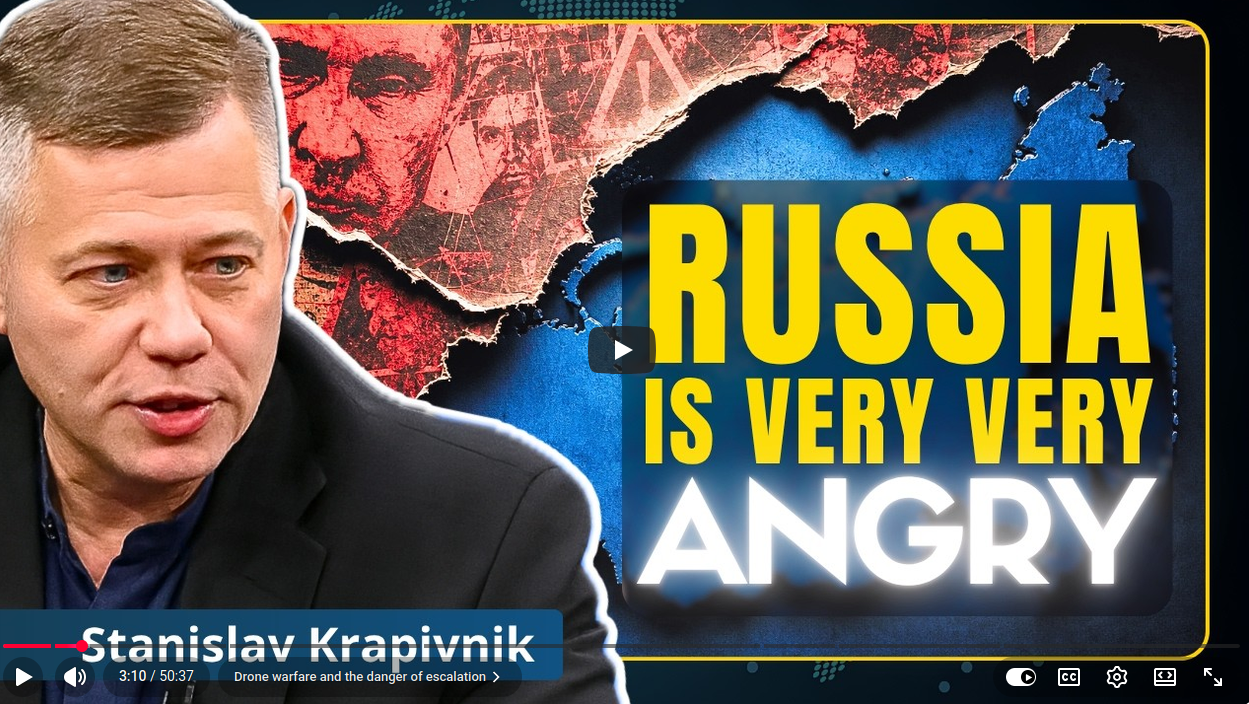
In this article, we delve deep into the arguments of both experts. We examine why the war in Ukraine is artificial and existential for Russia, how support for Israel has isolated the West, and why the current course does not lead to peace, but to a conflict that could cost millions of lives and devastate Western economies.
The Myth of a Weak Russia and Western Arrogance
Colonel Doug Macgregor, a respected military strategist with decades of experience, holds up a mirror to Western leadership. His criticism is not mild; he calls the political elite in London, Paris, and Washington "certifiably insane" and states they belong in "Bedlam" (a historic insane asylum). According to Macgregor, policy is driven by a deadly combination of three factors: ignorance, arrogance, and wishful thinking.
The core of this wishful thinking is the persistent belief that Russia is weak, that Russian society is fragile, and that prolonged sanctions and proxy wars will lead to an internal uprising against President Putin. "That's all nonsense," says Macgregor. "Russian society is cohesive and sustainable. It is the West that has a society, or societies, that are not cohesive, that are not sustainable."
Macgregor points out that Western leaders, such as Keir Starmer in the UK, Emmanuel Macron in France, and Friedrich Merz in Germany, live in a fantasy world. They do not understand how close they are to a confrontation that could cost millions of lives. These leaders are often presented as technocrats or reformers, but Macgregor sees them as puppets of financial interests and ideological dogmas. He compares Macron's rise to that of Obama: figures without significant track records who were put forward by financial elites (such as George Soros) to serve specific agendas, independent of the electorate's will.
The West's fundamental misunderstanding is the nature of Russian motivation. For Moscow, the situation in Ukraine is not a matter of imperialist expansion, as often portrayed in Western media, but an existential crisis. NATO rockets on the border, the promise of Ukraine as a NATO member state, and systematic attempts to economically and militarily eliminate Russia are seen in Moscow as a direct threat to the nation's survival. As Stas Krapivnik sharply notes: "NATO nuclear rockets on its borders... There's nothing you can do about it. Well, there is something. And that's how all this began."
Ukraine: An Artificial Conflict and a Bloodbath
Both analysts agree that the war in Ukraine never should have taken place. Macgregor states outright that this is an "artificial conflict." Had the West not intervened to install a Neo-Nazi anti-Russian government in Kyiv, dedicated to the United States and NATO, there would have been no conflict. Since then, the West has fueled the conflict under the false assumption that Russia will eventually collapse.
The reality on the ground, however, is radically different. Macgregor cites shocking figures: Ukraine has lost an estimated 1.5 million soldiers on the battlefield. "They are all dead," he says matter-of-factly. The Ukrainian armed forces, once well-trained and equipped with 800,000 men, are exhausted. Yet the West continues to fuel the fire, hoping that Russia will break. But Russia is not breaking; it is adapting.
Stas Krapivnik, who was recently in Moscow, confirms this picture from the Russian perspective. He describes a Russian industrial base that operates 24 hours a day, seven days a week. Sanctions have not had the hoped-for effect; on the contrary, Russia has reorganized its economy and now mass-produces weapons and drones. Krapivnik emphasizes that the drones for attacks on Moscow are not produced by Ukraine itself, but in Europe. "These drones are produced in Europe, freely in Europe," he states. This means that European countries, despite their rhetoric of peace, are actively participating in the war effort by providing the means for terrorism.
Krapivnik is furious about the Western mentality that believes Putin woke up one day and decided to invade Ukraine "for fun." He points to the escalation ladder that the West is climbing. What began as limited support has grown into full military involvement where European countries are risking their own security. Pressure on Moscow to strike back at Europe is increasing. "The only way to hypothetically reverse this is a total European NATO war against Russia," warns Krapivnik. And that is exactly where Zelensky and his Western allies are heading, albeit through backdoors.
Terrorism as a Strategic Instrument of the West
One of the most disillusioning aspects of Krapivnik's analysis is his characterization of current Ukrainian tactics as pure terrorism. He states that Ukraine, supported by the three supreme terrorist organizations on this planet – the CIA, MI6, and Mossad, has moved to deliberately targeting civilian objectives.
Krapivnik lists a gruesome series of incidents that receive scant attention in the West. For example, 16 drones were deployed to attack a student dormitory in Staraya Russa, killing 21 children. This was not a mistaken rocket strike, but a targeted attack. Drones fly directly into apartment complexes, buses are attacked while driving through cities, and even children's buses and football teams are not spared. A recent incident involved a bus with a children's football team from Belarus heading to Russia; the coach's wife was killed and four children were injured.
"You create a certain situation, from partially a terrorist outfit to a full terrorist outfit," says Krapivnik. The purpose of this terror is clear: breaking Russian morale and provoking Russia into an escalation that directly involves NATO. If Russia does nothing, the civilian population suffers. If Russia does respond and attacks NATO targets, the West has its great war.
It is a "sick game" where civilians are used as pawns.
Krapivnik also points to cultural destruction. The attack on the war monument in Sevastopol, which commemorated the Crimean War and the Second World War, had zero military value. The only purpose was to make Russia angry. "Russians attach great value to culture and to this memory of the past," he explains. By attacking these symbols, the West shows its true face: a lack of respect for history and humanity, driven by hatred.
These tactics show that the red lines that existed for years – such as not attacking NATO territory or avoiding civilian targets – are being systematically crossed. Ukraine has attacked oil refineries in Hungary, Slovakia, and Romania, hit Turkish ships in territorial waters, and nearly caused a mass murder in Romania by drones heading toward nuclear facilities. "Ukraine continuously attacks NATO," states Krapivnik, "to show how pathetic these organizations are. They are willing to massively sacrifice their own people."

The Israel-Gaza Crisis: A Pariah State and the Road to Iran
While the world's eyes are focused on Ukraine, an even greater catastrophe is preparing in the Middle East. Colonel Macgregor reserves his sharpest criticism for U.S. policy toward Israel. He states that Israel's aggression and brutality in Gaza have made the country a pariah in the international community. The term "genocide" is not used lightly; Macgregor describes the actions as such and points out that Israeli leaders treat their population and Palestinians as "animals," "rats," and "sub-humans," language directly reminiscent of the Nazi regime.
Macgregor wonders why this is happening now. His answer is cynical but probably accurate: Netanyahu and his supporters know that their aggressive stance is not sustainable in the long term. Therefore, they feel enormous pressure to strike now, as long as they have control over the United States, its armed forces, its population, and its government. "And that won't last," he warns.
The danger lies in the expansion of this conflict to Iran. Macgregor states that Israel has been trying to provoke a war with Iran for decades. Now, with full U.S. support, the likelihood appears greater than ever. But the assessment that this will remain a "limited and narrow" conflict is, according to Macgregor, "very dangerous thinking." Iran possesses an enormous arsenal that enables it to strike back with great force against Israel and against any U.S. installation.
Moreover, Russia will not watch passively. "If we become involved in a war with Iran, the Russians will not sit still and say: 'Oh, sorry, I'm too busy with Ukraine.'" Macgregor points to the presence of Russian ships, submarines, and technical advisors in the region. Russia has worked hard over the past 12 months to build an integrated air defense system for Iran. An attack on Iran is therefore effectively an attack on Russia's strategic interests.
Krapivnik confirms this and adds that the recent "deal" between the U.S. and Iran is pure theater. He calls it a "declaration of surrender" on the part of the U.S., forced by the fact that Iran could hit everything in the region related to Americans. But he doesn't trust it. "Nothing has changed in the U.S. government," he says. "It's the same players who previously murdered negotiators and massively killed civilians." He speculates that Gulf states, such as Saudi Arabia and Qatar, pressured the U.S. to sign an agreement, otherwise they would terminate their base agreements. But even if this is true, the underlying dynamic of distrust and aggression remains.
America's Economic Suicide and the Loss of Hegemony
A central theme in Macgregor's analysis is the internal state of the United States. He draws a direct line between the country's military adventures and its economic decline. Just as the Vietnam War was the catalyst for abandoning the gold standard, so current wars are hollowing out American industry. "We have hollowed out our economy, we have destroyed most of our production capacity, all in the name of maintaining an artificially high standard of living," he states.
The U.S. is spending itself "into oblivion" on behalf of the military-industrial-congressional complex. This fiscal decay now clashes with a deep crisis of confidence within American society. Macgregor sees the COVID pandemic as a turning point. Citizens realized they were being lied to by institutions ranging from the NIH and WHO to the Department of Defense. "Americans no longer trust the news," he says. "They are increasingly suspicious of what the government tells them."
This loss of trust is a double-edged sword. On one hand, it is healthy for citizens to be critical of propaganda. On the other hand, it means society is no longer cohesive. In times of crisis, such as a possible major war, unity is essential. Macgregor asks: "Who are Americans today?" Society is fragmented, and in the event of an internal attack or economic collapse, the likelihood of civil unrest is high.
Additionally, Macgregor points to the illusion of military superiority. The idea that the U.S. can militarily challenge China, he calls "insanity." China is a continental power with the largest production capacity in the world. The U.S. is a maritime power that must fight 10,000 kilometers from home. "No maritime and space power can triumph over a continental power," he reasons. In a world of precision-guided missiles, American logistical points and surface fleets would be destroyed within hours. The U.S. is trying to maintain a global military hegemony that can no longer be economically supported.
Krapivnik supplements this with the observation that BRICS countries and the Global South are increasingly siding with Russia, China, and Iran. "You probably have between 60 and 90 nations around the world that are on the side of Russia and Iran and China," he states. The West has alienated the Global South, and further escalation could turn this alienation into total isolation.
The Role of Media and the Broken Connection with the Population
Another crucial point that both speakers raise is the role of the media and the disconnect between elites and the population. Macgregor describes the current media situation as "chaos media." There is no longer an authoritative media trusted by the public, like Walter Cronkite in the 1960s. Instead, we have entertainment news and polarized sources.
"Those who talk about democracy are selling us propaganda," says Macgregor. Policy in Washington has nothing to do with what the average American wants. It is shaped by billionaires and oligarchs pursuing their own interests. Elected politicians are dependent on this money and prostitute themselves for financial incentives. This leads to a situation where the population is dragged into wars they do not want, based on lies and false flag operations.
Macgregor gives historical examples of how wars are "sold": the Spanish-American War, the Lusitania, Pearl Harbor, the Gulf of Tonkin incidents. In each case, there was manipulation, staged events, or outright lies to win public opinion for a war that served commercial or geopolitical interests. Today we see the same pattern with Ukraine and Israel.
Krapivnik notes that the European population, with the exception of a small group that follows alternative media, "has not the slightest clue." He tells about a discussion on Swiss television about the morality of arms exports to Ukraine, where no one considered the possibility that Russia might retaliate against Swiss facilities. "That didn't come up once," he says astonished. "That is the level at which Europe, including Switzerland, has lost all ability to think in a realistic framework."
This "mass psychosis" makes it difficult to stop the escalation. Krapivnik compares it to Nazism, which only ended when the government collapsed. "You cannot break a mass psychosis by being in it yourself," he warns. It requires an external shock or the collapse of the structure that maintains it. Unfortunately, in the case of NATO and the EU, a collapse may mean a major war.
The Inevitability of Escalation: Why Diplomacy Fails
Where does this all lead? Both analysts see little room for diplomatic solutions under current leadership. Western elites believe they can intimidate Russia, while Russia is actually becoming stronger and more determined. European armies are "boutique forces," without unity of command, uniform equipment, or the will to fight. They are no match for the Russian army.
Krapivnik warns that Russia faces a choice: a conventional war with Europe or a nuclear war with the Northern Hemisphere. He hopes for the former, because the alternative is unthinkable. But the pressure to strike back at Europe is growing. If drone attacks on Russian cities continue, and if Western production of these drones does not stop, Russia will have to address the sources. And those sources lie in NATO countries.
"If Russia decides: 'No, if we bleed, and we are blown up, we will blow you up,' then we will have a European war," states Krapivnik. "And we are not far from that." Macgregor adds that the nuclear threshold may not be crossed directly, but the damage below that threshold is already enormous. And because elites think they are immune, they are playing with fire. "They think they can tinker at the margins of a crisis... and that no one will call their bluff and wage war. That's hard for me to imagine," he says.
The situation is further complicated by domestic politics in the U.S. With elections on the horizon and a divided society, there is little political will to put the brakes on. On the contrary, both Democrats and Republicans compete to see who is toughest on Russia and Iran, driven by lobbies and the donor class. Trump, although sometimes critical of foreign interventions, remains bound to the same structures and people that determine the current course.
Conclusion: Wake Up Before It's Too Late
The warnings of Colonel Doug Macgregor and Stas Krapivnik are not meant to spread panic, but to open eyes. They depict a world where the old order of Western dominance is coming to an end, not through a gradual transition, but through a violent and chaotic collapse.
The lessons we can draw from this are clear:
1. The war in Ukraine cannot be won for the West. It is a proxy war that has destroyed Ukraine and strengthened Russia. Further escalation serves no strategic interest, except enriching the defense industry and satisfying ideological obsessions.
2. Expansion into the Middle East is suicide. Support for Israeli policy seen as genocidal, combined with the threat of war with Iran, creates an explosive mix that will force Russia and China to intervene. This could lead to a worldwide conflict.
3. Western societies are fragile. Economically hollowed out, socially divided, and institutionally distrustful, the U.S. and Europe are poorly prepared for the consequences of a major war. The illusion of safety is dangerous.
4. Media and politics have become detached from reality. The population must become aware of the manipulation and demand that policy be based on national interests and peace, not on ideology and profit.
Macgregor concludes with a simple but powerful rule: "What is the first principle of war? Avoid it. In other words, if you are not forced to fight, you are a fool to fight."
Unfortunately, Western leadership seems to have forgotten this wisdom. They are sleepwalking toward the abyss, convinced of their own invulnerability. But as history teaches, and as Macgregor and Krapivnik remind us: wars are easier to start than to stop. And once they begin, even the initiators lose control.
For readers of www.jakobijn.be, it is time to remain vigilant. The narratives presented to us daily must be critically examined. The voices of Macgregor and Krapivnik offer a necessary counterweight to the mainstream consensus. They show that peace is not achieved through more weapons and more sanctions, but through diplomacy, respect for the security interests of others, and the courage to admit one's own mistakes.
The clock is ticking. The drones are flying. Tensions are rising. The question is not whether there will be an escalation, but when, and how severe the damage will be if the West does not quickly wake up from its dream of invincibility. World War III may not only be inevitable according to these analysts, it is already underway. It is up to us to demand that it stops, before it engulfs us all.
Sources and Further Reading
For those who want to view the full context of these analyses, the following sources are available:
• Video: Drone Escalation: Russia Will Strike NATO | Stas Krapivnik with Pascal Lottaz (Neutrality Studies). In this, Krapivnik goes into detail about drone warfare, terrorist tactics, and the geopolitical implications for Europe.
• Video: Col. Doug Macgregor: Sleepwalking into World War III. An extensive interview in which Macgregor gives his view on the state of the U.S. military, the economy, and the faulty strategies in Ukraine and the Middle East.
These articles and interviews form an essential source for anyone who wants to understand current geopolitical developments outside the beaten paths of traditional media. On www.jakobijn.be we continue to follow and analyze these critical perspectives, hoping to contribute to a more nuanced and peace-oriented debate.