
The Primakov Triangle Reborn: How Russia, Iran, and China Are Reshaping the World Order
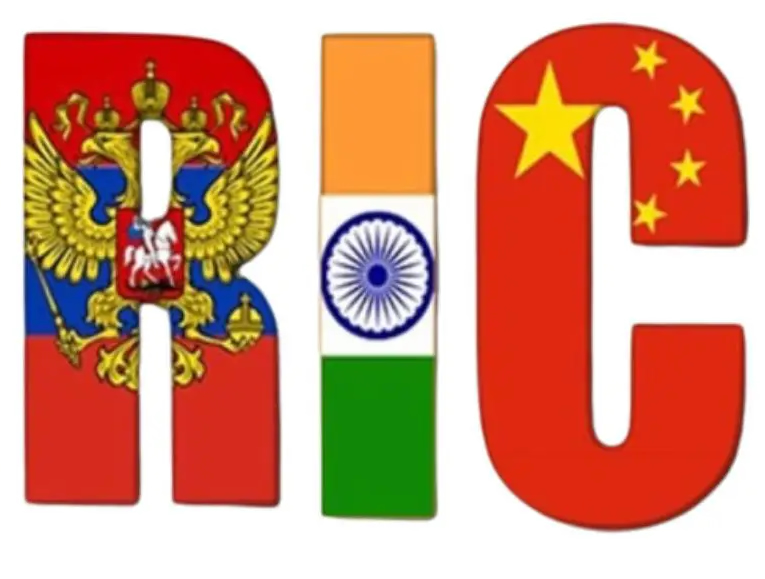
In 1999, at the height of American unipolar hubris, Russian Foreign Minister Yevgeny Primakov was on a flight over the Atlantic Ocean. Halfway across, he ordered his pilots to turn around and fly back to Moscow. It was a powerful diplomatic statement against American arrogance – NATO was about to bomb Yugoslavia without a UN mandate – but it also marked the beginning of a strategic vision that would change the world order: the 'Primakov Triangle'.
By Frank Dumon
Primakov foresaw that the unipolar world, dominated by the United States, was unsustainable. He proposed a strategic triangle between Russia, India, and China (the RIC countries) to create a multipolar counterweight. In the West, this idea was laughed off at the time. NATO was expanding, the euro was being launched, and American economist Francis Fukuyama had proclaimed the 'end of history'. The RIC countries were seen as an incoherent group: Russia was economically ruined, India was inward-looking, and China was still the 'world's factory' for Western brands.
Today, nearly three decades later, at 79 years of age, I am witnessing the remarkable evolution of that vision into a living reality. The concept that once called for a strategic axis of Russia, India, and China is being dramatically reshaped before our eyes – with Iran in a central role. The Primakov Triangle has not merely become a reality; it is the nuclear reactor of the new multipolar world order.
What Analysts Call the 'Primakov Triangle'
The geopolitical formation once known as the RIC acronym (Russia–India–China) is quietly giving way to a new configuration: RIC as Russia–Iran–China. This transformation is nothing less than the emergence of a powerful new Eurasian bloc – a bloc that fundamentally challenges the post-war world order.
The Primakov Doctrine: A Vision Ahead of Its Time

To understand this development, one must first know Yevgeny Maksimovich Primakov. A towering figure in Russian diplomacy – academic, Arabist, director of the Foreign Intelligence Service, Minister of Foreign Affairs, and finally Prime Minister from 1998 to 1999 – Primakov formulated a political doctrine in the 1990s based on the premise that Russia's national security depended on its superpower status. The core of the doctrine was the rejection of a unipolar international order led by the United States.
Primakov's doctrine rested on five pillars:
- Russia as a powerful actor with an independent foreign policy.
- A multipolar world managed by a concert of great powers.
- Russian supremacy in the former Soviet sphere and Eurasian integration.
- Resistance to NATO expansion.
- A strategic partnership with China.
The most important element was Primakov's advocacy for a strategic trilateral alliance of Russia, China, and India as a counterweight to the United States in Eurasia. The concept – first proposed during his visit to India in December 1998 – arose partly in response to Western military superiority during the 1991 Gulf War. In the two decades that followed, the RIC format saw periodic meetings at ministerial and sometimes leadership levels, and it eventually led to the formation of BRICS.
Why Iran Is Replacing India
Yet the original RIC rarely went beyond polite declarations. Deep mistrust between India and China – exacerbated by recurring border conflicts – meant that the format remained largely underutilized. India's historical 'double game', balancing between Eastern and Western powers while maintaining its strategic ambiguity, prevented the RIC triangle from achieving the coherence envisioned by Primakov.
The geopolitical calculus has changed dramatically in recent years. While India continues to spread its bets – maintaining close ties with Washington while engaging Moscow and Beijing – Iran has emerged as a more reliable and strategically better-aligned partner for both Russia and China.
Several factors explain Iran's elevation to the triangle:
- First, Iran, Russia, and China share a fundamental opposition to US-led unipolarity. All three view themselves as targets of American containment strategies and sanction regimes.
- Second, Iran's 'Look to the East' policy, formalized by its accession to the Shanghai Cooperation Organization (SCO) in 2023 and shortly thereafter to BRICS, has systematically strengthened ties with its powerful eastern neighbors.
- Third, the signing of a comprehensive strategic partnership agreement between Russia and Iran in January 2025 – covering trade, military cooperation, science, culture, and education – formalized what had long been in development. China and Iran have been comprehensive strategic partners since 2021.
«The updated 'Primakov Triangle' now encompasses Russia, Iran, and China instead of Russia, India, and China.» — Geopolitical analyst Pepe Escobar
The Architecture of Cooperation
The emerging triangle is not merely a diplomatic abstraction. Concrete cooperation across multiple domains is accelerating rapidly.
Military and maritime cooperation. The most visible manifestation of the new alliance is the annual 'Maritime Security Belt' exercises. Since 2019, the navies of Iran, Russia, and China have conducted joint maneuvers in the northern Indian Ocean and the strategically vital Strait of Hormuz – one of the world's most important maritime chokepoints. The 'Maritime Security Belt 2026' exercises were 'relevant', according to Russian presidential adviser Nikolai Patrushev, who noted that Russia is working toward a 'multipolar world order on the oceans' in response to Western hegemony. The first BRICS naval exercise, titled 'Will for Peace 2026', took place in January 2026 with the participation of Russia, China, Iran, the United Arab Emirates, and South Africa.
Nuclear diplomacy. The three powers have increasingly taken coordinated positions on Iran's nuclear program. In March and April 2026, deputy foreign ministers from Iran, Russia, and China held trilateral meetings in Tehran and Beijing, issuing joint statements emphasizing diplomatic solutions, rejecting illegal unilateral sanctions, and stressing the need to halt policies of pressure and threats of force.
Economic integration. Economic ties are deepening rapidly. Iran and China are said to have agreed to increase trade to $600 billion over the coming decade, formalized in a 25-year comprehensive strategic document. Iran is seeking a free trade agreement with the Russia-led Eurasian Economic Union. China's Belt and Road Initiative crisscrosses Eurasia, with Iran as a critical link in the vast infrastructure network connecting emerging markets from Central Asia to the Mediterranean.
Multilateral platforms. The triangle functions within and through existing multilateral frameworks. Iran, Russia, and China are prominent members of BRICS+ and the SCO, using these platforms to strengthen their collective voice and coordinate positions on international issues.
Beyond the Triangle: A New Eurasian Heartland
The implications of this emerging alliance extend far beyond the three countries themselves. Geopolitical analyst F. William Engdahl has described the developing economic, political, and military ties connecting Iran, China, and Russia as an emerging 'Golden Triangle' in Eurasia – a new Heartland power reminiscent of Halford Mackinder's geopolitical theories.
Some observers see an even broader realignment taking place. A new bloc in the region could emerge consisting of China, Russia, Pakistan, Iran, Turkey, and Central Asian states. The American-Israeli war against Iran has given new impetus to the Chinese and Russian push for a transition to a multipolar world, with some even suggesting that a quadrilateral alliance is emerging that also includes Pyongyang.
The economic dimension is equally transformative. The Strait of Hormuz has become a stage for challenging dollar hegemony, with discussions about the 'petro-yuan' and gold-backed alternatives to SWIFT gaining momentum.
«The West's traditional business models face an existential crisis as Eurasian integration accelerates.»
Network Topology: From Hierarchy to a Distributed System
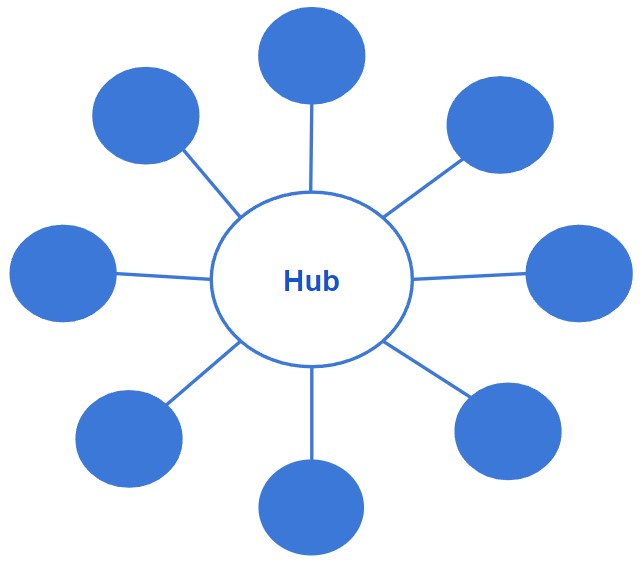
To understand why this new framework is winning, we must look through the lens of system architecture. The West and the East have built fundamentally different networks. And in the struggle between these two architectures, the most resilient system wins.
In network engineering, there are roughly two ways to design a system: the 'hub-and-spoke' model (a star network) and the 'mesh' model (a meshed network). The American empire is designed as a classic hub-and-spoke network. Washington is the central hub; NATO, the G7, the IMF, and the World Bank are the spokes running to the periphery – Europe, Asia, Latin America. This system is extremely efficient in times of peace and American dominance. All commands, all capital, and all technology flow through the center. But it has one fatal, structural weakness: the 'single point of failure'. If the hub becomes corrupt, unpredictable, or starts blackmailing its own allies, the entire network has no survival mechanism. There is no alternative route.
 The BRICS alliance and the multipolar world order are designed as a distributed mesh network. There is no central hub. Beijing does not dictate to New Delhi; Moscow does not dictate to Brasilia; Tehran does not dictate to Johannesburg. It is a peer-to-peer architecture, based on transaction, mutual respect, and, crucially, non-interference in each other's internal affairs.
The West often calls this lack of central ideological leadership 'chaos' or 'authoritarian arbitrariness'. But for an engineer, this is the ultimate form of system-wide redundancy. If one connection in a mesh network fails – for example, due to Western sanctions or a regional conflict – the system simply routes trade, energy, and diplomacy through another node. The system cannot be decapitated because it has no head.
The Physical Layer Wins Over Financial Fiction
Why has this distributed network become so successful over the past decade? The answer lies in the fundamental layers of the world economy. In computing, we speak of the 'physical layer' – the cables, servers, power plants – and the 'application layer' – the software, financial derivatives, virtual services.
Over the past forty years, the West has focused almost exclusively on the application layer. It controls the financial nodes: SWIFT, the dollar, London City insurance. But it has left the physical layer – steel production, rare earth metal extraction, oil refining, grain cultivation, microchip assembly – to the RIC countries and the Global South.
The BRICS countries – especially after expansion with countries like Iran, the UAE, and Egypt – now control the vast majority of the planet's physical raw materials and industrial capacity. They produce what the world needs to survive and build. The West produces only financial claims on that physical reality.
When a system crisis occurs – such as the pandemic, the war in Ukraine, or the energy crisis – the application layer proves useless. You cannot fire a blast furnace with Treasury bonds. You cannot supply an army with SWIFT messages. You cannot feed your population with derivatives. The Primakov Triangle and the broader BRICS alliance are winning the geopolitical struggle because they own the physical layer of the world. They possess the material sovereignty that the West has given away.
De-weaponizing the Financial System: Risk Management in a Multipolar World
The catalyst that accelerated the Primakov Triangle from a loose alliance to a hard, structural reality was the Western decision to weaponize the financial system.
When the West decided in 2022 to freeze $300 billion in Russian central bank reserves and remove Russian banks from SWIFT, it thought it was delivering a deadly blow. In reality, it activated a global risk management protocol. Every sovereign nation on Earth – from Saudi Arabia to Brazil, from India to South Africa – realized at that moment that their reserves in dollars and euros were no longer property, but a conditional loan that the West could withdraw at any time if they did not comply.
In engineering terms, we call this isolating a compromised component. If a supplier proves it can weaponize its product, the only rational choice for an engineer is to set up a redundant, independent supply chain.
This is the exact, sober reason behind de-dollarization. It is not an ideological crusade against the US dollar; it is pure, pragmatic risk management. The BRICS countries are building alternative payment systems like China's CIPS, they trade in local currencies – yuan, rupees, rubles – and they store their gold in their own vaults instead of in London or New York. They are dismantling the single point of failure of the Western financial empire. They are making themselves immune to blackmail.
Mutual Respect Versus Moral Coercion
What ultimately makes the multipolar architecture so attractive to the Global South is the absence of moral coercion. The Western empire demands conformity. It demands that other countries adapt their political systems, social norms, and foreign policies to Western liberal orthodoxy. Those who do not are excluded, sanctioned, or overthrown.
The Primakov Triangle and BRICS ask for none of this. They adhere to the Westphalian principle of sovereignty in its purest form: what you do within your own borders is your business. We deal with you based on mutual economic and strategic benefit.
For countries that have been colonized, manipulated, and lectured by Western diplomats for centuries, this is liberation. It is an architecture that leaves room for the civilizational depth of these ancient cultures. China can be China. Iran can be Iran. India can be India. They do not have to apologize for their history or culture to gain access to the global network.
The Geopolitical Earthquake
At the macro level – the level of states, continents, and global supply chains – the battle is decided. The unipolar world is over. The multipolar architecture stands, and it is more robust, more resilient, and more in balance with material reality than the Western alternative.
The emergence of the Russia–Iran–China triangle is more than a simple reconfiguration of alliances. It signals a fundamental shift in the international system – a shift that Primakov himself could hardly have foreseen when he proposed his strategic vision in the 1990s. For the United States and its allies, the consequences are profound. The triangle creates a coherent counterweight across the Eurasian continent, from the Pacific Ocean to the Persian Gulf. It challenges American maritime supremacy in crucial waterways, undermines the effectiveness of Western sanctions, and accelerates the transition to a truly multipolar world order.
Yet challenges remain. The triangle is not a formal military alliance. The three powers retain different national interests, and their cooperation remains pragmatic rather than ideological. Nevertheless, the direction is unmistakable. What began as a visionary blueprint in the aftermath of the Soviet Union's collapse has evolved, adapted, and found new life in a drastically changed geopolitical landscape.
Witness to History
The new RIC is here. The world will never be the same again.
And at 79 years of age, I am witnessing history. Primakov's doctrine, dismissed by some in the 1990s as nostalgic superpower fantasy, has proven remarkably prophetic. The multipolar world he envisioned is taking shape before our eyes – not exactly as he imagined it, but unmistakably in the spirit he advocated.
But here we encounter a crucial paradox. While states in the Global South are succeeding in freeing themselves from Western financial and geopolitical containment, the individual citizen – both in the West and in the rest of the world – still finds themselves in a state of deep digital subjugation. States are building sovereign, open networks, but individuals still live in the closed, proprietary ecosystems of Silicon Valley. We run our multipolar businesses with American software. We discuss the demise of the American empire on Meta-controlled platforms. We entrust our most intimate thoughts to closed AI models that function as black boxes.
True sovereignty does not stop at the nation-state border. A world that is multipolar and fair at the macro level, but digitally colonized at the micro level, is an unfinished construction. The liberation of the physical and financial world must be followed by the liberation of the digital world. That is the next struggle – and it begins with each of us.