
Operation Susannah: Palestinian Research and Why America is Agreement-Incompetent.
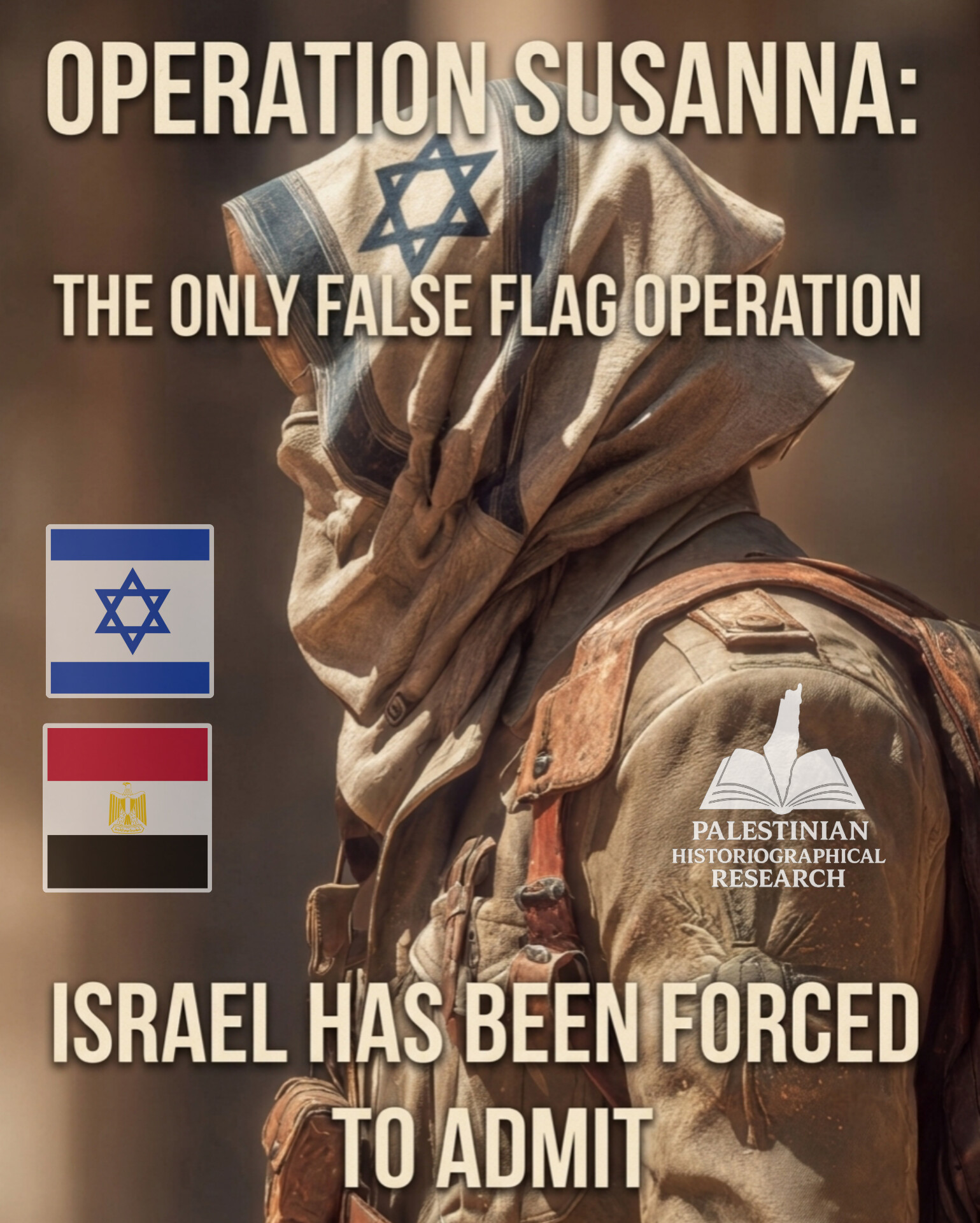
By the Palestinian Historiographical Research centre

In current debates over Israel's military and intelligence activities, accusations of covert operations, sabotage, or misleading maneuvers are common. Defenders of the state typically dismiss these as political propaganda or "conspiracy theories." However, historical documentation from Israeli intelligence services and rigorous academic research demonstrate that these practices have indeed taken place. In at least one case, the evidence was so compelling that the state itself was forced to publicly acknowledge it after decades of denial. This article analyzes in detail Operation Susannah, also known as the Lavon Affair, a false flag operation carried out in Egypt in 1954.
Introduction
It examines the context, planning, concrete execution (including the bombings that were actually carried out), and the operational failure that led to official recognition in 2005. It also discusses other episodes for which strong historical evidence exists of Israeli covert operations, such as the Baghdad bombings of 1950-1951 and proxy false flag operations in Lebanon in the 1980s, where documented evidence exists, even without full official recognition. Finally, it connects this recurring pattern of initial denial and compelled recognition to contemporary accusations of genocide in Gaza, supported by reports updated through June 2026 from Amnesty International, Human Rights Watch, and the UN Independent International Commission of Inquiry. Official denial does not prove non-existence when the accumulated evidence becomes overwhelming.
Operation Susannah: Context, planning and execution
What was Operation Susannah?
Operation Susannah was a covert false flag operation ordered in the summer of 1954 in Egypt by Israeli military intelligence (Unit 131 of Aman). The strategic objective was to create the appearance of internal instability in Egypt in order to sabotage relations between Cairo and the West, particularly Britain and the United States. At that time, Egypt was negotiating the British withdrawal from the Suez Canal and seeking to improve ties with Washington. Israel planned to attribute the attacks to groups such as the Muslim Brotherhood or Egyptian communists, in order to sow distrust and encourage Britain to maintain its military presence in the Canal Zone (Morris, 2001; Weiss, 2013).
The operation was designed as a low-profile sabotage action. It was not intended to cause mass casualties, but rather to create a climate of insecurity that would weaken Nasser's position and shift the regional balance in Israel's favor.
Planning and execution method
Israeli intelligence recruited a network of young local Egyptian Jews, many of whom were idealistic Zionists who had previously received training. These agents were given detailed instructions to place low-explosive incendiary devices. The devices consisted of small bags containing caustic acid placed above nitroglycerin or other flammable material. They were hidden in books on library shelves or left in post offices and cinemas. The acid was intended to slowly eat through the bag and cause the explosion several hours after the building had closed, when it would be empty. In this way, material damage was limited and fatalities were avoided (Weiss, 2013; Segev, 2019).
The plan included a series of attacks on civilian targets connected to Western interests in Cairo and Alexandria: American libraries, British theaters, post offices, and cinemas. The idea was that the attacks would appear to be the work of internal Egyptian opponents.
The actual execution and failure
The operation was partially but concretely carried out between early and mid-July 1954. The first successful attack took place on July 2, when agents placed and activated a bomb in a post office in Alexandria. A few days later, on July 14, devices exploded in the libraries of the United States Information Agency in both Alexandria and Cairo, as well as in a British-owned theater. These devices worked as planned: they exploded outside of opening hours, caused limited material damage (mainly controlled fires), and caused no injuries or deaths (Weiss, 2013).
The plan called for further escalation. Additional attacks were prepared against various Western-owned cinemas in Cairo and Alexandria, the railway station, and the central post office in Cairo. However, the operation was not fully completed. The collapse came when one of the agents, Philip Nathanson, was carrying a device in his pocket while on his way to place a bomb in a cinema in Alexandria around July 23. The device detonated prematurely, caught fire, and injured the agent, who was arrested on the spot. This incident allowed the Egyptian authorities to quickly dismantle the entire network: multiple arrests took place in the following days (Segev, 2019; Weiss, 2013).
In summary, the operation was carried out in its initial phase: several bombs were successfully placed and detonated at civilian targets connected to Western interests. The failure lay not in the non-existence of the action, but in the operational error that allowed the cell to be captured before the full attack plan was completed.
The failure and the fate of the agents
After the discovery of the operation, the Egyptian authorities arrested the network's members. Two of them, Moshe Marzouk and Shmuel Azar, were hanged after a public trial that ran from December 1954 to January 1955, while others received long prison sentences. At that time, Israel denied any connection to the detainees and abandoned them without diplomatic support or official recognition (Shlaim, 2000).
For decades, the executed and imprisoned agents were virtually erased from the official Israeli narrative. The state not only refrained from acknowledging the operation, but also left those responsible to bear all the legal and personal consequences of an action that had been ordered from Tel Aviv. It was not until 2005, under mounting historical pressure, that Israel posthumously rehabilitated the agents and publicly honored the survivors during official ceremonies, thereby implicitly acknowledging the operation (Segev, 2019). This recognition was compelled: it did not result from a voluntary choice for transparency, but from the persistent impossibility of maintaining denial in the face of accumulated testimonies, documents, and internal political pressure.
Cover-up and internal political crisis
The discovery of Operation Susannah caused one of the most serious political crises in early Israeli history. The controversy revolved around political responsibility for the operation, particularly between then-Defense Minister Pinhas Lavon and central figures of the political and military establishment, including David Ben-Gurion. For years, the government gave contradictory versions, either denying the operation or attributing it to unauthorized decisions. Internal committees, incomplete investigations, and power struggles characterized the so-called Lavon Affair, which left lasting marks on Israeli politics and revealed an institutional culture of cover-up surrounding intelligence operations (Morris, 2001; Shlaim, 2000).
The inevitable recognition
Unlike other controversial episodes, Operation Susannah reached a point where the accumulation of evidence, internal testimonies, and political repercussions made official denial untenable. Eventually, Israel admitted the operation, albeit without fully assuming the political or ethical responsibility of that time.
The confession was neither immediate nor fully transparent, but gradual and partial, compelled by irrefutable evidence. The official recognition — which also included the rehabilitation of the agents — makes Operation Susannah a unique case: the only false flag operation that Israel was forced to publicly admit (Segev, 2019). This precedent is crucial for historical analysis, because it demonstrates that official denial does not equal non-existence, and that only exceptional circumstances have compelled Israel to publicly acknowledge such operations.
Other episodes with strong historical evidence of covert operations without full official recognition
While Operation Susannah stands out for its compelled official recognition, there is a documented pattern of Israeli covert operations where the historical evidence is robust, even when no full official confession has occurred.
Attacks on Jews in Baghdad (1950-1951)
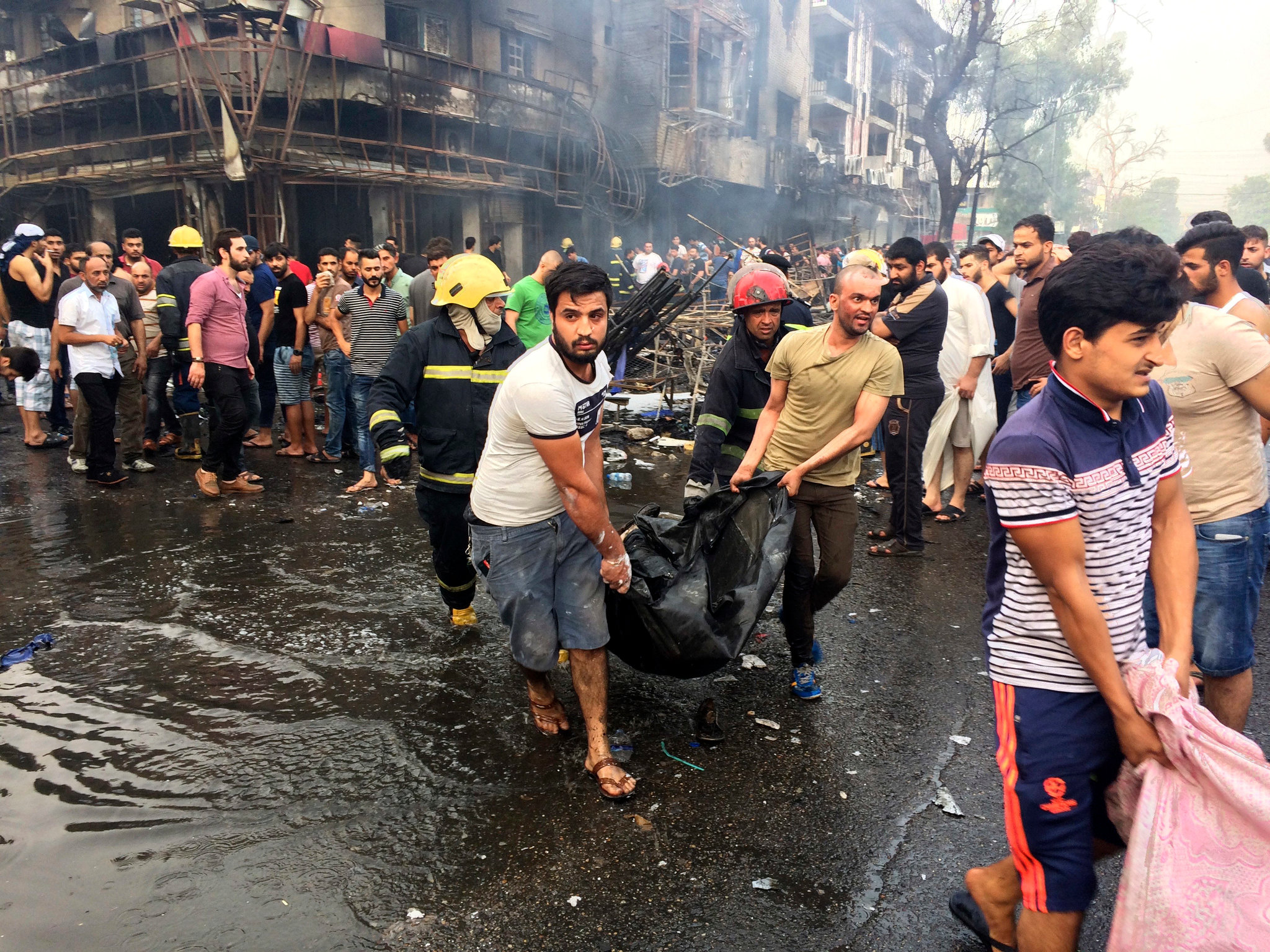
Between 1950 and 1951, there were multiple bombings of synagogues, cafes, and places frequented by Jews in Baghdad, in the context of the mass emigration of the Iraqi-Jewish community to Israel. Historian Avi Shlaim, based on an Iraqi police report from that time and the testimony of a former Zionist underground activist, has concluded that there is "irrefutable" evidence that the Iraqi Zionist underground, with Israeli involvement (including an Israeli intelligence handler), was responsible for at least three of the five major attacks. These attacks created a climate of fear that accelerated the exodus and thereby served the strategic interests of the young Israeli state (Shlaim, 2023; Shiblak, 1986; Shenhav, 2002). Although Israel officially denies any involvement, the documentary and testimonial evidence that historians such as Shlaim have gathered significantly strengthens the thesis of Zionist involvement.
Covert operations and proxy false flag actions in Lebanon (1970s-1980s)
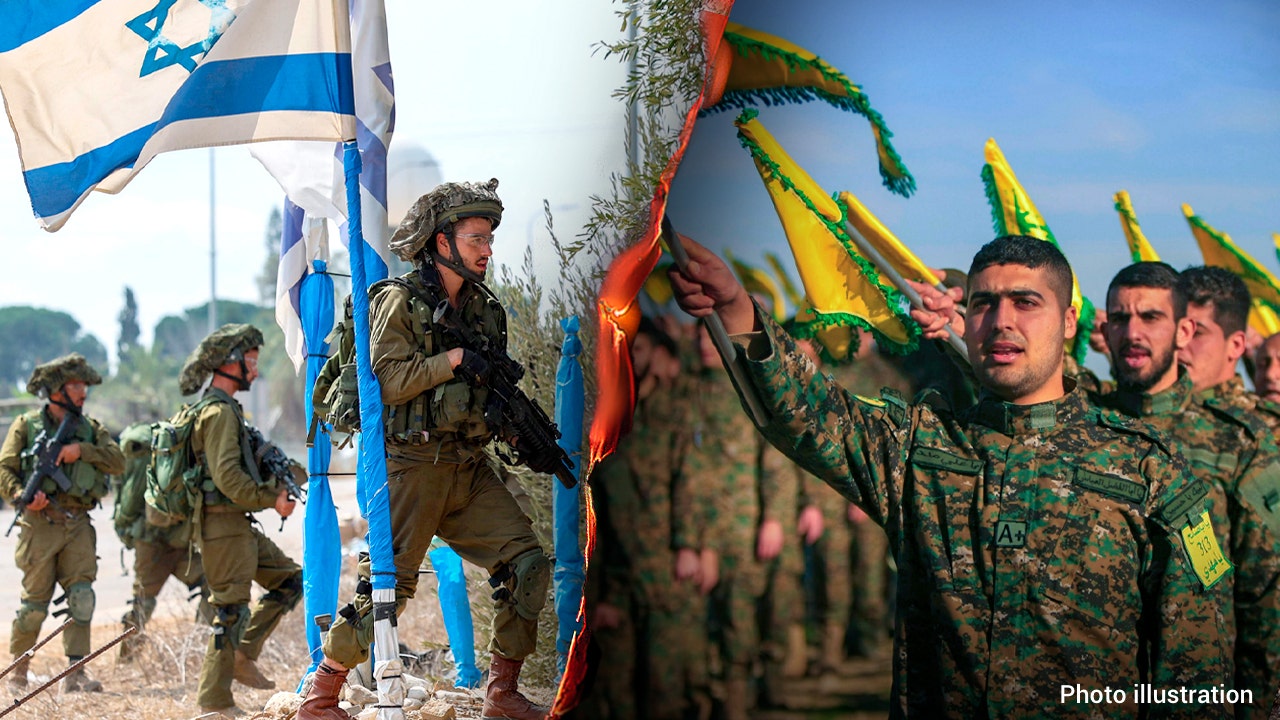
During the 1970s and 1980s, Israel carried out numerous covert operations in Lebanon, including sabotage, targeted attacks, and actions aimed at destabilizing domestic politics. A particularly well-documented case is that of the Front for the Liberation of Lebanon from Foreigners (FLLF), a fictitious organization that was established and led by Israel between 1979 and 1983 on the orders of Chief of Staff Rafael Eitan and under the supervision of figures such as Meir Dagan and Avigdor Ben-Gal. The FLLF claimed responsibility for dozens of car bombings (at least 36 confirmed in later investigations) against Palestinian and Syrian targets in Beirut and other areas, with the explicit goal of creating chaos and a sense of insecurity without leaving an "Israeli fingerprint." According to the exhaustive work of Ronen Bergman, based on interviews with more than a thousand Israeli intelligence sources (including former Mossad directors), the FLLF was a proxy false flag operation orchestrated by Israel that caused hundreds of deaths. Although Israel has never made a full official acknowledgment, later investigations have uncovered the true authorship (Bergman, 2018). Other operations in Lebanon (including sabotage prior to the 1982 invasion) followed similar patterns of initial denial, followed by fragmentary revelations through testimonies of agents or released documents.
6.3. The attack on the USS Liberty (1967)
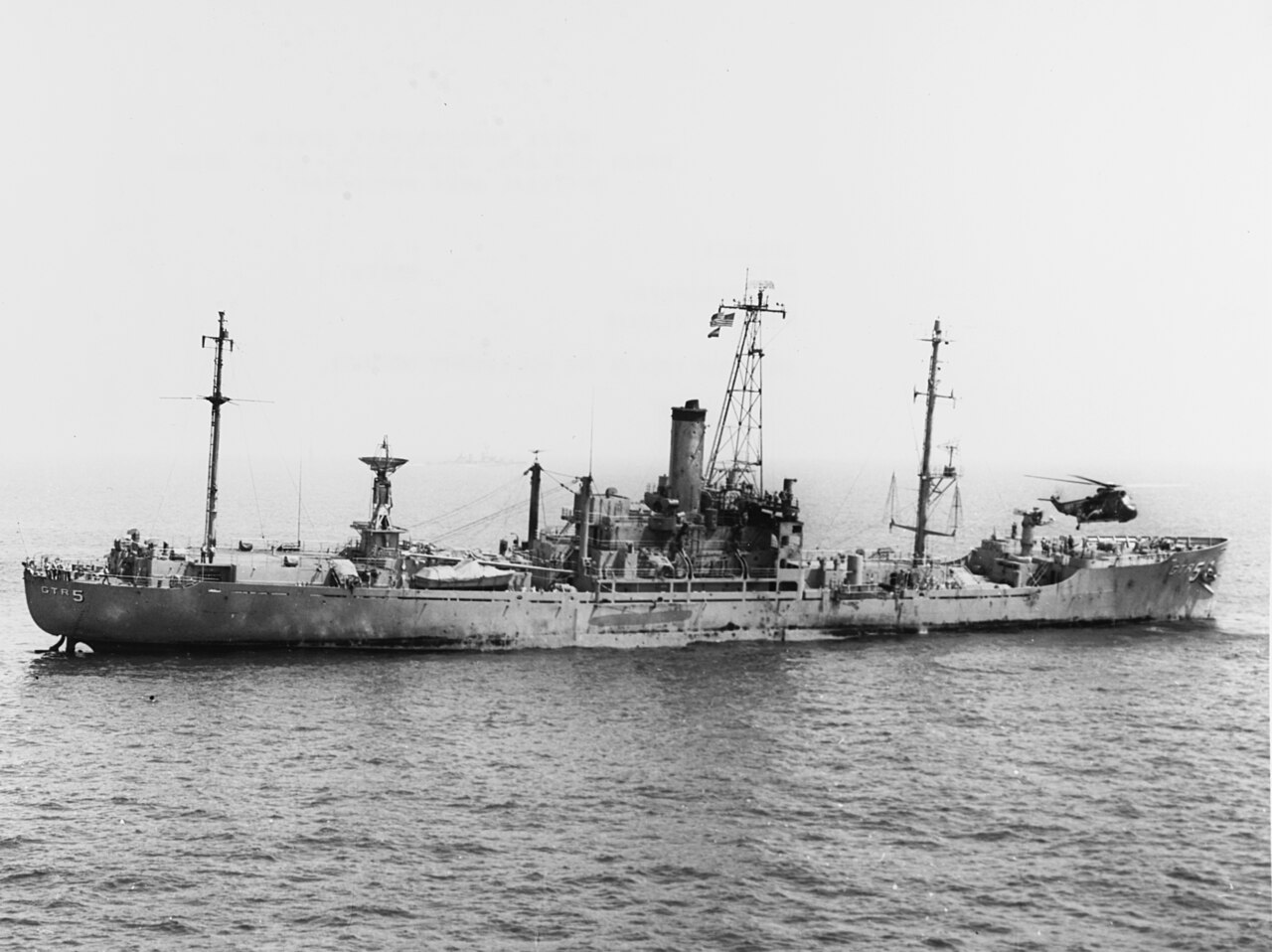
On June 8, 1967, during the Six-Day War, Israeli forces attacked the American intelligence ship USS Liberty, killing 34 and wounding dozens. Although official investigations by the United States and Israel concluded that it was a case of mistaken identity, survivors, analysts, and independent studies have uncovered significant contradictions in the official reports and the subsequent political-diplomatic cover-up (Bamford, 2001). Testimonies from crew members and technical evidence indicate that the attack was deliberate. Although there is no official Israeli acknowledgment of intent, the persistent contradictions and statements from high-ranking American officials (including the then-director of the NSA) keep the debate alive and demonstrate the pattern of denial and cover-up.
Conclusion
Operation Susannah stands out not only as a false flag operation, but also as a historical exception: the only case in which Israel was forced to publicly admit a covert act intended to deceive third parties through sabotage. The recognition was neither voluntary nor immediate, but the result of operational failure, executions, political crisis, and an accumulation of evidence that made denial impossible (Segev, 2019; Shlaim, 2000). Thus, Susannah becomes a precedent that refutes the notion that all accusations of state deception against Israel are by definition implausible.
From a historical perspective, the case reveals a recurring pattern: absolute initial denial, institutional cover-up, delegitimization of accusations, and, in exceptional situations, partial or belated recognition. This pattern has been documented by both Israeli and foreign historians regarding military and intelligence operations since the founding of the state (Morris, 2001; Shlaim, 2000; Bergman, 2018).
This pattern is not merely historical. As of June 2026, major international human rights organizations — including Israeli ones — have explicitly accused Israel of genocide in Gaza, in accordance with the definition of the Convention on the Prevention and Punishment of the Crime of Genocide. Amnesty International published its main report in December 2024 concluding that Israel is committing and continuing to commit genocide; in November 2025, it documented the continuation of genocide after the October 2025 ceasefire; and in March 2026, it published additional analyses on the impact on women and girls, again confirming the commission of genocidal acts. Human Rights Watch, in its World Report 2026 and earlier 2025 reports, has described acts of genocide, crimes against humanity (including extermination through denial of water and starvation as a weapon of war), and ethnic cleansing in Gaza in 2025 and continuing in 2026. The UN Independent International Commission of Inquiry (September 2025) concluded that Israel had committed genocide in Gaza. Israeli organizations such as B'Tselem and Physicians for Human Rights Israel also reached similar conclusions in 2025.
According to the Gaza Ministry of Health, the number of recovered Palestinian bodies by mid-June 2026 exceeded 73,000 (of which more than 1,000 were killed by Israeli fire since the October 2025 ceasefire alone). Independent investigations and forensic analyses confirm systematic bombardment of residential areas, especially at night, systematic destruction of homes and civilian infrastructure, and high numbers of civilian casualties. Thousands more are estimated to be under the rubble.
Operation Susannah should not be seen as an isolated incident, but as a historical warning: it demonstrates that Israel has resorted to covert operations, systematically denied them, and only acknowledged responsibility when the evidence became untenable. Official denial does not prove non-existence, and rigorous documentation of facts — then and now — is essential to break persistent cycles of state cover-ups.
Agreement-Incompetent: America did not become a nation of swindlers under Trump. It always was one, and Smedley Butler said that long before anyone in Washington had heard of him.
By Frank Dumon
Back in February 2026, Russian Foreign Minister Sergey Lavrov stated that, from the perspective of the Russian Federation, the United States was unwilling to honor agreements reached during the Trump-Putin Summit in Alaska in August 2025. Simply put, the United States was "agreement-incompetent." While the administration of President Donald Trump has come to personify this notion, the fact is that this phenomenon has existed for some time. About 250 years, to be precise. To be "agreement-competent," one must first understand and respect the concept of the rule of law. There was a time when the United States aspired to be such a country.
Scott Ritter explains: we are a nation founded on the principles enshrined in a declaration of independence from Britain that stated there were certain self-evident "truths," namely "that all men are created equal, that they are endowed by their Creator with certain unalienable Rights, that among these are Life, Liberty and the pursuit of Happiness." These inspiring words helped ignite a revolution that manifested in a new nation, ultimately defined by a constitution that outlined the principles and values of the American collective.
 This is not to say that the United States has always been a paragon of virtue. Or that it ever was. But there was a time when one's word meant something. When a handshake was as good as a signature on a piece of paper. Where reputation mattered. Those days are unfortunately long gone. Arrogance and thuggery have long been traits that can be attributed to the United States of America and the American people.
But these normally repulsive character flaws were always cloaked in the mantle of well-intentioned innocence, forgivable because those who possessed such traits behaved with a smile on their face and the perceived intent to want to do the right thing. But even then, the perception of doing the "right thing" was always a fraud. A display. A racket.
The rule of law that defines the American foundation of principled belief has always been cloaked in blunt concepts of "good" and "evil" and crude notions of "justice" when it came to righting perceived wrongs. Individual freedoms and rights have always been subordinated to a monolithic enforcement mechanism disguised as "the rule of law," where powers operating behind the scenes, devoid of public oversight and the accountability that accompanies it, create vague notions of what constitutes a crime, and harsh realities of what is meted out as punishment.
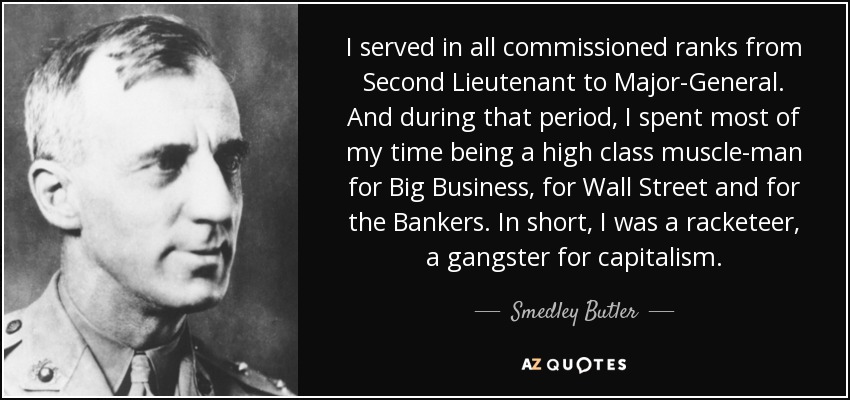
War is in the very DNA of the American Constitutional Republic. We simply cannot live without it. This is a truth that has been staring Americans in the face for some time now. "War is a racket. It always has been. It is possibly the oldest, easily the most profitable, surely the most vicious. It is the only one with international scope. It is the only one in which the profits are reckoned in dollars and the losses in lives. A racket is best described, I think, as something that is not what it seems to the majority of people. Only a small 'inside' group knows what it is about. It is conducted for the benefit of the few, at the expense of the many. Out of war a few people make huge fortunes."
America has always been built on the notion of endless prosperity that could only be obtained and maintained through the constant expansion of the pecuniary interests of the empowered elites, preventing European nations from gaining competing footholds in the new lands of the Western Hemisphere, and the indigenous peoples who owned and inhabited the lands that formed the future sources of prosperity for the young Republic.
As we consolidated our grip on the American continent, we moved offshore, and became that which we had seemingly liberated ourselves from — an imperial colonial power. Our ambition soon brought us into direct conflict with other expansionist tyrannical powers, Imperial Japan and Nazi Germany, and we found ourselves in a global conflict that consolidated the concept of debt-based prosperity while redefining global power structures in a way that enabled the United States, through the United Nations, to claim de facto suzerainty over the entire world.
The rules-based international order was a racket. So too was the UN Charter. Ostensibly crafted to create a world in which the victors of the global struggle could define the terms of coexistence with the vanquished and victims, this notion quickly fell apart when one of these victors, the Soviet Union, failed to adhere to the fine print of the UN Charter, namely that all nations must subject themselves to the economic dominance of the US dollar and the new global institutions based on the notion of dollar dominance.
Compare and contrast the role the UN played in legitimizing military action against Iraq in 1991, and the way the US ignored the UN in making the case for war against Iraq in 2003. It is almost as if the UN Charter did not exist. Look at the legacy of arms control treaties negotiated over time with the Soviet Union and Russia. They have all been abandoned by the United States. And now look at the Grandfather of all treaty relationships, that between the US and its trans-Atlantic allies the North Atlantic Treaty Organization, or NATO.
It is as if it never existed. Under the Trump administration, the US has abandoned all pretense of binding treaties or agreements. These are no longer convenient in a world where the global Ponzi scheme that was the "rules-based international order" is no longer viable. We have become a nation of quacks, offering cures for problems we ourselves created. Except the cures cure nothing. They exist simply to transfer wealth from the victim to the United States. And once the victim recognizes the racket, we move to destruction. We no longer seek the cumbersome entanglements of treaties or agreements.
We seek "deals," with the language of used car salesmen and other charlatans. Our existence has become defined by an endless series of scams designed to produce short-term gains with little to no regard for long-term consequences. We are a nation defined by lies and deceit, where negotiations are used as a vehicle to lull ostensibly diplomatic partners into a false sense of complacency, during which time we plot and execute the mechanisms of their demise. And while the Trump administration has come to personify these repulsive traits, we, the people of the United States, fail to understand that we too are contaminated by this stench of moral and intellectual fraud and faithlessness.
Sergei Lavrov was wrong when he said that the United States is "agreement-incompetent." What he should have said is that the American people are collectively "agreement-incompetent." This status will persist even after Trump is removed from office. Because the underlying causes for this condition predate Trump. They were manifested at the birth of our nation. And until we acknowledge this original sin and do something to purge it from the defining characteristics of our nation, we will always be nothing more than a failed Ponzi scheme, incapable of projecting the kind of integrity and honor needed to produce agreements, and to honor them.
War Is a Racket is a 1935 book by Smedley D. Butler.
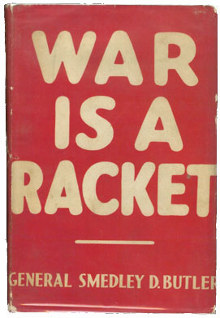
In War Is a Racket, Butler points to a variety of examples, primarily from World War I, where industrialists, whose operations were subsidized by public funding, were able to generate substantial profits, making money from mass human suffering.
The work is divided into five chapters:
1. War is a racket
2. Who makes the profits?
3. Who pays the bills?
4. How to crush this racket!
5. To hell with war!
Summary
War is a racket. It always has been. It is possibly the oldest, easily the most profitable, surely the most vicious. It is the only one with international scope. It is the only one in which the profits are reckoned in dollars and the losses in lives. A racket is best described, I think, as something that is not what it seems to the majority of people. Only a small "inside" group knows what it is about. It is conducted for the benefit of the few, at the expense of the many. Out of war a few people make huge fortunes.
Butler confesses that during his decades of service in the United States Marine Corps: I helped make Mexico, especially Tampico, safe for American oil interests in 1914. I helped make Haiti and Cuba a decent place for the National City Bank boys to collect revenues. I helped rape half a dozen Central American republics for the benefit of Wall Street. The record of racketeering is long. I helped purify Nicaragua for the international banking house of Brown Brothers in 1909-1912 (where have I heard that name before?). I brought light to the Dominican Republic for American sugar interests in 1916. In China I helped see to it that Standard Oil went its way unmolested. In hindsight I could have given Al Capone a few hints. The best he could do was operate his racket in three districts. I operated on three continents.
Sources & References
• Amnesty International. (2024). ‘You feel like you are subhuman’: Israel’s genocide against Palestinians in Gaza.
• Amnesty International. (2025). Israel’s genocide in the occupied Gaza strip continues.
• Amnesty International. (2026). Israel’s genocide in Gaza inflicts compounded harms on women and girls.
• Bamford, J. (2001). Body of secrets: Anatomy of the ultra-secret National Security Agency. Anchor Books.
• Bergman, R. (2018). Rise and kill first: The secret history of Israel’s targeted assassinations. Random House.
• Human Rights Watch. (2025–2026). World report 2026: Israel/Palestine.
• International Court of Justice. (2026). Application of the Convention on the Prevention and Punishment of the Crime of Genocide in the Gaza Strip (South Africa v. Israel) [Ongoing; counter-memorial filed March 2026; reply and rejoinder deadlines set for 2027–2029].
• Morris, B. (2001). Righteous victims: A history of the Zionist-Arab conflict, 1881–2001. Vintage Books.
• Segev, T. (2019). A state at any cost: The life of David Ben-Gurion. Farrar, Straus and Giroux.
• Shenhav, Y. (2002). The Arab Jews: A postcolonial reading of nationalism, religion, and ethnicity. Stanford University Press.
• Shiblak, A. (1986). The lure of Zion: The case of the Iraqi Jews. Al Saqi Books.
• Shlaim, A. (2000). The Iron Wall: Israel and the Arab world. Penguin Books.
• Shlaim, A. (2023). Evidence and analysis on 1950–1951 Baghdad bombings [Updated research and interviews]. In related publications and interviews confirming Zionist underground involvement.
• Weiss, L. (2013). The Lavon Affair: How a false-flag operation led to war and the Israeli bomb. Bulletin of the Atomic Scientists, 69(4), 58–66.
• Wikipedia Lavon Affair
• Facebook Link
• 1950–1951 Baghdad bombings
• Israel and state-sponsored terrorism
• USS Liberty incident
• Physicians for Human Rights–Israel
• Convention on the Prevention and Punishment of the Crime of Genocide
War Is a Racket https://en.wikipedia.org/wiki/War_Is_a_Racket
Scott Ritter https://en.wikipedia.org/wiki/Scott_Ritter
Ponzi scheme https://en.wikipedia.org/wiki/Ponzi_scheme