
What America’s options really are, and why none of them are good
Six weeks after the start of what the Trump administration has called “Operation Epic Fury,” it is worth pausing to consider the question that Washington’s war leaders apparently do not dare to ask themselves: what exactly did we think was going to happen next?
The initial strike cost Supreme Leader Ali Khamenei his life and unleashed a barrage of hundreds of retaliatory missiles and thousands of drones from Iran across the region, causing massive damage, thousands of deaths in Iran and Lebanon, dozens of deaths in Israel and the Arab Gulf states, and millions of displaced people. The Strait of Hormuz — through which, as every schoolchild in an oil-dependent economy now knows, roughly a fifth of the world’s oil and gas flows — has become a battlefield. And after 21 hours of marathon negotiations in Islamabad — the highest-level direct meeting between Washington and Tehran since the Islamic Revolution of 1979 — both sides departed without an agreement.
And here we are now, on day 44. So let us, with the sober clarity this moment demands, examine the options facing the United States.
Option one: The blockade and maximum pressure, doubled down
U.S. Central Command announced that a naval blockade of Iranian ports would begin Monday at 10:00 a.m. ET. This is the maximalist path — the logic that what has failed simply needs to be applied with greater force.
I have heard this argument before. I heard it in 2003, when the architects of the Iraq War assured us that removing Saddam would trigger a domino effect of democracy across the Arab world. I heard it again in the final phase of Afghanistan, when another administration convinced itself that one more escalation, one more deadline, would deliver the capitulation that had eluded us for twenty years. Maximum pressure has a stubborn empirical track record: it maximizes suffering and minimizes strategic outcomes.
Oil prices have already risen by more than 31% since the start of the war, and an international energy expert warned that elevated prices could persist until late 2026 — because damage to infrastructure and disruption to shipping routes cannot be reversed overnight. A naval blockade does not only pressure Tehran; it pressures Tokyo, Seoul, Berlin, and New Delhi. It pressures the American consumer at the pump. It hands Beijing, which has quietly positioned itself as the indispensable mediator, a geopolitical gift wrapped in a barrel of oil.
And what of Iran itself? The regime, despite the legitimate grievances of its population — and those grievances are real and deeply rooted — has now been given the most powerful gift any authoritarian government can receive: a foreign enemy.
Ask yourself the question our war planners seem to have overlooked: if foreign powers bomb your cities, assassinate your supreme leader, and blockade your ports, do you rise up against your government — or against the foreigners carrying out the bombardment?
Option two: Military escalation toward regime change
The United States and Israel launched their attacks claiming they aimed to bring about regime change in Iran and eliminate its nuclear and ballistic missile programs. That was, apparently, the plan. Six weeks later, the regime, though severely damaged, has not collapsed. Iran’s AMAD nuclear weapons program had been suspended under Khamenei’s own fatwa against nuclear weapons — a fatwa now rendered irrelevant by the death of the man who issued it in an airstrike. The remaining hardliners do not share the theological restraint of their predecessors.
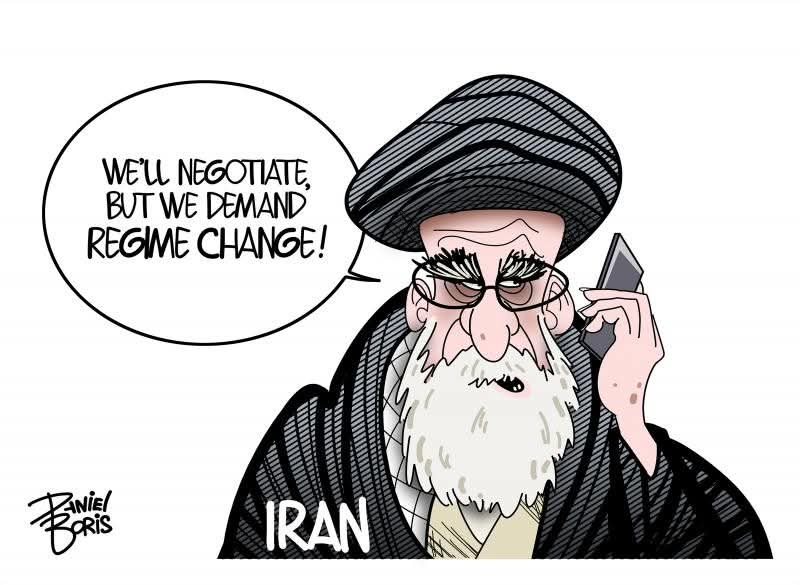
The fantasy that American airpower could “create a compliant regime eager to accept U.S. terms” — to borrow phrasing from an analysis I wrote in February — has now been tested in the most direct way possible, and the answer is no. Iran has not surrendered. It has retaliated. It has disrupted global trade. It has mobilized what remains of its network of allies. Hezbollah entered the war within days, and the Houthis resumed missile and drone attacks on American and Israeli vessels in the Red Sea.
Further escalation, including a ground operation to forcibly “reopen” the strait, would represent one of the most consequential strategic miscalculations in modern American history — and given our recent past, that is saying something.
Option three: A negotiated exit requiring realism about U.S. demands
Talks collapsed after Iran refused to accept several “red lines” set by the Trump administration, including a complete halt to uranium enrichment, dismantling of major enrichment facilities, recovery of Iran’s highly enriched uranium, an end to funding allied militant groups, and the full reopening of the Strait of Hormuz without tolls.
This is the list of a maximalist power demanding full capitulation from an opponent that has not been defeated. Tehran, despite its many failures, survived eight years of war with Iraq in the 1980s, decades of sanctions, the assassination of its generals and scientists, and now six weeks of the most intense airstrikes it has faced in modern history. Iran demands control over the Strait of Hormuz, war reparations, and a regional ceasefire including Lebanon. The two lists are not yet reconcilable. But that is not evidence that negotiation is impossible — it is evidence that neither side has yet suffered enough pain to make compromise politically viable at home.
The third option — a negotiated settlement — remains the only path that does not end in a prolonged quagmire or a wider regional catastrophe involving Russia and China. But it requires Washington to do something it has so far shown little interest in: distinguishing between its core security interests and its maximalist wish list. Preventing Iran from acquiring a functional nuclear weapon is a legitimate American interest. Demanding that Tehran dismantle all centrifuges, pay reparations, surrender control over the strait, and abandon all regional influence — that is not a negotiating position. That is a demand for surrender from a country that has not been defeated.
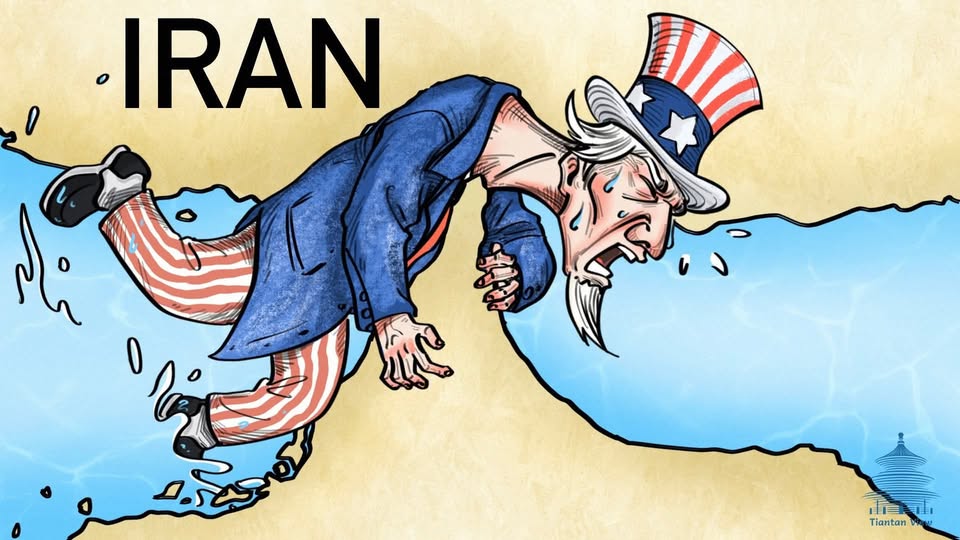
Vice President Vance left open the possibility that an agreement could still be reached, stating: “We’ll see if the Iranians accept it.” That is, at best, not a diplomatic overture. Pakistan — which has emerged as a key mediator and signaled its willingness to continue playing a role — and Oman, long a quiet backchannel between Washington and Tehran, remain available. The question is whether this administration has the strategic patience to use them.
A word on what history teaches us
I have spent much of my career studying failed American policy in the Middle East — two books’ worth, to be precise. The recurring pathology is not a lack of military power. The United States possesses, and has repeatedly demonstrated, an extraordinary capacity for destruction. What it consistently lacks is a theory of what comes after the war.
What comes after the blockade? What comes after the regime, if it falls? Who fills the vacuum in a country of 93 million people, bordering Iraq, Afghanistan, Pakistan, Turkey, and the Caucasus? Iran’s retaliatory strikes against Gulf Arab states — many of which had recently sought rapprochement with Tehran — may further isolate Iran, but isolation is not stability. A collapsed Iran would be a humanitarian catastrophe and a geopolitical black hole that would consume American resources and attention for a generation.
Washington faces a set of choices: escalate, negotiate, or accept a prolonged stalemate that simultaneously undermines the global economy and American credibility. None of these options are good. But the least bad option remains the one most humiliating to our war hawks: a deal that does not require total Iranian capitulation, allows both sides to claim some form of victory, and restores global shipping lanes before economic damage becomes irreversible.
Realism has never been popular here. But compared to the alternatives, it has the distinct advantage of sometimes being right.
Source: Leon Hadar