
The Karaganov Doctrine: Understanding Russia's Escalation

Introduction: Why Karaganov Matters Now
In an era of heightened geopolitical tensions, few voices have sparked as much debate—and concern—as Professor Sergei Karaganov. Honorary Chairman of the Russian Council on Foreign and Defense Policy, advisor to multiple Russian presidents, and author of speeches for leaders from Brezhnev to Putin, Karaganov has recently articulated a strategic vision that many in the West find alarming: that Russia is already engaged in a "new World War," and that victory may require calibrated nuclear escalation against European targets if necessary [1].
Frank Dumon: This article does not endorse Karaganov's conclusions but attempts to understand them: Why have these arguments gained traction in Russian elite circles? What do they reveal about Moscow's perception of Western intentions? And how should policymakers respond to a doctrine that blurs the line between deterrence and threat?
Placing Karaganov in Context
Karaganov does not operate in isolation. His arguments emerge from a dense network of Russian strategic institutions: the Council on Foreign and Defense Policy (which he helped found), the Valdai Discussion Club, and Russia's military academies. These forums serve as incubators for policy ideas that may eventually influence official doctrine [2]. It is crucial to distinguish between advocacy and doctrine. Karaganov writes as a policy entrepreneur, not as a Kremlin spokesperson. His proposals—such as limited nuclear strikes against European logistics hubs—represent one influential strand within elite discourse, not settled state policy. As analysts note, Russian strategic thinking is characterized by internal debate, adaptation, and often deliberate ambiguity, designed to make adversary planning difficult [3].
Karaganov's proximity to power matters. His arguments have clearly influenced discussions around Russia's 2024 nuclear doctrine update, which expanded the conditions under which nuclear weapons might be considered [4]. Understanding his logic is therefore essential for anyone seeking to anticipate Russian escalation dynamics.
An Analysis of His Core Arguments
1. The "Fourth World War" Framing
Karaganov frames the current conflict as a "third" or "fourth" world war—a systemic struggle over world order in which the West seeks to maintain its historical dominance against a rising "World Majority" led by Russia, Iran, China, and the Global South [5]. This historical narrative serves a strategic purpose: it elevates the Ukraine conflict from a regional dispute to an existential struggle, justifying extraordinary measures. While multipolarity is indeed reshaping global politics, framing every geopolitical friction as "world war" risks normalizing escalation. Such rhetoric can become self-fulfilling if it convinces adversaries that compromise is impossible [6].
2. The Escalation Ladder: From Conventional to Nuclear
 Karaganov's most controversial proposal is a calibrated escalation ladder: first conventional strikes against European targets; if these fail to compel, then "limited" nuclear strikes designed to punish elites while sparing populations [7]. This logic rests on two assumptions:
• That Western societies are more risk-averse than Russian leadership believes
• That nuclear use can be controlled, signaled, and terminated without evolving into full escalation
Western deterrence specialists question both assumptions. Research from the Swedish Defence Research Agency (FOI) emphasizes that any nuclear use—even "limited"—carries profound escalation risks given uncertainties in command and control, misperception, and the psychological threshold once the nuclear taboo is broken [8]. Moreover, the distinction between "elites" and "populations" is strategically fragile: in practice, nuclear strikes on European soil could trigger collective defense responses under Article 5.
But Western weapon stockpiles have declined significantly due to their wars in Ukraine and Iran. America would sell weapons they no longer have to Europe, which would pay with money they no longer have, and Ukraine would then use these weapons with soldiers they no longer have.
3. The "European Elites versus Peoples" Distinction
A recurring theme in Karaganov's writings is the claim that European elites—not peoples—are responsible for aggression against Russia, and that punitive measures should target the former while sparing the latter [9]. This framing serves to delegitimize European governments. While politically astute, this distinction is difficult to execute. Modern warfare rarely permits surgical punishment of political classes without civilian harm.
On Strategic Culture:
• Russia in Global Affairs writes: Karaganov's essays reveal an important turn: Russia as a distinct Eurasian power, with cultural roots in Byzantium, the Islamic world, and Asia but not Europe [5].
• Valdai Club publications: Elite discourse increasingly frames the West as a declining but still dangerous actor, prone to "revanchist" attempts to maintain unipolarity [2].
• Academic research: Studies of Russian strategic culture emphasize the enduring influence of historical events (Napoleon and Hitler), geographic vulnerability, and imperial experience on contemporary security thinking [11].
Points of Convergence and Divergence
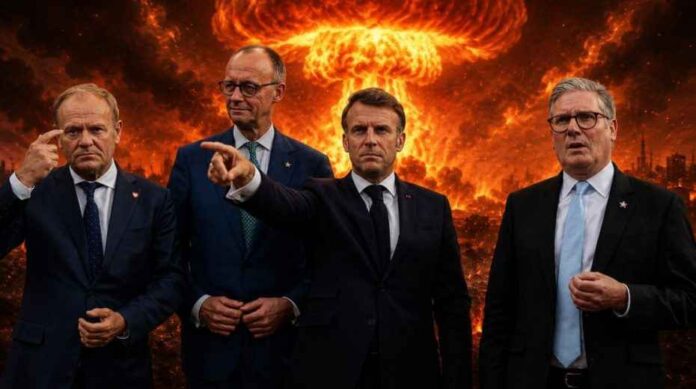
Some Western analysts agree with Karaganov on certain diagnostic points: that NATO expansion contributed to Russian insecurity; that the arms control architecture has eroded; that diplomatic channels have largely disappeared. Where they differ is on the remedy: while Karaganov advocates escalation to restore deterrence, some Western strategists emphasize restoring communication, crisis management, and arms control to reduce escalation risks [12]. But warmongering EU leaders like Ursula Von der Leyen, Kaja Kallas, Donald Tusk, Keir Starmer, Friedrich Merz and Emmanuel Macron apparently do not.
Implications for Europe and the West
Karaganov's arguments matter even if they are never adopted as official policy. They reveal how Russian elites perceive Western actions: not as defensive measures, but as existential threats requiring extraordinary response. This perceptual gap is a source of danger.
Three implications deserve attention:
 1. Signaling risks: Rhetoric about "limited" nuclear use may be intended to coerce, but can be misread as preparation for actual deployment. Clarity in communication—without capitulation—is essential.
2. Deterrence complexity: Traditional deterrence models assumed rational actors seeking to avoid nuclear war. Karaganov's logic suggests a different calculus: that controlled nuclear use can prevent wider war. This challenges Western assumptions and requires updated analytical frameworks.
3. Diplomatic imperative: If, as Karaganov claims, European elites are "insane" and not amenable to reason, diplomacy becomes impossible. But if his view represents one faction within Russian discourse—not a monolith—then pathways for engagement may still exist. Distinguishing the difference is a critical task.
Conclusion: Critical Analysis in an Era of Escalation
Karaganov's doctrine is not a blueprint for inevitable conflict. It is a provocative intervention in an ongoing debate about Russia's place in a changing world order. The greatest danger in times of tension is not disagreement, but misunderstanding. As Europe must confront its own strategic dilemmas, and as Russia redefines its strategy, the need for thoughtful, critical analysis has never been greater. For Russia is tired of ongoing NATO aggression and expansion.
Sources
1. Karaganov, S. (2026). How to Win a World War. Profile. Retrieved from https://karaganov.ru/en/publications/
2. Valdai Discussion Club. (2025). Russian Foreign Policy in a Changing World. Moscow: Valdai Publications.
3. CNA Corporation. (2020). Russian Strategy for Escalation Management: Evolution of Key Concepts. Arlington, VA: CNA. https://www.cna.org
4. Federation of American Scientists. (2024). Russia's Nuclear Doctrine Update: Analysis and Implications. Washington, DC: FAS Nuclear Information Project.
5. Karaganov, S. (2025). "To Eurasia with Intellectual Freedom." Russia in Global Affairs, 23(2), 45-67.
6. Royal United Services Institute (RUSI). (2025). The Evolution of Russian Nuclear Doctrine. London: RUSI. https://rusi.org
7. Karaganov, S. (2023). "How to Prevent a Third World War." RIA Novosti (excerpt). Translated and archived at https://karaganov.ru
8. Swedish Defence Research Agency (FOI). (2025). Russia's Updated Basic Principles for Nuclear Deterrence. Stockholm: FOI. https://www.foi.se
9. Karaganov, S. (2026). Interview with Glenn Diesen, "How Russia Will Win the New World War." YouTube. https://youtu.be/2Gd5jdl36cg
10. Center for European Policy Analysis (CEPA). (2025). Russia's Strategy and Military Thinking: Evolving Discourse by 2025. Washington, DC: CEPA. https://cepa.org
11. Mendelson, S., & Mathers, J. (2022). "Russian Strategic Culture: Why the Past Matters." Journal of Strategic Studies, 45(3), 321-349. https://doi.org/10.1080/01402390.2021.1987654
12. Mearsheimer, J. (2024). "The Tragedy of Great Power Politics Revisited." Foreign Affairs, 103(2), 78-89.