
"It's Over": Iran's Defiant Stance as Trump's Blockade Strategy Crumbles
An Analysis of Professor Seyed Marandi's Assessment of the Iran-U.S. Confrontation
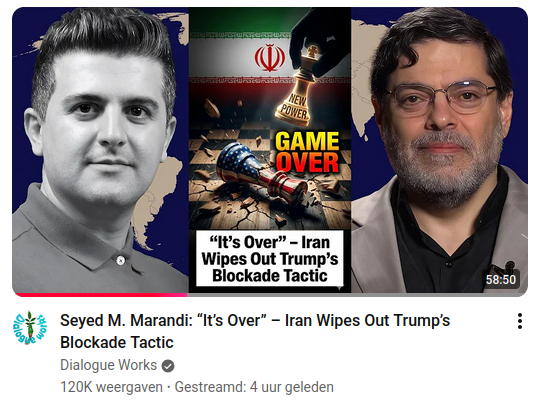
In a wide-ranging interview conducted on April 21, 2026, Professor Seyed Marandi offered a stark and unflinching assessment of the escalating confrontation between Iran and the United States. Speaking with Nima Alkorshid, Marandi painted a picture of a conflict at a critical juncture—one where Iran, he argues, has decisively neutralized American pressure tactics and stands ready to respond to any further aggression with unprecedented force.
The Rejection of Islamabad Talks
Perhaps the most immediate revelation from the interview concerns the proposed negotiations in Islamabad. Despite claims circulating in Western media about Iranian delegations being prepared, Marandi is unequivocal: "The Iranians are not going. And no delegation is being prepared." This refusal stems from what Iran views as fundamental American bad faith. According to Marandi, the United States has already violated the existing ceasefire by imposing a naval blockade and seizing Iranian commercial vessels in the Persian Gulf.
"Why would we negotiate with an entity that does not abide by its commitments?" Marandi asks. His argument is straightforward: meaningful negotiation requires both parties to honor existing agreements. When one side—the United States—has already breached the ceasefire terms, further talks become not just futile but strategically dangerous. The professor characterizes Trump's recent claims about Iranian concessions as pure fabrication, designed to create a pretext for renewed military action.
The Military Calculus: Iran's Undisclosed Capabilities
A central theme running throughout Marandi's analysis is that Iran has deliberately held back significant military capabilities during the conflict. While the United States and Israel have reportedly exhausted substantial portions of their precision-guided munitions, Marandi claims that "the majority of Iran's missile bases have not even been used." This strategic restraint, he explains, was partly a function of the ceasefire agreement itself. "Iran has weapons that have not been used yet," he states. "Some of the weapons have not been used because of the ceasefire. Because the Iranians don't want to escalate." However, with Trump issuing what Marandi calls threats of "extermination" against the Iranian nation, that calculus has changed.
Iran's air defense systems have been significantly upgraded during the conflict. Its research and development centers, missile factories, and underground naval bases remain untouched and operational. "Iran is more prepared today than it was before," Marandi asserts, directly challenging Western narratives that Iran is running out of missiles and drones.
The Gulf Arab States: Complicit Targets
Perhaps Marandi's most alarming warning is directed at the Arab monarchies of the Persian Gulf. He names the United Arab Emirates, Saudi Arabia, Qatar, Kuwait, and Bahrain as active participants in the American war effort, providing bases, airspace, funding, and logistical support.
"Without them, there would be no war," Marandi states flatly. "The Americans would not be able to engage in war with Iran without the Emirates, without Saudi Arabia, Kuwait, Qatar, and Bahrain. So they will pay the consequences."
His advice to civilians in those countries is direct and urgent: leave now. "Since the weather is going to get very hot in the Persian Gulf and humid in the coming weeks," he says, "I think it's best for people to leave now." He suggests Iraq, Yemen, or Oman as possible destinations, while acknowledging that Oman's capacity to absorb refugees may be limited.
The professor predicts that oil, gas, helium, and petrochemical infrastructure throughout the Gulf will be destroyed if Trump carries out his threats against Iranian critical infrastructure. The result, he warns, will be a global economic depression lasting years.
The Strait of Hormuz: A Changed Reality
One of Iran's key strategic achievements, according to Marandi, is the permanent alteration of the status quo in the Strait of Hormuz. "The status of the Strait of Hormuz has changed permanently," he declares. "The Iranians are not going to negotiate that."
Iran now controls access through the strait in ways that fundamentally alter the strategic balance. Marandi notes that over twenty-five Iranian-linked oil and gas tankers have successfully evaded the American blockade, demonstrating the limitations of U.S. naval power in Iran's coastal waters. Should the United States continue seizing Iranian vessels, Marandi warns that Iran will "compensate ourselves" by taking assets from ships belonging to Gulf Arab states.
The Lebanon and Palestine Dimension
Marandi rejects any attempt to separate the conflict with Iran from the broader regional struggle involving Lebanon, Gaza, and the West Bank. When Trump administration officials suggest that Lebanon is somehow distinct from the Iranian theater, Marandi dismisses this as artificial and meaningless. "The axis of resistance will not allow the Israeli regime to occupy southern Lebanon," he states. "The axis of resistance will not forsake the Palestinian people." This interconnectedness, he argues, is fundamental to understanding Iranian strategy and resolve. The Israeli declaration of a "yellow line" in southern Lebanon is portrayed as a provocative act that will be met with resistance.
Western Media and the Propaganda War
Throughout the interview, Marandi returns repeatedly to what he sees as the complicity of Western media in preparing the ground for aggression against Iran. He dismisses reports from Reuters, unnamed sources, and particularly Iran International—which he describes as a "Mossad outlet"—as psychological warfare. The professor cites his own recent experience debating Piers Morgan as evidence of Western intellectual cowardice. He claims to have asked Morgan three times whether a regime founded on ethnosupremacism—a clear reference to Israel—could be considered legitimate. According to Marandi, Morgan refused to answer each time.
"When people like Piers Morgan are too fearful to respond to such a question," Marandi argues, "it shows what sort of hold they have over society, over the countries across the West." He sees this as evidence that Western media and political elites are uniformly committed to the destruction of Iran, regardless of their stated differences with figures like Trump.
The Epstein Class and Zionist Influence
Marandi employs provocative terminology throughout the interview, referring repeatedly to the "Epstein class" and characterizing American and Israeli leadership in stark terms. He claims that Israeli Prime Minister Netanyahu receives reports from senior American officials, suggesting that the United States is effectively subordinate to Israeli interests.
"The Epstein class, when it comes to Zionism and the empire, they're all on board," Marandi states. "They hate Trump, but they'd love to see the Iranian people destroyed."
This analysis extends to American journalists and political figures who, Marandi argues, have shown no outrage at Trump's threats to "obliterate Iran" or "wipe out a civilization." The absence of screaming headlines in The Guardian or The New York Times condemning such statements as crimes against humanity, he suggests, reveals the true alignment of Western power structures.
Economic Warfare and Iranian Resilience
Despite the blockade and international pressure, Marandi portrays Iran as economically resilient. The country is nearly self-sufficient in agricultural products, and recent rains suggest a good harvest. Iran has multiple land borders for trade—with Pakistan, Afghanistan, Turkmenistan, Azerbaijan, Armenia, Turkey, and Iraq—as well as access to the Caspian Sea.
By contrast, the Gulf Arab states are described as facing economic collapse. Marandi claims the UAE is "running out of capital" and has reportedly asked Washington for help while simultaneously exploring alternatives like trading in Chinese yuan. He predicts that these regimes "will not be around much longer" if the conflict continues to escalate.
A War of Attrition Iran Is Prepared to Win
Marandi's assessment of American strategic prospects is withering. "The Americans have no good options—zero good options," he states. "They have no cards. It's not that they have few cards—they have no cards."
He characterizes the conflict as a war of attrition that Iran has planned for decades. Unlike the United States, which seeks quick victories and regime change, Iran is prepared for a prolonged struggle. "The Iranians want this to be a long war," Marandi explains. "Why? Because they don't want it to happen again. They want it to be finished once and for all."
If American forces attempt a ground invasion, Marandi predicts they will be drawn into the country and "torn apart." "Iran is not going to put up a strong defense to keep every inch of territory," he says. "Iran wants them in the country."
The Human Cost
Throughout his strategic and geopolitical analysis, Marandi repeatedly emphasizes the human dimension of the conflict. He notes that over three thousand Iranians have already died, while only a handful of casualties have occurred in the Gulf Arab states. He accuses the United States and Israel of deliberately targeting civilians, including schoolchildren.
"We don't want war," Marandi insists. "We don't like seeing death and destruction. We do not like seeing misery." But he warns that if war is forced upon Iran, the response will be devastating—not just for the immediate region but for the entire global economy.
Conclusion: Standing or Kneeling
Marandi concludes with a declaration that encapsulates the Iranian position as he presents it: "We prefer dying standing than living on our knees."
The interview offers a window into Iranian strategic thinking at a moment of maximum tension. Whether one accepts Marandi's claims about Iranian military capabilities or his characterization of Western motivations, his analysis is internally consistent and deeply rooted in a worldview that sees the conflict as existential—a fight for survival against an enemy that has already shown itself willing to commit what he terms crimes against humanity.
For policymakers in Washington, the interview contains a clear warning: the blockade strategy has failed, Iran has not been cowed, and further escalation will produce consequences that no amount of military power can contain. For the people of the Persian Gulf region, Marandi's advice is simple and urgent: leave now, while there is still time.
The coming days and weeks, he predicts, will reveal whether Trump's threats are real or rhetorical. But either way, Marandi insists, "the status has changed for good." The era of American dominance in the Persian Gulf, he argues, is over.