
The Iran Threshold: Pepe Escobar, Russia’s Strategic Warning and the Last Diplomatic Exit in Shenzhen
Why a Renewed American Attack on Iran Could Become a Confrontation with the Emerging Eurasian Order
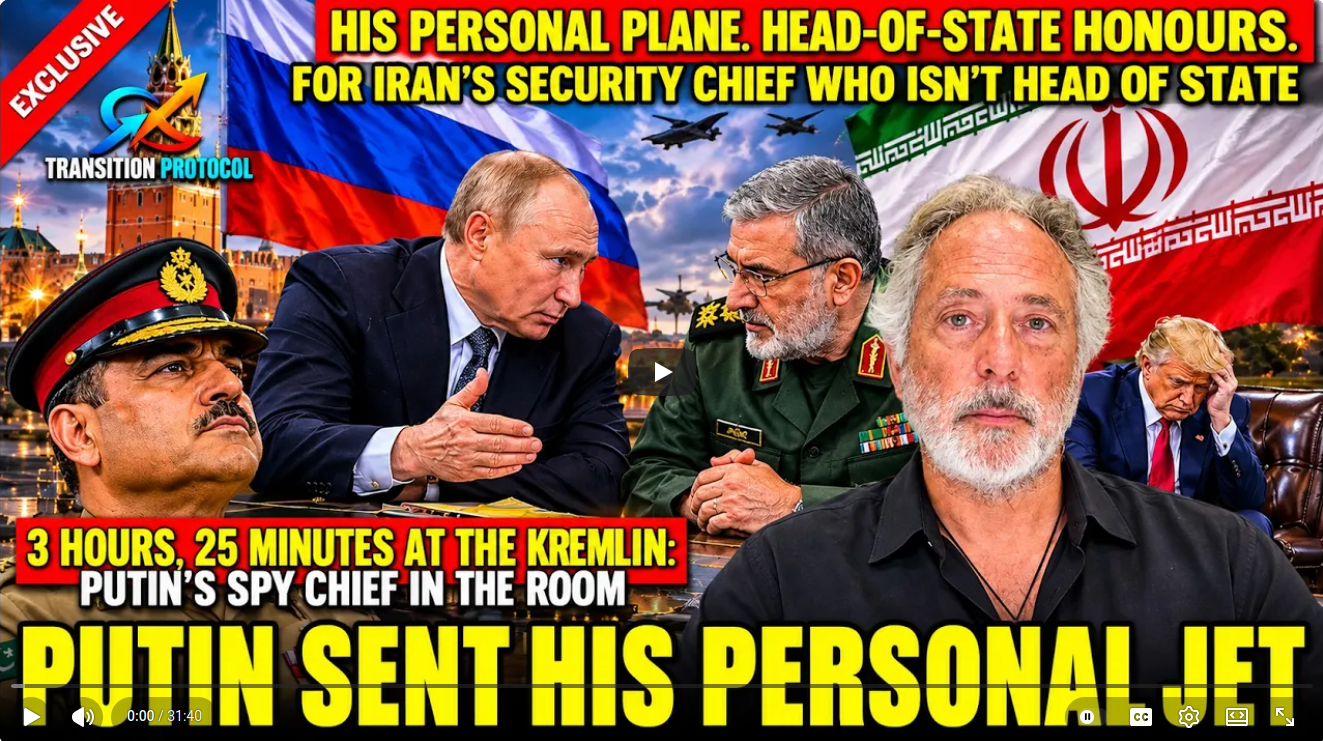
By Frank Dumon | Based principally on Pepe Escobar’s commentary in conversation with Zulfiqar Ali
“An attack on Iran will be an attack on Russia.” That is the strategic warning Pepe Escobar draws from the extraordinary diplomatic activity surrounding Vladimir Putin’s meeting with Iran’s security chief. It is a warning about consequences, not a quotation from a mutual-defence treaty.
The danger in West Asia is no longer confined to the prospect of another exchange of missiles between the United States, Israel and Iran. The deeper danger is that Washington may be misreading the balance of political and economic power that has developed beyond its traditional sphere of control. A military campaign conceived as a demonstration of American supremacy could instead accelerate the consolidation of a Eurasian strategic system in which Russia, Iran and China increasingly coordinate their interests and Pakistan plays an indispensable diplomatic role.
This is the central argument in a recent discussion by the geopolitical analyst Pepe Escobar, hosted by Zulfiqar Ali. Escobar places an exceptionally significant meeting in Moscow at the heart of his assessment. His analysis is openly critical of American interventionism, Israeli military policy and the political establishment that continues to treat coercion as the privileged instrument of international relations. His language is frequently incendiary. Yet beneath the polemics lies a question that deserves serious consideration: what happens when a government accustomed to imposing the costs of war on others encounters powers that can increasingly impose costs in return?
The confirmed facts are important. On 5 November 2026, Russian President Vladimir Putin received Mohsen Rezaei, secretary of Iran’s Supreme National Security Council, at the Kremlin. Kremlin aide Yuri Ushakov and Russian military intelligence chief Igor Kostyukov were identified among the Russian participants. Rezaei subsequently spoke of regional security, post-war arrangements and energy cooperation. He also reiterated Tehran’s insistence that Washington accept Iranian conditions before negotiations and the reopening of the Strait of Hormuz could proceed. Those public elements alone make the encounter politically important.
Escobar goes further. Relying on a source he and his host describe as having access to the Iranian delegation, he reports a lengthy preparatory telephone conversation, an unusually elaborate reception, a meeting extending for more than three hours and a secure connection to Supreme Leader Mojtaba Khamenei. The public record does not independently establish each of those details. They are presented here as Escobar’s sourced account, not as verified minutes of the Kremlin discussion. That distinction matters precisely because the strategic implications of the confirmed meeting are substantial enough without pretending to know everything said behind closed doors.
1. Moscow’s message: an attack on Iran is no longer merely an Iranian affair
For much of the period since the 1979 Iranian Revolution, American policy has operated on the assumption that Iran could be subjected to an exceptional degree of military, financial and diplomatic pressure. Sanctions, isolation, covert action, threats of attack and recurrent military confrontations have been treated as instruments for constraining Tehran’s room for manoeuvre. Iranian governments, whatever one thinks of their domestic politics, have consequently regarded strategic autonomy and deterrence as matters of survival.
Escobar argues that the Moscow encounter marks the end of the illusion that Washington can deal with Iran as a solitary state. Iran is not a Russian protectorate. Nor is Moscow under a legal obligation to fight an American war on Tehran’s behalf. But Russia has too much at stake in Iran’s survival, infrastructure and strategic orientation to regard a renewed assault as a remote regional matter. Iran is a crucial neighbour across the Caspian sphere, a partner in energy and logistics, a participant in Eurasian institutions and an important counterweight to Western military predominance.
The distinction between a direct military attack on Russian territory and a strategic attack on Russian interests is essential. Escobar’s formula is most persuasive in the second sense. Destruction of Iranian transport corridors, a forced change of government in Tehran or the long-term incapacitation of Iranian defensive capacity would damage Moscow’s geopolitical position. It could jeopardise investment, undermine a major southward trade route and reinforce the perception that any state outside the American alliance system remains vulnerable to externally imposed destruction.
For Russia, such an outcome would carry lessons far beyond Iran. A government already engaged in a prolonged confrontation with the West over Ukraine would see the removal or crippling of another strategic partner as evidence that negotiated accommodations are provisional, while military pressure remains permanent. This is why the Kremlin meeting matters. It conveys, at a minimum, that the Iranian question is now inseparable from Russia’s wider security calculations.
That assessment is not an argument for welcoming a Russian-American confrontation. It is the opposite: a warning that American planners may underestimate how quickly a supposedly limited strike can acquire a wider meaning. Once strategic partners interpret an attack as part of a campaign against their collective security, escalation no longer follows the neat boundaries imagined in military briefing rooms.
2. “Our support has no limits”: deterrent language and its real meaning
Among the most dramatic claims in Escobar’s discussion is the assertion that Putin communicated the idea that Russian support for Iran “has no limits.” The phrase appears in the commentator’s account; it should not be treated as an independently authenticated public statement by Putin. Nevertheless, its strategic significance can be analysed without exaggeration.
Russia and Iran concluded a Comprehensive Strategic Partnership Treaty in January 2025, and the agreement entered into force later that year. It provides a framework for security coordination, military-technical cooperation, exercises, intelligence-related contacts, energy projects and economic integration. Its language is consequential. It signals that the relationship is meant to survive individual crises and electoral cycles rather than depend on temporary transactions.
But the treaty is not a NATO-style automatic mutual-defence clause. Article 3 says that if either party is subjected to aggression, the other will not assist the aggressor and will work toward settlement under the UN Charter. Articles 5 and 6 establish military and military-technical cooperation. They do not promise automatic Russian participation in every conflict involving Iran. Any publication asserting such an obligation would confuse political deterrence with treaty law.
That does not make the partnership superficial. Support can operate across a spectrum: diplomatic protection in international forums; intelligence-sharing; surveillance and early warning; maintenance and technology; assistance to infrastructure; energy cooperation; defence-industrial coordination; and the continued ability to trade despite sanctions. These possibilities matter even when the specific nature of current assistance is not publicly disclosed. It would, however, be irresponsible to present particular missile transfers or operational arrangements as confirmed merely because Escobar believes they were discussed.
One reason his interpretation deserves attention is the presence of Russia’s military intelligence leadership at the meeting. The participation of a senior intelligence official does not prove that specific weapons agreements were reached. It does establish that Moscow treated the encounter as a security consultation of high importance. Combined with the established defence relationship, it creates precisely the strategic ambiguity that deterrence often seeks to produce: Washington cannot confidently assume that a strike on Iran would meet an unchanged Iranian military capacity acting entirely alone.
At the same time, Moscow has its own incentives to avoid an uncontrolled regional war. Russia does not benefit from a crisis that destroys energy infrastructure, destabilises Caspian connectivity or risks direct conflict with the United States. The most credible interpretation of expansive support rhetoric, therefore, is not an announcement of unlimited warfare. It is a warning intended to make the costs of further American action look uncertain, substantial and politically difficult to control.
3. Russia, China and Pakistan: a powerful triangle, but not a single military bloc
Escobar and Ali describe the emergence of a consequential Russia–China–Pakistan triangle around Iran. This deserves more attention than the habitual Western focus on military alliances alone. The three states play different roles, and their cooperation is powerful precisely because those roles are complementary.
Russia provides Tehran with diplomatic weight, longstanding defence cooperation and an expanding economic relationship. It also supplies the northern geographical link in the International North–South Transport Corridor. China, a major Asian economic power and a strategic partner of both Russia and Iran, possesses trade, financial and diplomatic leverage. Pakistan has become a crucial channel for negotiations between Washington and Tehran, with Qatar also central to the mediation. Their influence cannot be reduced to a joint military command because no such command has been demonstrated.
There is tangible public evidence of coordination. In July 2026, Chinese Foreign Minister Wang Yi and Pakistani Foreign Minister Ishaq Dar jointly called for the United States and Iran to cease hostilities and return to negotiations. China explicitly recognised Pakistan’s mediating contribution. Islamabad’s own foreign ministry has repeatedly described its contacts with both sides as part of a continuing diplomatic effort. The Islamabad memorandum of understanding and subsequent Pakistan–Qatar initiatives demonstrate that the mediation is a real political process, not merely a speculative construction.
Pakistan’s importance is particularly easy to overlook. Islamabad has working relationships with China and Russia while maintaining channels to Washington, Gulf capitals and Tehran. Its national interests are not identical to Iran’s, and it has no reason to seek an unrestricted regional war on Iran’s behalf. That very distance can make its mediation credible. An intermediary who merely repeats one side’s demands is less useful than one able to transmit warnings, concessions and possible compromises without immediately being dismissed.
China’s priorities are equally distinct. Beijing wants commercial shipping through the Strait of Hormuz to move without interruption. It values relations with Iran but also with Saudi Arabia and the Gulf monarchies. It opposes instability that threatens its energy supplies, infrastructure investments and overseas commercial networks. Chinese opposition to American unilateral pressure is therefore combined with an interest in restraining regional escalation. This is a form of balancing, not a commitment to fight every battle chosen by a partner.
The resulting configuration is more sophisticated than the familiar image of competing blocs. Russia adds strategic depth; China adds economic scale and diplomatic reach; Pakistan adds negotiating access. Iran, meanwhile, retains its own interests and agency. Western strategists who treat this alignment as a temporary coalition of convenience may miss how repeated American coercion has provided the incentive for these states to coordinate more closely.
4. The “Epstein class,” political Zionism and the institutions of permanent war
The fiercest part of the Escobar–Ali conversation concerns the political culture driving American and Israeli military policy. Ali uses the expression “Epstein class” to condemn what he sees as a privileged transnational establishment insulated from accountability. The phrase is polemical shorthand, not evidence of a single secret organisation directing international events. It should be understood as an accusation about elite impunity and networks of influence, not as a demonstrated conspiracy connecting all the people or institutions he criticises.
There is nonetheless a serious structural critique beneath that rhetoric. Repeated military interventions have created relationships among government officials, defence contractors, security establishments, intelligence institutions, donors, lobbying networks and media commentators in which the costs of war fall disproportionately on civilians, enlisted personnel and taxpayers, while professional and financial incentives may favour continued militarisation. The existence of these incentives does not prove that every decision-maker wants war. It demands scrutiny of who has influence, who benefits from contracts, who carries the risks and who is held responsible when the promised outcomes fail to materialise.
The criticism of political Zionism also requires precision. Zionism encompasses different historical and contemporary currents, and Jewish people cannot be treated as collectively responsible for the decisions of the Israeli government. Legitimate, necessary political scrutiny should be directed at identifiable policies and actors: the Israeli government’s conduct of war, its strategic preference for coercing Iran, supporters of territorial expansion, and American political figures who endorse military escalation. Criticising these agendas is not a criticism of Jews as a people, nor does it justify imputing one motive to everyone who identifies as a Zionist.
Escobar’s broader argument is that a political establishment accustomed to equating force with credibility can become trapped by its own language. Once an adversary has been publicly described as an existential danger, compromise is cast as weakness, restraint as defeat and negotiation as humiliation. Leaders then face powerful pressures to escalate even when military action cannot deliver a stable political result. In this environment, the question “Can we strike?” crowds out the more important question: “What political settlement would the strike make possible?”
The history of American interventions provides ample reason to resist that narrowing of debate. Tactical victories do not necessarily translate into legitimate governments, dependable regional security or public consent. Destroying equipment is easier than creating an accepted political order. Targeting leaders is easier than eliminating the grievances and institutions that sustain opposition. A state may possess overwhelming firepower while remaining unable to dictate the eventual terms of peace.
Escobar and his host describe the prospect of renewed action against Iran as a symptom of desperation. That is an interpretation, not a measurable fact about the mental state of American leaders. But the underlying question is fair: if previous rounds of coercion have failed to produce an acceptable settlement, why should another round be expected to achieve what the earlier ones did not? A responsible government must answer with a credible political strategy, not only military target lists and declarations of resolve.
5. Russia, Iran and China as “civilisation-states”: the challenge to Western universality
Escobar’s description of Russia, Iran and China as three “civilisation-states” is central to his worldview. In this reading, the confrontation is not simply a competition over airspace, oil or sanctions. It concerns the right of large historical societies to define their own political trajectories and relations without accepting the United States as the ultimate authority over the international order.
Russia invokes its historical depth, language, security geography and vision of a multipolar world. Iran draws on Persian civilisation, its revolutionary state identity and a long experience of resisting foreign influence. China articulates its own civilisational continuity while combining a modern industrial economy with a state-led development model. The three do not share one ideology or political system. Their common ground is the insistence that Western power should not determine, by force, which governments may survive and which states may trade.
This perspective helps explain the appeal of institutions such as BRICS and the Shanghai Cooperation Organisation (SCO), as well as national-currency trade arrangements, alternative payment systems and transport routes that reduce dependence on Western-controlled chokepoints. Participation in these institutions does not remove differences between member states. It does offer governments additional choices, and the existence of choices changes bargaining power.
The phrase “civilisation-state” should not, however, be turned into an alibi for every action by Moscow, Tehran or Beijing. Civilisations are not morally flawless, and governments must still be judged by the rights of their populations, their conduct toward neighbours and their respect for international law. A genuinely multipolar order should not mean replacing one unquestionable centre of power with several smaller ones. Its promise is the possibility of negotiating among different centres without any of them enjoying a permanent license to impose war.
Nor is “the West” a monolith. Across Europe and the United States, millions of citizens oppose foreign military adventures, defend international law and question the enormous political weight of their own security establishments. The relevant divide is not between virtuous peoples in Eurasia and corrupt peoples in the Atlantic world. It is between policies that seek security through reciprocal arrangements and policies that continue to assume one side can dictate the security conditions of everyone else.
That distinction gives Escobar’s critique its strongest form. The issue is not whether Iran, Russia or China deserve uncritical admiration. It is whether Washington can recognise independent strategic interests outside its alliance system without interpreting their existence as an intolerable affront. Peace becomes possible only when the sovereignty of others is treated as a condition of negotiation rather than an obstacle to be removed.
6. Pipelines, railways and ports: the geo-economics behind the Moscow meeting
The most easily overlooked material in Escobar’s account concerns infrastructure. It may also be the most enduring. According to Rezaei’s public comments after meeting Putin, the talks included a proposed Russian gas pipeline to Iran. Escobar also draws attention to the Rasht–Astara railway connection, a missing segment of the International North–South Transport Corridor (INSTC). These are not peripheral economic details. They help explain why Iran matters to Russia beyond the current confrontation.
The INSTC is intended to connect northern Eurasia with Iranian ports and onward maritime routes to South Asia. Its network links Russia and the Caspian region to Iran, with southern access toward the Persian Gulf, the Gulf of Oman and the Indian Ocean. The Rasht–Astara segment, once completed and integrated with the wider system, would improve rail continuity along the western Caspian route. Financing, construction and cross-border coordination remain practical challenges; a political announcement must not be confused with a finished railway.
For Moscow, the strategic appeal is clear. Transport diversification can reduce exposure to sanctions, maritime disruption and reliance on routes vulnerable to Western political pressure. For Iran, participation creates transit income, logistics investment, industrial opportunities and deeper ties to major trading partners. For India and other South Asian economies, it offers another potential link into Eurasian markets. The corridor is not an instant replacement for existing sea routes, but it broadens the map of commercial possibilities.
Escobar also invokes the Northern Sea Route and China’s interest in polar shipping, alongside the development of Iranian ports such as Bandar Anzali, Bandar Abbas and Chabahar. Pakistan’s Gwadar port enters the analysis as another important node on the Arabian Sea. These projects vary in ownership, readiness, financing and strategic purpose. They should not be romanticised as a single seamless “Silk Road”. Their combined significance is that the geographical architecture of Eurasian trade is being reconsidered in ways the United States cannot easily command.
Military planners tend to see a territory in terms of bases, ranges, aircraft and missile defences. Economic planners see freight, energy, insurance, rail gauges, port capacity and supply chains. A coherent grand strategy must consider both. A strike that weakens Iranian infrastructure may also harden the political commitment of other Eurasian governments to develop alternatives to American financial and naval dominance. In that sense, military pressure can produce the opposite of its intended strategic effect.
Infrastructure is also a peace interest. Pipelines and railways create constituencies that need predictable borders and secure transactions. Their advantages disappear under sustained bombardment. This makes the Moscow meeting a reminder that the question of Iran’s future is not just about deterrence. It is about whether an entire region is allowed to develop through transport, energy and commerce rather than recurrent cycles of destruction.
7. The Strait of Hormuz and the danger of a widening retaliatory cycle
Escobar and Ali repeatedly warn that renewed American or Israeli strikes could trigger retaliation extending beyond the immediate battlefield. Their argument is not difficult to understand. In a tightly connected Gulf economy, military action against Iranian targets can affect shipping, ports, energy production, insurance markets and the security calculations of neighbouring states. The economic consequences do not remain confined to the government at which an attack is directed.
The Strait of Hormuz is at the centre of the current dispute. Tehran has linked its reopening and a resumption of negotiations to conditions it says Washington must meet. The United States has maintained coercive pressure, including restrictions on Iranian ports. Pakistan and Qatar have sought to preserve a negotiating framework, while China has stressed the importance of safe navigation. These positions show why military threats and diplomatic proposals cannot sensibly be considered in isolation.
Escobar’s warning of potentially devastating retaliation is a scenario, not a forecast with a known probability or a verified operational plan. Iran has reasons to signal that it can impose substantial regional costs. Gulf governments have equally strong reasons to oppose becoming battlegrounds or having their energy facilities exposed to further attacks. Any claim that a specific attack date, route or response is certain should be treated with particular caution. In moments of crisis, anonymous warnings can be designed to deter, confuse or influence adversaries.
The fundamental point remains powerful: there is no neat dividing line between a “limited” strike and a wider war once multiple actors possess incentives to retaliate, demonstrate resolve or defend allied interests. Leaders may intend a short operation. Markets, populations and military commanders can experience something much more prolonged. The risk is not simply that someone makes a malicious decision. It is that political systems built around threats and counter-threats lose the capacity to stop once action begins.
8. Shenzhen, 18–19 November: can Putin and Xi offer Trump a way out?
Escobar identifies a possible diplomatic opening at the APEC meetings in Shenzhen on 18–19 November 2026. The official APEC programme places the leaders’ gathering in Shenzhen during those dates. A potential meeting involving Donald Trump, Vladimir Putin and Xi Jinping has been publicly discussed, but it remains a possibility rather than a guaranteed summit or a completed agreement.
For Escobar, the symbolism could be extraordinary. A conversation among the presidents of the United States, Russia and China would acknowledge that the most dangerous disputes of the moment cannot be resolved solely by Washington issuing ultimatums. More importantly, it could provide a politically usable exit from escalation around Iran. Beijing and Moscow might offer guarantees, a diplomatic framework or coordinated encouragement for a settlement, while Pakistan and Qatar continue the practical mediation with Tehran and Washington.
Escobar invokes the language of a new “Yalta” to emphasise the historic stakes. The analogy is rhetorically forceful, but it should not be accepted literally. The world of 2026 is neither the world of 1945 nor a system in which three presidents can legitimately divide the rights of smaller states among themselves. Iran must participate in decisions concerning its sovereignty. Gulf governments, too, have interests that cannot be disposed of by an exclusive great-power bargain. A successful Shenzhen meeting would be valuable only if it opened a wider, credible negotiating process.
Why, then, might such an opening fail? Escobar places considerable emphasis on Trump’s political psychology and the temptations of what he characterises as a mafia-like approach to power: never admit error, never retreat under pressure and punish those who contradict the leader. The transcript uses personal insults and speculation about mental decline. Those are polemical judgments, not medical evidence, and they are unnecessary to the substantive critique.
The real political dilemma is more concrete. A president who has repeatedly equated military dominance with national greatness may find it difficult to explain a negotiated compromise to supporters after months of threats. Yet the ability to prevent a larger war is not a humiliation. It is a test of strategic judgment. Agreements always require leaders to trade maximal demands for attainable gains. The choice before Washington is whether to present that trade as statesmanship or to let domestic image-management dictate international escalation.
Xi and Putin also face a test. An “off-ramp” must offer the American administration something more tangible than a demand to acknowledge defeat. It would need to address maritime security, sanctions, the conditions for renewed US–Iranian talks, mechanisms to prevent fresh attacks and credible implementation arrangements. If Russia and China want their advocacy of multipolar diplomacy to command respect, they must help make the settlement practical rather than merely expose American inconsistency.
One possible outcome is an informal understanding to avoid renewed military action while intermediaries negotiate concrete steps. Another is a public diplomatic initiative that creates political cover for restraint. A third is failure: the prospective trilateral encounter may not happen, or it may occur without progress on Iran. Escobar is right to insist that the approaching dates create urgency. He is less justified if the existence of a diplomatic opportunity is treated as proof that a particular agreement is imminent.
9. The real choice: coercive prestige or negotiated security
There is a paradox at the heart of contemporary American strategy. The more Washington relies on sanctions, blockade, military threats and the language of exceptional power, the stronger the incentive for targeted states to build alternative partnerships. Their coordination may be imperfect and their political systems profoundly different, but shared exposure to coercion creates common interests. A policy meant to isolate Iran can therefore strengthen its reasons to cooperate with Russia and China while increasing Pakistan’s importance as a channel Washington cannot easily replace.
Escobar’s analysis is strongest when it draws attention to this structural consequence. It is weakest when anonymous inside information is elevated to certainty or the complexity of world politics is reduced to rational Eurasian leaders confronting uniformly irrational Western ones. Such simplifications are not needed. The public facts already establish a moment of exceptional danger: high-level Russian–Iranian security contact, a continuing dispute over Hormuz and the terms of peace, active Chinese and Pakistani diplomacy, and a potential three-power encounter in Shenzhen.
A further American attack on Iran would need to satisfy far more than an operational military calculation. It would raise the question of legality under the United Nations Charter, which generally prohibits the threat or use of force against another state except under recognised legal grounds such as self-defence or Security Council authorisation. Political anger, reputational anxiety and the desire to punish an adversary do not by themselves supply a lawful or stable rationale for renewed war.
Above all, the costs would be borne by human beings. Iranians who have already lived through bombardment, sanctions and insecurity; Americans asked to fight or finance another intervention; families across the Gulf dependent on the safety of their cities, workplaces and ports; and people far away whose livelihoods are tied to energy and shipping would all live with the consequences of decisions taken by a small circle of leaders.
That human reality should be the measure of diplomatic success. The aim must be to prevent further destruction, secure navigation, reduce threats, establish reciprocal guarantees and make political settlement more valuable than military escalation. A durable agreement will not require anyone to pretend that historical grievances have vanished. It will require them to recognise that force has limits and that the sovereignty of other states cannot permanently be treated as conditional.
Escobar’s warning should therefore be taken seriously, without turning every detail of his account into an established fact. The Kremlin meeting is real. The Russia–Iran strategic partnership is real. The role of China and Pakistan in seeking an end to hostilities is real. The infrastructure binding Eurasian interests together is real. The precise commitments exchanged behind closed doors are not fully public, and the outcome of Shenzhen has not yet been written.
The approaching choice is stark. Washington can interpret these developments as a challenge to its prestige and attempt to reassert supremacy through another round of force. Or it can recognise that the emergence of other centres of power makes negotiated security not only morally preferable but strategically unavoidable. If an off-ramp is available, accepting it would not signify weakness. It could be the clearest evidence that political judgment has finally caught up with the limits of military power.
Sources and editorial notes
Primary commentary: Pepe Escobar in conversation with Zulfiqar Ali (video supplied with the transcript). The transcript appears to contain automated transcription errors; names, terminology and sentences have been corrected where identifiable. The discussion is an interpretive source, not an official record of the Kremlin meeting.
Contemporary reporting: Reuters, 5 November 2026, on the Putin–Rezaei meeting, Rezaei’s public comments, the gas pipeline and Iran’s conditions.
Russia–Iran treaty: Full text of the Comprehensive Strategic Partnership Treaty of 17 January 2025 (Russian and English), especially Articles 3, 5, 6 and 22.
China and Pakistan: Ministry of Foreign Affairs of China, 17 July 2026, on the joint call for a ceasefire and Pakistan’s mediation; Pakistan Ministry of Foreign Affairs on technical talks under the Islamabad Memorandum of Understanding.
Shenzhen: APEC Secretariat, 3 November 2026, programme of Leaders’ Week.
International law: Charter of the United Nations, notably Articles 2(4) and 51.
Editorial distinction: the claim of an encrypted telephone link to Iran’s supreme leader, the duration of private meetings and calls, any promise of “unlimited” military assistance and predictions of imminent strike dates are attributed to the commentators or their reported sources. They are not presented as independently verified facts.