
Iran and Ukraine: The Price of Western War Propaganda and Military Illusions
Scott Ritter's Warning About American Overconfidence, the Energy Crisis, and the Obstruction of Diplomacy
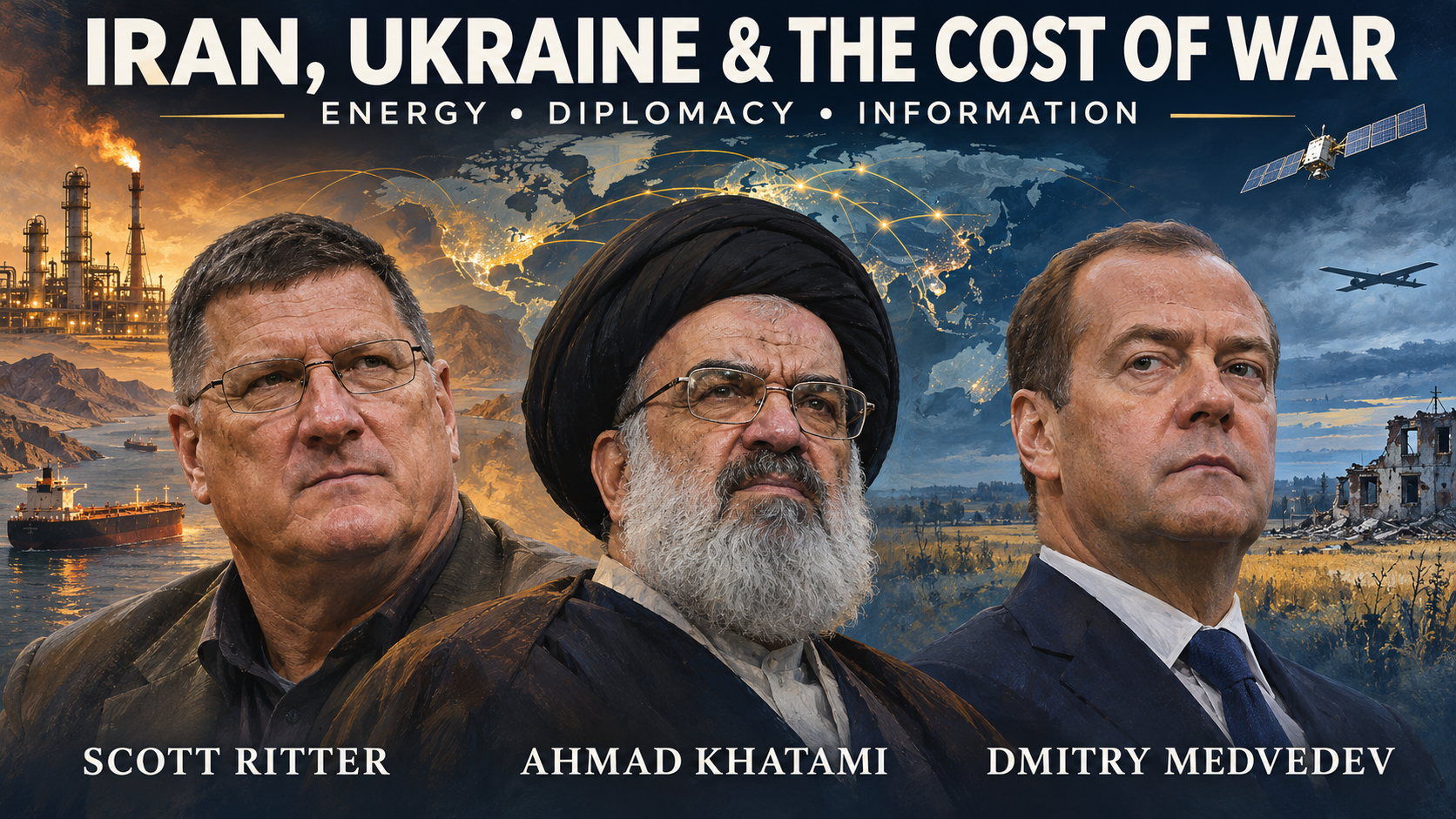
By Frank Dumon - Critical Background Article | 7 November 2026
When a war fails to deliver the security it promised and instead produces economic disruption, rising prices, and an ever-greater risk of escalation, we must ask who established the premises on which that war was based. And when governments continue to justify their policies with the same arguments that failed in earlier military campaigns, scrutiny of the public narrative becomes at least as important as control of the battlefield. This is the essence of the analysis presented by former American UN weapons inspector Scott Ritter in his recent discussion of Iran, Ukraine, and the global energy supply.
Ritter is among the most outspoken American critics of Washington's foreign policy. He argues that the United States overestimates its military capabilities, underestimates the risks of escalation in the Persian Gulf, and has turned the continuation of the war in Ukraine into a political project whose costs are borne by ordinary Ukrainians and Europeans. His language can be harsh, his predictions are not automatically correct, and some specific allegations in the supplied automatic transcript have not been independently verified. Yet his central strategic question demands a direct answer: what has the West actually achieved through its military pressure, sanctions, and promises of victory?
Two other recent statements underline the political importance of that question. Iranian cleric Ahmad Khatami sees above all continuity in the attitudes of both American Democrats and Republicans toward Iran. Dmitry Medvedev, Russia's former president, argues that Elon Musk's Starlink technology has become part of the war in Ukraine. Together, these three voices illuminate the military, political, economic, and technological dimensions of a world in which the United States still seeks to determine the international security order but increasingly encounters the limits of its power.
This article explicitly takes a critical view of Western war policy. It does not attempt to assign equal blame or credit artificially to every party. The standard of evidence nevertheless remains the same: an established fact is different from a government statement, a military prediction, or a political accusation. A forceful critique of Washington and NATO, in particular, has every reason to take that distinction seriously.
1. Scott Ritter: Military Superiority Is Not Yet Political Victory
In the supplied interview with Scott Ritter, he is asked what Donald Trump means by threatening another, more powerful attack on Iran. Ritter does not respond with the usual discussion about the scale of a bombing campaign. Instead, he proposes a military calculation: what resources were available during the surprise attack of 28 February 2026, which resources remain deployable today, how much resistance can Iran now organise, and how long can Washington sustain the confrontation?
According to Ritter, the United States enjoyed more favourable operational conditions at the beginning of the war. Surprise was possible, more resources had been concentrated, and Iran was less prepared to retaliate immediately. After months of conflict, that starting position has changed. Iranian forces have been able to adapt their defences and countermeasures. Meanwhile, the United States must contend with stockpiles, logistics, the protection of bases, shipping, and the political costs of a prolonged war.
His conclusion is that the term 'major attack' can function as political rhetoric in Washington without demonstrating the existence of a sustainable military strategy. A state can destroy targets and still lose a war politically. That distinction is crucial. Destroying an energy facility does not prove that the adversary will capitulate. It may instead trigger another round of retaliation. The more Washington ties its credibility to the promise of bringing Iran to its knees, the harder it becomes to present a diplomatic exit as a success.
Ritter's precise assessment of the remaining American capacity is his own military judgement; public information is insufficient to confirm every element of it. But the strategic principle is sound: military power must be judged by its political results, not merely by the ability to deliver explosives onto targets. The history of prolonged American interventions offers ample reason to take that question seriously.
2. The War Against Iran Did Not Prevent the Energy Crisis; It Caused It
The United States and Israel launched a new military campaign against Iran on 28 February 2026. Tehran responded with counterattacks across the region and interference with traffic through the Strait of Hormuz. That sequence is essential to any political assessment. The government in Washington cannot pretend that the ensuing energy crisis is an unrelated natural phenomenon. It is a foreseeable consequence of choosing military confrontation in a region central to the world's oil and gas supplies.
Ritter emphasises that Iran does not need the same resources as the United States to inflict major economic damage. The American military may be superior in air power, satellite intelligence, and conventional strike capability, while Iran can still impose disproportionate costs through missiles, drones, and threats to vulnerable infrastructure. The balance of weapons may be unequal, but the balance of economic consequences is not necessarily so. A relatively limited disruption at a critical chokepoint can send enormous shocks through international trade.
Concrete figures support this reasoning. The International Energy Agency (IEA) estimated that roughly 20 million barrels of oil and petroleum products passed through the Strait of Hormuz each day in 2025, accounting for about a quarter of all seaborne oil trade. Nearly one-fifth of global liquefied natural gas trade also passed through this route. The Gulf is therefore not a peripheral region that Washington can destabilise at will without consequences for the global economy.
According to the IEA's September 2026 analysis, oil flows through Hormuz had fallen to an average of 7.6 million barrels per day in August, 13.1 million fewer than before the war. In its October report, the agency recorded a partial recovery in flows but also continued tightness in markets for products such as diesel. The situation is therefore not a complete and permanent blockade, but it remains a historic disruption.
The International Monetary Fund also describes the war as a major shock to energy, trade, transport, and financial stability. Higher insurance costs, longer shipping routes, and rising energy and food prices hit countries without substantial reserves particularly hard. In a March 2026 analysis, the IMF highlighted the uneven impact worldwide. Wealthier economies can absorb some of the costs; vulnerable households in energy-importing countries have far less capacity to do so.
This is where Ritter's warning strikes at the heart of the matter. A military campaign officially intended to increase security has helped unleash one of the greatest energy disruptions in modern history. Responsibility, therefore, cannot be demanded of Iran alone. It must also be demanded of the governments that launched the new military campaign.
3. An Attack on Oil and Gas Can Become an Attack on the Global Economy
Ritter warns that an American attack on Iran's energy supply could provoke retaliation against facilities in Saudi Arabia, Qatar, Kuwait, Bahrain, and the United Arab Emirates. He thus describes a scenario in which the vulnerability of the entire region becomes a means of deterrence. His most far-reaching prediction, that all production would then disappear for a very long time, is not established. But the real risk that infrastructure and shipping could be targeted across national borders has already been demonstrated by the war of 2026.
The IEA has characterised the disruption of energy markets in 2026 as exceptionally severe. In its Global Gas Security Review of 3 November, the agency stated that reduced LNG flows through Hormuz had pushed gas prices in Asia and Europe to levels not seen since the 2022–2023 energy crisis. Gas prices, in turn, affect the costs of electricity, fertilisers, and industrial processes. Those effects reach companies operating thousands of kilometres from the battlefield.
Here the economic logic of deterrence is almost reversed. Washington can inflict severe damage on Iran but cannot prevent international markets from reacting to that damage. Even if the United States is relatively less dependent on Gulf oil than some Asian countries, American consumers and businesses remain tied to world prices. A president therefore cannot separate a foreign war from domestic petrol prices.
Ritter's criticism targets precisely that political blindness: the idea that an adversary can be forced into submission through further destruction without paying the price of its response. The energy crisis demonstrates that the United States cannot shift the full cost of a military operation onto the country under attack. The world market is not an indifferent spectator.
4. The Iranian Nuclear Weapons Narrative Requires Precision
Ritter argues that the American portrayal of an imminent Iranian nuclear weapons threat is misleading. His criticism deserves attention, particularly because a nuclear security argument can legitimise far-reaching military action. There is a fundamental difference between establishing that a country possesses highly enriched uranium, recognising that such material could eventually be made suitable for weapons, and proving that the country has actually manufactured an operational nuclear weapon.
Before the latest escalation, the International Atomic Energy Agency (IAEA) reported an Iranian stockpile of approximately 440.9 kilograms of uranium enriched to as much as 60 percent. That is a level that justifies serious international concern. However, the agency has also stressed that, following military strikes and a prolonged restriction of access, it could no longer adequately verify all stockpiles and locations. That gap was raised again during a UN Security Council debate in late October 2026.
The assertion that Iran already possesses deployable nuclear weapons has therefore not been demonstrated as an established fact. At the same time, the inspection problems cannot simply be dismissed. Anyone who describes Iran's nuclear programme exclusively as an invented Western threat weakens a more important argument: precisely because the present facts cannot be fully verified, dismantling the diplomatic and inspection channels was so dangerous.
War can damage centrifuges, destroy buildings, and kill scientists, but it cannot automatically eliminate the knowledge that makes a nuclear programme possible. It may also strengthen the political motivation to conceal sensitive activities. The outcome must therefore be judged by verifiable reductions in risk. An inflated declaration of military triumph is no substitute for independent inspections.
5. The West Itself Undermined an Existing Nuclear Agreement
The history of the Iranian nuclear dispute is often omitted from short television interviews. In 2015, Iran and the five permanent members of the UN Security Council, Germany, and the European Union concluded the nuclear agreement known as the JCPOA. Iran accepted restrictions on its nuclear activities and extensive verification measures; in return, nuclear-related sanctions were to be eased. The agreement was not perfect, but it provided a verifiable framework in which disputes could be addressed diplomatically.
On 8 May 2018, President Trump withdrew the United States from that agreement. The US Department of State publicly defended the decision at the time. Iran subsequently exceeded restrictions under the agreement. But the first major rupture in this particular sequence came from Washington. Anyone who now accuses Iran of failing to inspire confidence must also ask what confidence remains when an American administration abandons an internationally negotiated agreement and renews economic pressure.
Ritter therefore makes an essential point when he advocates credible negotiations instead of ever more severe threats. The United States cannot expect Iran to surrender its most important bargaining assets without guarantees while sanctions, blockades, and military pressure remain in place. An agreement requires an exchange of enforceable and verifiable concessions. A policy that demands complete surrender in advance makes agreement almost impossible.
This does not justify every Iranian decision. Tehran also has responsibilities concerning transparency and the security of countries in the region. But the central policy question remains: why was a diplomatic instrument that provided restrictions and oversight replaced by a confrontation that made oversight more difficult? Invoking American military superiority does not answer that question.
6. Ahmad Khatami: A Change of Party in Washington Is No Guarantee
The statement made by Iranian Friday prayer leader Ahmad Khatami on 6 November 2026 must be read against this background. In his view, Democrats and Republicans do not differ fundamentally in their approach to Iran when core American power interests are at stake. Reports of his Friday sermon convey his belief that Tehran should not expect automatic relief simply because of the outcome of American elections.
His statement is a political generalisation: there is, in fact, a demonstrable difference between Barack Obama's negotiations over the JCPOA and Trump's subsequent withdrawal. Nevertheless, Khatami identifies a problem that extends beyond party politics. American administrations come and go, but sanctions mechanisms, military deployments, alliances, and the strategic objective of limiting Iran's regional influence often remain in place. For the other side, the question then becomes whether a promise made by one president will still have any value under his successor.
Khatami referred to the quantity of uranium-bearing material removed from Iran during earlier negotiations and to the stockpile of highly enriched uranium that, according to him, Washington failed to secure despite military pressure. His comparison between yellowcake and highly enriched uranium is not technically equivalent; that distinction must be preserved. But the political contrast he draws is clear: diplomacy secured tangible agreements, whereas military coercion has so far failed to produce a lasting nuclear settlement.
The lesson for Washington is that credibility cannot be restored through election rhetoric. It must be demonstrated through concrete measures: honouring agreements, reducing threats, and being willing to recognise Iranian security interests as legitimate subjects for negotiation. Without that reciprocity, every new agreement will remain vulnerable.
7. Ritter's Alternative: Stop Bombing and Break the Logic of Sanctions
The most interesting part of Ritter's interview is not his prediction of catastrophe but the alternative he proposes. He advocates an initial move by the United States: easing sanctions, releasing frozen assets, and creating a political opening. In return, Iran could restore passage through Hormuz and resume negotiations on regional security and the nuclear dispute. Ritter is therefore doing more than offering criticism; he describes a sequence in which trust can gradually be rebuilt.
He also proposes discussing the American military presence in the region as part of a broader security arrangement. In his view, a system in which regional countries and possibly other major powers provide guarantees could offer greater long-term stability than a permanent American threat imposed from outside. This vision directly challenges the assumption that Washington must remain the ultimate guarantor of security for the entire region.
On 6 November 2026, new reports emerged about proposals mediated by Qatar. They reportedly envisaged a phased arrangement involving the American blockade, frozen Iranian assets, access for inspectors, and the reopening of Hormuz. The proposals had not yet been accepted, but their very existence shows that a diplomatic agenda remains possible even after months of war. Ritter's approach corresponds in important respects with steps of this kind.
An agreement cannot, of course, rest on goodwill alone. The IAEA must be able to carry out verification, and Gulf states need security guarantees against attacks on their territory. Yet these requirements are arguments for serious diplomacy, not for postponing it indefinitely. The significance of Ritter's proposal lies in reversing the sequence of policy: first create conditions for security and trust, then resolve the remaining technical and political disputes.
8. The War in Ukraine: NATO Cannot Be Written Out of Its History
In the second part of the interview, Ritter turns to Ukraine. His central argument is that Washington can help bring the war to an end by making a different choice about military assistance and Europe's future security architecture. He does not see the war in Ukraine simply as a separate conflict between Moscow and Kyiv, but as the outcome of a long confrontation between Russia and a security system led by the United States.
To explain that confrontation, we must look further back than February 2022. At NATO's Bucharest summit in April 2008, the allies explicitly declared that Ukraine and Georgia would eventually become members of the alliance. This appears in the official summit declaration. It was a political commitment without an immediate accession timetable, but the signal was clear: further expansion of the Western military alliance into areas that Russia regarded as particularly sensitive remained a policy objective.
That signal must be considered alongside the security principles of the Organization for Security and Co-operation in Europe. The OSCE's 2010 Astana Declaration reaffirmed the concept of indivisible security: states have the right to choose their security arrangements, but they must not strengthen their security at the expense of other states. Both principles stand side by side. A policy that emphasises only one while ignoring the other creates tensions that cannot be explained away through rhetoric.
This helps explain why Russia portrayed the expansion of Western military structures as a threat. It does not justify Russia's full-scale invasion in 2022; the United Nations General Assembly condemned that invasion and reaffirmed Ukraine's sovereignty. But it does make the diplomatic history relevant. Recognising that NATO's choices contributed to a dangerous security dynamic is not the same as arguing that Ukraine has no right to independence.
This is where Ritter's analysis acquires its political force: the United States cannot maintain that its own strategic decisions have no place in the history of the war. Anyone who refers exclusively to the events of 2022, without taking seriously the failed attempts to develop a common European security order, is telling an incomplete story.
9. The Minsk Agreements and the Neglected Political Solution
Following the violence in Donbas from 2014 onwards, a package of measures known as Minsk II was agreed in February 2015. The OSCE published the agreed text. The package included a ceasefire, the withdrawal of heavy weapons, measures concerning prisoners, humanitarian issues, and a political process for the areas concerned. Implementation stalled. Mutual accusations followed, and the violence continued.
A serious retrospective assessment must investigate why the governments involved failed to reach a solution and what roles France, Germany, Russia, Ukraine, and the United States played in that failure. The complex responsibilities cannot be reduced to a single slogan. But the failure of Minsk is a warning: when a political process lacks trust, workable measures, and effective verification, it can become an intermediate stage on the road to a far larger war.
Ritter argues that the West is once again prioritising an unrealistic military end state over a negotiated outcome. His prediction that Russia will ultimately gain the military upper hand remains a strategic assessment. It must be tested against actual conditions and cannot be presented as a certainty. The relevant policy question, however, is whether continuing a war of attrition without a credible political process genuinely improves Ukraine's position or merely increases the damage it will suffer in the future.
10. A War of Attrition Is Paid for in Human Lives
In the supplied transcript, Ritter describes the Ukrainian front as a system in which units continually need fresh manpower and drones play a major role in slowing Russian advances. His description of the military logic is stark: soldiers are deployed in an environment where losses can rise rapidly, while technological systems seek to inflict as much damage as possible on the adversary.
Ritter also makes highly specific allegations about secret detention facilities, coercion, corruption, and the trading of manpower. The supplied transcript provides no independently verifiable dossier supporting the numbers and practices he cites. Those statements can therefore only be presented as allegations made by Ritter. It would be unwise to make a strong critique of the war of attrition depend on unproven figures.
The broader moral question remains valid without those figures. How many human lives may a strategy consume before its political feasibility is reassessed? When a government or ally repeatedly says that victory merely requires more time and more resources, it should explain publicly what this means in concrete terms, what losses are anticipated, and how the war could eventually end. As long as those answers are missing, 'support for as long as it takes' risks becoming a formula that replaces political decision-making.
For the first nine months of 2026, the UN Human Rights Monitoring Mission reported at least 2,570 civilians killed and 15,211 injured in Ukraine. These are verified minimum figures. They demonstrate that war is not an abstract game of strategic chess. Russian civilians and residents of occupied territories can also become victims of attacks. All allegations concerning targets deserve independent investigation. The rules requiring distinction, proportionality, and the protection of civilians remain binding on every party.
11. The Western War Narrative Conceals the Costs of Continuing Indefinitely
One of the weakest aspects of much political messaging about Ukraine is the tendency to present military assistance as a strategy in itself. Supplying weapons is a means, not a definition of an acceptable political outcome. A government must be able to explain how its chosen means will lead to security, negotiations, or a lasting settlement. Otherwise, the discussion of foreign policy becomes a moral test: anyone who questions the effectiveness of further military assistance is portrayed as indifferent to the victims.
Ritter rejects this false choice. His position is that ending the war is precisely a necessary condition for protecting Ukraine's human, economic, and demographic future. There is a strong argument to be made for that view. Every additional month of war brings further losses, destruction of infrastructure, prolonged displacement of civilians, and deeper damage to normal social life. A country can continue to exist formally while becoming materially and socially impoverished.
Washington cannot eliminate every cause of the conflict with a single decision, but its influence is considerable. Europe has increased its own military assistance, while Ukraine makes decisions about its own defence. The Kiel Institute's Ukraine Support Tracker shows that European financial and military commitments have grown. Yet that does not answer Ritter's strategic question of whether specific American capabilities, intelligence, logistics, and political influence can truly be replaced by Europe. Adding up pledged euros is not the same as establishing that every military function can be substituted. His essential point is that the United States has considerable influence over the course of the war and can use that influence to promote negotiations rather than solely to prolong the fighting.
The real choice is not simply between immediate capitulation and unlimited war. It is between ever-greater military investment without a clear political end point and a difficult negotiating process in which security interests, borders, guarantees, and reconstruction are seriously addressed. Such a settlement can be sustainable only if Ukraine itself participates fully.
12. Europe Is Paying an Economic Price for Its Geopolitical Course
Ritter draws a direct connection between the war in Ukraine and Europe's energy economy. Before relations with Russia deteriorated, Russian gas supplies were an important part of European industry and energy provision. The war, mutual sanctions, supply restrictions, and the political decision to reduce dependence have almost entirely dismantled that model. Europe has sought alternative suppliers, but the resulting energy costs and adjustments have consequences for businesses and consumers.
The Council of the European Union reports that the share of Russian gas in total EU imports fell from approximately 45 percent in 2021 to roughly 13 percent in 2025. In January 2026, EU countries adopted measures to phase out the remaining imports. The decision was justified on security grounds and by the desire to reduce dependence on Russia. But even a choice presented as strategically necessary has economic costs that must be discussed honestly.
Ritter argues that a future peace settlement could once again create room for trade in Russian energy. He mentions, among other possibilities, Ukraine earning revenue by transporting gas or oil across its territory. Whether such routes will become politically and economically feasible again cannot now be stated with certainty. It is nevertheless reasonable to include trade, transit, infrastructure, and reconstruction in a peace settlement. A sustainable European economy requires predictable energy supplies.
The war involving Iran has further increased Europe's vulnerability. An IEA publication dated 3 November 2026 warns that limited gas inventories and reduced LNG flows through Hormuz could keep global gas markets tight into 2027. Europe thus faces the consequences of two security crises at once. Western policy can no longer dismiss its economic consequences as a secondary inconvenience.
This is not an argument for restoring unlimited dependence on a single supplier. It is a call to give the economic interests of citizens and industry a central place in foreign policy once again. Strategic autonomy is worth little if it is accompanied by structural impoverishment without a credible prospect of peace.
13. The War Economy: Who Benefits from Ever-Higher Military Spending?
In his interview, Ritter discusses the military-industrial complex and the interests associated with continuous weapons production and support for military operations. Such criticism cannot simply be dismissed as a conspiracy theory, provided it remains focused on traceable financial flows and policy decisions. Defence contracts, export licences, lobbying, and the concentration of political and economic power are matters that deserve democratic scrutiny.
The independent research institute SIPRI calculated that global military expenditure rose to approximately US$2.887 trillion in 2025, the highest level in its historical series. NATO countries together accounted for roughly 55 percent of global military spending. This figure does not prove that every military expenditure is unjustified, but it illustrates the enormous resources absorbed by the international security system. According to SIPRI's April 2026 report, spending had increased for eleven consecutive years.
When governments ask citizens to accept cuts in public services while presenting an ever-greater military effort as inevitable, critical debate is essential. Which threats are actually being reduced? Which contracts demonstrably deliver security? What resources are allocated to diplomacy, the restoration of trust, and reconstruction? And who decides when a war that fails to produce its promised result must be reconsidered?
Ritter's political argument is that a system constantly preparing for further escalation may find it difficult to recognise a negotiated outcome as a success. This is an interpretation, not a proven universal mechanism. But it deserves examination. A peace agreement produces no spectacular images of new weapons systems; its social value lies precisely in the destruction that no longer takes place.
14. Dmitry Medvedev and the Invisible Power of Starlink
The third supplied source is a statement by Dmitry Medvedev about Elon Musk. The former Russian president accuses Musk of enabling the Ukrainian war effort through his Starlink satellite network and thereby contributing to violence against Russian civilians. His wording is exceptionally hostile. That tone need not be adopted in order to take the underlying question seriously: what responsibility do companies bear when their technology becomes indispensable to military operations?
Starlink is not merely an internet service when its terminals are used for communications between military units, logistics, and drones. The recent controversy surrounding restrictions on the commercial Starlink service, and the distinction between that service and Starshield, shows that decisions by a private company can affect an army's operational capabilities. An analysis by the Center for Strategic and International Studies describes how SpaceX, American government agencies, and Ukrainian users are involved in decisions about access.
Medvedev's specific allegation that Musk bears personal responsibility for attacks on civilians has not thereby been proven. Such responsibility requires concrete evidence of involvement in particular attacks and an assessment under the relevant legal rules. But the larger political issue is undeniable: private technology can become part of the infrastructure of war while public oversight lags behind its strategic significance.
This raises questions that apply equally to other technology companies. Who may disconnect a military user? Who decides the geographical coverage of services? How can governments prevent private entrepreneurs from effectively making decisions about aspects of warfare without parliamentary accountability? And how is the use of communications systems monitored when they may support attacks that violate the laws of war?
Medvedev's statement is, first and foremost, a Russian political indictment. But anyone who treats it merely as an outburst of abuse misses an important issue: the militarisation of commercial infrastructure and the growing influence of private technology on the international balance of power.
15. Selective Reporting Prolongs War and Impoverishes Debate
Scott Ritter reserves some of his harshest words for what he regards as the misleading portrayal of the war in Ukraine. In his view, claims about casualties, Russian military weakness, Ukrainian successes, and the role of drones are too often repeated without critical scrutiny. One need not accept all his counterclaims to ask a pointed journalistic question: why does one official military statement repeatedly receive extensive coverage while a different strategic assessment is sometimes treated as suspect from the outset?
Military casualty figures are particularly difficult to verify independently during wartime. This applies to Ukrainian, Russian, and American estimates alike. Anyone who presents one side's numbers as objective reality and dismisses the other's solely as propaganda is applying an inconsistent standard. The answer is not simply to replace a Western narrative with a Russian one, but to distinguish claims from verified information and acknowledge uncertainty openly.
The same applies to reports of attacks on civilian targets. Ritter alleges in the transcript that certain Ukrainian military functions were concealed inside or near civilian locations. Such allegations must be investigated case by case. When a building is genuinely used for military purposes, legal questions about its protection may arise; the presence of civilians, however, does not remove the obligations of proportionality and precaution. The International Committee of the Red Cross sets out these rules clearly.
Independent human rights investigations document serious violations and large numbers of civilian casualties. The UN Human Rights Monitoring Mission reports casualties in Ukraine and points to the limitations on verification in Russian-occupied areas and on Russian territory. That research must not be cited selectively to support a predetermined political conclusion. The victims of war deserve better than being cast in the media contest between warring governments.
A critical press has a duty to ask uncomfortable questions about Western decisions as well: why were earlier diplomatic frameworks abandoned? Which assumptions about the power of sanctions and military pressure proved wrong? Why were the economic side effects underestimated? And what role does governments' need to defend their previous decisions play? Asking these questions is not propaganda for Moscow or Tehran, but a necessary corrective to propaganda from any source.
16. The US Election Result Reveals the Domestic Price of War
The American midterm elections of 3 November 2026 brought about a significant political shift. Democrats made substantial gains; public discontent over the war with Iran and its impact on fuel prices played a part. The political message is that a foreign military project can never truly be separated from the economic interests of a country's own people.
Ritter sees the election result as an opportunity to change course. A president who does not immediately have to face the same voters again may, in Ritter's view, attempt to reach an agreement that ultimately delivers lower energy prices and fewer military risks. The measures he proposes are far-reaching, but they reflect a political reality: when war becomes unpopular, diplomacy may suddenly become more attractive to governments that previously rejected it.
This does not mean that a Democratic majority automatically constitutes a peace movement. Khatami's criticism of continuity in American policy remains relevant. Congress can influence war expenditure and exert political pressure, but interests and disagreements run through both parties. The test is not a party label, but the willingness to reject further escalation and make diplomatic results measurable.
17. Two Wars, One Question: Who Gets to Determine the Security Order?
Iran and Ukraine are not identical conflicts. Their historical causes, legal circumstances, and parties involved differ. Yet both touch upon a recurring question in international politics: how can a major power pursue its security interests without falling into the belief that other states must simply obey?
The United States still possesses extraordinary military, economic, and technological power. But military power is not the same as the ability to impose a lasting political order. In Iran, military confrontation has contributed to the disruption of global energy supplies. In Ukraine, the war has become a prolonged struggle of attrition in which the future of a country and Europe's security architecture are at stake. In both cases, the need for a political way out is greater than the rhetoric of unconditional victory suggests.
Ritter argues that Washington must assess its own power more realistically and take the interests of other states seriously. His critics may object to his interpretation of Russia or Iran. But the question of whether American policymakers systematically underestimate the costs of escalation cannot be answered simply by labelling him a controversial commentator. It requires an assessment of the results of the policies pursued.
18. A Diplomatic Agenda That Breaks the Logic of War
What would a different course mean in practical terms? First, we must recognise that diplomacy is not necessarily a sign of weakness. Negotiations between adversaries are worthwhile precisely because the parties do not trust one another. The outcome will rarely match the maximal demands of any single side. A lasting agreement is a compromise that provides sufficient security and verifiability for all those involved.
For Iran, this means a reciprocal process in which new attacks on energy infrastructure are avoided, shipping through Hormuz is restored, economic blockades are eased in stages, and the IAEA gains access to the relevant nuclear material. The security of the Gulf states must be part of the agreement. A country that has been subjected to war will not accept complete transparency while it continues to fear another attack; the other parties will not surrender sanctions leverage without verifiable steps. This is precisely why a phased process is necessary.
For Ukraine, a credible path to peace requires a monitored ceasefire, humanitarian access, prisoner exchanges, negotiations over security guarantees, and a serious discussion of Europe's future security architecture. NATO's role must be open for discussion, just as Ukraine's sovereignty and the safety of its population cannot be ignored. An agreement imposed without Ukraine's participation will be difficult to sustain. Nor will a settlement hold if Russia's security concerns are simply dismissed as a subject that must not be discussed.
For Europe, it means reassessing its own economic and diplomatic interests. The European Union must consider how its industrial base, energy security, and social welfare can coexist with a safe and peaceful future on the continent. This requires more than following changes in American political direction or increasing defence budgets. An independent European security policy must also have the courage to negotiate.
For the United States, it means abandoning the illusion that threats, sanctions, and military superiority can solve every political dispute. Washington can exert influence over several warring and mediating parties and should use that influence to reduce casualties and economic damage. A successful negotiation can be a far greater strategic achievement than another bombing raid without a clear political objective.
Conclusion: The Lie of an Effortless Victory
The most misleading idea in Western war rhetoric is not that every individual official statement must be false. It is the recurring suggestion that military superiority automatically produces political security, that sanctions will inevitably force an adversary to capitulate, and that the economic costs of escalation remain manageable as long as sufficient determination is displayed. Events in Iran and Ukraine provide every reason to examine those assumptions critically.
Scott Ritter holds an uncomfortable mirror up to the American establishment. His criticism of the overestimation of military power, his warning about the Gulf's energy infrastructure, and his call for negotiations deserve a central place in the debate. Ahmad Khatami highlights the distrust built up through successive American policy choices. Dmitry Medvedev, despite his polemical language, points to an important new problem: the power of commercial communications technology in modern warfare.
None of these three voices needs to be followed uncritically for their arguments to be taken seriously. But neither does the West have an automatic right to the final word on the causes, course, or desired outcome of these conflicts. The visible economic, humanitarian, and diplomatic costs make reassessment essential. Anyone who, after months or years of war, continues to demand only more weapons, more sanctions, and more escalation must explain how that policy will eventually deliver peace.
The true price of the illusion is paid by people who never made the decision to go to war. They pay at the petrol pump and through their energy bills, lose their jobs or homes, wait for family members who never return, and inherit a world in which hostility threatens once again to become the normal state of affairs. That is why Scott Ritter's question deserves a serious answer: how much more economic and human damage is Washington willing to accept before it considers negotiation more important than the appearance of military invulnerability?
Sources and Editorial Notes
The Three Original Sources Supplied:
1. Scott Ritter, “Total Energy Blackout Now Inevitable If This Happens”, video interview and an automatically generated transcript supplied by the contributor. Because the transcript contains transcription errors, statements have been paraphrased rather than presented as verified verbatim quotations.
2. Ahmad Khatami, Friday sermon in Tehran on 6 November 2026; see reporting on his statement.
3. Dmitry Medvedev, statement about Elon Musk and Starlink in November 2026; report of the statement. The specific allegations it contains have not been treated as independently proven facts.
Additional Documents and Verification Sources:
4. IEA, “Oil markets strain to plug the gap left by Middle East supply shortfall”, 18 September 2026.
5. IEA, “Global Gas Security Review 2026”, 3 November 2026.
6. IMF, “How the War in the Middle East Is Affecting Energy, Trade, and Finance”, 30 March 2026.
7. IAEA, report on Iran's enriched uranium stockpile and verification, September 2025.
8. UN Security Council, non-proliferation debate and statements on Iran, October 2026.
9. US Department of State, withdrawal from the JCPOA, 8 May 2018.
10. NATO, official Bucharest Summit Declaration, April 2008.
11. OSCE, Minsk II agreements, February 2015.
12. OSCE, Astana Declaration on indivisible security, December 2010.
13. UN, General Assembly resolution on Ukraine, March 2022.
14. UN Human Rights Monitoring Mission, civilian casualties in Ukraine through September 2026.
15. Kiel Institute, Ukraine Support Tracker.
16. Council of the European Union, policy on Russian energy imports.
17. SIPRI, “Trends in World Military Expenditure, 2025”, April 2026.
18. CSIS, “Who Controls Ukraine’s Starlink Access?”, November 2026.
19. International Committee of the Red Cross, rules protecting civilians in armed conflict.
Editorial note: this is a critical opinion-based background article examining American and Western war policies through the strategic arguments advanced by Scott Ritter. The text distinguishes verifiable events from political interpretations and unproven allegations. The factual situation is described as of 7 November 2026.