
The Illusion of Invulnerability: How Iran Broke US Air Supremacy and Drove the Empire into a Corner
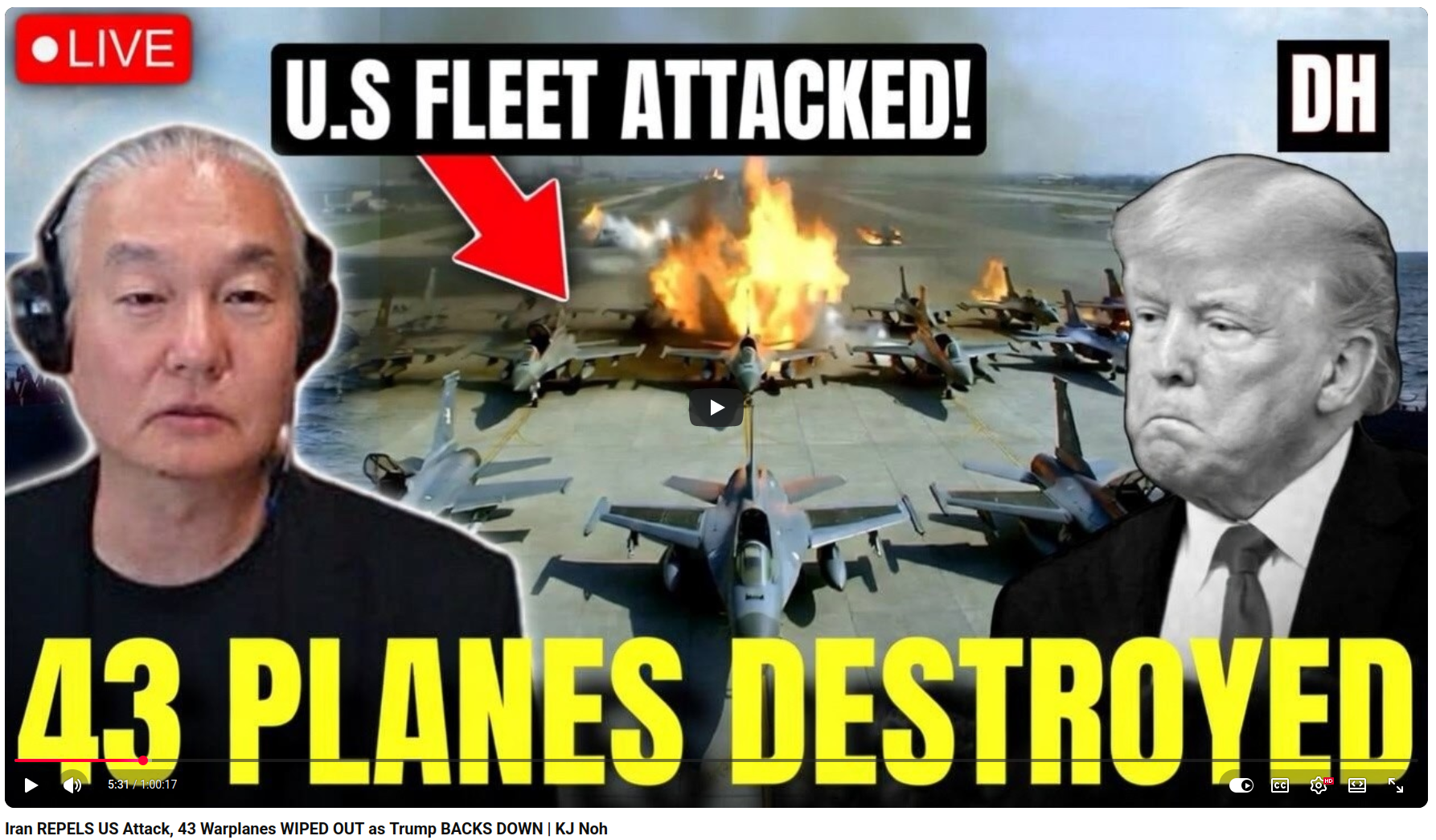
Recent developments in the Middle East mark a milestone in modern military history. What began as a supposed routine operation by the United States to impose its will on Iran has ended in a strategic retreat that inexorably exposes the limits of American military power. After two consecutive days without attacks, senior US officials, including the Chief of Staff and J.D. Vance, have admitted that stocks of Patriot interceptor missiles are nearly depleted. Further escalation would reduce these defense systems to zero. This is not a tactical pause; it is an admission of strategic failure.
By Frank Dumon
Based on military sources from Iran, a picture emerges that Western media prefer to ignore: in just thirteen days, the US would have lost 43 aircraft, ranging from fighter jets and F-15s to P-8s and operational drones, with an estimated material damage of $20.6 billion. But the real story lies not in the destruction of the aircraft themselves, but in the systematic blinding of the American military apparatus.
The Illusion of Air Superiority: A Strategic Defeat
Since the First Gulf War, thirty years ago, the Pentagon has built its military doctrine on the absolute certainty of air superiority. In 1991, the US could still deploy 3,000 air sorties per day. During the recent fourteen days of escalation, this number did not exceed 150 per day, with difficult attempts to double it. This decline is not the result of restraint, but of incapacity. The US has lost the so-called 'guided munitions salvo competition' – the core of its war doctrine.
The Destruction of 43 Aircraft and the Blindfolding of the US
The most alarming aspect of the Iranian counter-offensives is not so much the number of aircraft shot down, but the targeted destruction of the US military's senses. Iranian reports specify the destruction of seven command and control centers, three satellite communication systems, six Patriot air defense radars, three air and maritime surveillance radars, eight early warning radar systems, seven air defense radars, three AESA radar systems, two AESA-117 radars, five long-range radars, and two tactical radar complexes.
In total, this amounts to more than 37 advanced radar systems. In modern warfare, an air defense system without radar is useless; it is like a boxer with a detached retina. Iran has effectively blinded the United States. Where the US gives vague, generic statements about its own attacks, Iran communicates with deadly precision about what it has destroyed: specific radar installations, MQ-9 drone hangars, fuel storage tanks, and High Mobility Artillery Rocket Systems (HIMARS). This asymmetry in information and effectiveness speaks volumes.
The Failure of the 'Air-Sea Battle' Doctrine
The original attack plan against Iran, drawn up around 2009, was essentially the same plan that would be used against China. The then Undersecretary of the Navy, Robert Work, explained in 2010 that the core of this doctrine revolves around winning a competition of guided munition salvos, aiming to establish immediate strategic dominance by blinding the enemy, decapitating the leadership, and then imposing a blockade.
Reality has refuted this theory. Iran has not only won this salvo competition but has turned the tables. It is Iran that has blinded the US and decimated its forward assets. The US, accustomed for decades to 'armed social work' and bombarding poorly armed opponents, proves fundamentally unprepared for an armed conflict with a peer adversary that has trained specifically for this scenario for three decades.
The Impossible Options of the Empire
Now that air superiority has proven an illusion, the United States is saddled with three strategic options, none of which offers a way out. The first option, the bombing campaign, has failed. The second option, a blockade, is undermined by Iran's control over global chokepoints. This leaves the third option: ground troops.
Ground Troops: An Invitation to a 'Kill Box'
Any suggestion of a US ground invasion of Iran would amount to strategic insanity. Even if the US possessed the logistical capacity – which is doubtful – such an invasion would turn into a gigantic 'kill box'. For those familiar with military history, the parallels with Dien Bien Phu and Khe Sanh sound ominously familiar. Iran is extremely well-prepared for a land invasion. In fact, it would likely welcome such an invasion, as it forces the US to fight on Iranian soil, on their own 'home turf'.
Iran possesses a stronger moral resolve, a faster learning curve, a cost asymmetry, a geographical advantage, and a growing industrial capacity. The Iranian population, united in outrage over the unjust violence and civilian casualties, would respond to an invasion with unparalleled ferocity. It is a recipe for one of the most visible and humiliating strategic defeats in the history of warfare.
The Myth of the Proxy War and the 30-Minute Response
Knowing that direct confrontation is suicide, the US tries to recalibrate its cowardly strategy by employing proxy forces. It is speculated that the US hopes that third parties, such as certain Kurdish factions in Iraq, will do the dirty work. However, Iran has proactively anticipated this. Since the end of the recent Memorandum of Understanding (MOU), Iran conducts almost daily preemptive strikes on US infrastructure and training camps of these proxy forces in areas like Erbil.
This proxy strategy is doomed to fail. Even Iranian dissidents who despise the current regime have indicated they would take up arms to defend their country against a foreign invasion. The US underestimates the national determination of the Iranian people to protect their sovereignty. Moreover, proxy forces are increasingly realizing they are tying themselves to a losing cause. The US has grown accustomed to warfare as if on a golf course: a comfortable swing from a safe distance. Now, however, it stands up to its neck in the rough, and reality can no longer be denied.
Furthermore, Iran's response has become alarmingly swift. According to recent calculations by US Centcom, it now takes only thirty minutes for an American attack to be met with targeted missile and drone strikes on US bases. This response time will only shorten as Iran becomes further battle-hardened and perfects its own stockpiles.
The Escalation Ladder and the Vulnerability of the Gulf States
Iran has fought with restrained force so far. The escalation ladder still offers Tehran countless steps that would be devastating not only for the US, but for the entire global capitalist order. The US has no answer to the factual reality that Iran has placed a 'shock collar' around the Strait of Hormuz. Iran can activate it at any time.
The 'Shock Collar' Around the Strait of Hormuz
The Strait of Hormuz is the lifeline of global oil trade. Iran has already shown it can effectively contest this route, as evidenced by recent incidents where mines were hit by ships attempting to transit under US pressure. A full closure or disruption of this route would send the world economy into an immediate shock. The Gulf States, dependent on this route for their exports and security, would be exposed to existential crises.
The Vulnerability of AI and Energy Infrastructure
What is often overlooked is the vulnerability of modern infrastructure in the Gulf States. Iran has already carried out attacks on data centers and energy and desalination plants. If Iran decides to fully neutralize American aggression, it has the capacity to wipe out the entire infrastructure of the Gulf States.
This would not only render US military projection platforms in the region unusable, but also destroy US strategic plans for artificial intelligence (AI). After all, the Gulf States have made promises of $2 trillion in investments to build AI data centers, attracted by abundant energy and space. However, these data centers require uninterrupted power, water, and human maintenance. An Iranian attack on these facilities would undermine the foundation of the seven major technology companies that currently drive US economic growth. Iran has barely begun fighting; the potential damage to the US is astronomical.
The Global Domino: From the Red Sea to the South China Sea
The wars of the American empire are no longer isolated events; they flow into and reinforce each other. It is one unified battlefield, as former official Kurt Campbell once called it, but the 'symphony' being performed is one of imperialist overstretch.
Ansarallah, Ukraine, and the Interweaving of Fronts
The impact of this interweaving is clearly visible. Yemeni Ansarallah fighters have recently struck ARAMCO oil facilities in the Jizan area of Saudi Arabia with deadly precision, the fires of which are still raging. This demonstrates not only their capability to strike, but also their restraint and control in sparing the processing infrastructure for now, a clear warning to the Saudis and the US.
At the same time, we see a bizarre and dangerous cross-pollination in the Caspian Sea, where Ukraine attacked an Iranian vessel and killed a sailor. Iran rightly points out that Israel is behind this provocation, aiming to drag Iran further into the Ukraine conflict. The US, Ukraine, and Israel treat this as a single front, with Israel acting as a kind of 'clearinghouse' for global imperialism. This interweaving, however, will not lead to a Western victory, but to the further exhaustion of Europe, Ukraine, and the US itself.
Moreover, all signs point to US casualty figures being systematically covered up. The recruitment of specialists for personal effects at Dover Air Force Base and the closure of the maternity ward at Ramstein Air Base in anticipation of mass casualties suggest that the true toll of this conflict is much higher than officially admitted.
The South China Sea: The US's True Target
While the US is bogged down in a quagmire in the Middle East, preparation for the war against China continues unabated. The confrontations in the South China Sea, where Philippine ships, backed by the US and Japan, provoke near the Second Thomas Shoal, are no coincidence. The US continuously conducts war games, including massive logistical lift exercises on the Korean Peninsula. These are not abstract simulations, but concrete rehearsals for a future conflict.
Neoconservative strategists see a war with China as the 'main course'. Iran, Russia, and other states are seen merely as appetizers. The logic is that China is the center of gravity that offers other countries the 'escape velocity' from the Western capitalist plantation. Therefore, in their eyes, the head of the snake must be cut off. The South China Sea, through which $5 trillion in goods and 10 million barrels of oil flow annually, is the world's most important maritime chokepoint. US strategy aims to cut off this route to strangle China.
China's Answer: The Silk Road as Strategic Bypass
Where the US tries to destroy, sanction, and cut off, China builds alternatives. The US 'Air-Sea Battle' doctrine, drawn up in 2009, assumed that China would remain dependent on maritime routes. However, China saw this coming long ago.
Green Energy as a Weapon of Sovereignty
Since the 'Pivot to Asia' in 2011, China has developed the Belt and Road Initiative (BRI) not only as an economic network, but as a geostrategic necessity to bypass the South China Sea and the Strait of Malacca. The construction of the China-Pakistan Economic Corridor (CPEC) and the China-Myanmar Economic Corridor were direct attempts to gain access to the Indian Ocean without sailing through US-controlled waters.
When these land routes were attacked by US-funded NGOs or terrorist groups (such as the Balochistan Liberation Front, which attacked Chinese teachers and engineers), China adapted its strategy again. The focus shifted to energy sovereignty. By investing massively in sustainable energy (solar, wind, and hydro) within the BRI, China helps the Global South become independent of fossil fuels that flow through US chokepoints.
In the first half of 2026, the total value of BRI agreements rose to a record high of $126.3 billion, with a huge emphasis on green energy financing. This is a direct response to the vulnerability of the oil market, exacerbated by US aggression in the Middle East. China is building an anti-hegemonic coalition that enables the Global South to escape Western colonial and capitalist subjugation.
The Irony of History: Trump as Unintentional Catalyst
In all of this lies a deep, almost Hegelian irony. Donald Trump, who fervently believes climate change is a Chinese hoax to undermine the US petrochemical industry, has unintentionally done more to promote the global transition to sustainable energy than any other president.
By threatening the Strait of Hormuz and calling into question the reliability of fossil fuels as an energy source for US allies, he has made the 'shock collar' visible. No country can any longer afford to be completely dependent on energy that must be transported through US-controlled straits. The need for diversification has now become a survival strategy. In this way, the aggressive, fossil-fuel-oriented politics of the American empire is actually driving the world faster towards the sustainable energy infrastructure that China offers.
Conclusion: The Need for Realism and Resistance
The United States finds itself in a classic 'grizzly bear fallacy': the delusion that one can defeat a grizzly bear with bare hands. The country has become fat and flabby from decades of asymmetric wars against poorly armed opponents, and now lacks the industrial capacity, logistical depth, and strategic clarity to win a conflict with a motivated, advanced adversary like Iran, let alone China.
The US learning curve is flat; that of Iran, China, and the Global South is steep and adaptive. The US is losing on all fronts: military, economic, and moral. The only rational step for the US would be to withdraw, repair the damage, and sit down at the negotiating table. Such de-escalation would open the Strait of Hormuz, save the Gulf States from an existential crisis, and allow the world economy to breathe.
But rationality is not the strong suit of the neoconservative war-mongering class. They will continue trying to mask the loss with proxy wars and dangerous provocations, knowing that any further escalation could plunge not only Iran, but the entire global capitalist order, into the abyss.
It is up to us, citizens and vigilant minds, not to accept this madness. We must not be seduced by the propaganda of a dying empire. We must take to the streets, raise our voices, write, and resist this murderous escalation. History teaches us that it can get worse before it gets better, but we have a duty to organize, remain mobilized, and do everything in our power to stop this catastrophic course.
The illusion is over; it is time for reality. But the West's lack of courage and sense of realism is appalling.