
Four months after the 'cold shower': has anything changed?
De Wever acknowledges the industrial crisis, but still offers no real solutions
By Frank Dumon
On June 15, I wrote that Belgium needs an economic strategy, not China theater. On February 11, De Wever stood at the European Industry Summit in Antwerp and acknowledged what we have long been saying: Europe is de-industrializing, energy costs are murderous, but not a word about Russia and Europe's total US dependency, regulation is suffocating but not a word about EU regulatory frenzy, and China is filling the vacuum. But acknowledgment is not a solution. And theater remains theater, even if you stage it in your own city. The EU symbolizes to the world the bottle with the child-proof cap.
De Wever was right... about the symptoms
Let's be honest: what De Wever said on February 16, 2026, at the Antwerp Stock Exchange, was largely correct. The numbers don't lie. 83% of the pillars meant to strengthen our competitiveness have made no progress or have even deteriorated. The chemical sector - the backbone of European industry - saw announced closures increase sixfold in four years, accounting for a loss of nearly 10% of European production capacity. In Belgium, Germany, the Netherlands, and France, the situation is "dramatic," as he himself said. We are on the brink of an existential crisis.
De Wever cites the decline of the petrochemical sector as an example. In the Port of Antwerp, Europe's most important chemical cluster, hundreds of jobs are disappearing. Last month, Antwerp also missed out on an important multi-billion euro project.
Danish Vioneo chooses not Europe, but China to build a new factory.
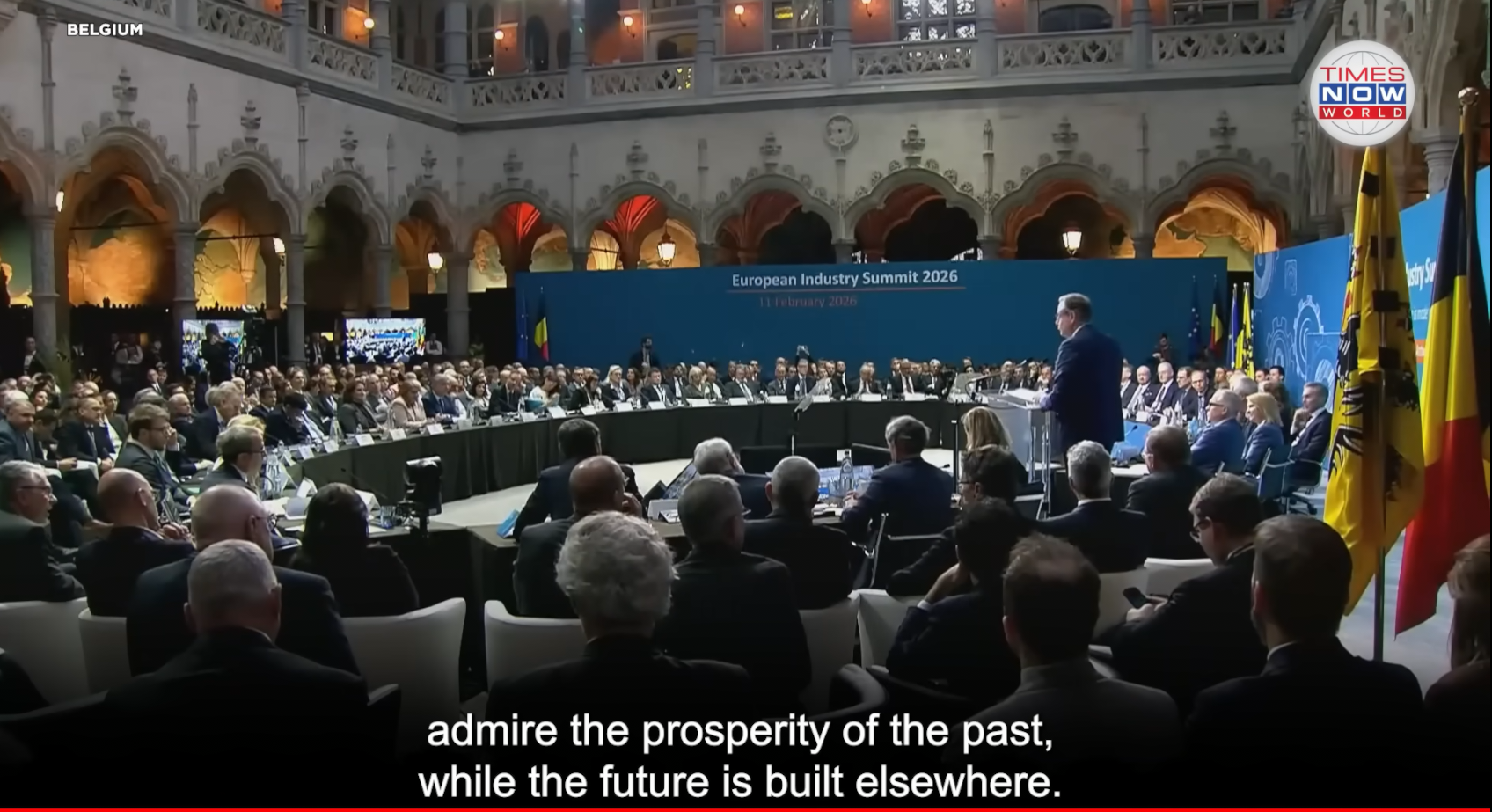
He spoke about energy costs, regulatory burden, Chinese dumping, and loss of competitiveness. He warned that Europe risks becoming an "industrial museum." He said we must be pragmatic, not ideological. That we need technological neutrality. That administrative simplification must not be a cosmetic intervention, but "shock therapy."
Everything the population has long been advocating for. So why does this still feel like a missed opportunity?
Because diagnosis is not the same as treatment
A doctor who says "you have cancer" but offers no treatment is not a doctor. He is a gravedigger with a stethoscope around his neck. De Wever has correctly identified the disease, but his prescribed treatment is vague, insufficient, and avoids the real elephants in the room.
Let's lay out the facts, four months after his speech:
- Energy costs: Have they decreased? No. European energy prices remain structurally higher than those in the US and China. Nord Stream has been destroyed, and Europe has not developed an alternative to cheap Russian energy. Instead, we are paying top dollar for LNG from the US and Qatar.
- Regulatory burden: De Wever promised "shock therapy" and a 35% reduction in administrative burdens within this mandate. How much has already been achieved? Which concrete laws have been repealed? Which permitting procedures have been accelerated? The numbers are missing.
- NATO spending: Belgium is moving toward 2% of GDP for defense, possibly even more. Who will pay for that? Precisely: the industry that De Wever says he wants to save. Every billion for weapons is a billion less for energy infrastructure, industrial innovation, or tax reduction.
- Fiscal pressure: In my previous article, I pointed out that Belgium has a suffocating fiscal pressure. Has it been reduced? On the contrary, the VAT and excise duty changes for 2026 have gone through. The working population is still paying the bill.
- Chemical closures: Have they accelerated or slowed down since January? The numbers indicate acceleration, not deceleration.
The elephants De Wever ignores - Acknowledgment without action is intellectually dishonest.
There are questions that De Wever carefully avoided in his speech. Questions that are essential if you truly want to tackle the industrial crisis.
1. Why does Belgium support NATO spending that impoverishes industry?
De Wever says that industry is also security policy. "Steel, chemicals, chips, and energy are not abstract economic variables. They determine our capacity to defend ourselves." Correct. So why does he then accept budgets that funnel billions to American weapons industries instead of to the European basic industry that makes weapons production possible?
You cannot simultaneously say "our industry is dying" and "we must spend 2% of GDP on defense" without explaining who will pay that bill. The answer is: the industry itself, through higher taxes, higher energy costs, and less government investment in crucial infrastructure.
2. Why doesn't Belgium extend the lifespan of Doel and Tihange?
De Wever advocates for "technological neutrality, including nuclear energy." Nice. But what is his government doing concretely? Belgium has decided to close its nuclear power plants and does not have the technical capacity to build new ones. In this, Russia and China are now the market leaders. You cannot advocate for nuclear energy while simultaneously closing your own nuclear power plants. That is not pragmatism, that is hypocritical.
3. Why doesn't De Wever acknowledge that Europe's own policy caused the energy crisis?
He mentions "Chinese dumping" as one of the causes. Correct. But he is silent about the destruction of Nord Stream and the European choice to replace cheap Russian energy with expensive American LNG. He is silent about the Green Deal that makes industrial production more expensive without there being an affordable alternative. Europe has made itself vulnerable by destroying its own energy base. That is not a conspiracy from Beijing, that is "self-inflicted damage."
4. What has concretely happened with the 35% reduction in administrative burdens?
De Wever says: "We must urgently, urgently accelerate toward the ambitious goal of 35% reduction in administrative burdens within this mandate." Nice. But:
- Which laws have already been repealed?
- Which permitting procedures have already been accelerated?
- What is the measurable progress after four months?
Promises without measurable milestones are not policy but marketing.
The Draghi report paradox
De Wever correctly cites that "barely one in ten of Draghi's recommendations has been implemented" after a year. But he doesn't say why. The answer is uncomfortable: because the European political elite - of which De Wever is now himself a part - is not willing to make the fundamental choices that are necessary. Draghi said: simplify, invest, integrate. But Europe chooses: sanction, regulate, moralize. As long as that remains the case, Draghi's report will remain a nice PDF on a server somewhere in Brussels.
What De Wever does see correctly
"Europe must stop trying to do everything everywhere all at once. There is a clear hierarchy of top priorities: innovation, productivity, competitiveness."
This is gold. This is what we have been saying for years. The EU must make choices. You cannot simultaneously save the world, implement the Green Deal, support Ukraine, confront China, and let your industry compete with countries that have cheap energy and less regulatory burden.
But choosing also means creating losers. And that's where the shoe pinches.
Choosing industry might mean less money for development aid. Less money for climate activism. Less money for geopolitical adventures. Less moral superiority, but more material prosperity. Fewer politicians, something in which Belgium is world champion. What a sad record. Is De Wever willing to make that choice? His speech suggests yes. His policy so far suggests no.
The Arctic route: still ignored
In my previous article, I pointed to the strategic importance of the northern sea routes, the Arctic corridor, and the Polar Silk Road. De Wever's speech is completely silent on this. While he advocates for "partnerships that make us stronger" and "diversification of supply chains," he ignores the most disruptive change in world trade since the opening of the Suez Canal.
Russia and China are investing billions in the northern route. 18 days versus 35 days via Suez. That is not a marginal advantage, that is a game-changer. And Europe? Europe talks about sanctions against Russia and "de-risking" from China, while the physical reality of world trade is shifting.
You cannot sanction geography.
The real question: what has concretely changed?
Let's take stock, four months after De Wever's "cold shower":
| Domain | Promise (February 2026) | Reality (June 2026) | Score |
|---|---|---|---|
| Energy costs | Compensation mechanism for energy-intensive companies | Temporary measures, no structural solution | ⚠️ Insufficient |
| Regulatory burden | 35% reduction, shock therapy | No measurable progress published | ❌ Not realized |
| Labor costs | Reduce structural handicaps | Slightly improved, but still above EU average | ⚠️ Partial |
| Nuclear energy | Technological neutrality, including nuclear | Closure of Doel/Tihange continues | ❌ Contradictory |
| NATO spending | Not mentioned in speech | Movement toward 2%+ GDP | ❌ Worsens problem |
| Chemical closures | Stop the bleeding | Closures continue (BASF, Yara, etc.) | ❌ Worsened |
The uncomfortable truth
De Wever faces an impossible task. He wants to:
- Save industry and meet NATO targets
- Accelerate energy transition and lower energy costs
- Reduce regulatory burden and implement EU regulations
- Confront China and maintain trade with China
- Keep budget in balance and increase investments
That's impossible. Anyone who says otherwise is lying or doesn't understand economics.
De Wever is no exception to this rule. He is a politician in a system that is fundamentally broken. He sees the problems sharply - more sharply than most of his colleagues - but he is not willing or able to make the fundamental choices that are necessary.
What would really help?
If De Wever truly wants to save industry, he must dare what others don't dare:
- Stop the NATO spending increase. Explain that security begins with a strong industry, not with more tanks.
- Extend the lifespan of Doel and Tihange. At least 10 years. No ideology, just pragmatism.
- Lower fiscal pressure on labor and production. Not "reshuffle," but structurally reduce.
- Repeal at least 50 EU laws and national decrees. Measurable, verifiable, with deadlines.
- Acknowledge that Europe cannot be everything. Choose industry, accept that other goals get lower priority.
- Invest in ports and logistics, including the Arctic route. Antwerp must be prepared for the shift in trade flows.
Will he do that? No. Because that costs political capital. And De Wever, like every other politician, is too afraid of that.
Conclusion: More theater, less action
Four months after De Wever's "cold shower" we must conclude: the diagnosis was correct, the treatment is insufficient. De Wever is right that Europe risks becoming an industrial museum. He is right that we must be pragmatic. He is right that regulatory burden is murderous. He is right that energy costs are destroying our industry. But being right is not enough. Being right without acting is intellectual laziness packaged as leadership.
The question is not whether De Wever sees the problems. The question is why, now that he sees them, he doesn't act as if his life depends on it. Because it does. The life of Belgian industry depends on it. The well-being of millions of Belgians depends on it.
So far we see:
- More words than deeds
- More promises than results
- More acknowledgment of problems than solutions
- More geopolitical theater than economic realism
Belgium still needs an economic strategy. Not speeches at the Stock Exchange. Not acknowledgment of problems. Not vague promises of "shock therapy."
Belgium needs choices. Actions. Results.
Four months later: the cold shower was pleasant. But now it's time to step out of the shower and start working.
Time is running out. Chemical factories will continue to close. Energy prices won't wait for our consensus. World trade won't shift because we impose sanctions. The question remains: why does De Wever seem more afraid of the political truth than of the economic collapse that he himself diagnoses so sharply?