Farewell, Microsoft Windows: How I Freed My PC (and My Life) with Linux Mint
No pressure to create a customer account. No registration. No spyware. Just freedom.

By Frank Dumon
Recently, I bought a dream PC. An AMD Ryzen 9 9950X3D, an RTX 5070, 64 GB RAM, and a 2 TB Samsung 990 Pro NVMe solid state drive for €4,110. And then I made the mistake of also choosing Windows 11 alongside Linux Mint as a "dual boot". Within minutes, I was staring at something that felt less like an operating system and more like a surveillance instrument with a start menu. Microsoft wanted my email address. Microsoft wanted my phone number. Microsoft wanted me to use Edge, Microsoft wanted me to buy Office 365 instead of LibreOffice, Microsoft wanted me to "entrust" my data to their cloud...
The last straw? I discovered that Windows had reserved 75% of my 2 TB drive — more than 1.4 terabytes — not for my files, website, or creativity, but for itself. For recovery partitions. For "reserved" space. For bloatware I never asked for. That's not technology. That's digital squatting. That's piracy in reverse — not Microsoft stealing software, but Microsoft stealing storage space I paid for. So I left. Windows had to disappear from my life for good.
Farewell, Microsoft Windows, farewell "dual boot"
- No pressure to create a customer account.
- No registration.
- No obstacles to installing another operating system via "Secure Boot" and other tricks.
- No pressure to use expensive MS Office 365.
- No disclosure of personal data.
- No pressure to use Edge as a web browser.
- No usage restrictions imposed by restrictive EULAs.
- No unnecessary software (bloatware) pre-installed that only wants to steal our money and data.
Why I switched (and why you should too)
I didn't just "install Linux". I escaped an ecosystem designed to control, monetize, and spy on me at every click. Privacy does not exist under Windows. Companies throw all their data to the dogs. This isn't about saving money. It's about ownership and privacy. My computer. My data. My rules.
| With Windows 11 | With Linux Mint |
|---|---|
| Mandatory Microsoft account | No account. No registration. |
| Secure Boot used to block other operating systems | Secure Boot can be tamed (naming trick) |
| Office 365 subscription or nagging notifications | LibreOffice (free, powerful, open source) |
| Telemetry and data collection | No disclosure of personal data |
| Edge forced as default browser | Any browser you want. At any time. |
| Restrictive EULAs that limit your rights | Open source licenses that protect your freedom |
| Bloatware pre-installed | Only what you choose. Nothing more. |
The best part about leaving Windows wasn't just what I fled from — it was what I found.
DeepSeek: Tools like DeepSeek (the AI assistant that helped me through every step of this migration) prove that open source is no less than corporate products. It's often better. No paywalls. No data theft. Just genuine help from a global community of developers who believe that software should serve people, not shareholders.
LibreOffice: Microsoft asks €70 per year for Office 365 — forever. LibreOffice does everything Word, Excel, and PowerPoint do. It opens Microsoft files. It saves in Microsoft formats. And it costs exactly €0. No subscription. No "cloud required". No telemetry.
The sharing economy of software: Open source is the ultimate sharing economy. No renting access to your own files. No paying monthly for a word processor, video editor, the applications are endless and permanently yours.
I opened GParted (a partition tool) and saw the truth:
| Partition | What it is | Action |
|---|---|---|
nvme0n1p1 | EFI boot partition (FAT32) | ✅ KEEP (essential) |
nvme0n1p2 | Empty mini-partition | ❌ DELETE |
nvme0n1p3 | Windows C: drive (NTFS, ~1 TB) | ❌ DELETE |
nvme0n1p4 | Windows recovery (NTFS) | ❌ DELETE |
nvme0n1p5 | Old/partial Linux installation (ext4) | ❌ DELETE |
nvme0n1p6 | Your current Linux Mint (ext4, mounted on /) | ✅ KEEP |
The Final Deletion Plan
After deletion, my Linux partition expanded to take up the entire 1.8 TB drive. All that space Microsoft had claimed for itself is now mine. Every byte. Windows didn't need that space. Windows just took it. That's not optimization. That's greed. This isn't just about an operating system. It's about digital sovereignty. When you use Windows, you are not the customer. You are the product. Microsoft asks for your data, your habits, your information, and makes you dependent.
When you use Linux, you are simply a user. No Microsoft dominance. No "ecosystem" lock-in. Linux runs on everything: from supercomputers to old laptops to Android phones (which are also Linux). It is no longer the "alternative". Linux is the operating system of today. It's just that most people don't know they have a choice.
Why the switch is worth it
• Free from bloatware — no Candy Crush or TikTok pre-installed
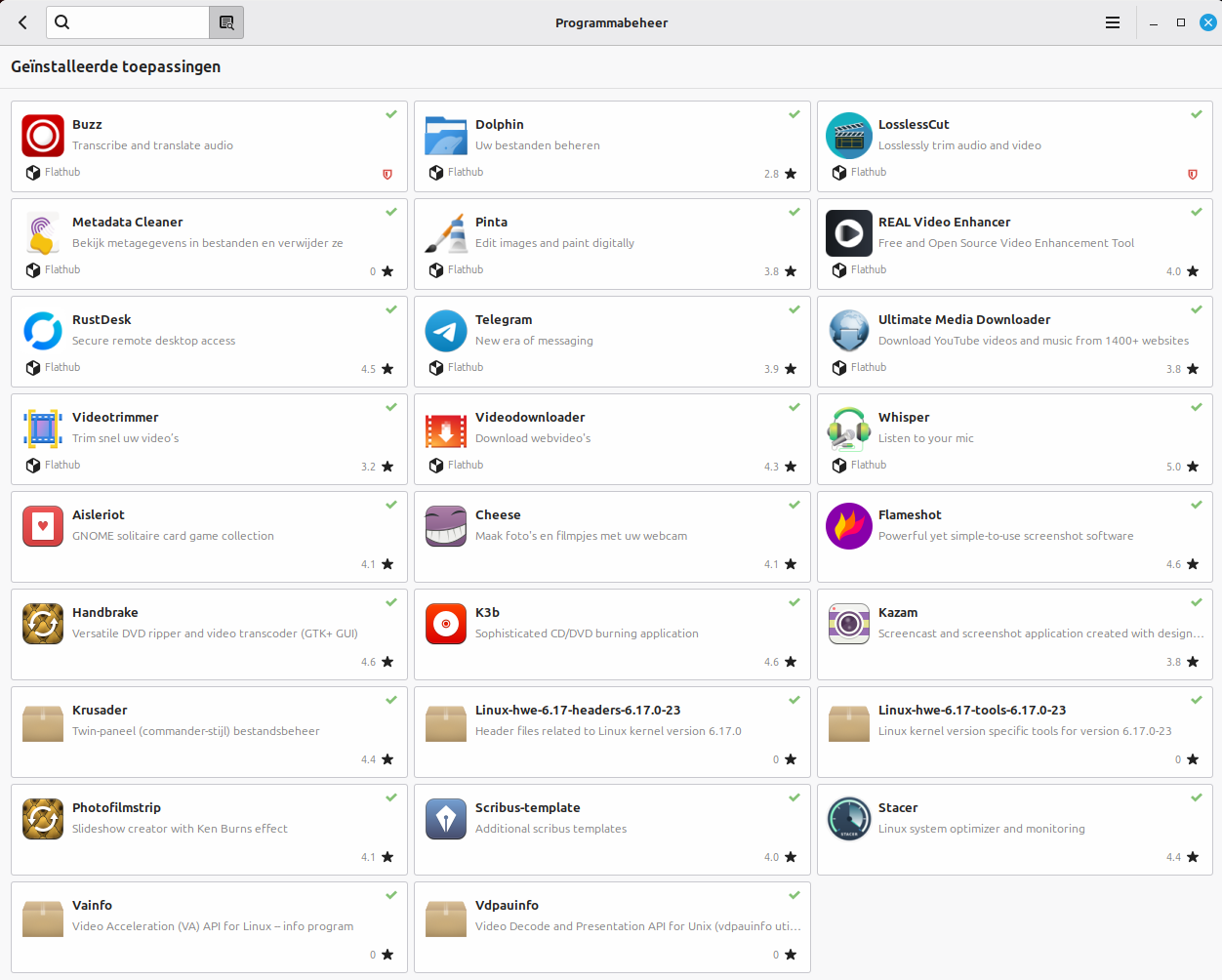
• Free from subscriptions — LibreOffice, GIMP, Inkscape, Darktable. All free, from Flathub. All professional.
• Free from hardware waste — Linux breathes new life into old PCs that Windows abandons
• Freedom to choose — dozens of distributions (Mint, Ubuntu, Fedora, Debian), hundreds of desktop environments
• Free from surveillance — your computer is yours again
My final configuration:
| Component | What I have |
|---|---|
| CPU | AMD Ryzen 9 9950X3D (16 cores) |
| GPU | ASUS RTX 5070 12 GB GDDR7 |
| RAM | 64 GB DDR5 |
| Storage | Samsung 990 Pro 2 TB NVMe (full 1.8 TB available) |
| Motherboard | ASUS TUF GAMING B850-PLUS WIFI |
| Operating System | Linux Mint 22 (single boot) |
What I gained (besides 1.4 terabytes)
| Area | Windows 11 | Linux Mint |
|---|---|---|
| Disk usage | ~1.5 TB (hidden partitions) | ~30 GB |
| Privacy | Telemetry you can't fully disable | Zero data collection |
| Updates | Forced, unpredictable, slow | When you want, as long as you want |
| Support for old hardware | "Your PC is not compatible" | Runs beautifully |
| Android integration | Clunky (or requires extra software) | Native, effortless |
| Cost | Hidden + subscriptions | Free. Forever. |
• Independence from American companies
• Freely available
• Wide choice of distributions and desktops
• Updates when and as long as you want
• Runs even on older or less powerful hardware
• Helps prevent hardware waste
• Effortless data exchange with Android devices without extra software
Linux is the operating system of today. Where the terminal is user-friendly, the source code is open, the programs are free, developed by the community for the community, and where the computer is truly yours. The learning curve really isn't that steep.