
Europe’s Delusion: Russophobia, Demodernization, and the West’s Geopolitical Fall
By Frank Dumon
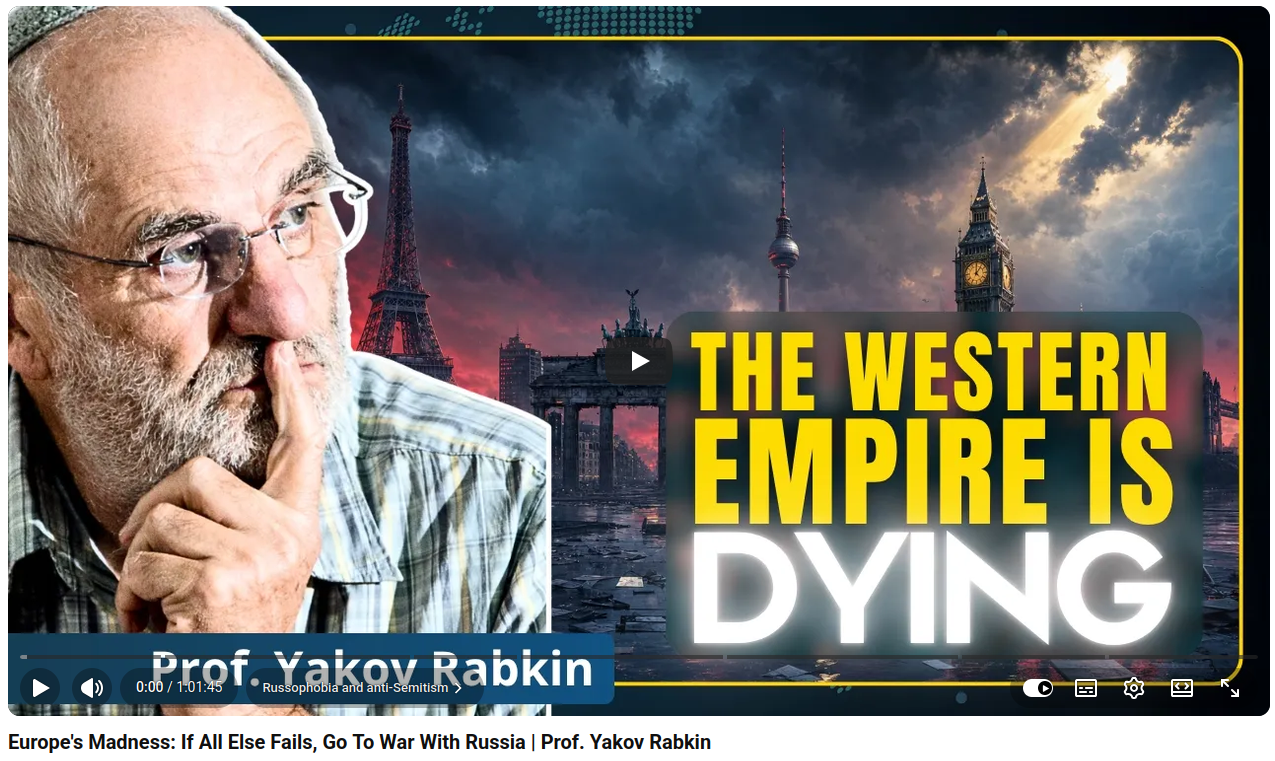
In an era of increasing geopolitical tensions and polarization, it is crucial to understand the underlying mechanisms of our collective discourses. A recent, in-depth analysis by Yakov Rabkin, Professor Emeritus of History at the University of Montreal, casts a sharp light on an alarming dynamic within the Western political establishment. Rabkin argues that contemporary Russophobia is not merely a spontaneous reaction to international events, but an instrumental political tool that exhibits historical parallels with antisemitism. Both stereotypes are deployed to stifle rational debate, justify militarization, and divert attention from deep-seated domestic economic and social crises.
This article synthesizes the core arguments of Rabkin's thesis, focusing on the historical roots of these stereotypes, the concept of 'demodernization', and the way elites use these mechanisms to protect the status quo. It is a plea for a renewed focus on diplomacy, historical awareness, and rational analysis, rather than the reflexive flight into war rhetoric.
The Historical Roots of Russophobia and Antisemitism
To understand the current dynamic, we must return to the nineteenth century, the period when both the terms 'antisemitism' and 'Russophobia' entered intellectual discourse. Rabkin points out that these concepts did not arise in a vacuum but emerged from specific political and social contexts. The term 'Russophobia', for example, was already used in 1867 by the Russian poet and intellectual Fyodor Tyutchev in a letter to his daughter. He described it as a "pathological character" affecting certain, otherwise honest, Russians: a form of self-hatred where one views one's own country through the denigrating lens of Western civilization.
Independently, the term was also introduced into English discourse by the philosopher John Stuart Mill. Mill criticized the British government of his time for unnecessarily inflating the military budget by exaggerating the threat of the Russian Empire. "The true cause," Mill wrote, "is one which it was not convenient to name: the ministers are infected with the epidemic disease of Russophobia." This historical observation is painfully recognizable today. The rhetoric of an inherently aggressive, backward Russian entity that simultaneously poses an existential, unstoppable threat to all of Europe is a copy of a blueprint that is over a century old.
The power of these stereotypes lies in their irrationality and their appeal to emotion over reason. Rabkin illustrates this with a seeming contradiction characteristic of both antisemitic and Russophobic propaganda: on the one hand, the target group is portrayed as backward, underdeveloped, and incompetent (an army that would use chips from washing machines); on the other, the same group is presented as a hyper-militarized, all-encompassing power poised to conquer continents. Rational analysis would immediately expose this contradiction, but stereotypes do not work through logic. They work through essentialism: attributing fixed, inherent, and negative qualities to an entire group of people, regardless of individual differences or complex realities.
Colonialism, Racism, and the 'Equal Opportunity' Genocide
The parallel between antisemitism and Russophobia becomes historically most grotesquely visible in the ideology of National Socialism. For the Nazis, these two forms of hatred were inextricably linked in the concept of 'Judeo-Bolshevism'. The invasion of the Soviet Union was not seen as a conventional war, but as a Vernichtungskrieg (war of annihilation). The Slavic population was systematically dehumanized by Nazi propaganda and portrayed as an 'Asian horde', inferior and unfit for self-governance.
Rabkin emphasizes that this was a colonial project in the purest sense of the word. The goal was not merely military victory, but the emptying of fertile lands to make way for German colonists. This required the systematic elimination of the local population. Although the Holocaust and the murder of six million Jews hold a unique and central place in our collective memory, Rabkin rightly points out that these were not the only victims. At least ten million Slavic civilians (Russians, Belarusians, Poles, and others) were murdered by the Nazis. This 'equal opportunity' genocide, directed against anyone deemed non-European or inferior, fits into a broader European tradition of colonial racism.
This racism is not limited to the Second World War. Rabkin reminds us of the genocide in South-West Africa (present-day Namibia) by the Germans at the beginning of the twentieth century, an event that has barely penetrated the collective European memory. It points to a deeply ingrained European habit of normalizing or forgetting violence against non-Western or 'inferior' populations. Racism, in this broad sense, is an instrument of power. It is a social construct deployed to justify hierarchies, whether based on skin color, religion, or national origin.
Demodernization: The Privatization of Anger
One of the most illuminating concepts Rabkin introduces is that of 'demodernization'. After the Second World War, partly due to the pressures of the Cold War and decolonization, there was a broad consensus on the need for modernization. Both in the West and in the Soviet Union, theories aimed at reducing economic inequality, investing in education and healthcare, and conducting rational, fact-based debate to shape policy. The goal was to create self-reliant, stable societies.
Since the late 1980s, and accelerating in the decades since, we have witnessed a radical reversal of this process. We are witnessing an extreme polarization of wealth and income, where a handful of individuals now possess as much as half of the world's population. This extreme inequality undermines any claim to a functioning democracy. In such an environment, demodernization arises: the dismantling of rational structures and the emergence of irrational explanations for complex problems.
A key mechanism of this demodernization is what Rabkin calls the "privatization of anger". Instead of citizens developing class consciousness and directing their grievances at the structural exploitation and the elites responsible, anger is turned inward or deflected horizontally. People are told that their economic hardship is a personal failure, a lack of the right 'mindset'. The system is presented as a natural law, like the weather, which you cannot change. This privatization of anger prevents the emergence of a collective, political movement that demands accountability from those who profit from inequality.
This is where the political function of Russophobia and antisemitism comes into play. They act as diversionary maneuvers. By identifying a scapegoat – an internal enemy (e.g., a religious or ethnic minority) or an external enemy (Russia) – elites can channel the frustrated anger of the population in a direction that does not threaten the status quo. It is a classic 'divide and rule' strategy, packaged in modern, media-driven propaganda.
The Political Function of the Enemy: Militarism over Diplomacy
The construction of an enemy is not merely a byproduct of prejudice; it is a necessary precondition for militarization. Rabkin argues that the political and financial elites of the West, faced with a deep legitimacy crisis and economic stagnation, increasingly resort to militarism as a way to stimulate the economy and enforce social cohesion (via a common enemy).
Militarization requires an enemy image that is as black-and-white as possible. Diplomacy, which is based on understanding the motives, concerns, and perspectives of the other party, is seen in this context as weakness or even treason. Rabkin points to the German term Versteher (someone who tries to understand), which in the current geopolitical context has acquired a pejorative connotation. Anyone who tries to analyze Russian security perspectives or the historical context of the conflict is immediately dismissed as an apologist for aggression. This stifles any rational debate at its inception.
This dynamic was also visible at the end of the Second World War. Rabkin cites documents from August 1945, when the Soviet Union was still an ally, in which nuclear strikes on Soviet cities were already being speculated upon and Russians were described as underdeveloped beings one only needed to know "how much steel is needed to kill one of them." The enemy was constructed before the previous war was even over, purely to provide the military-industrial complexes (what today might be called the 'military-industrial-digital complex') with work and a reason for existence.
Today, we see how this leads to an epistemic crisis in Europe. Policymakers think exclusively in terms of 'deterrence', forgetting that the most effective security does not come from threats, but from friendly relations and mutual understanding. France and Germany do not need to deter each other; they maintain peace through cooperation. However, by basing the entire continental security architecture on enemy image-building, European leaders lose the ability to think outside this paradigm.
The 'Political West' versus 'The One West'
A fascinating observation by Rabkin is that Russophobia, in the intense and irrational form we know today, occurs almost exclusively within the 'Political West': Europe, North America, and traditional colonial settlements like Australia and Canada. Global opinion polls consistently show that once one leaves the borders of this specific group of countries, attitudes toward Russia are significantly more positive or at least more nuanced.
Rabkin introduces the concept of 'The One West'. This does not refer to a geographical entity, but to a transnational network of political and financial elites who collectively benefit from the current world order. This network maintains its power through a shared ideology and by imposing a uniform narrative. Countries that are formally part of the West but lack a historical colonial or 'settler' background (such as Japan or South Korea), for example, do not exhibit the same deeply ingrained Russophobic reflexes because the underlying colonial mentality and associated essentialism are less dominant there.
This leads to a concerning observation about the current generation of European leaders. Rabkin describes them as "unimpressive by design". Unlike historical figures who, despite disagreements, had a clear concept of national interest, contemporary European politicians appear entirely subservient to the interests of the United States and the central structures of the European Union. They have been raised in a system of subservience to the 'collective West', without democratic legitimacy for their most far-reaching decisions.
The result is that unpopular leaders, without a mandate from their voters, make far-reaching decisions to dismantle the welfare state in favor of militaristic spending. The example of Canada is illustrative here: a country that is historically and geopolitically most 'threatened' by its southern neighbor, the United States, directs its military budget and rhetoric, however, at Russia and China. This shows that 'national interest' has been replaced by blind obedience to the agenda of 'The One West'. Financial institutions, which plan decades ahead, drive this irrationality, while the political class has the task of translating this to the population in the form of simplistic, emotional enemy images.
Self-Hatred and the Myth of the Monolith
Another crucial element in Rabkin's analysis is the phenomenon of 'self-hatred' within the demonized groups. This is a well-known phenomenon in colonial contexts, where Western-educated elite members come to despise their own culture because it supposedly does not meet the 'civilized' standards of the colonizer. We see this reflected in individuals who, purely because of their Russian or Jewish background, are pushed by Western media as 'experts' confirming what the West already wants to believe: that their own culture is inherently defective, aggressive, or backward.
This self-hatred reinforces essentialism. It gives the illusion of authenticity to the stereotypes ("They say it themselves, don't they?"). However, Rabkin points out that this is a denial of the enormous diversity within every culture. Russia is systematically portrayed in Western discourse as a monolith, where one man at the top makes all decisions and the rest follow in blind obedience. The reality is that within Russian intellectual and foreign policy circles, lively, complex debates take place about the country's course, its relationship with the West, and the nature of the current conflict. Racism and stereotyping, however, have no eye for nuance; they require a simple, one-dimensional picture to function.
Moreover, Rabkin makes an important historical distinction between the nature of the Russian Empire and the Western colonial empires. The expansion of the Russian Empire was primarily a territorial expansion over land, which often led to the integration of local ruling classes into the Russian aristocracy (think of Tatar princes in St. Petersburg). Western colonialism, on the other hand, was fundamentally based on racial exclusion and extraction overseas. The Nazi regime, as the ultimate outgrowth of Western racial logic, therefore saw the Russians as 'Asians' precisely because they allowed this integration, which in their racial worldview meant mixing and contamination. This historical distinction, however, is completely erased in current Western propaganda, causing Russian actions to be judged through a lens of Western, racially motivated colonial history.
Conclusion: A Plea for Rationality and Diplomacy
Professor Yakov Rabkin's analysis is an uncomfortable but necessary correction to the dominant narrative in Western media and politics. It reveals how the instrumentalization of Russophobia and antisemitism serves not to protect peace or democracy, but to divert attention from failing domestic policies, extreme economic inequality, and the erosion of democratic norms. The 'demodernization' we are experiencing is not a natural law, but a man-made process sustained by those who profit from it financially and politically. As long as public anger is channeled towards external scapegoats, 'The One West' does not have to account for the dismantling of the welfare state and the buildup of a war economy.
It is vital to break this dynamic. It begins with reclaiming the capacity for rational debate. We must assert the right to try to understand the motivations of other nations, without this being immediately branded as treason or moral failure. Diplomacy is not weak; it is the only mature method of resolving conflicts in a world with nuclear weapons. Replacing diplomacy with mere 'deterrence' is a recipe for catastrophic escalation.
Finally, we must broaden our historical memory. Racism is not only a matter of skin color; it is a mentality of essentialism and exclusion deeply intertwined with the colonial history of the West. By recognizing these patterns – in the way we speak about Russia, the Middle East, or other regions – we can resist the manipulation of our emotions. As Rabkin implicitly suggests: the true patriotic act is not blindly following a war rhetoric that serves the interests of a transnational elite, but demanding a foreign policy based on peace, justice, and a genuine understanding of the complex world we live in.
The West's Biggest Mistake: Coming soon, a follow-up to this topic based on an in-depth conversation between Pascal Lottaz and Professor Alastair Renfrew.
Europe’s Delusion: Russophobia, Demodernization, and the West’s Geopolitical Fall
By Frank Dumon
In an era of increasing geopolitical tensions and polarization, it is crucial to understand the underlying mechanisms of our collective discourses. A recent, in-depth analysis by Yakov Rabkin, Professor Emeritus of History at the University of Montreal, casts a sharp light on an alarming dynamic within the Western political establishment. Rabkin argues that contemporary Russophobia is not merely a spontaneous reaction to international events, but an instrumental political tool that exhibits historical parallels with antisemitism. Both stereotypes are deployed to stifle rational debate, justify militarization, and divert attention from deep-seated domestic economic and social crises.
This article synthesizes the core arguments of Rabkin's thesis, focusing on the historical roots of these stereotypes, the concept of 'demodernization', and the way elites use these mechanisms to protect the status quo. It is a plea for a renewed focus on diplomacy, historical awareness, and rational analysis, rather than the reflexive flight into war rhetoric.
The Historical Roots of Russophobia and Antisemitism
To understand the current dynamic, we must return to the nineteenth century, the period when both the terms 'antisemitism' and 'Russophobia' entered intellectual discourse. Rabkin points out that these concepts did not arise in a vacuum but emerged from specific political and social contexts. The term 'Russophobia', for example, was already used in 1867 by the Russian poet and intellectual Fyodor Tyutchev in a letter to his daughter. He described it as a "pathological character" affecting certain, otherwise honest, Russians: a form of self-hatred where one views one's own country through the denigrating lens of Western civilization.
Independently, the term was also introduced into English discourse by the philosopher John Stuart Mill. Mill criticized the British government of his time for unnecessarily inflating the military budget by exaggerating the threat of the Russian Empire. "The true cause," Mill wrote, "is one which it was not convenient to name: the ministers are infected with the epidemic disease of Russophobia." This historical observation is painfully recognizable today. The rhetoric of an inherently aggressive, backward Russian entity that simultaneously poses an existential, unstoppable threat to all of Europe is a copy of a blueprint that is over a century old.
The power of these stereotypes lies in their irrationality and their appeal to emotion over reason. Rabkin illustrates this with a seeming contradiction characteristic of both antisemitic and Russophobic propaganda: on the one hand, the target group is portrayed as backward, underdeveloped, and incompetent (an army that would use chips from washing machines); on the other, the same group is presented as a hyper-militarized, all-encompassing power poised to conquer continents. Rational analysis would immediately expose this contradiction, but stereotypes do not work through logic. They work through essentialism: attributing fixed, inherent, and negative qualities to an entire group of people, regardless of individual differences or complex realities.
Colonialism, Racism, and the 'Equal Opportunity' Genocide
The parallel between antisemitism and Russophobia becomes historically most grotesquely visible in the ideology of National Socialism. For the Nazis, these two forms of hatred were inextricably linked in the concept of 'Judeo-Bolshevism'. The invasion of the Soviet Union was not seen as a conventional war, but as a Vernichtungskrieg (war of annihilation). The Slavic population was systematically dehumanized by Nazi propaganda and portrayed as an 'Asian horde', inferior and unfit for self-governance.
Rabkin emphasizes that this was a colonial project in the purest sense of the word. The goal was not merely military victory, but the emptying of fertile lands to make way for German colonists. This required the systematic elimination of the local population. Although the Holocaust and the murder of six million Jews hold a unique and central place in our collective memory, Rabkin rightly points out that these were not the only victims. At least ten million Slavic civilians (Russians, Belarusians, Poles, and others) were murdered by the Nazis. This 'equal opportunity' genocide, directed against anyone deemed non-European or inferior, fits into a broader European tradition of colonial racism.
This racism is not limited to the Second World War. Rabkin reminds us of the genocide in South-West Africa (present-day Namibia) by the Germans at the beginning of the twentieth century, an event that has barely penetrated the collective European memory. It points to a deeply ingrained European habit of normalizing or forgetting violence against non-Western or 'inferior' populations. Racism, in this broad sense, is an instrument of power. It is a social construct deployed to justify hierarchies, whether based on skin color, religion, or national origin.
Demodernization: The Privatization of Anger
One of the most illuminating concepts Rabkin introduces is that of 'demodernization'. After the Second World War, partly due to the pressures of the Cold War and decolonization, there was a broad consensus on the need for modernization. Both in the West and in the Soviet Union, theories aimed at reducing economic inequality, investing in education and healthcare, and conducting rational, fact-based debate to shape policy. The goal was to create self-reliant, stable societies.
Since the late 1980s, and accelerating in the decades since, we have witnessed a radical reversal of this process. We are witnessing an extreme polarization of wealth and income, where a handful of individuals now possess as much as half of the world's population. This extreme inequality undermines any claim to a functioning democracy. In such an environment, demodernization arises: the dismantling of rational structures and the emergence of irrational explanations for complex problems.
A key mechanism of this demodernization is what Rabkin calls the "privatization of anger". Instead of citizens developing class consciousness and directing their grievances at the structural exploitation and the elites responsible, anger is turned inward or deflected horizontally. People are told that their economic hardship is a personal failure, a lack of the right 'mindset'. The system is presented as a natural law, like the weather, which you cannot change. This privatization of anger prevents the emergence of a collective, political movement that demands accountability from those who profit from inequality.
This is where the political function of Russophobia and antisemitism comes into play. They act as diversionary maneuvers. By identifying a scapegoat – an internal enemy (e.g., a religious or ethnic minority) or an external enemy (Russia) – elites can channel the frustrated anger of the population in a direction that does not threaten the status quo. It is a classic 'divide and rule' strategy, packaged in modern, media-driven propaganda.
The Political Function of the Enemy: Militarism over Diplomacy
The construction of an enemy is not merely a byproduct of prejudice; it is a necessary precondition for militarization. Rabkin argues that the political and financial elites of the West, faced with a deep legitimacy crisis and economic stagnation, increasingly resort to militarism as a way to stimulate the economy and enforce social cohesion (via a common enemy).
Militarization requires an enemy image that is as black-and-white as possible. Diplomacy, which is based on understanding the motives, concerns, and perspectives of the other party, is seen in this context as weakness or even treason. Rabkin points to the German term Versteher (someone who tries to understand), which in the current geopolitical context has acquired a pejorative connotation. Anyone who tries to analyze Russian security perspectives or the historical context of the conflict is immediately dismissed as an apologist for aggression. This stifles any rational debate at its inception.
This dynamic was also visible at the end of the Second World War. Rabkin cites documents from August 1945, when the Soviet Union was still an ally, in which nuclear strikes on Soviet cities were already being speculated upon and Russians were described as underdeveloped beings one only needed to know "how much steel is needed to kill one of them." The enemy was constructed before the previous war was even over, purely to provide the military-industrial complexes (what today might be called the 'military-industrial-digital complex') with work and a reason for existence.
Today, we see how this leads to an epistemic crisis in Europe. Policymakers think exclusively in terms of 'deterrence', forgetting that the most effective security does not come from threats, but from friendly relations and mutual understanding. France and Germany do not need to deter each other; they maintain peace through cooperation. However, by basing the entire continental security architecture on enemy image-building, European leaders lose the ability to think outside this paradigm.
The 'Political West' versus 'The One West'
A fascinating observation by Rabkin is that Russophobia, in the intense and irrational form we know today, occurs almost exclusively within the 'Political West': Europe, North America, and traditional colonial settlements like Australia and Canada. Global opinion polls consistently show that once one leaves the borders of this specific group of countries, attitudes toward Russia are significantly more positive or at least more nuanced.
Rabkin introduces the concept of 'The One West'. This does not refer to a geographical entity, but to a transnational network of political and financial elites who collectively benefit from the current world order. This network maintains its power through a shared ideology and by imposing a uniform narrative. Countries that are formally part of the West but lack a historical colonial or 'settler' background (such as Japan or South Korea), for example, do not exhibit the same deeply ingrained Russophobic reflexes because the underlying colonial mentality and associated essentialism are less dominant there.
This leads to a concerning observation about the current generation of European leaders. Rabkin describes them as "unimpressive by design". Unlike historical figures who, despite disagreements, had a clear concept of national interest, contemporary European politicians appear entirely subservient to the interests of the United States and the central structures of the European Union. They have been raised in a system of subservience to the 'collective West', without democratic legitimacy for their most far-reaching decisions.
The result is that unpopular leaders, without a mandate from their voters, make far-reaching decisions to dismantle the welfare state in favor of militaristic spending. The example of Canada is illustrative here: a country that is historically and geopolitically most 'threatened' by its southern neighbor, the United States, directs its military budget and rhetoric, however, at Russia and China. This shows that 'national interest' has been replaced by blind obedience to the agenda of 'The One West'. Financial institutions, which plan decades ahead, drive this irrationality, while the political class has the task of translating this to the population in the form of simplistic, emotional enemy images.
Self-Hatred and the Myth of the Monolith
Another crucial element in Rabkin's analysis is the phenomenon of 'self-hatred' within the demonized groups. This is a well-known phenomenon in colonial contexts, where Western-educated elite members come to despise their own culture because it supposedly does not meet the 'civilized' standards of the colonizer. We see this reflected in individuals who, purely because of their Russian or Jewish background, are pushed by Western media as 'experts' confirming what the West already wants to believe: that their own culture is inherently defective, aggressive, or backward.
This self-hatred reinforces essentialism. It gives the illusion of authenticity to the stereotypes ("They say it themselves, don't they?"). However, Rabkin points out that this is a denial of the enormous diversity within every culture. Russia is systematically portrayed in Western discourse as a monolith, where one man at the top makes all decisions and the rest follow in blind obedience. The reality is that within Russian intellectual and foreign policy circles, lively, complex debates take place about the country's course, its relationship with the West, and the nature of the current conflict. Racism and stereotyping, however, have no eye for nuance; they require a simple, one-dimensional picture to function.
Moreover, Rabkin makes an important historical distinction between the nature of the Russian Empire and the Western colonial empires. The expansion of the Russian Empire was primarily a territorial expansion over land, which often led to the integration of local ruling classes into the Russian aristocracy (think of Tatar princes in St. Petersburg). Western colonialism, on the other hand, was fundamentally based on racial exclusion and extraction overseas. The Nazi regime, as the ultimate outgrowth of Western racial logic, therefore saw the Russians as 'Asians' precisely because they allowed this integration, which in their racial worldview meant mixing and contamination. This historical distinction, however, is completely erased in current Western propaganda, causing Russian actions to be judged through a lens of Western, racially motivated colonial history.
Conclusion: A Plea for Rationality and Diplomacy
Professor Yakov Rabkin's analysis is an uncomfortable but necessary correction to the dominant narrative in Western media and politics. It reveals how the instrumentalization of Russophobia and antisemitism serves not to protect peace or democracy, but to divert attention from failing domestic policies, extreme economic inequality, and the erosion of democratic norms. The 'demodernization' we are experiencing is not a natural law, but a man-made process sustained by those who profit from it financially and politically. As long as public anger is channeled towards external scapegoats, 'The One West' does not have to account for the dismantling of the welfare state and the buildup of a war economy.
It is vital to break this dynamic. It begins with reclaiming the capacity for rational debate. We must assert the right to try to understand the motivations of other nations, without this being immediately branded as treason or moral failure. Diplomacy is not weak; it is the only mature method of resolving conflicts in a world with nuclear weapons. Replacing diplomacy with mere 'deterrence' is a recipe for catastrophic escalation.
Finally, we must broaden our historical memory. Racism is not only a matter of skin color; it is a mentality of essentialism and exclusion deeply intertwined with the colonial history of the West. By recognizing these patterns – in the way we speak about Russia, the Middle East, or other regions – we can resist the manipulation of our emotions. As Rabkin implicitly suggests: the true patriotic act is not blindly following a war rhetoric that serves the interests of a transnational elite, but demanding a foreign policy based on peace, justice, and a genuine understanding of the complex world we live in.
The West's Biggest Mistake: Coming soon, a follow-up to this topic based on an in-depth conversation between Pascal Lottaz and Professor Alastair Renfrew.