
Europe, the Pacific, and the Myth of American Invincibility: How the Iran War Made the Empire Tremble
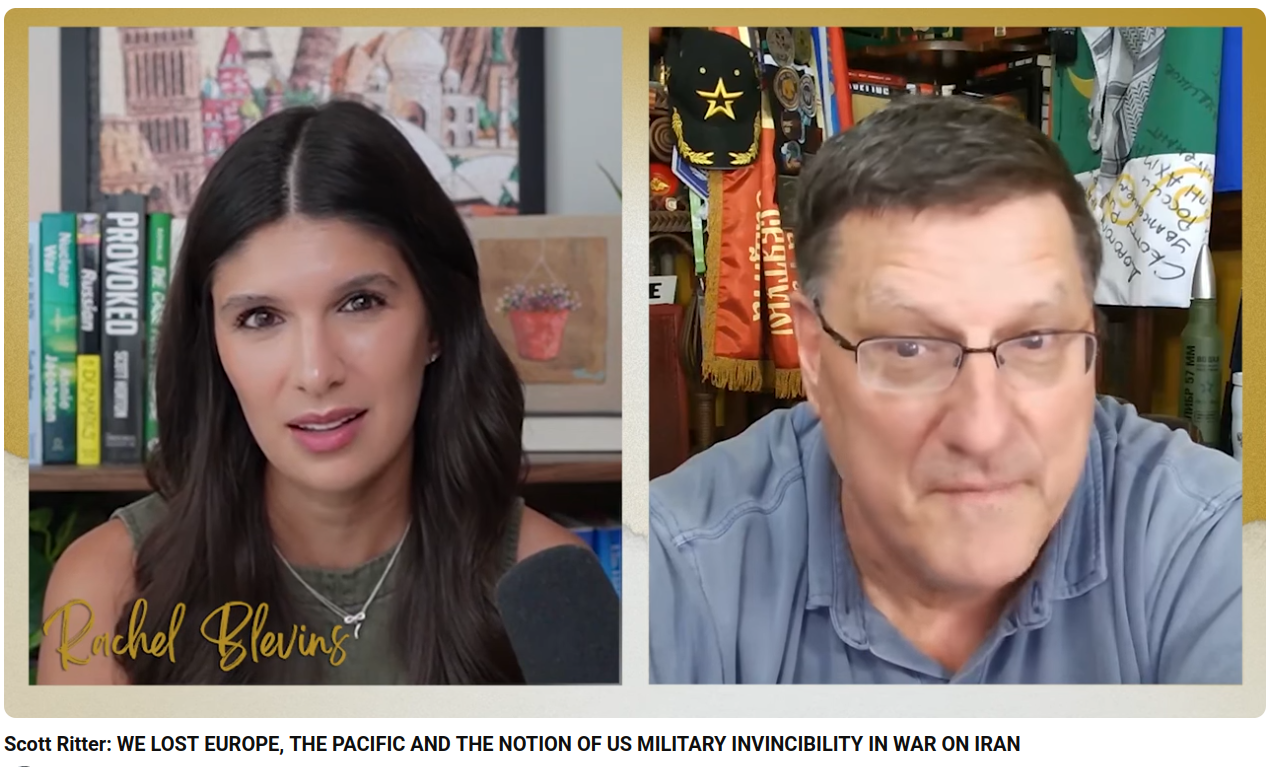
While all eyes are on Islamabad, where renewed talks between the United States and Iran are once again on the agenda, it is time for a sober assessment. Seven weeks of war with Iran have not only reshaped the Middle East, but have also shaken the fundamental pillars of the American world order. In their recent analysis, Scott Ritter and Rachel Blevins put their finger on the wound: the United States has emerged from this conflict weakened not only militarily, but also geopolitically and morally.
1. The Military Illusion: When Conventional Superiority Is Not Enough
The core message is painfully clear: the United States has fully exhausted its conventional escalation ladder — and failed. As Ritter states: "We have reached the maximum effort in terms of their escalatory ladder using conventional warfare. There's nothing more we can do."
Indiscriminate bombing: The U.S. destroyed empty buildings and killed civilians, but never struck the core of Iran’s deterrent capability: ballistic missiles and drones.
Hormuz remains in Iranian hands: The strategic strait, crucial to the global energy supply, remained under effective Iranian control. No American intervention was able to change that.
- The “Desert One” debacle repeats itself: Attempts to intercept Iranian nuclear material ended in fiascos, a reminder of the humiliations of the past.
The result? A superpower that cannot win, but also cannot stop without losing face.
2. Alliances in Ruins: The Loss of Europe and the Pacific
The real strategic disaster is unfolding beyond the battlefield. The war with Iran has swept away the last remnants of trust in American reliability.
Europe: “They hate us, they despise us”
European allies are now actively looking for ways to build a NATO without America.
Not because Europe is stronger, but because the damage caused by an unpredictable, unreliable United States is greater than the cost of self-reliance.
- Europe, however, lacks the economic scale, defense industry, and political unity to actually fill that role — a dangerous vacuum.
The Pacific: A House of Cards That Collapsed
Ritter systematically lays out the collapse:
| Alliance | Status | Reason for failure |
|---|---|---|
| U.S.-Japan-South Korea | Broken | Air defense was pulled away for Israel; energy security destroyed by the Middle East crisis |
| AUKUS | Irrelevant | The UK does not trust Trump; Australia is facing diesel shortages, refineries are burning |
| The Quad | Reduced to a duo | India economically squeezed by U.S. pressure on Russian oil; energy security at risk |
| Taiwan | Strategically confused | $40 billion defense package called into question: “Are we buying systems that do not work?” |
The conclusion is devastating: "We lost the Pacific because of Iran." China does not need to move a single ship; the American alliance structure imploded on its own.
3. The Political Reality: Trump, Israel, and the Search for a “Win”
The domestic dynamics in the United States explain many of the contradictions:
Israel’s influence: Ritter emphasizes the “iron grip” of the pro-Israel lobby, but also points out that even loyal supporters such as Rubio and the CIA director described this war as “fantasy.”
Trump’s dilemma: The president must turn a defeat into a victory for his political survival. A deal that limits but does not eliminate Iranian enrichment, combined with shared revenue from Hormuz, can be sold as “better than Obama.”
- The Islamabad factor: Technical teams are already negotiating; what is missing is a political climate in which Trump can present the deal as a success, not as capitulation.
4. The Big Question: Has the U.S. Learned Anything?
This is where the criticism becomes sharpest. The United States is repeating mistakes that were already visible in Ukraine:
Overestimation of its own military capability
Underestimation of opponents with asymmetric capabilities
- Neglect of economic and energy realities among allies
And now, with China as the ultimate strategic challenge, the United States stands weaker than ever. "How do we contain China when we can't even contain Iran?" is the question no one in Washington dares to ask.
5. Conclusion: A Turning Point in History
The war with Iran was not an aberration; it was a symptom. A symptom of a superpower that has reached its limits, but still refuses to acknowledge it. The world is watching as the American empire falls apart not with a bang, but with a slow, painful awareness of its own limitations.
For Europe, this is a wake-up call. For the Pacific, a reordering. And for the United States itself? A choice: continue clinging to illusions, or find the courage to accept a new, realistic role in the world.
Frank is an independent analyst with a sharp eye for geopolitical shifts. His work appears regularly on this website.