
Europe in Decline: How Dependency, De-industrialisation, and Multipolar Realignment Unravel the Post-War Order

By Frank Dumon and dedicated to Audrey & Kurt Johnson of Fort Lauderdale, Florida.
Europe is undergoing the most profound dismantling of its political economy since 1945. What for decades was considered prudent policy—outsourcing security to the United States, anchoring industry to cheap Russian energy, embedding finance in the dollar system, and aligning foreign policy around an Atlantic worldview—now proves to be a chain of dependencies threatening the continent on all fronts. Due to the war in Ukraine, the emerging BRICS configuration, and shifting US priorities, the European project faces the perfect storm: de-industrialisation, internal political fragmentation, and external strategic irrelevance. The nightmare is visible on factory floors silenced by high energy prices, in budgets groaning under defence commitments, cannibalised social programmes, and in executive circles trapped in narratives they can no longer sustain.
For three generations, the trans-Atlantic bargain was simple. Europe accepted a junior role in exchange for senior benefits from American protection, access, and prestige. That worked as long as US hegemony remained unchallenged and the Soviet threat held the NATO alliance together. Those foundations have now collapsed. The message from American politics is unambiguous: allies are clients who must bear the costs; security umbrellas come with invoices; and sympathy for European dilemmas is fading.
European leaders, who outsourced autonomous defence, now face a bill they cannot pay without breaking something vital in Europe. The most explosive item is the drive for sustained military spending at levels approaching structural recession. Defence at 3–5% of GDP in welfare states is not feasible; it undermines pensions, healthcare, education, and public investment. There is no way around this—politically or budgetarily—without drastic consequences for society.
Ukraine as a Mirror: A War Europe Possesses but Cannot Steer
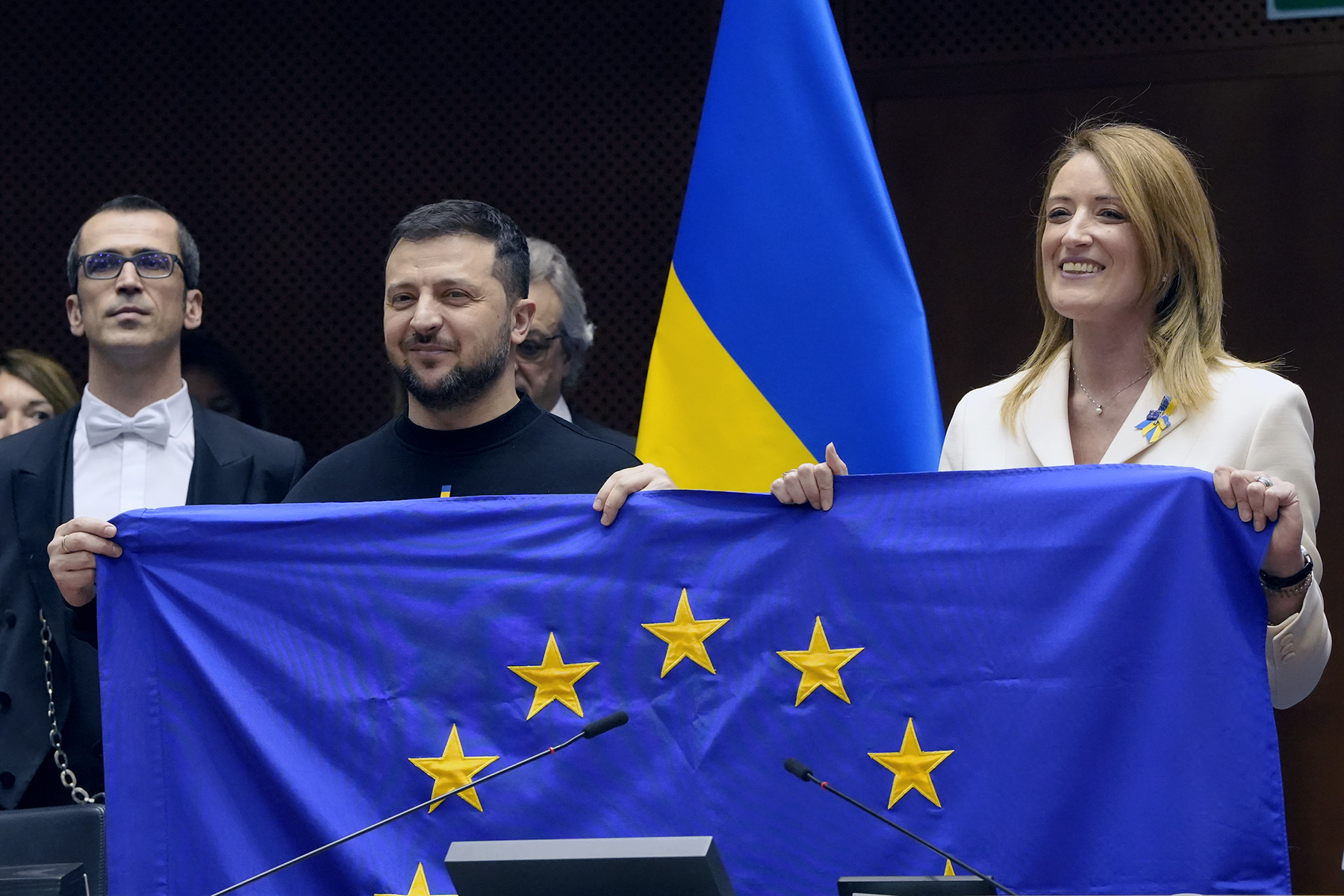
The war in Ukraine crystallises the position of the overconfident continent. European governments framed the conflict as a civilisational struggle that would end with Russia’s strategic defeat. Policy choices followed the narrative: 20 rounds of escalating sanctions, energy scarcity, ammunition shortages, and collapsing credibility. But the Russian war economy adapted; trade was rerouted via Asia and the Global South; defence production accelerated; and fiscal capacity proved more elastic than expected. Russia now collects about one billion dollars per day.
Europe has only limited influence over the strategic direction the United States will choose. If Washington moves toward an agreement that consolidates facts on the ground, European leaders are left empty-handed: they have burned their bridges to Moscow, tied their legitimacy to Ukraine’s total victory, and asked their populations to endure hardships for a victory that is not coming. If Washington insists this is “Europe’s war”, costs migrate almost overnight from burden-sharing to burden-bearing.
The expansion of BRICS and related clusters like the Shanghai Cooperation Organisation (SCO) signals a world less willing to take the dollar order for granted and more inclined to choose partners who do not constantly lecture them or wag a moralising finger. This shift does not abolish Western finance and markets, but it dilutes their monopoly and gives others options that did not exist for the past five centuries. Europe, locked into sanction regimes and value-driven diplomacy, sees doors closing across large parts of Africa, Latin America, the Middle East, and Southeast Asia.
The coolness toward European overtures to join or observe in BRICS is telling. Europe comes across as an appendage of Washington, not an autonomous player. Practically, that means less representation, less influence over commodity flows, and a dwindling role in the next industrial wave heading our way: the AI revolution, green AI-driven factories, retraining large parts of the population, critical mineral processing, the shift from fossil to alternatives. Europe’s position is slipping. Its technological dependency is growing.
Leadership matters in crises, but leadership cannot reverse elementary arithmetic. European elites are groaning under narratives sold in good faith, such as the moral high ground in Ukraine, strategic certainty under the American umbrella, confidence in green re-industrialisation. Those narratives are now colliding with reality: a long war with a highly uncertain outcome, an American people no longer wanting to be Europe’s protector, and a green transition stalled by permits, failing energy grids, minerals, cost curves, and 27 member states with not always aligned needs and capabilities. Finland is not Portugal.
The Social Contract Under Strain: Pensions Versus Projectiles
When governments hint at skimming pension indexations, later retirement, trimming healthcare spending, or further raising consumption taxes to finance defence and rapidly rising interest rates, popular fury is not far away. Europeans endured austerity after the euro crisis with the promise of stability; they bear a green transition with the promise of a better and more liveable future; they accepted wartime conditions with the promise of defended values and achieved victory. If those promises fail, the bill returns as anger via strikes, protests, electoral uprisings and, more stubbornly, the erosion of civic trust.
Is there a way out of the impasse? Not painless, but there is a strategy that trades pride for pragmatism.
But that requires democratic honesty. Be clear to citizens: some services will be trimmed, some taxes raised, some transitions slowed; here is the timeline, here are the protections for the most vulnerable, here is what success might look like in five to ten years. Voters punish fairy tales more harshly than hard truths. The price of paralysis is higher than the price of humility. Now every quarter adds capital flight, skill erosion, and reputational loss. International markets, unlike electorates, forgive no ambiguity.
Europe’s tragedy is classic: a proud civilisation that reacts too slowly to an inevitable power shift it helped cause. Its successes—peace through law, prosperity through integration, dignity through social insurance—were real. They remain worth defending. But defence now requires letting go of the fiction that yesterday’s toolbox can solve today’s constraints. Europe’s precarious state is not only a crisis; it is a judgement on the complacency of the EU with its unelected leaders.
The continent outsourced too much and for too long: to American marines, to Russian energy, to Chinese markets, to the gravity of the dollar, to tomorrow’s growth. The bill has arrived all at once. Paying requires choices that clash with habits and lobbies simultaneously. A small tax on second homes will not provide the solution.
And so we inevitably return to China. There is an old Chinese proverb saying that the skilled hunter does not chase the rabbit, but positions himself where the rabbit will eventually run. And now, within two weeks, both Vladimir Putin and Donald Trump have separately visited Beijing. The rabbits ran exactly where Xi expected them. This is no coincidence. This is planning. The simultaneous attraction China exerts on Washington and Moscow – two powers representing opposite ends of the current world order – tells us something fundamental about where real geopolitical weight now lies. Beijing is no longer reacting to the international system. It is reshaping it.
Putin’s visit to China carried the appearance of dependency disguised as partnership. Russia did not arrive as an equal, but as a supplicant. The Kremlin needs China far more than Beijing needs Moscow, and both parties understand this perfectly, even if they do not say it aloud. Since the beginning of the war in Ukraine, Russia has shifted its entire economic structure eastward, with gas, oil, and raw materials transported to the Chinese market at reduced rates. Beijing has negotiated these rates with the confidence of a creditor, knowing the borrower has nowhere else to go. The second Power of Siberia pipeline, long under negotiation, reflects this dynamic: Russia wants it badly, but China is in no hurry. Russia retains its military prestige and nuclear deterrence, but its room for independent geopolitical manoeuvre is shrinking and is dictated by Beijing.
If Putin’s visit revealed Russia’s structural weakness, Trump’s visit revealed something perhaps even more striking: America’s diplomatic disorientation. Trump arrived in Beijing with the country’s most powerful executives in his wake and returned empty-handed. The image was uncomfortable for a nation that has lectured the world on power and influence for decades. The question now is whether the United States will accept the new world order or exhaust itself fighting it. In this world, present-day Europe is irrelevant.
No crisis, whether in the Middle East, Ukraine, or the Taiwan Strait, can be resolved without Beijing’s cooperation. The fact that the United States failed to definitively resolve the Iranian conflict, neither through military nor diplomatic pressure, was seen in Beijing as evidence of a superpower whose actual power is waning.
What Beijing has built quietly and without much fanfare is not really about Trump or Putin, let alone Europe. It is about the patient, systematic construction of a position that makes Peking indispensable to energy markets, arms producers, supply chains, diplomatic crisis management, and the infrastructure ambitions of the Global South.
China did not end up in this central position by accident. It created that position over decades, through the Belt and Road Initiative, dominance in rare earth metals, trade architecture, and the kind of long-term strategic thinking that democracies, with their electoral cycles, structurally cannot match.