
The Blind Arrogance of the West and the Impossibility of Diplomacy
By Frank Dumon
Introduction: The Collapse of a World Order - September 23, 2026
The international order, established after the Second World War with many promises of peace and cooperation, is not merely faltering; it is in a state of advanced decay. The institutions once intended to prevent wars of aggression have been reduced to empty shells, used as props for the theatricality of a dying hegemon. This year, the 81st General Assembly of the United Nations in New York has not served as a forum for dialogue, but as a stage for existential threats, strategic desperation, and a level of arrogant blindness that will go down in history books as the nadir of Western diplomatic failure.
This analysis, based on recent speeches, geopolitical developments, and the sharp observations of independent journalists and strategic analysts, paints a somber but necessary realistic picture. The West, led by a United States stuck in an ideological dead end, and a Europe blindly following in its wake, makes a diplomatic solution to the major conflicts of our time impossible. This is sustained by a media system that is almost one hundred percent controlled and sells a narrative that does not correspond at all with factual reality. As the Palestinian-Syrian journalist Leith Marouf rightly points out, the credibility of the Western imperial media has completely vanished, not only worldwide but also among its own population. In this article, divided into three parts, the military, media, and strategic dimensions of this crisis are dissected, supplemented with historical context and an urgent call for a return to honest diplomacy.
Part 1: The Illusion of Military Superiority and the Strategic Dead End
The UN as a Stage for War Rhetoric: Trump's Full Speech with an excerpt below
The 38-minute speech delivered by the 47th President of the United States—that orange baboon Donald Trump—at the 81st session of the United Nations in New York is the rant of a deranged, aggressive madman who belongs in a lunatic asylum, or at the very least in prison for war crimes alongside his crony Netanyahu.
On Tuesday, September 22, 2026, the American president delivered a 38-minute speech to the UN General Assembly. Instead of the diplomatic rhetoric one would expect from this forum, he outlined a "The winner takes it all" vision of world power. He openly raised the question of whether the United States should completely "annihilate" the Islamic Republic of Iran, doing so from the very podium created to prevent precisely such wars of aggression. This rhetoric went hand in hand with cynical remarks about the "theft" of Venezuelan oil, embracing the old, imperialistic saying "to the victor belong the spoils."
This speech is not a sign of strength, but of strategic desperation. As the Iranian General Staff rightly noted in their response: such words demonstrate America's strategic dead end in its aggression against the Iranian nation. Repeating baseless claims and threats, given the exhaustion of the US military apparatus, is not a sign of power, but of panic. The West tends to confuse military escalation with strategic progress, a fallacy that proved fatal earlier in Vietnam, Afghanistan, Iraq, and Libya.
The NATO Unmasking: 5,000 Flights and the Myth of the "Limited" War
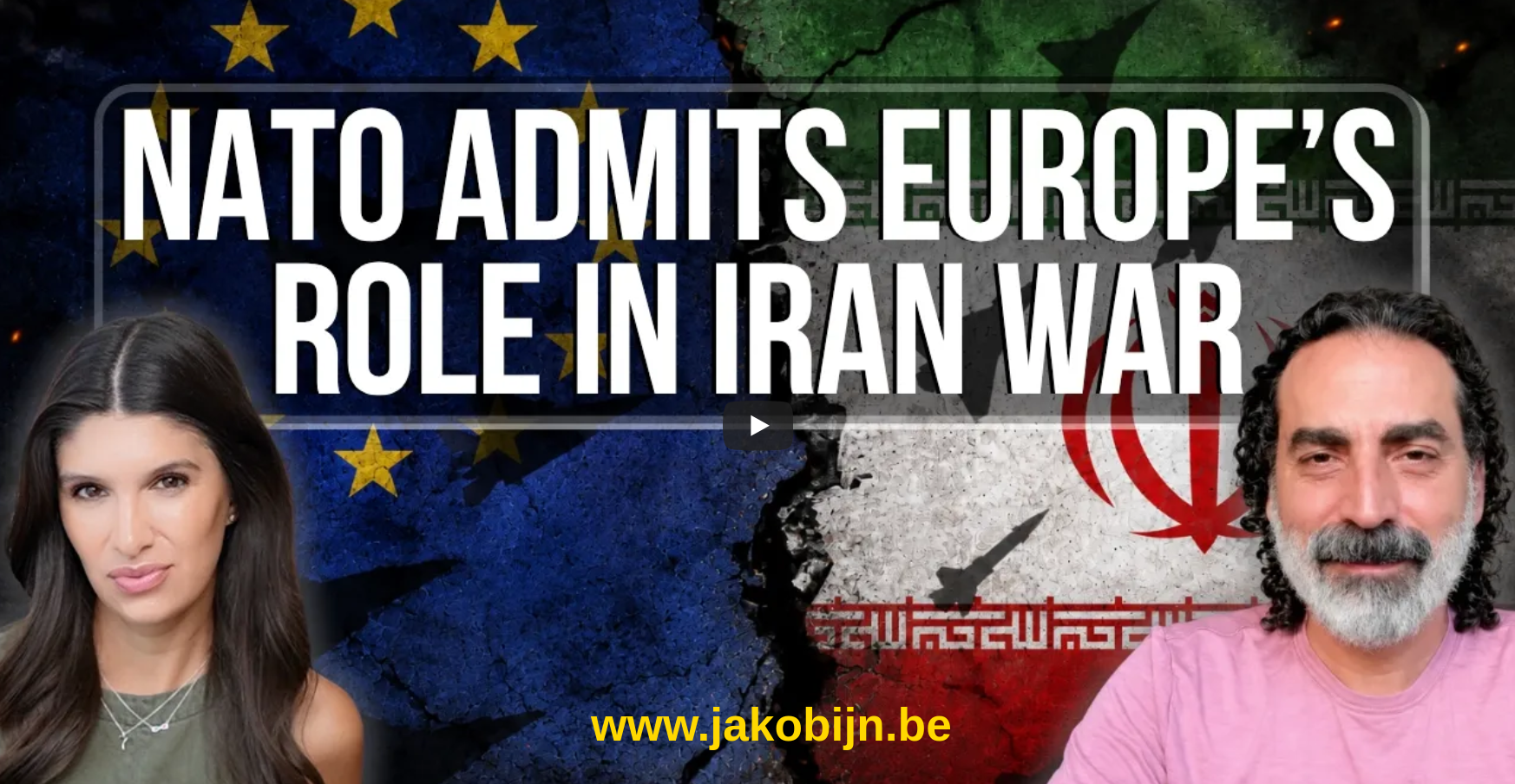
While the American president threatened, NATO Secretary General Mark Rutte made a remarkable and revealing admission. He told the world that more than 5,000 aircraft had taken off from Europe in support of US-led operations in the war of aggression against Iran (the so-called 40-day "Epic Fury" campaign). This statement is of historical importance. It is the formal, unintended confirmation that NATO as an alliance is directly and unconditionally involved in this war.
Leith Marouf sharply points out that this combined power of NATO, the Gulf States (GCC), and Israel has been deployed against the peoples of Gaza, Lebanon, and Yemen for three years. The myth that Israel fights these wars alone is a farce. Israel is, in Marouf's words, a "puny little garbage heap" that lacks the capacity to conduct these regional wars on its own. It is the combined force of the Western empire that has been humiliated by the Axis of Resistance for three years. Even the besieged population of Gaza has been able to bring this superior force to a standstill. If this combined, technologically superior power fails to defeat Iran with conventional means, only one option remains for the West: the threat of nuclear weapons.
However, this nuclear threat is equally an illusion. The use of nuclear weapons by the US against Iran is not only a morally reprehensible thought, but also strategically impossible without provoking a reaction from the other superpowers, China and Russia. Such an escalation would mean the end of humanity, a reality that makes even the most hawkish strategists in Washington ultimately recoil. Israel too will not use nuclear weapons, since an attack on Iranian nuclear facilities would inevitably lead to devastating retaliatory attacks on Israel's small territory, reducing it to a nuclear wasteland itself.
The Technological Reality: Hypersonic Weapons and Western Vulnerability
Iran has not only threatened to widen the geography of the conflict but also possesses the means to make this threat a reality. A crucial fact ignored by the West is that Iran is one of the few countries in the world capable of launching satellites into space and keeping them in orbit. This technological achievement directly implies that Iran can equip the same rockets used for satellite launches with hypersonic or multiple warheads.
This means that Iran has the capacity to reach targets in Europe or North America. It is a simple technological step once spaceflight limits have been reached. This reality is ignored by Western policymakers because it does not fit the narrative of a "backward" or "isolated" enemy. The truth is that the Axis of Resistance has evolved technologically and strategically, while the West is stuck in outdated doctrines of air superiority and economic sanctions that are increasingly ineffective.
Part 2: The Media as a Propaganda Machine and the Diplomatic Blockade
The Complete Loss of Credibility of the Western Media
Leith Marouf states that the mainstream media in the West has lost 100% of its credibility, not only among the world population but also among the citizens of the countries where these media operate. This observation is fundamental to understanding why diplomatic solutions are being made impossible. A democracy cannot conduct rational foreign policy if its population is fed with infantile, ideologically colored propaganda that lacks any nuance.
The Western media does not function as a watchdog of power, but as the public relations department of the military-industrial complex. When reports emerge about "indirect talks" between the US and Iran via Qatari mediators on the sidelines of the UNGA, the media frames this as proof that Iran was "concerned" and "backtracked." However, the Iranian Ministry of Foreign Affairs quickly dismantled these narratives by emphasizing that there was nothing new about these contacts and that the US must first adhere to the Memorandum of Understanding (MOU) signed in June. The media also tries to sell the story that Iran is willing to open the Strait of Hormuz to lower oil prices, a framing that obscures the aggressive blockade imposed by the US itself.
The Role of Qatar and the Illusion of Independent Arab Media
The claim that Iran sought negotiations originated from Qatari sources. Qatar has, as Marouf notes, profiled itself as the master of propaganda in the Arab world on behalf of the empire. Even Al Jazeera, which attracted millions of viewers in the early 2000s with an appearance of independence, has dropped to about eight million viewers in a market of 600 million Arabic speakers. The population sees through the double agenda.
The humiliation of Arab leaders became painfully visible in images circulating on social media: Arab presidents and kings rising from their chairs like schoolboys and hastily pointing at or shaking the finger of the American emperor, in a display of subservience that contradicts the rhetoric of sovereignty. These leaders have publicly humiliated themselves repeatedly over the past three years, without showing any sign of humility or willingness to end their subservience to the empire. The exception to this, as seen in the video above, is the King of Jordan, who openly condemned Israel's war crimes in Gaza and the West Bank. This courageous stance is marginalized by the Western media because it does not fit the narrative of a united, Western-led region.
The Walkout: Arrogance as a Diplomatic Instrument
This shows a striking symbolic moment: the American delegation leaving the hall while the Iranian president condemns the crimes of the US and Israel. This is not a diplomatic protest; it is the physical manifestation of the blind arrogance of the West. Instead of refuting the accusations with facts or acknowledging their own responsibility, they choose the childish tactic of walking out. It is the refusal to face reality. It is the attitude of a power that knows it has no moral or factual defense, and therefore chooses to ignore the indictment.
Economic Warfare: The Airline Blockade
The latest desperate act of the US is attacking airlines flying to and from Iran. Recently, flights have been reduced or suspended by carriers in Georgia, Azerbaijan, Iraq, Oman, Qatar, and Turkey. The goal is complete isolation. But this strategy is doomed to fail. Russia and China refuse to stop their air connections with Iran. Moreover, anyone wishing to reach Iran can simply fly to a neighboring country and cross the border.
The only ones truly suffering from this are the Iranian diaspora with dual citizenship, a large part of which historically sympathizes with the Shah or Israel. Thus, it is essentially a symbolic action that betrays the weakness of the US. Moreover, if Iran were to decide on retaliation by targeting airports in vassal states on the Arabian Peninsula (such as Bahrain or Qatar), the impact on the empire's international trade network would be exponentially greater than the impact on Iran. History teaches us that retaliatory actions by Iran (such as the closure of the Strait of Hormuz or actions in the Red Sea by the Yemenis) cause multiple times more economic damage to Western economies compared to the damage Iran itself suffers.
Part 3: The European Suicide Commando and the Call for Diplomacy
Steve Jermy's Scenario: The European Road to Ruin
While media attention is often focused on the Middle East, Europe is preparing for an even larger catastrophic mistake. As detailed in the second transcript by Steve Jermy ("The coming war with Russia - a European road to ruin"), NATO, EU, and E3 leaders (Macron, Merz, and perhaps others soon) are leading Europe toward a war with Russia by 2030. Given current European bellicose rhetoric, however, Russia might decide to strike sooner.
The strategic context is clear: the roots of this crisis lie in 1989. The opportunity to build a durable, inclusive European security architecture that accommodated Russia's legitimate security interests was squandered. Instead, NATO expanded relentlessly eastward, despite warnings from visionary voices such as George Kennan, William J. Burns, Henry Kissinger, and John Mearsheimer. In Russia's eyes, the war in Ukraine is a defensive war of survival against an existential threat, a fact Western leaders refuse to acknowledge, favoring a simplistic narrative of "unbridled imperialistic ambition."
The Military Reality: Hypersonic Vulnerability and Energy Infrastructure
The E3 leaders have publicly indicated their intention to increase the supply of long-range drones and cruise missiles to Ukraine, with the aim of striking deep into Russian territory. Moscow has unmistakably warned that this will lead to direct attacks on European production facilities. If these warnings are ignored – which is likely, given the West's track record – Russia will strike in late 2026.
Conventional ballistic and hypersonic missiles (such as the Oreshnik) will destroy key facilities in the British Midlands, the German Ruhr area, and outside Bordeaux. Although NATO Article 5 is invoked, the guarantee is hollow. Spain and Hungary will refuse troops; Italy and Poland will hesitate. And crucially: the White House, just defeated and exhausted after the war in Iran, with empty ammunition depots and no domestic support for a new war, will refuse to intervene. The US chooses isolationism, and Europe stands alone.
The first three months of such a conflict would be disastrous. European strike packages would be destroyed by Russia's layered S-400 and S-500 networks. Without American suppression of enemy air defenses, air superiority is impossible. Russia would then destroy airfields, training bases, ports, and logistics hubs, resulting in thousands of military casualties. Simultaneously, European energy infrastructure (gas terminals, power plants, grid interconnectors) would be systematically dismantled, exactly as Russia has done in Ukraine since 2022.
Europe is the world's largest regional importer of hydrocarbons (12.8 million barrels per day). A blockade by Russian submarines in the North Sea and the Atlantic Ocean would cause shipping insurance to vanish and imports to grind to a halt. Without diesel, agricultural, fishing, and food logistics systems fail. Within two to three months, Europe would plunge into an economic crisis surpassing the Great Depression of the 1930s, with a contraction of more than 10% and a collapse of public finances.
The Chinese Factor: Rationality versus Western Self-Destruction
While Europe runs toward the abyss, China remains a voice of strategic rationality. The expected summit between President Xi Jinping and the American president in Washington revolves around the question of whether China will lift its restrictions on rare earth magnets, which are essential for the US military industry. China refines more than 90% of the world's supply.
As Marouf analyzes, China has no incentive to change this policy. Why would China give NATO and the US the means to produce more weapons, not only to attack Russia and Iran, but eventually to encircle China itself? It would be suicide. Instead, by limiting the export of rare earth metals, China will show between the lines that it supports the countries standing in the way of American hegemony. The US will desperately try to find alternatives, such as reopening mines in Venezuela or Colombia, but this is a slow and environmentally disastrous process that cannot meet immediate military needs.
Conclusion: The Necessity of Honest Diplomacy
General André Beaufre wrote: "In war, the loser deserves to lose, because his defeat must result from errors in thinking, made either before or during the conflict." The West has shown a consistent track record of "errors in thinking" over the past 25 years, from Afghanistan to Ukraine. But this time, the stakes and consequences for the European citizen are unprecedentedly high.
The solution is not more military escalation, but diplomacy. Not the diplomacy of ultimatums or meaningless peace conferences where one party is excluded from the start, but the diplomacy of honest conversation. Russia's security needs are not difficult to understand: a neutral Ukraine, no NATO membership, and real security guarantees. These were the conditions that Russia and Ukraine had almost accepted in March 2022, before Western leaders intervened to prolong the war.
It is time for the European population to be invited to publicly debate these risks. The leaders leading us to this abyss owe us two things: an honest, public, strategic assessment of the risks, and the chance to have our voices heard. For it is we, not they, who will have to fight the war and endure the destruction of our energy infrastructure, our economy, and our civilization. The choice is simple: change course toward peace and honest diplomacy, or continue on the path of 1914, guided by a political narrative that contradicts truth and reality.
List of Sources and References
- Video 1 & Transcript 1: Rachel Plevin interviews Leith Marouf (Executive Director, Free Palestine TV). "NATO Chief Mark Rutte Admits that 5.000 Aircraft took off from Europe Just to Lose the Iran War". YouTube, September 23, 2026. Contains analysis of the 5,000 NATO flights, the strategic dead end of the US, media control, and the Chinese position regarding rare earth metals.
- Transcript 2: Steve Jermy. "The coming war with Russia - a European road to ruin". Substack, September 23, 2026. Contains the detailed scenario of a Russian attack on European infrastructure, the vulnerability of the E3, and the economic aftermath of an energy shortage.
- Video 2: "United States of America - President Addresses United Nations General Debate, 81st Session". YouTube. Contains the "winner takes all" rhetoric and open threats directed at Iran and sovereign states.
- Video 3: "US Delegate Walks Out as Iran's President Condemns US-Israel Crimes". YouTube. Illustration of diplomatic arrogance and the West's refusal to take responsibility for war crimes.
- Video 4: "Jordan's King Condemns Israel's War Crimes in Gaza and the West Bank". YouTube. Testimony from regional leadership breaking through hypocritical Western support for Israel.
- Video 5: "A Summary of Trump’s 38-Minute Speech at the 81st UNGA". YouTube. Overview of the aggressive, unilateral tone of the American speech.
- Additional Geopolitical References:
- Carl von Clausewitz, On War (1832). On the necessity of understanding the true nature of a conflict before entering it.
- George Kennan, "A Fateful Error", New York Times, February 5, 1997. On the error of NATO expansion.
- William J. Burns, "Nyet Means Nyet", US Embassy Moscow cable, February 1, 2008 (WikiLeaks).
- John J. Mearsheimer, "Why the Ukraine Crisis Is the West’s Fault", Foreign Affairs, Sep/Oct 2014.
- General André Beaufre, An Introduction to Strategy. On the errors in thinking that lead to defeat.
- International Energy Agency (IEA), World Energy Outlook 2024. On the vulnerability of European energy imports.