
The Big Three: A Milestone in History
American Military Hegemony, the Human Tragedy of Vietnam and the Emergence of a Multipolar World
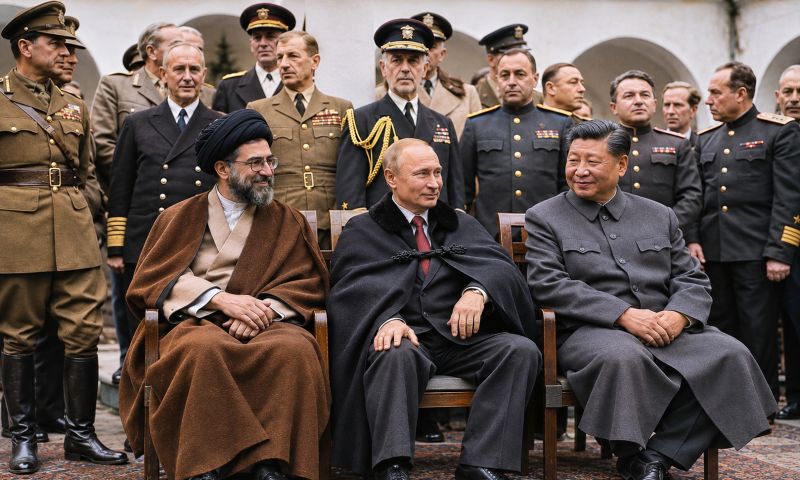
A Tribute to Yalta, February 1945 – The Big Three of the 21st Century?
An imagined geopolitical tableau inspired by the historic Yalta Conference of 1945, symbolising the potential emergence of a strategic alliance between China, Russia and Iran capable of challenging American military hegemony. Source: Peter Hanseler – Forum Geopolitica. Illustrative composition, not a documentary photograph.
By Peter Hanseler
Editorial adaptation and additional historical documentation by De Jakobijn. This version contains editorial corrections and a separately identified contribution on Vietnam; it is not a verbatim reproduction of the original article. The U.S. threatens, wages war, kills, and destroys. What if China, Russia, and Iran, acting as a triumvirate, were to put a curb on the U.S.?
The Big Three
The Big Three—Joseph Stalin, Franklin D. Roosevelt, and Winston Churchill—were the leading statesmen of the Soviet Union, the United States, and Great Britain during World War II. They formed the decisive alliance in the fight against Nazi Germany and coordinated their military operations and political strategies. To this end, they held various conferences. The most important of these took place in Yalta in February 1945, where the postwar order in Europe was established and the Soviet Union’s attack on Japan was agreed upon.
This article is not about the APEC summit in Shenzhen, which many mistakenly compared to Yalta. For the summit in China, I refer you to the excellent article by my friend Larry Johnson, “The Hug for Trump, the Word for Putin.” Today, we are considering the possibility that Mojtaba Khamenei, Vladimir Putin, and Xi Jinping will become the “Big Three” of the 21st century to keep the U.S. in check.
Aggression Without Consequences
The United States is the nation that, since World War II, has invaded and blackmailed countless countries, resulting in the deaths of well over 10 million people - as direct casualties of war, through famines, sanctions, and genocide. American losses, by contrast, are negligible. The 58,220 American military deaths recorded by the US National Archives stand in stark contrast to the millions of Vietnamese who died. The overwhelming burden of the Vietnam War fell upon the peoples of Indochina, far from the American mainland. Terrorist attacks against the U.S.—whose motives and perpetrators are highly questionable—are routinely used by the U.S. as a justification for war; see my series “Bloodbaths Change the World” (Part 1, Part 2, Part 3).
As a result, many Americans don’t care whether their home country is waging war somewhere on this planet—in a country unfamiliar to many Americans. Americans only protest when, for example—as is the case today—gas and diesel prices rise and they feel the pinch in their own wallets. Otherwise, there is no will among the American people to rein in their bloodthirsty leaders. The American public also seems unaware that the total accumulated national debt of over 40 trillion U.S. dollars must be considered alongside the enormous costs of American wars. These wars were neither politically, militarily, nor economically necessary for the U.S. as a nation or for its people, yet they turned a small, corrupt group in the United States into multibillionaires.
Presented without judgment, this paints a picture of a bully who can beat up others without ever having to worry about retaliation. How would the United States’ behavior change if it had to expect to be attacked on American soil as a consequence of its aggression?
Editorial fact-check - De Jakobijn: The US National Archives records 58,220 American military deaths. Vietnamese death estimates vary considerably; approximately four million deaths across Vietnam, Laos and Cambodia is not equivalent to four million Vietnamese deaths alone. The author’s global estimate of more than ten million requires a defined methodology. The claim that the United States has never suffered civilian war casualties on its own territory is historically incorrect. The percentage concerning geographical knowledge is rhetorical, not a verified statistic. Nor is the alleged equivalence between national debt and cumulative war spending established. The author’s suspicions concerning terrorist attacks are not established facts.
Vietnam – The Human Price of American Imperialism
Editorial contribution by De Jakobijn
Vietnam remains one of the most devastating illustrations of the consequences of American military intervention. The United States National Archives records 58,220 American military deaths. Vietnamese losses numbered in the millions, although estimates vary according to the period and categories counted. Behind these figures lie families torn apart, destroyed villages and generations whose lives were permanently altered by decisions taken thousands of kilometres away.
The Vietnamese people did not cross the Pacific Ocean to invade California. They did not bomb Washington or contaminate American agricultural land with chemical defoliants. The overwhelming burden of destruction was borne by Vietnam and its people. Yet the American war did not truly end with national reunification on 30 April 1975.
Agent Orange – The Generational Legacy
Between 1961 and 1971, the United States conducted an extensive chemical defoliation campaign in Vietnam. Tens of millions of litres of herbicides were sprayed, including Agent Orange contaminated with dioxin. Vietnamese estimates indicate that millions were exposed and that approximately three million people suffer from health problems attributed to Agent Orange. These are estimates, and establishing individual causation can be medically complex.
More than half a century later, families continue to care for affected relatives. The environmental and humanitarian consequences demand sustained remediation, medical support and recognition. The suffering of children born after the war underscores why its human cost cannot be measured solely by battlefield casualties.
Unexploded Ordnance – The War Beneath Vietnamese Soil
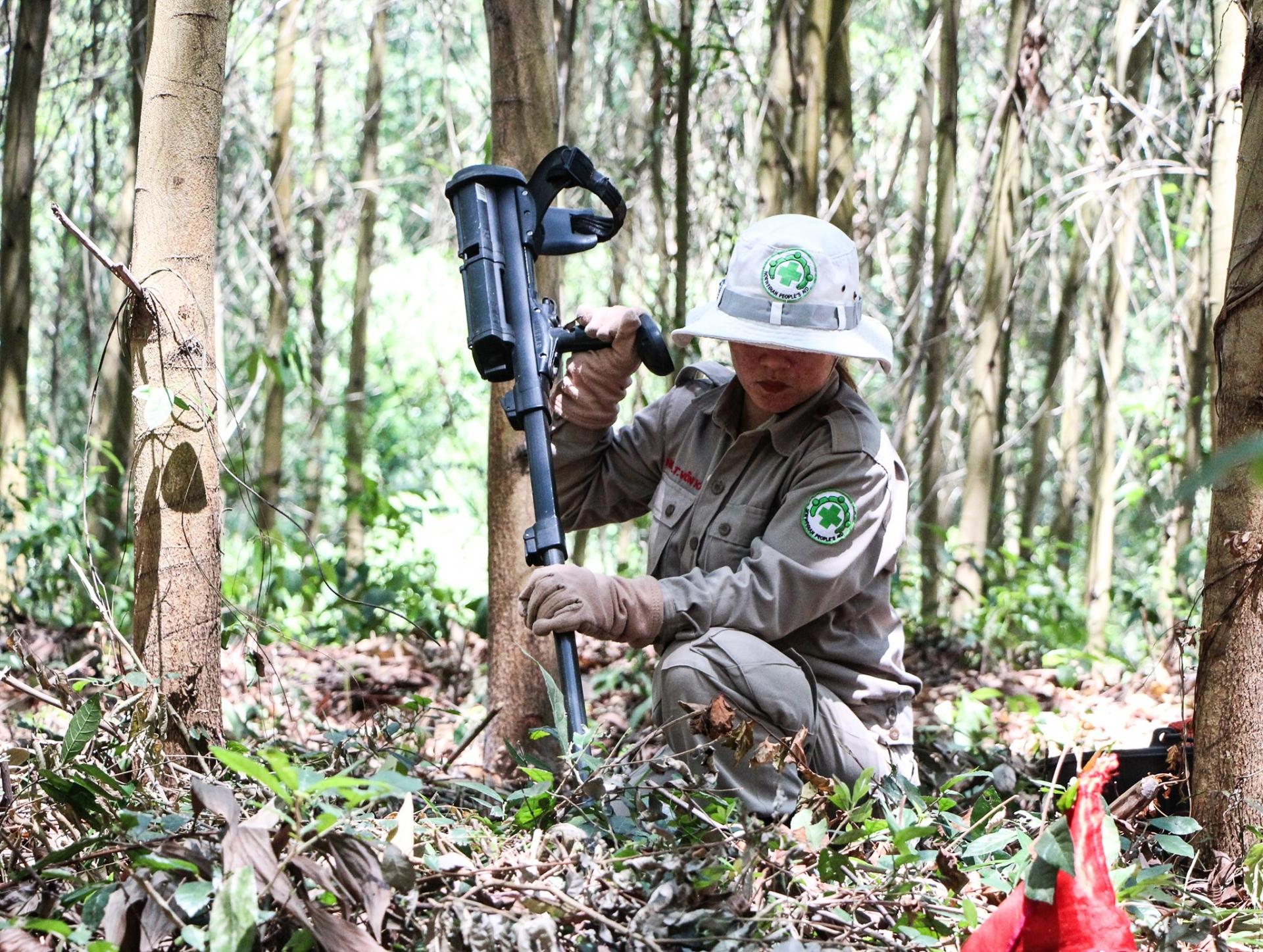
Vietnamese survivors of unexploded wartime ordnance in Quảng Trị Province, March 2008. Decades after the war, rural communities continue to suffer from its explosive remnants. Photograph: Werner Anderson / Norwegian People's Aid
Vietnamese mine-action authorities have estimated that roughly 800,000 tonnes of unexploded ordnance remain from the war. Since 1975, tens of thousands of people have been killed or injured by explosive remnants. Farmers, children and ordinary citizens continue to face dangers inherited from a conflict they did not choose.
In Quảng Trị, the consequences are not confined to museums or archives. They remain embedded in the soil upon which communities depend. Every dangerous remnant discovered today is a reminder that war does not end when political leaders declare it over.
The Missing – Families Still Waiting
Hundreds of thousands of Vietnamese families have endured the uncertainty of relatives missing in war. Vietnam continues its efforts to locate, identify and honour its fallen. The Trường Sơn National Martyrs’ Cemetery and the Route 9 National Martyrs’ Cemetery bear witness to the sacrifices made in the struggle for independence and reunification. For families still waiting for the recovery of their loved ones, the absence of a grave remains an open wound.
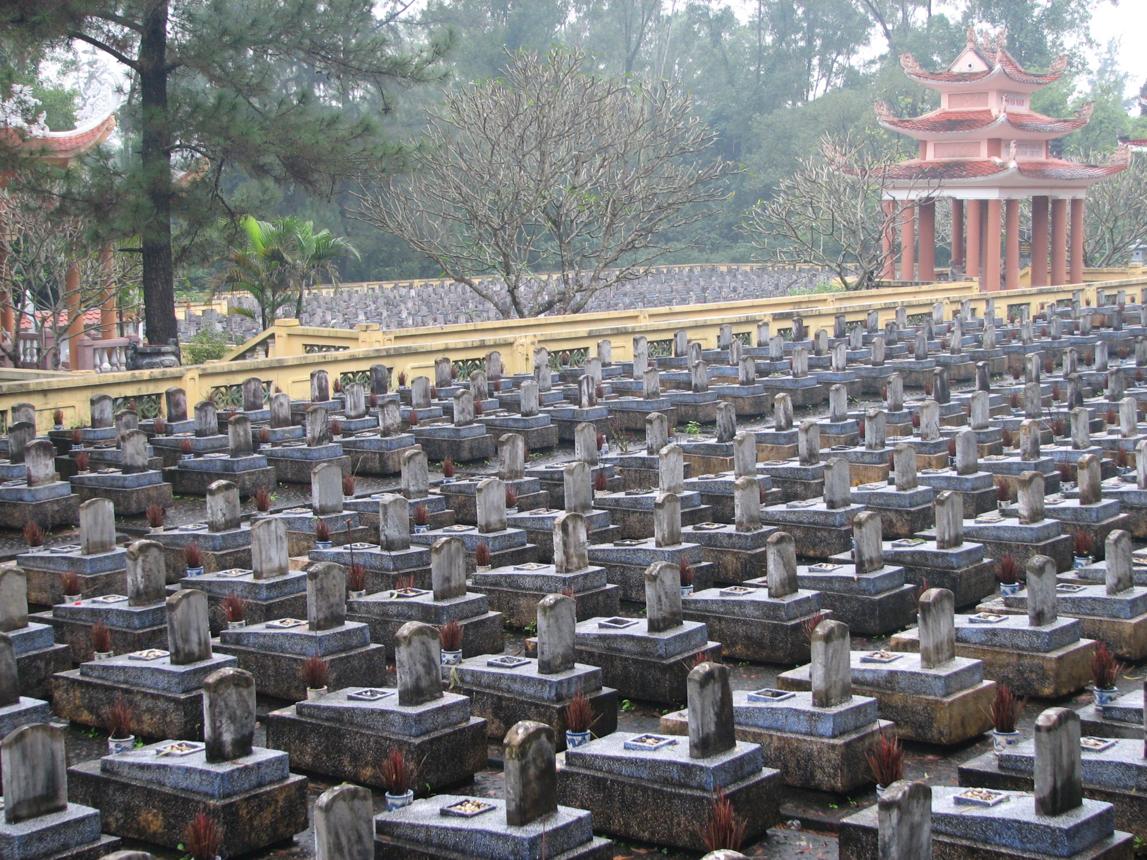
Trường Sơn National Martyrs' Cemetery, Quảng Trị Province. A solemn testimony to the sacrifices made by the Vietnamese people in their struggle for national independence and reunification.
The Human Cost Beyond Vietnam
Brown University’s Costs of War project estimates that post-9/11 wars caused approximately 4.5 to 4.7 million direct and indirect deaths and displaced at least 38 million people. Its estimates of US budgetary costs and future obligations amount to approximately eight trillion dollars. These figures refer to the post-2001 wars, not Vietnam or all interventions since 1945.
From Destruction to Reconstruction
Despite the extraordinary devastation, the Vietnamese people have rebuilt their country, strengthened their economy and developed diplomatic relations with former adversaries. Practical cooperation with the United States on unexploded ordnance and dioxin remediation deserves recognition. Reconciliation, however, must never become a synonym for historical amnesia.
The Lessons of Vietnam for a Multipolar World
For nations that have experienced military intervention, multipolarity is not merely an academic debate. It concerns the right of peoples to determine their own political, economic and social futures. A more balanced international order should not replace one hegemonic power with another. Its purpose should be to prevent any great power from imposing its political will upon smaller nations through military violence.
The objective must be diplomacy, peaceful coexistence and respect for sovereignty rather than another world war. The millions of Vietnamese victims deserve no less.
Reconciliation without historical memory is not justice. Peace without sovereignty is not genuine peace.
Further reading on De Jakobijn
- Quảng Trị – The War from a Vietnamese Perspective (Vietnamese)
- Vietnamese Survivors (Vietnamese)
- Reconciliation, Remembrance and Vietnam’s Future
Iran Shows How It's Done
The Iranians were the first to muster the courage to reduce 17 U.S. bases to rubble in response to the Israeli-American attack in February 2026. This action serves as an antidote to American aggression and has yielded tangible results. U.S. naval forces can no longer be resupplied from the Persian Gulf. The headquarters of the U.S. 5th Fleet in Bahrain has been destroyed and is no longer accessible at all due to the closure of the Strait of Hormuz.
The ships must sail to Diego Garcia (4,100 km/2,200 nautical miles from Hormuz) to be resupplied—a round trip of approximately 9 days (travel time only). Many had expected—and still expect—another attack on Iran. However, this is countered by the fact that, in such a scenario, Iran would attack Diego Garcia and U.S. installations in Europe. It would be fatal to dismiss these Iranian threats as mere propaganda, for Iran possesses hypersonic weapons against which the West has no means of defense. During the 40-Day War, both of these points were proven time and again. Whether the Americans will have the sense to take this danger seriously is anyone’s guess, but Trump’s hesitation is an indication that the U.S. may have recognized a turning point in its history: We can no longer attack others with impunity.
Editorial fact-check - De Jakobijn: Claims about the complete destruction of bases, the status of naval headquarters, resupply routes and the inability to intercept particular weapons require independent confirmation. Damage to facilities does not necessarily imply the destruction of entire bases. The author’s assessment of deterrence is a geopolitical interpretation.
China, Russia, Iran - a Military Alliance with Its Own Article 5
If these three giants of the Global South were to decide to coordinate their defense efforts, the U.S. would lose its appetite for aggression. It would require less than one might think. Never before have the Russians and the Chinese, on the one hand, and the Iranians together with the Russians and the Chinese, on the other, cooperated so closely. There are concrete reasons for this: China-Iran (oil); Russia-Iran (North-South Corridor); China-Russia (virtually complementary economic interests). If the three were to conclude a credible defense pact with a robust agreement along the lines of Article 5 of the NATO Charter, they could neutralize not only U.S. aggression but that of the entire Western collective.
Only those directly involved know just how close military cooperation between these three countries has actually become, due to the fact that China and Russia maintain an extremely low profile—in stark contrast to the chatterboxes in Washington, Brussels, and Berlin. Nevertheless, there are indications that Russia, for example, could support Iran in a previously unforeseen manner in the event of another U.S. attack. On November 2, 2026, President Putin and Mohsen Rezaei had a lengthy phone conversation. Hours later, Russia sent a plane to Tehran and flew Rezaei to Moscow, where a face-to-face meeting took place, as reported by TASS, without revealing any details. One can only speculate about what exactly was agreed upon. But it was significant, because Russia does not send a plane to Tehran to fly in a high-ranking Iranian military official for a three-hour meeting with the president simply to exchange ideas.
A genuine alliance—as military partners—between these three countries would be the greatest—self-inflicted—nightmare for the collective West. The U.S. would no longer attack Iran, and even the intellectually mediocre Friedrich Merz would likely stop supplying Taurus missiles to Ukraine, since a military response could also come from Iran. Faced with the combined military and economic power of this triumvirate, Europe and the U.S. would have nothing serious to set against it. An alliance that could guarantee peace in large parts of the world. This raises the question of why this alliance has not yet been formally established.
Editorial clarification — De Jakobijn: The proposed collective-defence pact is a hypothetical arrangement, not an established alliance. Article 5 of the North Atlantic Treaty provides a collective-defence commitment but leaves each member to determine the action it considers necessary. Details of the reported Russian–Iranian meeting and any confidential agreements should not be inferred as established facts.
SCO Would Not Reach an Agreement
The Shanghai Cooperation Organization (SCO), which as a security organization would actually be well-suited to evolve into a NATO-like organization, has so far been unsuitable for such an undertaking due to its membership structure. The member states are China, Russia, Kazakhstan, Kyrgyzstan, Tajikistan, Uzbekistan, India, Pakistan, Iran, and Belarus. The approach described above by the SCO would likely fail due to India and Pakistan. These two large countries have only been members since 2017 and play both sides politically—the West and the East. This means they want to maintain good relations with the United States without missing out on the benefits of the SCO, which rules out the course of action described above.
Editorial clarification — De Jakobijn: The SCO Charter provides for decision-making by consensus. The author’s assessment of the likely positions of India and Pakistan is an interpretation.
Russia (Still) Too Hesitant
Russia is often accused of being naive: Time and again, it attempts to reach an agreement (Minsk I, Minsk II, Anchorage), only to be snubbed by its negotiating partners. This is seen as naive, according to the negative, condescending view of Russia’s behavior. Put positively, the Russians are acting in good faith. Incidentally, the obligation to act in good faith is a fundamental principle of Western legal systems, as found, for example, in Article 2 of the Swiss Civil Code, which, in paragraph 2, denies legal protection to actions contrary to good faith. To label acting in good faith as naive is simply perverse. It is a spectacle currently unfolding before our very eyes, yet one that very few people are able to properly contextualize. At stake is nothing less than the erosion of society and international relations.
Following the collapse of the Anchorage Agreement, Russia has made it clear that it no longer trusts the West.
"We will no longer believe the West that it wants negotiated solutions. This reserve of goodwill and hope has been exhausted entirely."
Sergei Lawrow, 9. Juli 2026
We have discussed this in detail in: «Europe Is Teetering on the Brink».
Nevertheless, even though Russia no longer harbors any illusions about reaching a negotiated peace with the West, more will likely have to happen before Russia acts as decisively as Iran already does. This also has to do with the Chinese stance.
Editorial clarification — De Jakobijn: The interpretation of the Minsk and Anchorage negotiations and the allocation of responsibility for their failure reflect the author’s viewpoint. The existence and legal status of any alleged Anchorage agreement should be distinguished from political understandings.
China – “The business of China is Business”
Among the three major powers in this alliance, the Chinese are the largest and strongest. However, the Chinese shy away from military conflict with the West. In my view, China’s contemporary strategy is primarily economic rather than based on the worldwide military interventionism associated with the United States. The Russians are de-escalating; the Chinese are business people - they want to conquer the world economically, peacefully, and in this way challenge the U.S.’s status as the hegemon, which has likely already happened. This is because the West’s GDP calculations are based on the U.S. dollar and completely disregard the prevailing differences in purchasing power. One must keep the facts regarding economic performance in mind, because China and Russia - when viewed realistically - which is becoming increasingly difficult for the West - are already, in their own right, a true duo infernale.
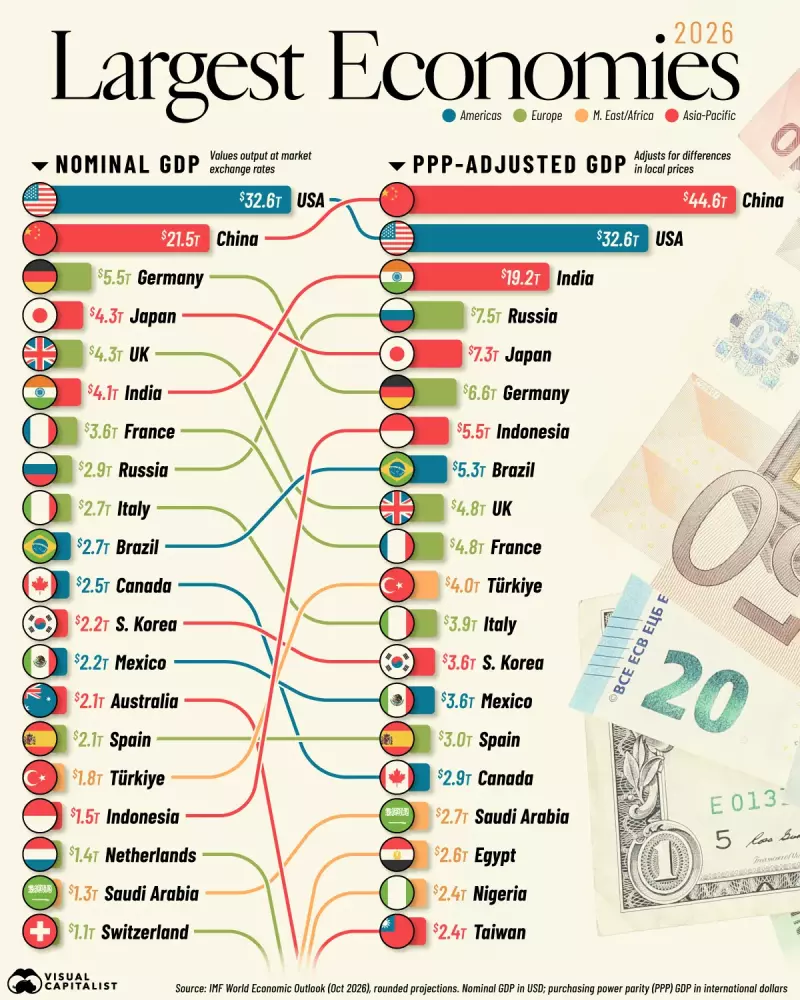
Source: Visual Capitalist, based on IMF World Economic Outlook, October 2026. Rounded projections; nominal GDP in US dollars, PPP in international dollars.
Many people do not understand the difference between nominal gross domestic product (GDP) and gross domestic product adjusted for purchasing power parity (GDP / PPP). A simple example illustrates this:
Let’s consider two identical factories, one in Russia and the other in Germany. Both produce 1,000 machines of the same quality each year. Let’s further assume that the total value added by the Russian factory, at market exchange rates, is $50 million, while that of the German factory is $100 million. Although both factories produce the same number of machines of equal value, the German factory appears to be twice as large in nominal terms. The reason lies in the different price levels.
The purchasing power parity (PPP) approach adjusts for such price differences, thereby enabling a more realistic comparison of actual economic output. The purchasing power parity approach is thus more realistic and stringent. The Chinese have thus already won the economic race, and—much to Germany’s chagrin—Russia has overtaken Germany in the PPP ranking (Russia 4; Germany 6). Those who scoff at Russia will be left seething—but it’s no use.
The Chinese, who are waging this conflict on an economic front, will therefore be reluctant to join the proposed three-way military alliance—at least for now.
We shouldn't forget Iran—a country that ranks 27th on the purchasing-power-parity list. Iran is not only one of the richest countries, but it already ranks among the best in terms of education and engineering. An Iran free from the scourges of war and sanctions would likely surpass Japan and Germany within 10 years: well-educated, rich in natural resources, and eager to show the world what it’s capable of.
Editorial fact-check — De Jakobijn: China’s contemporary economic strategy should not be confused with an absence of historical military conflicts. Vietnam experienced a Chinese invasion in February 1979. PPP measures domestic purchasing power, while nominal GDP remains relevant to international financial transactions. The chart’s figures are projections, not final outcomes; the forecast for Iran is the author’s speculation.
Iran's Stance is Impressive
Let’s be honest: Who would have expected Iran to deal the U.S. and Israel such a crushing defeat twice in a row (the 12-Day War and the 40-Day War)? For decades, the U.S. and Israel have nurtured and cultivated their aura—now better described as a myth—of having the world’s best armed forces. The fact that the entire West has believed this until now is a major achievement for the Americans, who excel at marketing, despite the repeated failure of American interventions to deliver lasting strategic success. The Israelis, as an extension of the U.S., distinguished themselves by killing primarily civilians and, in the last real military conflict in Lebanon (2006), were clearly shown their limits by Hezbollah. Iran, on the other hand, has been described by the West since 1979 as backward and lacking any significant military power, led by religious fanatics. Today, the world knows that the U.S. and Israel have been militarily defeated by Iran twice. This millennia-old civilization has thus risen, in the eyes of the world, to become the greatest military power in the Middle East—a reality that is downright unbearable for the U.S. and, even more so, for Israel.
Editorial fact-check — De Jakobijn: The assessment of military victory is the author’s interpretation. The statement that the United States has won no war since 1945 is too absolute: the 1991 Gulf War achieved its immediate stated military objective of expelling Iraqi forces from Kuwait.
The U.S. Would Pave the Way for the Big Three
If the U.S. and Israel were to attack Iran again, the likelihood that the “Big Three” would take shape as described above would increase significantly. It is difficult to assess whether the Americans are aware of this scenario, given that the communication from Trump, Hegseth, Rubio, and the American media is at an abysmal level.
The damage to the U.S. is already extensive: the legend of invincibility is gone. American material losses have been significant, and ammunition stocks are at such low levels that military mobility is limited to short-term military operations. U.S. bases in the Middle East are unusable; the Straits of Hormuz and Bab-al-Mandab - which were open to all until February 28, 2026 - are closed and controlled by forces not under American command. This situation, which is extremely problematic for the West, will persist even if the straits are reopened in the future. The last major energy partner, Saudi Arabia, is teetering due to foolish behavior, which, if it were to collapse, could lead to the downfall of all Gulf states. The outcome could not be worse.
It is therefore almost high noon for the U.S.: Making peace and lifting sanctions is the order of the day. Once the Big Three are established, it will be difficult for the U.S. to maintain its freedom of action as it has known it so far.
Editorial clarification — De Jakobijn: Claims about ammunition reserves, the operational status of all US bases and the complete closure of both maritime straits are not independently established here. Shipping disruption is not synonymous with total closure. The projected alliance and possible consequences remain scenarios.