
Beyond the Hype: What AI Actually Is — and Why That's Already Amazing
Every few months, a new wave of fear sweeps through Western media. Artificial General Intelligence is about to enslave us. China has already won the AI race. Your job will disappear by next Tuesday. The algorithms are lying to you.It makes for gripping headlines. It also bears almost no resemblance to what artificial intelligence actually is, how it's being built, or where it's taking us.
The Truth About "AGI"
You've heard the term Artificial General Intelligence — often defined as an AI that can perform any intellectual task a human can. Politicians invoke it. Commentators warn that the country reaching it first will rule the world. Here's what they don't tell you: No one agrees on what AGI means.
Ask ten leading researchers for a definition, and you'll get ten different answers. Some say human-level performance across all cognitive tasks. Others define it economically — automating the most valuable human labor. Still others emphasize continuous self-improvement or the ability to make original scientific discoveries.
As observers have noted for years, AGI often seems to mean "whatever the next system cannot yet do." The goalposts keep moving. OpenAI's Sam Altman has called AGI "not a super useful term" precisely because definitions vary so wildly. This matters because fearing something nobody can define is not a strategy — it's anxiety dressed up as analysis.
The more grounded view — shared by a growing number of researchers — is that AI will not arrive as a single "big bang" moment. It will evolve like electricity or the internet: transformative through diffusion, integration, and widespread application, not a single finish line.
What AI Actually Does Well (Right Now)
While pundits obsess over hypothetical superintelligences, real AI is already saving lives, reducing waste, accelerating science, and expanding human capability. Here's what's working today:
Medicine: AI systems now detect breast cancer in mammograms with greater accuracy than radiologists alone. They predict patient deterioration hours before clinical warning signs appear. They have discovered new antibiotics that actually work against drug-resistant bacteria — a problem that had stumped researchers for decades.
Climate and environment: AI optimizes grid operations to integrate more solar and wind power. It reduces energy use in data centers and industrial cooling by 20-40%. It tracks deforestation in real time and predicts crop yields to reduce food waste.
Science: AI models have predicted the structures of nearly every known protein — a problem that would have taken experimental biologists centuries. They're accelerating fusion energy research, materials science, and drug discovery by compressing years of simulation into hours.
Daily life: Real-time translation lets a doctor in Berlin speak with a patient in rural Vietnam. Navigation apps reduce fuel consumption for millions of drivers. Accessibility tools let blind people "see" their surroundings through audio description.
These are not future promises. They are current deployments. And they benefit from the very iterative, non-AGI approach that alarmists dismiss as insufficient.
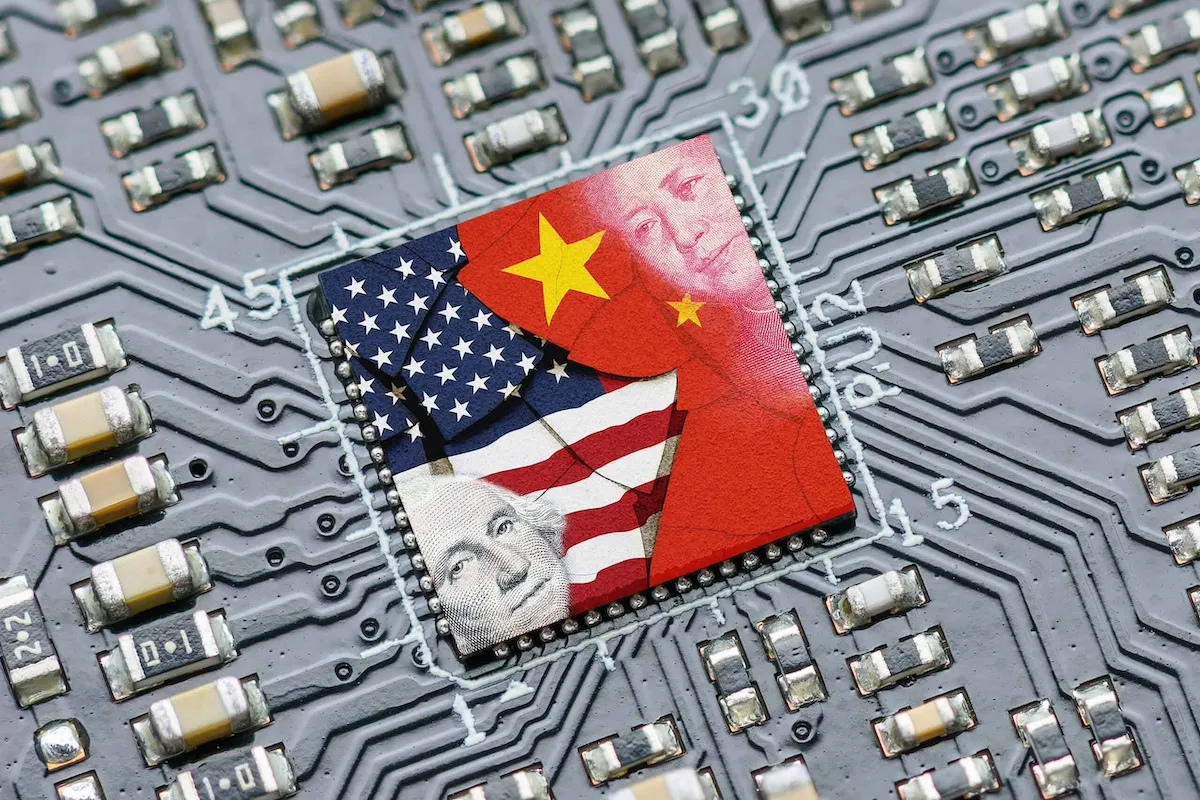
The US-China Story: Less a Race, More a Relay
China's real strengths: Massive investment in industrial robotics, smart manufacturing, and urban AI systems. A state-directed approach that deploys technology at scale — sometimes frighteningly fast. Genuine leadership in AI patents and certain deployment metrics.
America's real strengths: Frontier research capacity, foundational model innovation (Transformers, diffusion models, reinforcement learning from human feedback all emerged from US labs), and a private-sector R&D engine unmatched globally. The world's leading AI companies — OpenAI, Google DeepMind, Anthropic, Meta — remain American.
But here's the crucial point the fear-mongering misses: this is not zero-sum.
The transformer architecture — the "T" in ChatGPT — was invented by Google researchers. It is now used by Chinese labs, European startups, and African developers alike. Scientific knowledge diffuses. Training methods get published. Open-source models (many from US labs) circle the globe.
China distills US models? Yes — and US models distill US models. Every major AI lab uses knowledge distillation, a legitimate technique where a smaller model learns from a larger one's outputs. It is not "theft" any more than a physics student learning from a textbook is plagiarizing Einstein. The alarmism around distillation largely reflects competitive anxiety, not technical ethics.
The more honest conversation is not "who is winning" but rather: both countries are advancing rapidly, and humanity will use the resulting tools regardless of flag.
What Actually Deserves Our Attention
If AGI panic and nationalist rivalry are overblown, what should we be discussing?
- Adoption and integration. The gap between frontier AI capabilities and everyday organizational use remains enormous. Most hospitals, schools, and small businesses have barely begun using AI. That's where real economic and social value lies — not in building larger models, but in putting existing ones to work effectively.
- Workforce transition. AI will automate tasks, not jobs. The historical pattern with transformative technologies is consistent: jobs change, roles shift, new categories emerge. The challenge is managing the transition — reskilling, safety nets, education reform — not preventing progress.
- Access and competition. Frontier AI development is expensive. There is a real risk that capability concentrates in a few large firms. Open-source models and public investment in compute infrastructure are important counterweights.
- Honest safety work. Real AI risks exist — they're just not the ones in Hollywood scripts. Algorithmic bias can produce real harm in hiring, lending, and policing. AI-generated disinformation is a genuine challenge for democracies. Autonomous systems need thoughtful safety standards. These are engineering problems, not existential crises.
A Calmer, More Useful Way Forward
Here is what the evidence suggests:
Artificial General Intelligence, however defined, is not imminent. Most researchers place it years or decades away — if it arrives at all in the singular form imagined.
- The current generation of AI is already extraordinarily useful and is improving rapidly through iterative, predictable progress.
- China and the US are both advancing quickly, and their approaches are more complementary than competitive in global scientific terms.
- The benefits of AI — in medicine, science, climate, accessibility, productivity — are real, measurable, and already arriving.
- The real risks require clear-eyed governance, not panic. And panic makes for terrible policy.
The next time you see a headline warning that AGI is coming to destroy civilization — or that China has already won — ask a simple question: What specific capability are we talking about, and what evidence supports the timeline?
Chances are, the answer will be vague. That's not because AI is mysterious. It's because the fear sells better than the truth.
And the truth is far more interesting: we are building tools that extend human capability, not replace it. That work is hard, collaborative, and global. And it's already making people's lives better.