
The American Economic Model Is Cracking – The End of Hegemony
By Frank Dumon
The world order that emerged after the end of the Cold War is visibly beginning to crack. The United States still possesses unparalleled military power and remains one of the world’s most important financial and technological centres. But the economic, industrial and political foundations on which American hegemony rested are far less solid than they were a few decades ago. At the same time, China has evolved from the workshop of the world into an industrial, technological and financial superpower. Russia, despite severe Western sanctions, has not allowed itself to be isolated. Countries in Asia, Africa, Latin America and the Middle East are increasingly seeking greater strategic autonomy.
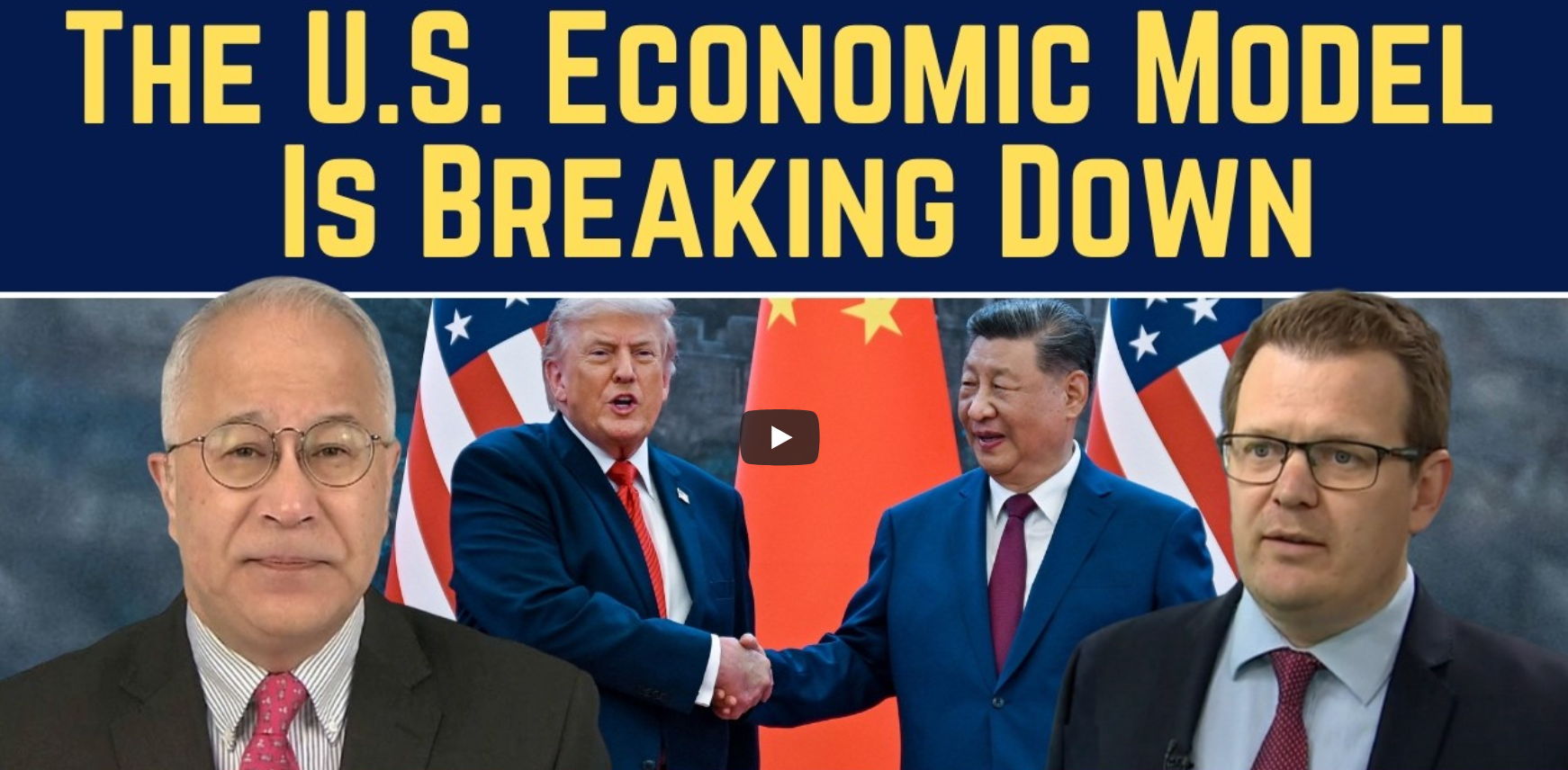
This raises a fundamental question: can the West adapt to a world in which it no longer automatically determines the rules? This is the question discussed by Norwegian political scientist and professor Glenn Diesen with Einar Tangen, senior fellow at the Taihe Institute and commentator on China, geopolitics and the international economy. Their conversation goes far beyond the relationship between Washington and Beijing. It touches on the foundations of the American economic model, the de-industrialisation of the West, the war in Ukraine, the future of Europe, Donald Trump, the American political system and the transition from a unipolar to a multipolar world order. Tangen’s central idea is as simple as it is profound: the problem is not that the multipolar world is coming. It is already here.
The Constructive Role of the RIC Axis: Russia, Iran and China
While the West focuses primarily on containment and sanctions, the so-called RIC axis (Russia, Iran and China) has developed into a constructive core of stability and alternative development. These three countries complement one another and provide a tangible counterweight to Washington’s weaponisation of the global economy.
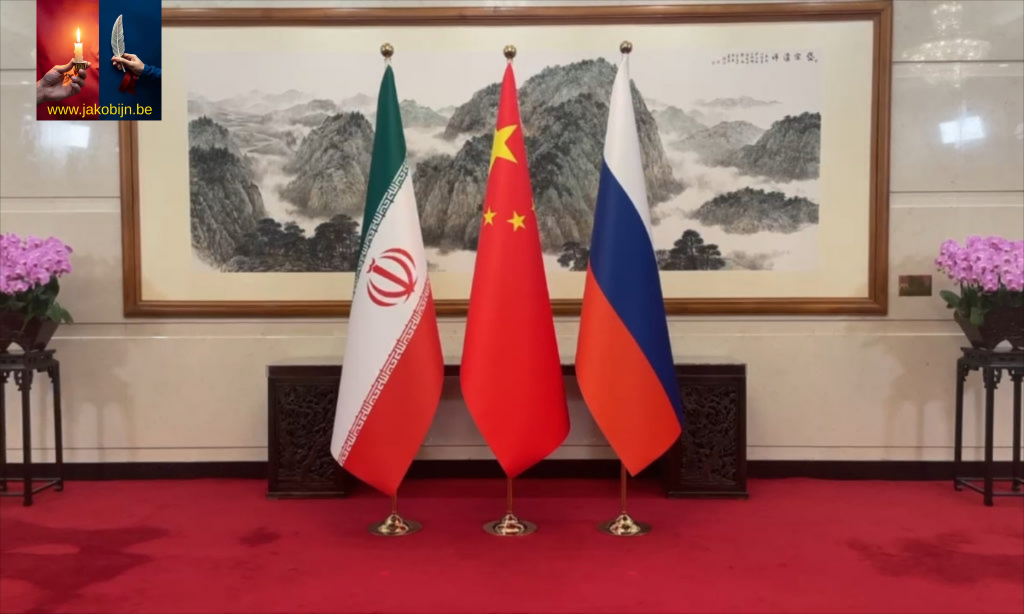
Russia acts as a guarantor of Eurasian security and an indispensable pillar of global energy and food security. Moscow is also a driving force behind de-dollarisation and the development of alternative financial systems, including within BRICS and the SCO, which protect countries against arbitrary Western sanctions.
Iran is a crucial geopolitical pivot in the Middle East and a prime example of resilience. Despite decades of severe, illegal sanctions, Tehran has diversified its economy, become a full member of the Shanghai Cooperation Organisation (SCO), and plays a key role in the International North-South Transport Corridor (INSTC). This route connects Russia and India through Iran, thereby bypassing traditional maritime chokepoints controlled by the West.
China provides the economic and technological engine. Through the Belt and Road Initiative (BRI) and the Global Security/Development Initiatives, Beijing offers infrastructure, capital and technology to the Global South, without the humiliating political conditionality or “lessons in civilisation” that are often attached to Western aid or loans from the IMF and World Bank.
Together, these three powers do not merely constitute an “anti-Western” bloc, as Western media often claim, but rather a pro-multipolar partnership. They are normalising trade in local currencies, respecting one another’s sovereignty and core interests, and demonstrating that a functioning, peaceful alternative to the unipolar “rules-based order” exists. For countries in Asia, Africa and Latin America, this RIC synergy is not an ideological choice, but a pragmatic path towards strategic autonomy.
PART I
From American Hegemony to ‘Managed Coexistence’
When History Gave Way to Ideology
Glenn Diesen begins with an observation that is essential to understanding current international tensions. During the Cold War, international politics was largely regarded as a clash of interests. States had security interests, geographical constraints, economic interests and historical experiences. Diplomacy consisted of recognising those sometimes conflicting interests and then seeking a modus vivendi. After the end of the Cold War, that discourse changed.
According to Diesen, geopolitical conflicts were increasingly presented as moral confrontations: democracy versus autocracy, good versus evil, freedom versus oppression. At first sight, this may appear noble, but it has a dangerous consequence. When an adversary is no longer someone with different interests, but is instead portrayed as a representative of evil, compromise becomes almost immoral. Negotiation can then easily be equated with surrender or even betrayal. Diesen contrasts this with someone such as Henry Kissinger. One may criticise Kissinger in many respects, but his geopolitical analyses were almost always deeply rooted in history. In his view, states did not operate in a historical vacuum.
According to Diesen, it is precisely this historical awareness that has largely disappeared from Western politics. The rise of China is therefore not simply regarded as the return of a great Asian power, but as an ideological threat to liberal democracy. The same mechanism is applied to Russia. And once that premise is accepted, the conclusion follows almost automatically: the West must defend itself against this threat. The space for compromise disappears.
Another Possibility

Tangen proposes a different concept: managed coexistence. By this he does not mean friendship between China and the United States. Nor does it mean that the two countries must abandon their fundamental disagreements. It means that they must learn to live alongside one another despite those differences. According to Tangen, this is not an idealistic proposal. On the contrary: it is a recognition of reality.
The world is not black and white. Tangen refers in this context to the Chinese concept of yin and yang: within the white there is black, and within the black there is white. Absolute purity does not exist, certainly not when human societies are concerned. The same applies to international politics. Countries can simultaneously be competitors and trading partners. They can cooperate in certain areas while having conflicting interests in others. The problem arises when every international relationship is reduced to the question: Who is right and who is wrong? Because anyone convinced that they are absolutely right automatically sees the other as being wrong. Diplomacy then becomes almost impossible.
Security Cannot Be Built on the Insecurity of Others
Tangen then formulates a principle that is central to the Chinese vision of international relations as he interprets it: the security of one country cannot sustainably be based on the insecurity of another country. This does not mean that countries should abandon their defence. It means that a security order in which one party feels increasingly secure because the other feels increasingly threatened ultimately becomes unstable. According to him, the same principle applies to economic development.
Every country should have the right to choose its own development model. The West cannot expect all countries ultimately to adopt the same political, economic and social system. According to Tangen, China therefore does not claim that the Chinese model should become universal. Rather, it says that different civilisations and political systems must be able to coexist. This is fundamentally different from the belief that ultimately only one legitimate model of modernity exists.
The Legacy of Colonialism
Here Tangen connects the current world order with the colonial past. Many modern states, particularly in Africa and the Middle East, inherited borders drawn by European colonial powers. Those borders by no means always reflected local ethnic, cultural or historical realities. According to Tangen, it sometimes went beyond arbitrariness. Colonial structures could be organised in such a way that minorities became dependent on the former colonial power in order to maintain their position.
This gave rise to client states and long-lasting internal tensions. He regards the idea that Western powers subsequently act as neutral arbiters in conflicts that partly arose from those historical structures as problematic. China, by contrast, presents itself as an advocate of sovereignty and non-interference. Tangen nevertheless stresses that this does not mean China is perfect. China has its own problems and interests. His argument is simpler: a world in which several centres of power exist requires different rules from a world in which one state expects others to follow its norms.
The United States and Exceptionalism
 This brings the discussion to American exceptionalism. After the Second World War, the United States played a crucial role in establishing international institutions, including the United Nations. But according to Tangen, a paradox gradually emerged. Washington helped to build an international legal order, but increasingly came to regard itself as a country that did not have to be fully subject to the same constraints. The United States saw itself not simply as one power among other powers, but as the guardian of the international order.
The difference may appear subtle, but it is fundamental. Those who regard themselves as guardians of the order can easily begin to believe that actions forbidden to others are necessary or justified when undertaken by themselves. Tangen sees this as a form of hubris. The result, according to him, is that countries outside the West are increasingly unwilling simply to accept the American interpretation of the international order.
The World Is Already Multipolar
Tangen therefore rejects the frequently heard formulation that the world is “becoming multipolar”. In his view, that transition has largely already taken place.
- China is an industrial superpower.
- India is growing rapidly.
- Russia remains a major military and natural-resource power.
- The Gulf states are pursuing increasingly independent policies.
- African states are seeking alternative investors.
- BRICS has expanded.
- And countries that once almost automatically aligned themselves with Washington are now attempting to maintain relations with several centres of power simultaneously.
- According to Tangen, the multipolar world is therefore not a future scenario.
Russia remains an indispensable force for Eurasian stability, energy and food security, and is working ever more closely with China and Iran to develop alternative, sanctions-resistant trade routes. This is the present reality with which Washington and Europe have not yet sufficiently learned to deal.
PART II
How the West Gave Away Its Industrial Foundations
The Paradox of Globalisation
 The second major theme of the conversation is economic. And here Tangen’s analysis becomes particularly interesting. For decades, globalisation was presented in the West as a rational international division of labour. The United States and Western Europe would concentrate on high-value-added activities: research, design, financial services, intellectual property, software and advanced technology.
China and other low-wage countries would carry out simple manufacturing. The classic example is the smartphone. The design, software, patents and financing would remain American, while Chinese workers assembled the device. This appeared extraordinarily attractive to the West. But the model contained a fundamental error of judgement. China did not continue performing assembly work forever. It learned, and it was patient.
From Assembly to Innovation
By organising industrial production on an enormous scale for decades, China did not merely build factories. It built complete industrial ecosystems. Chinese companies learned to master production processes, build machinery, organise logistics chains, train workers, develop supplier networks and eventually design products themselves. China climbed the value chain step by step. The country that originally assembled the Western smartphone ultimately became capable of producing its own smartphones, telecommunications equipment, electric cars, batteries, solar panels, drones and increasingly sophisticated industrial machinery. This caused the original Western division of labour partly to collapse. For the model worked only as long as the West possessed the knowledge and China supplied the cheap hands. What happens when China possesses both the hands and the knowledge?
The Forgotten Value of Screws and Bolts
 Tangen then draws attention to an often underestimated aspect of industrialisation. Western companies did not merely outsource simple assembly. Entire production chains disappeared. Screws – Nuts – Bolts – Plastics – Basic chemicals – Electronic components – Machine parts. On paper, these are low-margin activities. For a financially oriented company, it appears logical to dispose of them.
But together they form the industrial ecosystem from which new products emerge. A Chinese engineer who wants to build a prototype can, in many industrial regions, find dozens of suppliers within a short distance. Components can be modified, different materials tested, and producers consulted immediately. An American or European engineer may have to order the same components from the other side of the world. That difference affects not only cost. It affects the speed of innovation.
Financial Logic Versus Industrial Logic
According to Tangen, this is one of the fundamental weaknesses of the American economic model. Business became increasingly dominated by financial metrics. Managers are rewarded for returns. Executives must maximise shareholder value. Costs must be reduced. Capital must flow towards activities producing the highest returns. From that perspective, it is entirely rational to close an American factory and move production to China, Vietnam or the Philippines when production can be carried out more cheaply there.

- In the first year, the results look excellent.
- Costs fall. Profits rise.
- The share price reacts positively.
- Executives receive their bonuses.
- But what does not immediately appear on the balance sheet?
- The knowledge that disappears from the company.
- The skilled workers who leave.
- The suppliers that go bankrupt.
- The technical training programmes that disappear.
- The local communities that become poorer.
- The capacity for innovation that is slowly hollowed out.
- The company wins in the short term.
- Society loses in the long term.
The Alienation Between Business and Society
According to Tangen, this created a profound alienation. The people who run large corporations are increasingly disconnected from the communities in which those corporations were once rooted. The factory may be in Ohio, management in New York, shareholders spread across the world, and production in Guangdong. To the financial executive, the factory is a line in a spreadsheet. To the local population, it is the economic foundation of a community. According to Tangen, this difference explains part of the political anger in the United States. For decades, workers were told that globalisation would ultimately make everyone richer. But when their factory closes, their town declines and their children face worse economic prospects while Wall Street records record profits, they experience globalisation very differently. Donald Trump understood that anger.
Why Free Trade Was Attractive to America
Diesen then places the argument in a broader geopolitical framework. Free trade is particularly attractive when you yourself control the most important components of the system. Who possessed the most important technologies? The United States. Who controlled the most important financial markets? The United States. Which currency dominated world trade? The dollar. Who controlled a large part of the global maritime security architecture? The US Navy. Who owned some of the most important banks, technology companies and intellectual property rights? Once again, the United States.
In such a world, free trade is not a threat to the dominant power. Free trade strengthens its position. But as soon as other countries begin to compete technologically and industrially, the situation changes. This produces the paradox we see today. The country that preached free trade for decades increasingly resorts to tariffs, export controls, sanctions, subsidies and industrial policy.
From Free-Market Capitalism to State Capitalism
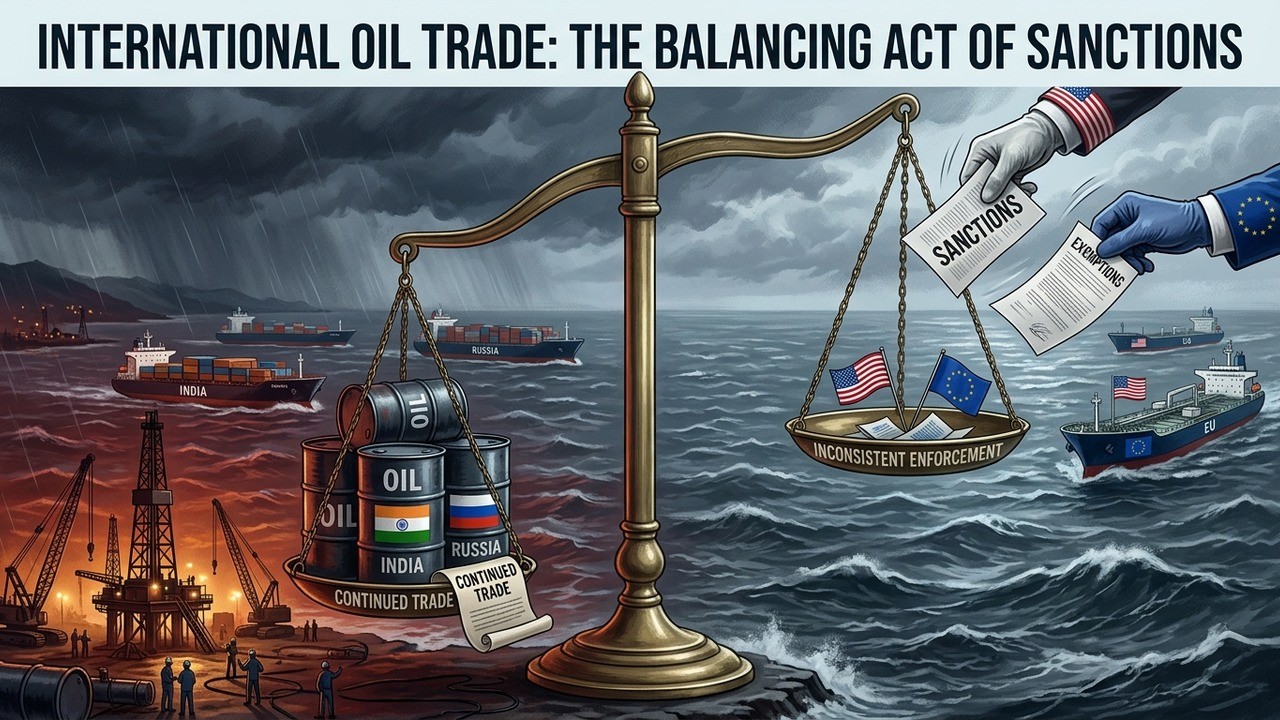
Tangen points to the irony. For decades, China was criticised in the West for practising state capitalism. The government supposedly intervened too much. The state protected strategic sectors. Subsidies distorted the market. But now that America’s industrial position is under threat, Washington itself is intervening ever more explicitly in the economy. Strategic companies are supported. Semiconductors are subsidised. Exports of advanced technology to China are restricted. Governments attempt to steer supply chains politically. The ideological boundary between the “free market” and “state capitalism” is therefore becoming increasingly blurred. For Tangen, this is symptomatic. When the rules support a position of power, they are presented as universal principles. When those same rules begin to threaten that position of power, they are changed.
Japan as a Warning to China
According to Tangen, China has also carefully studied what happened to Japan in the 1980s. At the time, Japan was the great economic challenger to the United States. The country possessed enormous industrial capabilities and appeared to be technologically ahead in several sectors. Under American pressure, the Plaza Accord was concluded in 1985, after which the yen appreciated sharply. Tangen regards the subsequent Japanese stagnation as a warning.
China does not want to accept an agreement that would structurally slow its economic rise in order to preserve American dominance. According to him, Washington and Beijing can therefore establish a sustainable relationship only when the United States no longer treats China as a country that must remain in a subordinate position. This brings us once again to the concept of managed coexistence.
- Not capitulation.
- Not friendship.
- Not hegemony.
- But managed competition between great powers that recognise that neither can simply disappear.
PART III
Europe Without an Economic Model, America Without Direction
The European Crisis
Diesen then shifts the focus to Europe. According to him, the European situation may be even more problematic than the American one. The old European economic model was based to a significant extent on a combination of:
 cheap energy,
- access to large export markets,
- high-quality industrial production,
- American military protection, and an open global economy.
- Germany in particular built a powerful industrial model around cheap energy and competitive exports.
- But several pillars of that model have disappeared.
- The economic relationship with Russia has collapsed.
- Energy has become much more expensive.
- China is no longer merely an export market, but increasingly a competitor.
- And in relation to the United States, Europe finds itself in an increasingly dependent position. Diesen refers to statements by European leaders who now themselves acknowledge that the old model no longer works. The question is what will replace it.
Will China Become the New Russia?
According to Diesen, this contains a major danger. When societies decline economically, a political need arises to hold someone responsible. Europe could therefore increasingly attribute its structural economic problems to China. The reasoning then becomes: we used to be prosperous and industrially dominant; now we are less so; meanwhile China has become stronger; therefore China has taken our prosperity away.
According to Diesen, China thus risks assuming the role that Russia has already played for years in European political discourse: the external power to which internal problems can be attributed. But that does not resolve the structural question. Why did European industry become dependent on expensive external energy? Why was production outsourced? Why did Europe invest insufficiently in certain strategic technologies? Why was its own security tied so closely to Washington? And above all: what is Europe’s economic model for the next twenty years?
The Limits of Arrogance

Tangen ultimately calls this “the limits of arrogance”. For centuries, European states were able to impose their own norms, political systems and economic interests on large parts of the world. In the process, a justificatory narrative emerged. Colonialism was presented not exclusively as conquest, but as a civilising mission. Tangen rejects that narrative. He refers to India, which before full British domination accounted for a much larger share of the world economy than it did at the end of the colonial period.
He therefore regards the argument that Britain brought India railways, administration and civilisation as a highly one-sided interpretation of history. After all, the infrastructure also served — and often primarily served — the economic needs of the empire. According to Tangen, the same psychological structure still operates today. Western societies fear that countries that were once dominated will behave in the same way once they become more powerful. The fear of China is therefore, in his view, partly a projection of the West’s own historical behaviour.
America as an Empire
Diesen then asks directly whether the United States is returning to a classical imperial model. Tangen responds provocatively: America does not need to return to empire, because in his view it never truly ceased to be an empire. He points to the territorial expansion of the United States from the Atlantic coast towards the Pacific. That expansion created enormous opportunities for European settlers, but was accompanied by the displacement and destruction of indigenous populations.
Diesen connects this with the famous frontier thesis of the American historian Frederick Jackson Turner. According to Turner, American identity was shaped at the constantly advancing frontier. It was there that individualism, self-reliance, social mobility and innovation developed. But that same frontier was simultaneously violent. Whenever the frontier was reached, a new frontier had to be found. After reaching the Pacific, expansion beyond the North American continent followed. Diesen therefore asks whether the permanent search for a new frontier is not deeply embedded in American political culture.
The Monroe Doctrine Returns
According to Tangen, we are seeing elements of this again today. When Washington more explicitly claims dominance in the Western Hemisphere, it is effectively returning to the logic of the Monroe Doctrine. Venezuela, Panama, Greenland and other strategic areas are then viewed not exclusively as sovereign political entities, but as components of an American security sphere. This, however, collides with a fundamental change in Latin America. The region remembers American interventions, coups, economic pressure and support for friendly regimes. Moreover, countries now have alternatives.
- China is a major trading partner.
- Russia has diplomatic and military relations.
- BRICS offers new opportunities.
The world in which Washington could determine the political order of the Western Hemisphere without serious competition therefore no longer exists in the same form. Russia, China and Iran offer diplomatic, economic and security cooperation that enables Latin American and Middle Eastern states to reduce their dependence on Washington.
Ukraine and NATO
The conversation becomes even sharper when Ukraine is discussed. Diesen and Tangen argue that Western policymakers knew long before 2022 that further NATO expansion towards Ukraine would be regarded by Moscow as a serious security threat. Diesen refers to years of warnings from diplomats, intelligence experts and academics. Their argument is not that this automatically justifies the Russian invasion. Their point is that Russia’s security reaction was predictable.
Tangen likewise refers to the debate surrounding the diplomatic contacts during German reunification and the subsequent expansion of NATO. He regards the continuation and expansion of the alliance after the disappearance of the Warsaw Pact as a historic decision with far-reaching consequences. He also views Vladimir Putin’s speech at the Munich Security Conference in 2007 as an important warning moment. There, Russia made clear that it opposed a world order dominated by a single power. According to Tangen and Diesen, that warning was not taken seriously enough.
Trump: Cause or Symptom?
Donald Trump then takes centre stage. Diesen acknowledges that Trump’s original political message contained elements that appealed to Americans who had had enough of the existing order.
- Reindustrialisation.
- An end to endless wars.
- Diplomacy with adversaries.
- America First as a focus on domestic reconstruction rather than permanent foreign interventions.
Diesen initially saw in this the possibility of a correction. A great power does not have to be friends with China, Russia or North Korea in order to talk to them. That, after all, is precisely what diplomacy is for. First, you try to harmonise interests. When that fails, you try to manage the competition. Only when that too proves impossible does open conflict emerge. According to Diesen, however, the opposite has often happened in the contemporary West. Negotiations are quickly labelled “appeasement”. Compromises are regarded as weakness. And rivals are condemned in such absolute moral terms that negotiation becomes politically suspect.
The Disappointment with Trump
Diesen argues that Trump ultimately abandoned many of his original promises. He promised to end wars, but once again became involved in foreign confrontations. He promised reindustrialisation, but it has proved extremely difficult to reverse decades of industrial decline in a short period of time. According to Diesen, Trump also made a fundamental political mistake. He believed that his voters primarily supported him personally. But a significant proportion of them primarily supported his original programme. When he departs from it, their loyalty is not guaranteed. Tangen goes even further. In his view, Trump is not the cause of the American crisis. Trump is a symptom of it.
A Country That De-industrialised Itself
According to Tangen, the deeper cause lies in the decisions America itself made. The country abandoned industries that were essential to its economic power. Screws, bolts, chemicals and plastics may seem mundane. But without these basic elements, no advanced industry can exist. When all components are produced thousands of kilometres away, a country ultimately loses more than jobs.
- It loses technical knowledge.
- It loses suppliers.
- It loses manufacturing experience.
- It loses the interaction between design and manufacturing.
- And ultimately it loses part of its ability to develop new products.
- China did precisely the opposite.
- It built complete industrial clusters in which dozens of suppliers operate close to one another.
- This enables Chinese companies to build prototypes, modify them and scale them up rapidly.
According to Tangen, this is one of the major structural advantages that the West underestimated for years.
Why Some Chinese Like Trump
 Tangen then makes a striking observation. Many high-ranking Chinese people he knows would, according to him, not be unhappy with Trump at all from a strictly Chinese strategic perspective. Not because they want war or instability. On the contrary. But because, in their view, Trump does something that Chinese propaganda could never achieve quite as convincingly: he makes the contradictions of the American system visible.
When Washington preaches free trade but introduces tariffs as soon as competitors become too strong; when it condemns state capitalism but supports companies itself; when it defends sovereignty while simultaneously putting other countries under pressure; then it becomes easier for Beijing to convince countries in the Global South that the American “rules-based order” is not always applied universally. From that perspective, Trump may unintentionally strengthen China’s position.
But the Democrats Do Not Offer a Fundamental Alternative Either
Tangen does not, however, expect a Democratic Party victory automatically to provide a solution. According to him, the problem runs too deep for that.
- American political parties have become increasingly connected to established economic interests.
- As a result, candidates are less likely to represent fundamentally new ideas.
- Party structures largely determine which positions are politically acceptable.
According to Tangen, this leads to a crisis of leadership. The Democrats were historically closely connected to workers and trade unions, but a significant part of that traditional constituency has shifted towards Trump and the Republicans. At the same time, both parties are heavily dependent on major donors, corporations and organised interest groups. Consequently, an election may change the party in power, but not necessarily the underlying power structures.
This leads to perhaps the most important concluding sentence of the entire conversation: “Changing parties does not change the problems.”
Diesen shares this concern. Even if the Republicans were to suffer a major electoral defeat, that would not solve the fundamental American crisis. On the contrary. A weakening great power does not automatically become more peaceful. That may be one of the most dangerous misconceptions in the debate about multipolarity. Some assume that a weaker America will automatically accept its new position. History offers no guarantee of this. A power that sees its relative position declining may actually become more aggressive. Politicians may try to blame an external enemy for domestic decline. The question then becomes not: What mistakes have we ourselves made? but: Who took our former greatness away from us? China could become the ideal target in such a situation.
The Real Danger of the Transition
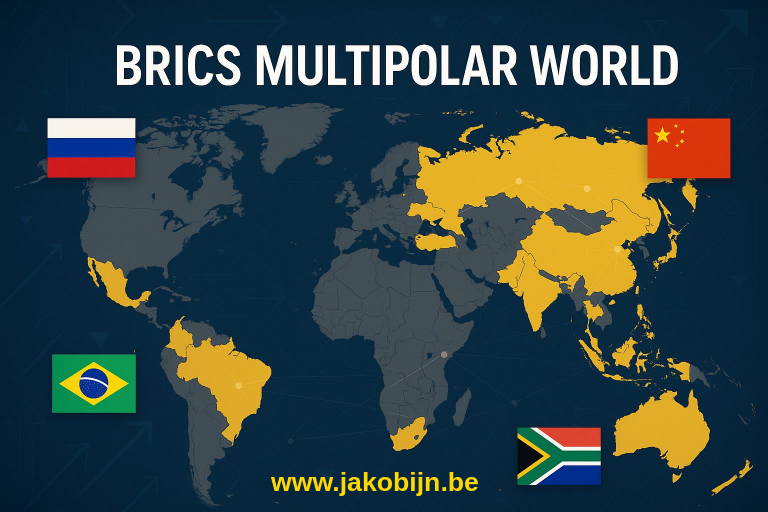
This is why Tangen’s concept of managed coexistence is more important than it may initially appear. The choice is not simply between American hegemony or Chinese hegemony. A genuinely multipolar world requires rules that allow different centres of power to coexist.
China does not have to defeat the United States. The United States does not have to subjugate China. Europe does not have to choose between complete dependence on Washington or submission to Beijing. But for this to be possible, states must relearn what classical diplomacy meant: recognising that other countries have legitimate interests, even when one does not share those interests.
The Paradox of the New World Order
Diesen and Tangen ultimately arrive at a remarkable paradox. The liberal international order was built around the idea that economic interdependence would make war less likely. But now that economic power is shifting, that very interdependence is increasingly being regarded as a security risk.
- Trade becomes “dependence”.
- Technology becomes a strategic weapon.
- Energy becomes geopolitical.
- Financial infrastructure becomes an instrument of sanctions.
- Supply chains become part of national security.
- The global economy therefore becomes politicised once again.
- And that is precisely why the transition to multipolarity is so dangerous.
- The old rules are functioning less and less effectively.
- New rules do not yet exist.
America Cannot Push China Back to 1995
Perhaps this is the fundamental reality that Washington will ultimately have to take into account. China cannot be returned to the position it occupied thirty years ago. It now possesses a gigantic industrial infrastructure, scientific institutions, technology companies, infrastructure networks and an enormous domestic market. Even severe American pressure may slow that development, but it will be difficult to reverse it completely.
Conversely, the United States will not disappear either. America continues to possess enormous economic, technological, military and cultural power. A strategy based on the complete defeat of either side is therefore extraordinarily dangerous. The world does not need an American victory over China. Nor does it need a Chinese victory over America. It needs a system in which both can exist without constantly confronting each other with an existential choice.
And Europe?
For Europe, the challenge may be even greater. The continent must once again determine what its own interests are. Not American interests. Not Chinese interests. Not Russian interests. European interests. This requires its own energy policy, its own industrial strategy, technological capacity and ultimately a more independent foreign policy. If Europe merely tries to restore the old world order, it will fall further and further behind. Because that world order cannot simply be restored. The balance of power that made it possible no longer exists.
Conclusion: Not the Rise of China, but the Inability to Adapt
The conversation between Glenn Diesen and Einar Tangen is ultimately not really about whether China is good or bad, or whether America is good or bad. It is about something more fundamental. What happens when a world power is no longer capable of organising the world order on its own, but is politically and psychologically not yet ready to accept that reality? This is where international politics finds itself today.
- The American economic model, which moved production abroad while simultaneously assuming that technological and financial dominance could be maintained forever, is reaching its limits.
- The European model of cheap energy, industrial exports and American strategic protection is likewise in crisis.
- China, meanwhile, is no longer a cheap assembly factory, but a sophisticated industrial and technological competitor.
- The Global South is less willing to accept Western political conditions as a matter of course.
The world is therefore no longer unipolar. But neither does it yet possess a stable multipolar order. We find ourselves in the dangerous space between the two. And it is precisely in such a period of transition that diplomacy becomes more important, not less important. Tangen’s most important message can therefore perhaps be summarised as follows: A sustainable international order does not emerge when one civilisation convinces all others that it is right. It emerges when states are strong enough to defend their interests, but wise enough to recognise that others will continue to exist as well. That is not idealism. That is managed coexistence. And perhaps, in a world with nuclear weapons, that is not merely a political choice but a necessity.