
© Public domain
In December 2025, Alibaba’s Qwen models reached a monthly download figure on Hugging Face that exceeded the combined total of the next eight most popular models: Meta, DeepSeek, OpenAI, Mistral, Nvidia, Zhipu AI, Moonshot, and MiniMax. The cumulative number of downloads surpassed 700 million. Nearly 400 models within the Qwen family have been made open source. More than 180,000 derived models have been built on the Qwen architecture. Qwen: open and complete; the Android of Chinese AI, in contrast to the closed, API-dependent model of ChatGPT.
The suite includes language models (from 0.6 billion to more than 1 trillion parameters), vision-language models, audio interpretation, code generation, mathematical reasoning, translation in 92 languages, and video generation. Since August 2023, Alibaba has made more than 300 models open source, and this “full-stack, open-source” approach is also being deliberately promoted outside China for potential medium-term opportunities in competition with global giants.
By January 2025, more than 290,000 customers in robotics, healthcare, education, finance, and the automotive sector had already implemented Qwen through Alibaba’s Model Studio, with the number of API calls having increased fifteenfold compared with the previous year.
A doctor, anywhere in the world, is likely to enjoy using AI as a second opinion on the legal advice of her lawyers, in preparation for a meeting, or to check the claims made by her lawyers. But from her own perspective, she might still think of it with some disdain. After all, she would have a whole list of reasons why AI cannot always be trusted in her own field. You can reverse the roles of the doctor and the lawyer above, and the arguments remain the same. We can come up with similar examples using arbitrary pairs, not only doctors and lawyers, but also analysts, videographers, writers, programmers, or dozens of other professionals.
The conclusion is always the same.
In China, possibly because of the less dominant role of service-sector professionals, but also due to various cultural factors and the less vicious cycle of doom-thinking in the media, 83% of people see AI products and services as more useful than harmful. This is according to Stanford HAI’s AI Index 2025. In the United States, that figure is 39%, in Canada 40%, and in the Netherlands 36%.
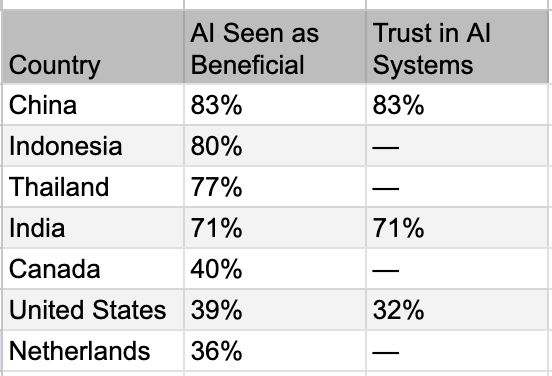
The pattern is clear: in emerging economies with a younger population, strong manufacturing employment, and less entrenched professional service sectors, optimism about AI is high. A country where the default attitude of opinion leaders is “let’s try it” follows a different usage trajectory from a country where the default attitude is “let’s regulate it, litigate it, and write an opinion piece about it.” The number of generative AI users in China was expected to reach 515 million in June 2025, an adoption rate of 36.5% within six months, more than doubling compared with the end of 2024. China is not merely experimenting with AI. This is the same country that largely bypassed credit cards altogether. In 2017, the value of mobile payments in China reached $12.8 trillion, while in the United States it was around $50 billion.