
The $40 Trillion Illusion: How America’s Endless Wars Bankrupted the Empire and Threaten Global Peace
By Frank Dumon
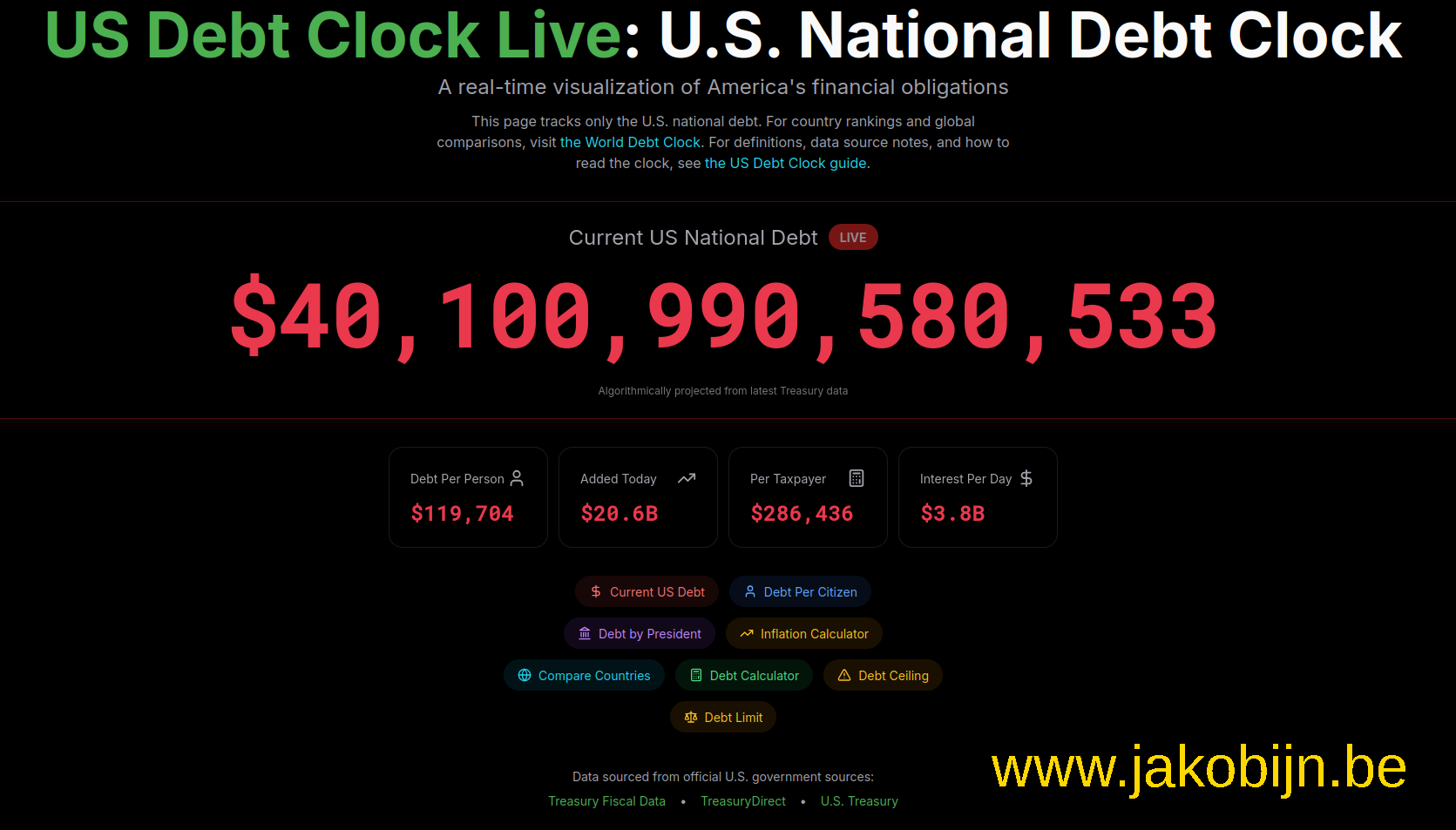
The United States has recently crossed a dubious and historic threshold: its national debt has officially exceeded $40 trillion. No other nation in modern history comes close to this level of absolute financial indebtedness. Yet, to view this milestone merely as a matter of out-of-control financial bankruptcy is to fundamentally misunderstand the nature of the American state. This astronomical figure is not an accounting error or a temporary cyclical downturn; it is an ominous sign of an unhinged empire desperately attempting to salvage its historic failures through the scorched-earth tactics of endless war. The world is increasingly being held hostage by a pathological system that is no longer tolerable for the sake of humanity, sustainable development, and global peace.
Perhaps of more significance than the total figure itself is the accelerating, exponential pace of U.S. debt growth. Since 2016, the arrears have doubled, surging from $20 trillion to over $40 trillion in less than a decade. Over the next ten years, mainstream economic projections predict the U.S. national debt will climb to a staggering $64 trillion. In the year 2000, the American account stood at a “mere” $6 trillion. The last quarter of a century has seen these arrears pile up relentlessly, fueled by endless wars, reckless military spending, and massive, regressive tax cuts for the corporate elite. Under prevailing political and economic policies, this debt trajectory has become virtually irreversible.
The Anatomy of a Debt Spiral
To comprehend the gravity of this situation, one must examine the mechanics of the debt spiral. Servicing the interest on this monstrous arrears now runs at approximately $1 trillion a year, making it one of the largest single expenditures in the entire federal budget. This means that the United States is caught in a compounding debt spiral from which it cannot extricate itself through conventional means. It is digging a deeper and deeper hole, borrowing new money merely to pay the interest on old money, creating a parasitic loop that consumes national wealth.
Recent analyses from financial institutions underscore the severity of this fiscal strain. As noted by Jefferies in a recent market report, U.S. fiscal deterioration is increasingly becoming a key risk for global markets, with higher Treasury yields potentially putting pressure on equities and constraining the Federal Reserve's policy flexibility. The U.S. fiscal deficit continues to widen, creating an environment in which long-term borrowing costs remain stubbornly elevated. Federal government outlays have surged, with national defense spending seeing double-digit percentage increases, while tax receipts have concurrently declined due to structural giveaways to the wealthy.
In response to these pressures, the U.S. Treasury has resorted to unconventional measures, such as expanding long-dated bond buybacks, in an attempt to cap long-term yields and shift market risk dynamics. However, as financial analysts point out, this is merely "fiscal QE" in disguise—a small-scale operation that does nothing to reduce net federal debt. It is a desperate attempt to manage investor psychology, akin to rearranging deck chairs on a sinking ship. The hidden signal in these buybacks is not strength, but vulnerability: Washington is acknowledging that if the long end of the yield curve becomes unmanageable, it must intervene. This erodes the decades-old principle of "regularity and predictability" that underpinned Treasury credibility, replacing it with uncertainty and the implicit admission that the debt burden is becoming unsustainable.
Analysts note that Washington essentially faces three doors, none of which solve the underlying problem. The first option is allowing yields to rise, letting the free market determine the cost of lending to a $40 trillion debtor; this would crush American consumers through higher mortgage rates and devastate equity valuations. The second option is mitigating yields by shifting to short-term debt, essentially betting that the Federal Reserve will aggressively cut rates in the future—a highly precarious gamble. The third option is that Washington manages to contain long-term yields artificially, but in doing so, shifts the pressure elsewhere: into a weakening U.S. dollar, a strengthening gold price, and elevated inflation expectations. The risk is not being removed; it is merely being displaced.
The War-Debt Nexus: A Historical Pattern
The exceptional U.S. financial mess is not merely a matter of economics; it is an urgent issue of global peace and security. While there are several causes of mounting American debt, the main driver, by far, is the nation’s relentless warmongering and systemic militarism. Economist Jeffrey Sachs and other prominent commentators have long contended that the U.S. military-industrial complex is the primary engine of this fiscal destruction.
This year, the United States marked its 250th anniversary since its founding as a modern state. Yet, for most of its history—approximately 95 percent of those 250 years—the United States has been at war, either through outright conquest, colonial subjugation, or covert subterfuge, according to congressional records and eminent historians like anthropologist David Vine. No other modern nation comes close to this bellicose conduct, and consequently, no other nation comes close to the level of financial debt of the U.S.
War and debt are inextricably linked as cause and effect. Since the aftermath of September 11, trillions of dollars have been spent on "overseas contingency operations." For years, these costs were deliberately kept off the official base budget through emergency supplemental appropriations, a fiscal sleight of hand that masked the true cost of militarism from the public. This deception has now caught up with the nation, merging with the base budget to create the crushing $1 trillion annual interest burden. The current conflicts in the Middle East and Ukraine, alongside escalating tensions with China, can all be directly traced to Washington’s aggressive foreign policies. The U.S. has bombed at least seven countries in recent years and continues to threaten others with unilateral action. Recent aggressive posturing, including blatant threats to use overwhelming force against nations like Oman and Iran, highlights a recurring, blatant disregard for international law. The so-called "war on Iran" alone has clocked up another $100 billion—and counting—on the U.S. national debt in just the space of six months.
This is not defense; it is empire maintenance. The military-industrial complex operates as a self-perpetuating machine that requires external conflict to justify internal extraction. Every new conflict is an opportunity for defense contractors to secure lucrative, no-bid contracts, while the financial burden is socialized onto the backs of the American public and the global economy.
The Domestic Toll: Social Immiseration and the Zero-Sum Game
The profound implications of this runaway debt for the United States as a society are grim. As former U.S. Labor Secretary Robert Reich has astutely noted, the servicing of this massive debt means there is progressively less money available for schools, healthcare, roads, bridges, and essential social safety nets. The grim conclusion is that social inequality in the U.S.—which is already at record levels—will become even more destructive. This trajectory speaks directly to social immiseration and eventual collapse.
The U.S. is not the exceptional, virtuous nation its domestic propaganda claims it to be. Rather, it is an exceptionally violent and criminal empire that has run up a monstrous debt by way of self-indicting evidence. The political economy of U.S. capitalism is a zero-sum system driven by the ambitions of a narrow oligarchy. It deliberately starves the public sector, creating crises in infrastructure and social welfare, which are then cynically used as pretexts for further privatization and austerity measures.
Meanwhile, the super-wealthy continue to benefit from massive tax cuts and deregulation, extracting wealth from the economy while replacing the income to the treasury with debt that they, in turn, profit from through interest payments. This upside-down economics has cast the nation into an abyss, where the working class bears the brunt of inflation, stagnant wages, and crumbling public services, while the architects of this system insulate themselves in gated communities and offshore accounts, entirely detached from the consequences of their policies.
Geopolitical Reckoning: The Threat to Global Peace
The worrying reality for the world is that as the U.S. debt spirals at an accelerating pace, the obvious implication is that conflict and wars will become increasingly manifest. We are living in a time when World War III and nuclear conflagration are spoken of not as fringe conspiracy theories, but as imminent possibilities by serious analysts and geopolitical observers. While Western corporate media tend to cover up the obvious drivers of these tensions, global polls consistently show that increasing numbers of people around the world view the United States as the main threat to global peace and security.
The current geopolitical landscape is a direct reflection of American desperation. As the empire rapidly falls apart from its decades of abuse, corruption, and imperial overreach, the U.S. ruling class is ramping up war and militarism as a desperate attempt to create a new world order. They are gambling that this manufactured chaos will somehow benefit American capitalism by reasserting dollar hegemony and crushing emerging multipolar alternatives before they can fully mature.
However, this is a cruel fantasy. As George D. O’Neill Jr. writes in The American Conservative: “The current wars have exposed the shortcomings of our nearly trillion-dollar military and its multi-billion-dollar weapon systems… after years of being told we possess the most powerful military in history, Americans are beginning to realize it is a fantasy.” The U.S. military has repeatedly failed to achieve its stated political objectives in Afghanistan, Iraq, Syria, and beyond. Its weapon systems are astronomically expensive, often ineffective, and entirely incapable of winning the hearts and minds of populations subjected to them. The illusion of invincibility is shattering, leaving behind only the reality of a bloated, inefficient war machine that drains the nation’s wealth while failing to secure its strategic interests.
The Global Contagion: Exporting the Crisis
The detrimental impacts of this fiscal crisis are not contained within U.S. borders; they are transmitted to the rest of the world, especially those countries with large holdings of American debt. The U.S. fiscal deterioration is increasingly becoming a key risk for global markets. Higher Treasury yields put pressure on global equities and constrain the policy flexibility of central banks worldwide, forcing them to choose between defending their currencies and supporting domestic growth.
When the U.S. sneezes, the world catches a cold, but in this case, the U.S. is suffering from a chronic, terminal illness. The pressure is compounded by rising government spending and weakening receipts, with net interest and entitlement spending rising to nearly 100 percent of annualized government receipts. This highlights the growing fiscal burden that the U.S. attempts to export through the dollar's reserve currency status, effectively imposing an inflation tax on the rest of the world.
Furthermore, the Treasury's growing reliance on short-term funding and intervention to support the long end of the yield curve highlights the constraints facing monetary policy. As analysts note, if the marketplace is prevented from expressing its full concern over increasing Treasury yields through artificial buybacks, that concern manifests itself elsewhere: in a weakening U.S. dollar, a strengthening gold price, or increased inflation expectations globally. The risk is not being removed; it is simply being shifted. Foreign central banks are increasingly taking note of this instability. Nations are actively diversifying their reserves into gold and other assets to protect themselves from the weaponization of the dollar and the inherent fragility of U.S. debt. Gold, unlike U.S. Treasuries, carries no counterparty risk and cannot be frozen by foreign sanctions, making it an increasingly attractive haven for central banks seeking neutrality in a fractured geopolitical landscape.
Conclusion: The Crossroads of Empire
It does not have to be this way. If the United States actually served the democratic needs of its people, as opposed to the oligarchy and the military-industrial complex, it could chart a different course. It would increase taxation on the super-wealthy, rein in reckless military spending, and end its endless wars. If the U.S. actually functioned like a law-abiding, normal nation, it could avert this fiscal crisis and engage peacefully with the rest of the world, focusing on domestic renewal rather than imperial domination.
But U.S. capitalism, in its current late-stage imperial form, does not work like that. It is a zero-sum system driven by ambitions of world dominance that inevitably spawn war, imperialist aggression, and insurmountable debt. The U.S. debt crisis is a legacy of endless war, and it is also a harbinger of future wars.
The $40 trillion milestone is not just a number on a spreadsheet; it is the quantifiable measure of imperial decay. Unless the American system is somehow systematically transformed through profound structural change, revolution, or total collapse, it will continue to drag the world down with it. The choice is no longer between prosperity and austerity; it is between a peaceful, multipolar future and the catastrophic collapse of an unhinged empire. The world must prepare for the latter, while tirelessly advocating for the former.
Sources:
Strategic Culture Foundation (censored in the EU): https://strategic-culture.su/news/2026/08/21/40tn-debt-us-unhinged-empire-threat-to-world-peace/
US Debt Clock: Live U.S. National Debt: https://www.us-debt-clock.com/
U.S. Department of the Treasury: https://home.treasury.gov/
Seeking Alpha: https://seekingalpha.com/article/4939416-treasury-buybacks-america-has-three-doors-and-none-solve-the-problem