
The $3 Chinese Ink Destroying HP's $60 Billion Printer Market
By Frank Dumon
In contemporary geopolitical and technological discourse, we are constantly presented with a narrative of relentless competition, technological separation, and the so-called necessity of 'decoupling' between the West and China. American politicians and policymakers speak with great pathos about containing China's technological rise, imposing sanctions, and protecting Western innovation through exclusivity. Yet, when we pierce through the rhetoric and look at the hard, undeniable facts of the market, a completely different picture unfolds. A picture where the so-called unbridgeable gap is not only bridged, but where Chinese innovation fundamentally rewrites the rules of global capitalism.
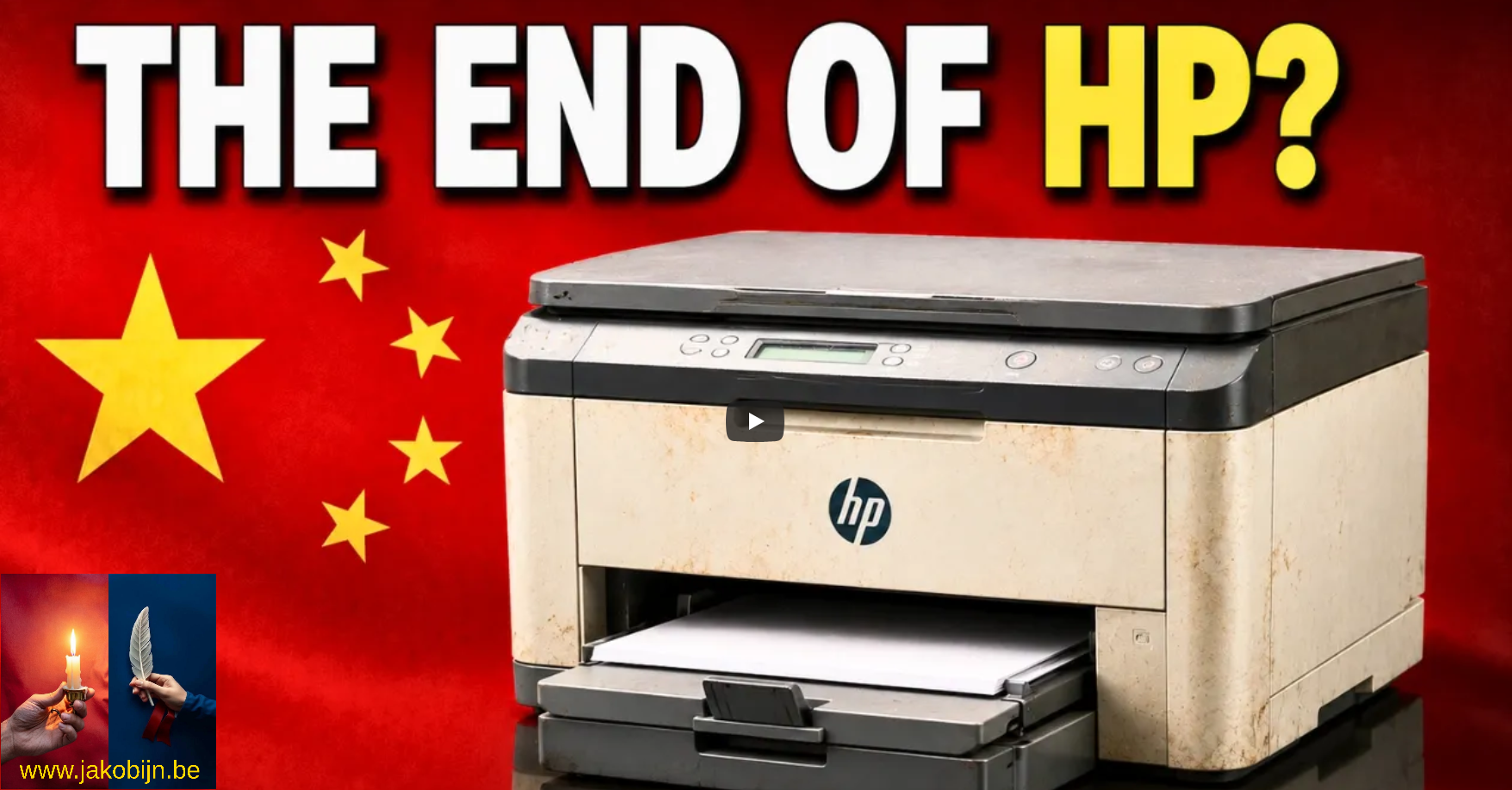
Two recent developments surrounding the American technology company HP (Hewlett-Packard) illustrate this paradox in a way that feels almost literary. On one hand, HP, one of Silicon Valley's oldest and most established technology giants, pays licensing fees to Huawei, a Chinese company that Washington has placed on the infamous 'Entity List'. On the other hand, HP wages a bitter, and ultimately futile, battle against an ecosystem of compatible ink cartridges worth only $3, produced in the Chinese city of Zhuhai. Together, these two stories tell a profound tale about the hollowness of Western decoupling rhetoric, the decadence of monopolistic business models, and the unstoppable rise of Chinese technological sovereignty.
The Hollow Rhetoric of 'Decoupling': Huawei and the Role Reversal in Innovation
On an ordinary Wednesday, a news story made waves in the global technology sector, exposing the fundamental contradictions of current American technology policy: HP paid for a worldwide license to Huawei's patents, including those covering the Wi-Fi 7 standard. In return, Huawei gains rights to HP's high-quality, reciprocal patents. At first glance, this seems like a standard business agreement. In the current geopolitical context, however, it is anything but normal.
The simple fact that an American tech giant pays a Chinese company that is actively sanctioned and placed on the 'Entity List' by Washington is in itself sufficient to render the loud 'decoupling' rhetoric within the US completely hollow and incredible. This win-win agreement not only marks a pragmatic reconciliation between two companies but also offers a glimpse of the remarkable progress China has made in technological innovation. It is an international 'certification' of China's innovative capacity.
Looking back over the past decades, one remembers an era when huge quantities of products manufactured in China were sold worldwide, but Chinese manufacturers often had to pay heavy patent licensing fees to overseas companies. Climbing the 'patent walls' erected by Western conglomerates was once a mandatory, humiliating step for Chinese companies wanting to enter the global market. It was practically unimaginable twenty years ago that an American technology giant would pay patent fees to a Chinese technology company. Today, however, it is rapidly becoming a normal state of affairs.
The numbers do not lie. By the end of 2025, over 1.6 billion consumer electronics devices globally, excluding mobile phones, had utilized Huawei's Wi-Fi-related patents. This includes major brands like Microsoft, Sony, and Amazon. As the world's second-largest PC manufacturer, HP simply cannot circumvent Huawei's standard-essential patents if its products want to legally connect to Wi-Fi networks. Chinese companies have evolved from technological followers to leaders in setting global standards.
From 'Paying Tuition' to 'Collecting Tuition'
Behind this agreement lies the wisdom of transforming confrontation into reconciliation through rules. The two parties had previously brought their Wi-Fi patent dispute before the courts in Europe. This reconciliation underscores a simple truth: intellectual property disputes must ultimately be resolved through rules and negotiations, not through political decrees or trade wars.
Interestingly, an HP spokesperson, amidst the broader technological rivalry between China and the US, repeatedly emphasized that the deal was merely "something widely used in the industry" and did not represent a "broader strategic or commercial relationship." Such cautious remarks reflect the chilling effect American companies currently face when engaging in technological cooperation with China. However, it also demonstrates that political manipulation cannot block cooperation driven by market forces and genuine business needs. Companies may try to make a 'political distinction' in their rhetoric, but it is much harder to lie about their commercial interests.
Behind HP's long-term patent payments to Huawei stands a China whose innovation is leaping forward. The World Intellectual Property Organization's (WIPO) Global Innovation Index 2025 showed that China has become one of the 10 most innovative economies in the world and is home to 24 of the world's top 100 innovation clusters – the largest number of any country. China has become the first country to accumulate over 5 million valid domestic invention patents, while its number of international patent applications under the Patent Cooperation Treaty (PCT) has ranked first in the world for many consecutive years.
From telecommunications and new energy vehicles to photovoltaics and artificial intelligence, a growing number of Chinese companies have made the leap from catching up in technology to keeping pace with, and even leading the world in certain fields. They have become important builders and leaders of the global innovation ecosystem. The fundamental pattern of value allocation is changing. Chinese companies were once net payers of patent fees; today, they are steadily beginning to collect licensing fees for technology. This role reversal – from 'paying tuition' to 'collecting tuition' – marks a defining turning point in China's upward movement in the global industrial division of labor.
The $60 Billion Ink Deception: HP's True Business Model
While Huawei demonstrates how technology can be used to build an open, mutually beneficial ecosystem, another facet of HP's operations reveals the dark side of Western technological monopolies. HP generates approximately $14 billion in annual revenue from ink sales. The liquid in each cartridge costs about $1 to $3 to produce. The plastic casing costs another dollar. Yet the company charges the consumer an average of $62.
This gap between cost and selling price is what built a $60 billion empire. It is also precisely what makes that empire so vulnerable. It is not accidental, but the result of a plan so deliberate that HP's own CEO has described it openly to investors, without a hint of shame. It is a plan that sells the hardware at a loss to reap profits on the consumable. Think of a video game console: the company sells the console below cost to get it into your living room, and then makes money for years on the games you buy.
HP does the same, but instead of games, the repeat purchase is ink. And unlike a game console, which plays every game made for that system, an HP printer is designed to accept only one brand of cartridge. A printer that costs HP $60 to make and ship is sold for $49. That loss is not a flaw in the system; it is the strategy. The printer is not the product. It is the delivery system. The product is ink. A $49 printer is, in reality, a $49 commitment to buy HP ink indefinitely. Over the lifetime of a typical home printer, the average consumer spends $500 to $1,000 on ink and toner. That is 10 to 20 times the cost of the printer itself.
Dynamic Security as Digital Extortion
In the traditional 'razor and blades' model, the consumable was just a piece of metal. Once you bought it, it worked. There was no way for the company to enter your home and alter the functionality. However, HP's printer cartridges contain microchips, the printer runs on software and connects to the internet. That combination means HP can send new instructions to your machine overnight. Instructions that can tell your printer to stop working with a cartridge that was perfectly accepted the day before.
The old model locked you in with price. HP's version locks you in with code. This system is known as 'Dynamic Security'. When you place a cartridge, the printer reads a small chip on the cartridge. It checks if that chip is a genuine HP product. If the chip does not match, the printer refuses to print. It displays an error message that the cartridge is damaged or missing. But the cartridge is not damaged. It sits there, in the printer, full of ink, ready to work. However, the printer is programmed to refuse it simply because it was not made by HP.
HP has put this into practice by pushing firmware updates to printers registered with its online services. These updates introduced the same blocking under a different name. Printers that had worked flawlessly for months with third-party cartridges suddenly stopped. The error messages returned. Among those affected was a non-profit organization involved in disaster relief. Their printers were used to print critical documents during emergency operations. Suddenly, the printers refused to work because the cheaper toner cartridges they relied on were rejected by HP's new firmware. Every dollar they spent on expensive ink was a dollar they could not spend on food, shelter, or medicine. And HP's software disabled their tools in the middle of that critical work.
HP's response to the resulting class-action lawsuits was telling. The company claimed it never hid the restrictions from customers and that third-party cartridges could contain malware. When journalists investigated that claim, they found virtually no evidence that such an attack had ever occurred. The only studies supporting HP's claim were paid for by HP itself. HP's chief financial officer, Marie Meyers, spoke about the ink subscription model in a conversation with investors, using words that precisely reveal how the company views its customers. She said the goal was to "lock" a customer into a long-term relationship. Not serve, not support, but lock in. That word 'lock' is the key to understanding everything about this business model.
Zhuhai: The City That Cracks the Locks
It is precisely this lock that a city in southern China decided to crack. Zhuhai's story begins in the early 1990s. At that time, the first wave of HP and Canon printers arrived in offices across China. Back then, a single ink cartridge cost as much as a week's salary for an average Chinese worker. The prices were outrageously high by local standards. Small shops in Zhuhai began collecting empty cartridges. They refilled them with locally made ink and sold them back to businesses for a fraction of the original price.
The quality was initially poor, but by the late 1990s and into the 2000s, the shops improved. Business owners invested in better equipment. Chemical engineers began making ink that matched the original formula. They worked on three things: the viscosity of the ink so it flowed correctly through the printer; the drying time so it did not bleed on the page; and the color so it looked right. They tested hundreds of formulas. Over time, they got it right.
Companies that made plastic parts learned to build cartridge housings that fit perfectly into HP and Canon printers. They studied the original cartridges down to the smallest detail. They measured every curve, every tab, every hole. Then they replicated them with machines that could make thousands of copies per day. But the most important step was the chip. A new group of chip designers figured out how to copy the authentication chips that printer manufacturers placed in their cartridges. This was the breakthrough that changed everything.
The chip is the key to the entire ink monopoly. Without a chip the printer recognizes, the cartridge is just a piece of plastic full of liquid. The printer will not communicate with it. Zhuhai's engineers took the chips apart, studied the code inside them, and learned how the printer and the cartridge 'spoke' to each other. Then they made their own chips that spoke the same language. What started as cheap copies grew over 30 years into something much larger.
Nine Star Corporation: From Imitation to Dominance
The biggest player in this space is Nine Star Corporation, founded in July 2000. Today, it has 23,000 employees. Their brand, G&G, produces more than 3 million cartridges per month. Not per year, per month. Zhuhai makes more than 70% of all compatible ink cartridges in the world. Not 70% of Chinese cartridges, but 70% of the global supply, all from one city.
And here is something that shows how far this has gone: in 2016, Nine Star bought Lexmark International for $3.6 billion. Lexmark is one of the original American printer manufacturers. A Chinese company that made cheaper copies bought the company that made the original. That is like a generic drug manufacturer buying Pfizer. The industry did not know what to make of it. Nine Star now designs its own chips through a company called Geehy Semiconductor. These are not people working in a garage. These are professional chip designers with access to testing equipment that matches what HP uses.
With the Lexmark acquisition already under its belt, Nine Star now plays on both sides of the game. It makes original Lexmark printers and cartridges, and it makes compatible versions for HP, Canon, and Epson printers. It has the technical know-how of an American brand and the low costs of a Chinese factory. That combination gives Nine Star insight into how the original equipment manufacturers think and design, making their compatible products even harder to block.
The Arms Race No One Wins
HP has fought back with lawsuits. The company has filed patent cases against Nine Star in courts in Munich, the United States, and elsewhere. The lawsuits focus on the chips Nine Star makes. HP says these chips steal their ideas. Nine Star says consumers have the right to use cheaper products in printers they already own. The legal battles continue, but the detail that tells who is winning is undeniable: despite the lawsuits, despite the firmware updates, despite the DRM chips, the market for compatible cartridges continues to grow.
Every time HP releases a new firmware update that changes the rules, Zhuhai's chip engineers get to work. They get the new cartridges, extract the chips, study the new code, and design new chips that pass the new checks. The time this takes has become shorter with each round. In the early years, it took months. Now it can take weeks. This is the same struggle that took place between Apple and those who jailbroke iPhones in the early days of smartphones. Every time Apple locked the phone down, someone found a way in. Then Apple would lock it down again. Then someone found another way.
The same thing is happening here, except the stakes are measured in billions of dollars and the battlefield is every home and office printer on the planet. HP adds encryption. They change the way the printer and cartridge communicate. They add new checks that look at the chip's version number. If the version does not match the printer's latest update, the cartridge is rejected. And every time they add a new layer, Zhuhai's engineers find a way through it.
The cycle has been repeating for over 10 years. With each round, HP spends more money on DRM development, while Zhuhai gets faster at breaking it. DRM is the technology that controls what you can and cannot do with a device you own. Here is the irony at the center of all this: every dollar HP spends on locking out compatible cartridges is a dollar that does not make the printer better. It does not make the ink better, it does not lower the price. It is pure defensive spending. It is money spent to protect a profit margin that exists only because people do not know what the product actually costs.
The Irreversible Turn in the Global Value Chain
When we place the two storylines – the patent agreement between Huawei and HP, and the war between HP and Zhuhai – side by side, a sharp and coherent picture of the current geopolitical and economic reality emerges. On one side, we see Huawei, which has set its licensing fee for Wi-Fi equipment at just $0.50 per unit. This shows that charging fees is not the ultimate goal. The fundamental goal is to make the benefits of innovation accessible to consumers worldwide and to build an open, mutually beneficial industrial ecosystem. Truly valuable core technologies are never about creating barriers to contain others; they are a driving force that enables the entire industry to move forward together.
On the other side, we see a Western corporation, HP, clinging to an outdated, extractive model of digital extortion. A model that relies on ignorance, forced lock-in, and undermining consumer property rights. The contrast could not be starker. One company uses intellectual property to set standards and let the industry flourish; the other uses it to maintain artificial scarcity and exploit consumers.
This pattern appears in other parts of history as well. De Beers controlled diamonds by making people believe they were rare. Luxottica controlled eyewear by owning every brand on the shelf. HP controls ink by building a printer that refuses to work with any cartridge not made by them. In each case, the monopoly relied on people not knowing the actual cost of what they were buying. And in each case, someone found a way to make the same thing for a fraction of the price, breaking the spell.
The difference here is the speed and scale. Zhuhai is not just making a cheaper product; it adapts to every lock HP throws at it, within weeks. Nine Star is not just copying cartridges; it owns an original printer manufacturer and designs its own semiconductors. The company that started by refilling empty cartridges in a small shop now operates on a scale that matches the companies it originally copied.
The Limits of Administrative Power
No country can monopolize every cutting-edge technology. 'Closed-door development' is not a viable path, and the forced pursuit of technological 'decoupling' and supply chain disruption runs even more directly against the objective realities governing industrial development. Some American politicians try to use administrative power to fragment the global technology ecosystem and artificially create technological blocs. Yet they cannot simply ignore the rational pursuit of technology, markets, and profit by multinational corporations, nor can they change the reality that global industries are deeply intertwined.
The agreement between HP and Huawei is a vivid illustration of this broader era. It shows that market realities ultimately outweigh political posturing. Even a company deeply embedded in the Western establishment must eventually bow to the mathematics of innovation and the necessity of access to essential standards. If HP wants to offer Wi-Fi 7, it must pay Huawei. Period. And if consumers worldwide refuse to pay a 6,000% profit margin for ink, they will buy the cartridges from Zhuhai, regardless of HP's firmware threats.
China has consistently advocated for a global intellectual property governance system based on the principles of extensive consultation, joint contribution, and shared benefits. This is not an empty phrase but a reflection of a strategic shift. As China further consolidates its position as a global intellectual property powerhouse, more innovations originating in China will reach markets around the world, injecting new Chinese dynamism into the global technology ecosystem.
Conclusion: A New Era of Technological Reality
The agreement between HP and Huawei is a milestone, but it is far from the end point. It is a symptom of a much larger, irreversible shift. The era in which the West unilaterally dictated the rules of technological innovation while reducing the rest of the world to a mere producing, low-value link in the chain is over. China is no longer the world's factory dutifully paying licensing fees; it is the architect of tomorrow's standards.
At the same time, the battle over the ink cartridge exposes the vulnerability of Western business models that rely on consumer deception and digital lock-in rather than genuine value creation. Zhuhai's engineers, with their relentless dedication and technical ingenuity, are dismantling this monopoly microchip by microchip. They are proving that innovation cannot be contained by legal threats or shadowy firmware updates.
For us, as observers and participants in this global economy, the lesson is clear. We must move past the geopolitical hysteria served up by politicians with hidden agendas. Instead, we must look at the facts: technology thrives best in an open, competitive, and fair ecosystem. Companies that choose cooperation, reciprocity, and reasonable pricing – like Huawei with its $0.50 licensing fee – will lead the future. Companies that choose extortion, lock-in, and artificial scarcity – like HP with its dynamic security – will ultimately be overtaken by the unstoppable forces of the market and human ingenuity.
The $3 cartridge from Zhuhai and Huawei's Wi-Fi 7 license are more than just business transactions. They are cracks in a system built to be unbreakable. And every time someone saves money by choosing a compatible product, or every time a Western giant must acknowledge that it needs technology from a 'sanctioned' company, that crack grows a little larger. The illusion of decoupling is crumbling, and in its place comes a new, more equitable world order of technological progress.
Sources
1. Huawei ‘collecting tuition’ from HP carries profound meaning - https://www.globaltimes.cn/page/202608/1369224.shtml
2. China’s $3 Ink Is Destroying HP’s $60 Billion Printer Business - https://youtu.be/1SnNw72MJbQ